

Comparing two suppliers on quality consistency means comparing processes rather than products, because the product is the same model. A buyer who compares the specification sheets of two factories for the same camera model is comparing two descriptions of the same thing, and the description that is longer wins, which is not a useful outcome. The comparison that decides a procurement decision is built from the five points at which a run drifts from the last one, and from what each supplier can actually show rather than what each supplier says.
This table is designed to be filled in. Every row has a question with a named answer, and a column for the artefact that would prove the answer. Fill the right-hand column for each supplier before comparing anything, because the filling is the work and the comparison is the by-product.
Smart glasses quality consistency is compared between suppliers, not inside one product
The reader is a procurement manager at the brand, a channel buyer or an importer holding two or three quotations for the same configuration, usually with a deadline and usually with the internal suspicion that the difference between them is mostly the difference between how the answer is written. This article is about making that comparison real.
The first thing to establish is what is actually variable. In this category, the model is a common reference: the cell capacity, the charge time, the resolution tier, the rated use, the charging interface, the case option and the Bluetooth version are stated per model and do not vary between units of that model. So if two suppliers are quoting the same model, the published rows do not distinguish them, and a comparison built on the published rows will produce a tie.
What distinguishes them is everything the published rows do not cover: whether the model is built to a frozen configuration, whether a component change is notified before it happens, whether a proof is retained, whether accessories are inside the acceptance criteria, and whether the records exist at the unit level. Those are process differences, and they are observable, and they are the reason two suppliers can quote the same model at very different levels of risk for the buyer.
The second thing to establish is what the comparison is for. It is not for scoring a winner on a hundred-point scale. It is for finding the question on which the two answers differ enough to change the outcome, and it is for deciding whether the difference is one the buyer has the leverage to close. A comparison that produces a number without producing a decision has not been worth the afternoon it took.
What a comparison in this category can and cannot settle
It is worth being blunt about the limits of a supplier comparison in this category, because the table below is more useful when the buyer knows what it is not going to settle.
It cannot settle price competitiveness in unit terms, because the unit prices, minimum order quantities and lead times for this range are not published and are negotiated per configuration. A comparison of total landed cost is a comparison the buyer has to build from a quotation, not from a catalogue, and that is a different task with a different set of inputs.
It cannot settle whether the product will meet the destination market's requirements, because the compliance position for a model is a matter of documents in the supplier's file rather than of anything visible in a comparison. Asking for the certificate number, the issuing body and the validity date is a separate request, and it should be made to every supplier at the same time as the table, not afterwards.
It cannot settle performance characteristics that the catalogue does not publish. There is no acoustic measurement, no ingress test report number, no sensor part number and no field of view for any model, so a comparison on those rows is a comparison of claims. The right use of those rows in a comparison is to establish that both suppliers will supply a document, and then to compare the documents.
It can settle the thing that actually goes wrong, which is drift between runs. That is a process property, and a process property is observable, and a process that produces records can be shown to produce them. A comparison built on that basis narrows a shortlist of three quotations to one or two, and it does so in an afternoon.

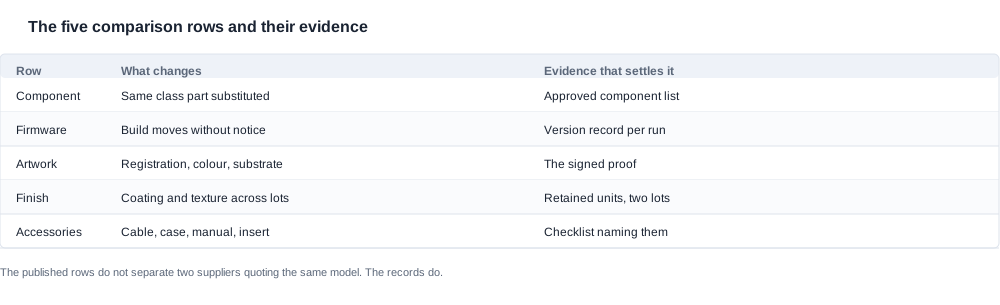
The five rows of the comparison, and the evidence each one demands
| Comparison row | What changes between runs | What to ask the supplier | Evidence that settles it |
|---|---|---|---|
| Component | Same class part substituted for the approved one | Is the part number fixed, and does substitution need your written approval? | The approved component list on the order |
| Firmware | Build moves without a notice | Where is the released version logged, and who approves an update? | A version record per run |
| Packaging artwork | Print registration, colour, substrate | Who approves the pre-production proof, and is it retained? | The signed proof, held by the buyer |
| Finish | Coating, paint and texture across lots | Can two lots be seen together on the same configuration? | Retained units from two lots |
| Accessories | Cable, case, manual and insert swapped | Are the accessories inside the acceptance criteria? | An inspection checklist that names them |
Two columns in that table are doing most of the work. The third column is what a buyer puts to the supplier, and the wording matters: each question asks for a rule, not for a reassurance. A question that asks "how do you ensure quality" produces a paragraph; a question that asks "is the part number fixed, and does substitution need written approval" produces a yes or a no, and a no is still a usable answer because it tells the buyer what the risk is.
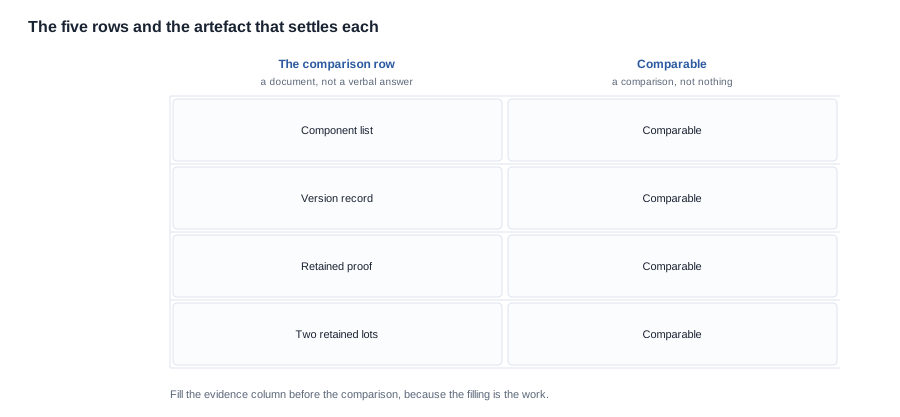
The fourth column is the one that separates a process from an intention, and it is the column most buyers fill in from the answer rather than from the document. A supplier who says the part number is fixed has a component list; a supplier who can show the component list has a control. The distinction is not pedantic. In a category where the published rows do not change when a cell is swapped for one of the same class — and the range runs from 40 mAh on the A05 and the A06 to 290 mAh on the CY05, the CY03 and the L2 Utral, and the L1 Pro, with eight or nine tiers in between — a substitution leaves the specification sheet completely unchanged, and only a document will reveal it.
How to word the questions so the answers can be compared
A comparison table is only as good as the question in each row, and the difference between a good question and a bad one in this category is whether the answer can be compared across suppliers at all.
The rule is that a question must be answerable with a fact. "How do you manage component quality" is answered with a paragraph and every supplier's paragraph is the same. "Is the part number fixed for this model, and does a substitution require our written approval before it is used" is answered with a yes or a no, a policy reference or a date, and the answers are directly comparable.
Three phrasings are worth avoiding, because each of them produces a non-comparable answer. Asking what a supplier's quality policy is returns policy. Asking whether they are a quality manufacturer returns positioning. Asking whether they have ever had a quality issue returns a judgement the buyer cannot verify, and the honest answer will be an evasion that has to be interpreted.
The opposite habit is worth building: ask the same question of every supplier in the same words, in the same order, and ask for the answer in a form that can be filed. That last part is the one buyers omit. A supplier who answers a question in a paragraph has given you an answer you cannot use, and the polite way to handle it is to ask the same question again in the form of a document, with a date on it.
Reading the answers: a process is a set of records, an intention is a paragraph
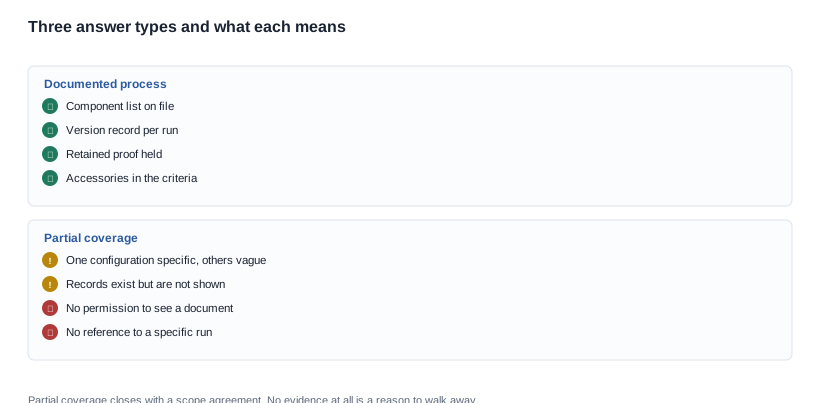
A supplier who holds a component list, a version record, a retained proof and an inspection checklist that covers accessories has a documented process. A supplier who describes the same four things has an intention. The difference is not a matter of trust; it is a matter of what will be available when there is a dispute in month nine.
The two rows where answers are usually vague are component substitution and accessories, and they are vague for the same reason: neither is in the acceptance criteria by default, and both are rows where drift actually happens. The electronics are specified by engineers who write things down. The packaging and the accessories are specified by commercial staff who approve a proof and move on. A buyer who understands that distribution can aim the afternoon at the right rows and get a much more useful answer for the same effort.
There is a second kind of vague answer to watch for, and it is more common than the first. It is the answer that is specific in the wrong direction: a supplier who can name the part number, the test method and the proof reference for one configuration, and who becomes vague about a second configuration of the same model. That answer is worth more than it appears to be, because it establishes that the records exist and that the gap is about coverage rather than about capability. Coverage gaps close with a scope agreement; capability gaps close with a change of supplier.

The comparison that matters most: two retained samples from two lots
Ask each supplier for two retained units from different production lots, on the same configuration, and examine them together. That single comparison catches finish drift, packaging registration and accessory substitution in one pass, and it takes about ten minutes once the units are in front of you.
It is also the only test available before a second order, because a factory that has run your configuration once has nothing to compare the first run against. A first order on a new configuration is an unvalidatable event: whatever arrives is the baseline, and the baseline cannot be compared with anything.
There is a commercial point here that is often missed. A supplier that can produce two retained lots on the same configuration is a supplier that has run your configuration more than once, and a supplier that has run your configuration more than once has already absorbed the learning curve. That is worth more to a buyer than a lower quotation, and it is the reason this row should sit at the top of a shortlist rather than at the bottom.
The practical instruction is to ask for the two retained units as a delivery item on the first order, which means specifying them in the purchase order rather than requesting them afterwards. Two units out of a few hundred is a trivial cost, and it is the cheapest way to buy the right to compare the next run.
There is a second reason the request is worth making in the first order rather than the second. A supplier who agrees to retain units and return them on request has demonstrated the retention side of the control, which is the harder half to verify because it only becomes visible when something has gone wrong. A supplier who agrees readily and then cannot produce the units in month nine has told you something more useful than a refusal would have, because a refusal is a position and an unfilled promise is a fact.

Turning the filled table into a decision
The table produces a result rather than a conversation, and the result arrives in one of three shapes.
The first pattern is a supplier with a documented electronics process and an informal packaging process. This is the commonest outcome, and it is not a bad supplier; it is a supplier whose records were written by the people who write specifications and not by the people who approve artwork. The commercial consequence is precise: the invisible drift points are under control and the visible ones are not, so the returns will be packaging returns and the product will be blamed. The remedy is narrow and cheap — a retained proof and a proof approval named in the order — and it does not require changing supplier.
The second pattern is a supplier who fills all five rows and produces none of the documents. This is a better outcome than the first, and it is worth recognising as one. It means the process exists and the records are simply kept somewhere else, usually on the line rather than in the file. The consequence for the buyer is that the evidence will be hard to reach when it is needed, but it is not missing. The single question that resolves the pattern is: may we see one, now, for a run you have already completed.
The third pattern is the one to walk away from: a supplier who answers all five rows in the abstract. No configuration, no part numbers, no reference to a specific run, no permission to see a document. In this category that pattern is not a manner of communication; it is a description of a factory with no quality system behind the sales relationship, and the risk it creates is not a bad batch but a batch that cannot be discussed, because there is no evidence to discuss.

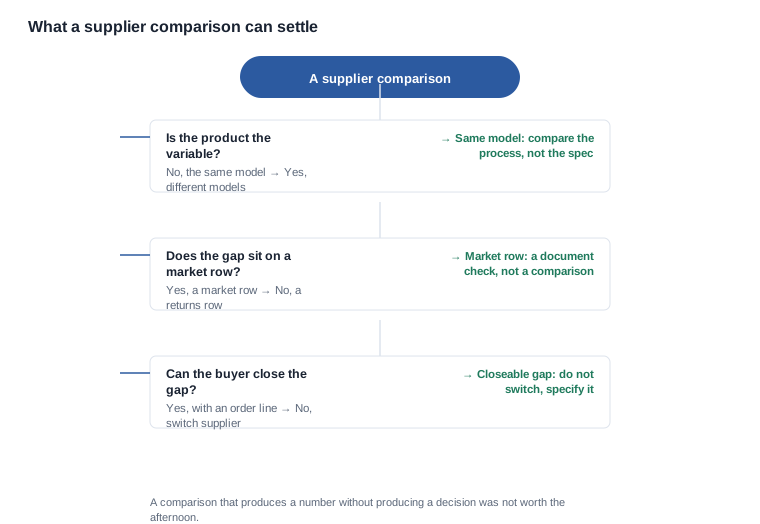
The two questions that turn a table into a shortlist
Once the table is filled, two questions decide what happens next, and neither of them requires another supplier conversation.
The first is: is the gap between the two suppliers on a row I can close myself? If the leading supplier has a documented electronics process and an informal packaging process, the gap is a retained proof and a named proof approval, and both can be requested in the purchase order. That gap does not justify the higher risk of the other supplier, and closing it is cheaper than switching.
The second is: does the gap sit on a row that affects the destination market? A gap on the artwork or the accessories is a returns problem. A gap on the certification documentation is a market-access problem, and a market-access problem is not closed by a supplier's good intentions; it is closed by a document with a number, an issuing body and a date. If the gap sits on that row, it does not belong in the quality comparison at all — it belongs in a separate document check that every supplier passes or fails on its own.
What Cynrin can evidence, and what it will not
The working rule we apply: a comparison in this category has to be built on documents, and a supplier who cannot produce a golden sample and a test record has not got a consistency process, whatever the paperwork says. We will fill our own column in the table, and we will fill it in the same form we ask any supplier to fill theirs: the model, the configuration, the artefact and the date it was created.
What we can evidence is the published configuration for a given model, which is consistent by definition: cell capacity, charge time, rated use, Bluetooth version where the catalogue states it, charging method and case capacity are stated per model and do not vary between units of that model. We will supply the records for a production run against an agreed configuration sheet, an agreed test plan and an agreed sample, and we will say which of them will not exist for a given order size.
What we do not publish is a defect rate, a consistency figure or a component-vendor list. All three are not published in our documentation, and none of them is a number we can evidence. We will not fill a cell in the table with an estimate, and we will not quote another supplier's figure as an industry benchmark, because a buyer who builds a shortlist on an estimated number finds the error in the field rather than in the quotation.
We will also say, in our own column, which rows we can fill and which we will fill with a document rather than a number, and we will fill them in the same order we ask any supplier to fill theirs. A supplier comparison that is not symmetric is a sales conversation, and this table is only worth the afternoon it takes if every column was filled to the same standard.
The framework is at the quality consistency section. The five change points in more detail are at the quality consistency checklist, the exposure ranking that decides which rows matter most is at who needs smart glasses quality consistency, and the factory-side method of drawing samples from finished stock is at the advanced factory audit guide.
The action to take now. Send us the two or three configurations you are comparing and the names of the suppliers, and we will tell you which rows of this table are the ones that will decide the comparison, and which published rows the answers have to be consistent with. A table filled in with the evidence column left blank is not a comparison; it is a summary.
Related reading
- The five change points in detail — quality consistency checklist
- Which rows matter most for your exposure — who needs smart glasses quality consistency
- Drawing samples from finished stock — advanced factory audit guide


