

Smart glasses shipping for a first order is not a freight problem, it is an ordering problem with a freight section attached, and the sections have to be settled in a particular order. A first-time buyer usually spends attention on the freight quotation and the customs broker, because those are the parts that resemble a decision most closely and are in fact the least changeable. The parts that are changeable are the ones upstream: the SKU you name, the case configuration you choose, the carton that follows from it, and the document set you ask for. Get that sequence right and the rest of the shipment arranges itself; get it wrong and the freight conversation will be conducted in the wrong units.

Smart glasses shipping: which decisions to settle, and in what order
Why a first order should be planned backwards from the documents
A first order is usually planned forwards from the unit price, because the unit price is the first number a buyer is given and the easiest one to react to. Planning forwards from it produces a familiar sequence: agree a price, agree a quantity, ask about the freight, discover the carton, discover the document set, and try to arrange the schedule around what is left. Every one of those discoveries happens late, which means each one arrives as a change to something already agreed.
Planning backwards produces a different sequence. Start from the destination market and what it requires, work out what the goods have to be to satisfy it, work out what the packed carton is, and only then ask what the freight costs and when the goods can be there. The first sequence treats the document set as an obstacle; the second treats it as the specification. For a category where every model carries a lithium cell and the conformity route depends on the destination market, the second sequence is the only one that does not require something to be renegotiated later.
The five decisions and the order they have to be made in
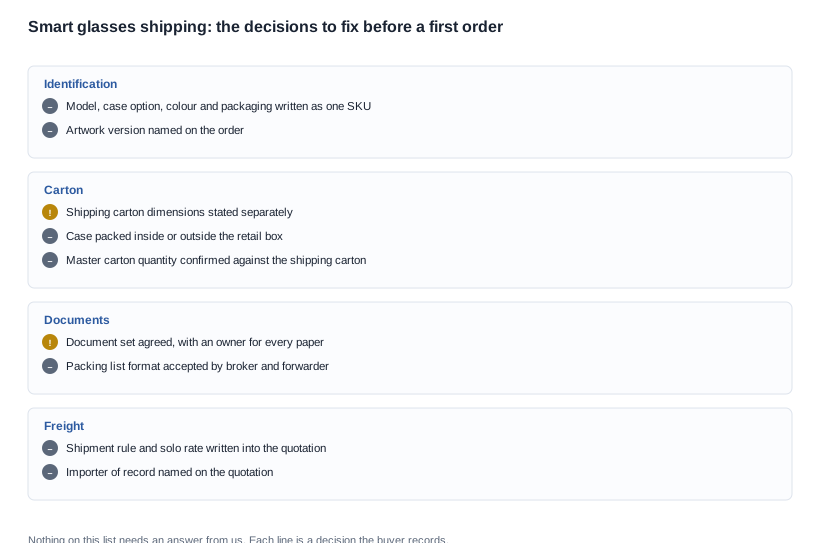
There are five decisions in a first order of this category, and each one constrains the ones after it.
- The SKU: model, case option, colour, packaging version and artwork version, written as one line.
- The carton: shipping carton dimension, gross weight, units per carton and carton mark.
- The document set: which papers travel, who prepares each one and by when.
- The packing list format: HS codes, declared values, carton counts and weights on one document that the broker and the forwarder both accept.
- The freight: method, mode, shipment rule, transit time and booking window.
The order is not a preference. The SKU decides the carton, because a camera model with a 1400 mAh charging case and the same model without one do not occupy the same carton. The carton decides the packing list format, because the carton count and the weights on that list come from the carton. The document set decides the packing list format, because the format has to satisfy the broker and the forwarder. And the freight comes last because it is the only one of the five that can be revised without invalidating the other four.

Naming the SKU, because everything downstream inherits it
Model, case option, colour and packaging in one line
A SKU that cannot be named precisely is a SKU that the broker will ask about on the packing list, and the questions arrive at the wrong moment. The name has to carry four components, because each one changes what is in the carton.
The model designation is the first, written exactly as it appears on the carton artwork rather than as it appears in a conversation. The catalogue distinguishes products that are nearly identical on a shelf: the V03 and the V03 Pro differ in configuration, with no charging-case row published for either of them, and the V03 Pro charging by Type-C rather than magnetically. The L1 Pro and the L2 Utral differ in charging case options, with the L2 Utral publishing either 900 mAh or 1400 mAh. The LC-105-1 and the LC-105-2 are separate line items in the catalogue with the same cell arrangement.
The case option is the second, and it is the one that most often gets left out because it feels like an accessory decision. It is not. It changes the carton, the declared weight, the battery transport file and the packing list description, all at once. The third is the colour option, where one is published: the V03 Pro is published in three colours and the V06 in four, and the remainder of the camera range has no listed colour options, which means the colour line of the SKU is empty for most models and has to be stated as empty rather than left open.
The fourth is the packaging version, which is the artwork revision. Artwork that is approved in a hurry is where a whole production run gets reprinted, and a reprint at programme volume is a much larger event than a reprint at first-order volume.
The designation that inherits everything
The reason to be this precise on the first order is that the designation is inherited by every document downstream, and a change made after the artwork is approved propagates into all of them at once. Change the case option and the carton drawing, the packing list description, the battery file scope and the artwork proof all have to change together.
The audio and sport lines carry their own naming detail, and it is worth naming it here so that the SKU rule covers the whole range rather than the camera half of it. The eight audio models publish their cell arrangements as either 55 mAh by two cells, 90 mAh by two cells or a single 100 mAh cell, and the three sport models publish 70 mAh by two, 115 mAh and 100 mAh respectively. A single 100 mAh cell and two 55 mAh cells are different transport subjects with the same nominal figure, which is exactly the kind of detail that a packing list description has to carry and a product name does not.
A first order is also the cheapest moment to make the change, because the number of things that depend on the designation is at its smallest. There is no stock to write off, no channel listing to correct, no delivered consignment to recall and no claim to file. Every later point on the curve is more expensive.
The case configuration and the carton it produces
The three case situations and the carton each one produces
The catalogue distinguishes four case situations, and the distinction is worth carrying into the order because each one produces a different carton.
The first situation is a published capacity. The CY05 and the CY03, and the L1 Pro ship with a 1400 mAh case, the L2 Utral with a 900 or 1400 mAh case, and the MT6 with a 1200 mAh foldable case. The second is a case whose capacity the catalogue does not publish, which applies to the KY06 and the MT5. The third is a silence, which applies to the V06 and the V03 Pro, and the V03 and the S7, where the catalogue has no charging case row at all and where no published row states that the box contains no case.
The distinction between a published capacity and a silence is the one buyers get wrong most often, so it is worth being blunt about it. The catalogue publishes a capacity for five camera models and a case without a capacity for two more. It publishes nothing about the case for four. Those are different facts, and neither of them can be turned into the other. "Only the V03 Pro has no case" is not a statement the catalogue supports.
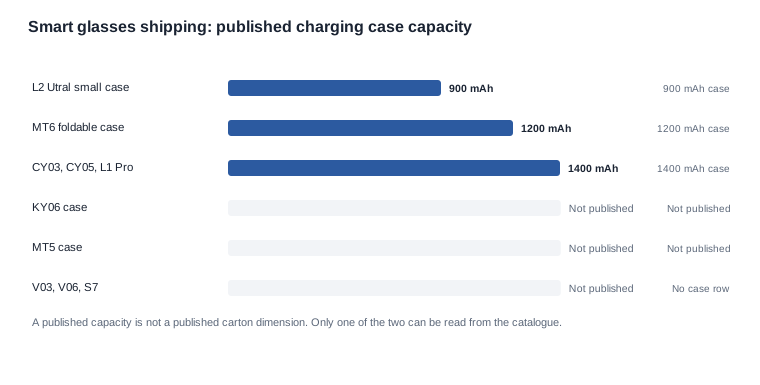
Each case situation produces a different packed unit. A 1400 mAh case is a substantial second object that turns a small parcel into a two-item package. The MT6's 1200 mAh case folds, which is the difference between a case that occupies space in the carton and a case that lies flat in it, and that difference shows up in the volumetric weight the carrier charges.
The four figures that decide the freight line
The published catalogue has no shipping carton dimension for any model, so the freight line has to be built on figures the supplier supplies. Four of them are needed, and they are the same four for every first order in this category.
- The shipping carton dimension, stated separately from the retail packaging dimension.
- The gross weight of the packed shipping carton.
- The number of retail units per shipping carton.
- The carton mark, carrying the buyer's own order reference.
Published weight exists for one model only. The catalogue gives the MT6 glasses body weight as 158 g, including the 265 mAh battery and the camera, and excluding the foldable charging case; the 1200 mAh case capacity is published separately, and the weight of the case itself is not published. That figure tells a buyer what the product weighs and nothing at all about what the shipment weighs, which is why it does not shorten this list.
The second practical consequence follows from the first. Decide whether the charging case ships inside the retail box or as a separate carton, because that changes the carton count, and the carton count changes the pallet configuration. Then confirm the master carton quantity against the shipping carton, because a mismatch discovered at the consolidation stage is a demurrage event rather than a delay.
The classification question that belongs in the first order
The third consequence is less visible but costs more when it goes wrong. A product carrying a lithium cell can be classified in more than one way, and which way applies can depend on the configuration and the destination rather than on the product alone. The HS code that appears on the packing list is not a formality: it drives the duty rate, it drives which conformity regime applies, and it is the field a customs authority will check the declaration against.
This is why the packing list format has to be agreed before the production slot rather than produced as an afterthought. A buyer who asks for the HS code late, after the broker has already filed a declaration against a code the factory used for a different configuration, has a classification dispute on their hands, and the party that can win that dispute is usually the party that wrote the technical file. The shipping checklist arranges the same ground by the stage at which each item has to be right, including the point at which a classification question has to be answered rather than deferred.
The practical request is small: the HS code proposed for each configuration, the classification reasoning in one line, and the name of the party who will support it if the destination asks. That third item is the one that matters in a dispute, and it is cheap to agree on the first order and expensive to agree after a consignment has been held.

The document set to request in writing, and its published status
What the catalogue settles and what it does not
Most first-time buyers in this category expect to be told that a supplier's paperwork is unavailable. In this case the opposite is true, and the useful move is to use the published rows rather than to ask around them.
The electrical rows are complete. Cell capacity is published for every model, from 40 mAh on the A05 and the A06 to 290 mAh on the CY03 and the CY05, and the L1 Pro and the L2 Utral. Charge time is published for every model, at no more than two hours for twenty-six of them and around one hour for the D17 and the ZH12. Charge method is published for twenty-four of the twenty-eight models, magnetic for seventeen and Type-C for seven, with the CY05 and the MT6, and the L1 Pro and the CY03 carrying no charge method row at all.
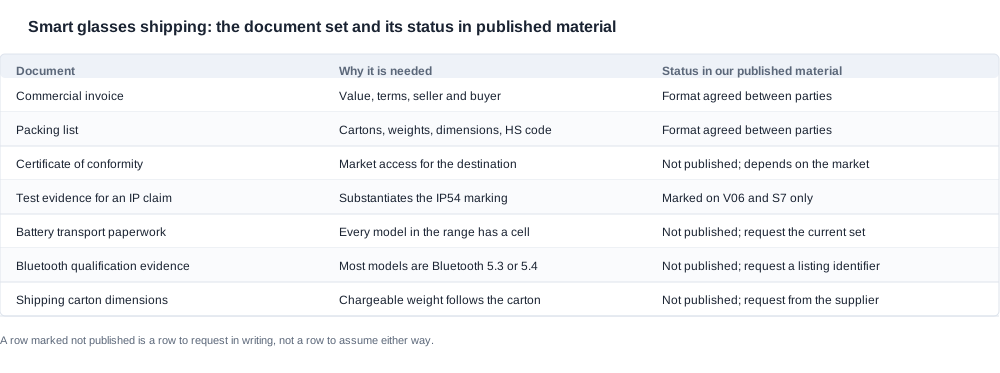
Two rows in that document table need attention, because they are the ones a retailer or a customs authority will pick at. The IP54 marking appears against exactly two models in the whole catalogue, the V06 and the S7, as a catalogue marking with no third-party report number published, so a request for substantiation is a request that has to go to the supplier's own file. And every model in the range ships with a lithium cell, which means the transport paperwork is not optional and cannot be assembled on the day of shipment.
The request that closes the open rows
The rows the catalogue does not settle have to be requested in writing, and the request is short because the catalogue has already narrowed it. What is needed is the shipping carton dimension, the gross weight, the units per carton and the carton mark per configuration, the conformity route for the destination market, the battery transport file for the specific build, and the Bluetooth qualification evidence where the buyer needs a listing identifier for the models on Bluetooth 5.3 or 5.4.
Written is the operative word. The published position on certificates is that certificate numbers, issuing bodies and validity dates are not published, so the request has to be framed as a request for documents rather than as a request for confirmation. A request for confirmation is answered with "yes", and a request for documents is answered with something the buyer can file.

From declaration to release, and what fails first
The four steps at the port and where each one fails
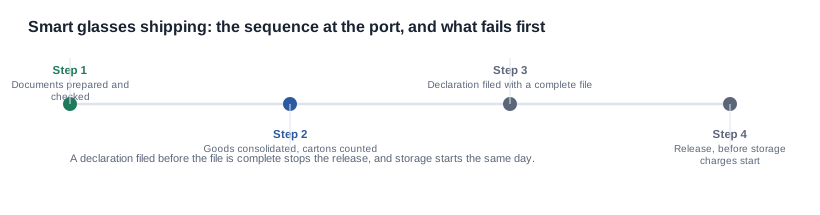
Four steps stand between a sealed carton and a released consignment, and they are performed in this order: the documents are prepared, the goods are consolidated, the declaration is filed, and the goods are released.
The first step fails quietly. Documents prepared from the order rather than from the physical cartons produce a packing list whose counts and weights nobody has checked, and that document is what the declaration is built on. The second step fails at the consolidation stage, when the master carton quantity does not match the shipping carton and the goods have to be repacked into a terminal that charges for the privilege. The third step fails when a declaration is filed before the file is complete, because the authority cannot release against an incomplete submission. The fourth step is the one that costs money, and it is the one that arrives as an invoice.
Why storage charges start before anyone notices
A release that stops is expensive for a reason that has nothing to do with the value of the goods: the unit sits in the terminal and the storage cost accrues per day, and the days are usually counted from a date the buyer did not know about. The person who benefits from a delay is not the person who pays for it, which is why a delay of this kind has to be managed by a named contact with a response time rather than by a policy.
That is also the reason the order of the steps is worth protecting. The buyer's interest is to have the file complete before the goods are made, so that the declaration can be filed complete, so that the release happens on the first pass. The sequence in the timeline above is the sequence that produces that outcome, and each step has an owner and a completion test.
The check that closes the first order
The four steps above end with a released consignment, and a released consignment is not the end of the first order. It is the point at which the buyer finds out whether the four decisions made at the start were the right ones, and the way to find out cheaply is to check the arrival against what was ordered rather than against what was expected.
Three checks do it. Count the cartons at the gate against the packing list, with the carrier present, because a carton count that is reconciled later cannot be reconciled at all. Verify the model and the case option on a sample of units before the consignment leaves the receiving area, because a configuration error found on the dock is a re-order and a configuration error found by a customer is a channel problem. And photograph the carton marks and the seal number, because those are the evidence for a short or damaged shipment claim, and a claim filed without them is difficult to support.
Then write the close-out note. What shipped, what was short, what was damaged, what was claimed, and what has to change before the next order. For a first order this note is unusually valuable, because the first order is where the buyer's own assumptions about the category get tested, and an assumption that is not written down is an assumption that will be repeated.
This is the step that turns a shipment into a procedure, and for a first order it is also the step that produces the second order's specification.
Sending the model and the market to get the list pre-filled
If you are about to place a first order, the most useful thing you can send us is short: the models, the quantities, the destination market and the case configurations you are considering. We will come back with which configurations exist, which of them are open on the published data, and what has to be requested in writing for each open row.
That is the whole of what can be settled from a published catalogue. The AI camera glasses range shows the model-by-model figures, the shipping and logistics guidance covers the commercial side of the same first order, and our lead time discussion is where the schedule assumptions get tested against a document rather than against a promise.
What we will not do is fill an open row with a typical figure from a general supplier list. A plausible number that turns out to be wrong gets built into a carton drawing and a cost model, and it is found at the container. What we will do is tell you which rows are open, and what to ask for to close each one.


