

Smart glasses shipping is governed less by weight than most buyers expect and more by two things: the lithium battery inside every unit, and the fact that a charging case changes the parcel's volume and adds a second cell. Get those two right and the rest is arithmetic. Get them wrong and a shipment stops at a carrier counter or at a customs desk, and the delay is measured in days rather than in freight.
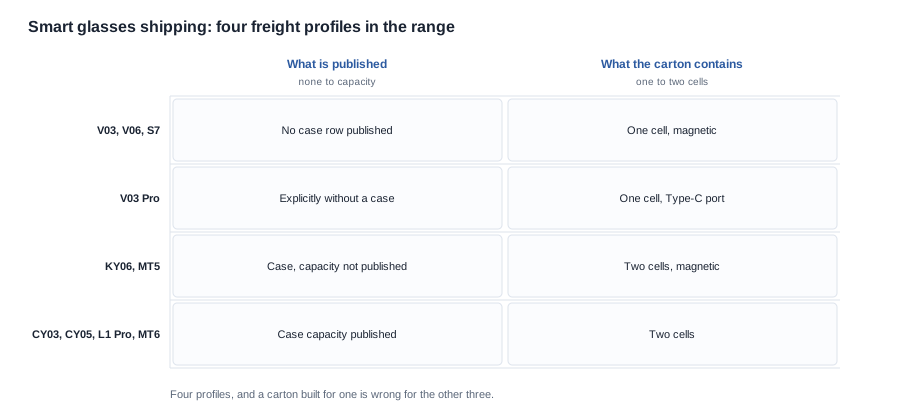
There is a third thing that most buyers do not anticipate, and it is the reason this guide is organised around the catalogue rather than around the freight market. This range does not ship as one product. It ships in four distinct freight profiles, and the carton built for one of them is wrong for the other three. None of the transit figures below are published as fixed numbers on this site — transit and lead times are not published for this range and are confirmed per enquiry.
Smart glasses shipping: what the configuration decides before the carrier does
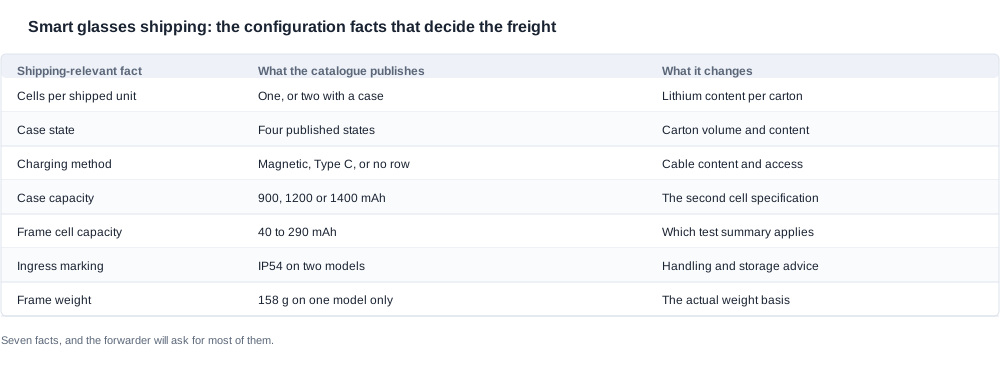
A freight quote is an arithmetic exercise over four inputs: the packed dimensions of the carton, the weight, the lithium content, and the destination market. Three of the four are set by the configuration, and only one of them — the destination market — is set by the buyer. That is why the useful conversation with a forwarder starts with the configuration rather than with the mode and the lane.
The table above lists the seven published facts that feed those inputs. Reading them in order produces a short specification the forwarder can quote against, and it is worth doing before the first conversation rather than during it, because a forwarder asked for carton dimensions and given a product name will either guess or ask for a sample to measure.
Two of the rows deserve emphasis because they are the ones most often left to assumption.
Cells per shipped unit. Every unit in this range carries a frame cell, and every unit that ships with a case carries a second one in the case. The published case capacities are 900 mAh and 1400 mAh for the L2 Utral, 1200 mAh for the MT6's foldable case, and 1400 mAh for the CY03, the CY05 and the L1 Pro; the KY06 and the MT5 ship with a case whose capacity is not published. Two cells per unit is a different lithium declaration from one cell per unit, and it changes both the packaging instruction and the documentation.
Frame cell capacity. The published capacities run from 40 mAh in the children's protective models through 55 mAh × 2, 70 mAh, 90 mAh × 2, 100 mAh, 115 mAh and 200 mAh, up to 220, 260, 265 and 290 mAh in the camera range. Each is a distinct cell specification, and the transport test summary attaches to the cell rather than to the product.

How many cells the carton contains, and why the case doubles it
The single most consequential shipping fact in this category is that a cased model is a two-battery consignment rather than a one-battery consignment, and it is easy to miss because the second battery is inside the accessory rather than inside the product.
A buyer planning a shipment of the V06 is planning single-cell units, and the frame cell is 260 mAh. A buyer planning the same volume of the CY05 is planning units with a 290 mAh frame cell plus a 1400 mAh case cell, with the case capacity published and the charging method not published at all. These are not the same consignment, and they do not travel the same way.
The mechanism behind the difference is the packaging instruction. A single-cell unit ships under one classification; a unit plus a case usually ships under a different one, with different packing, marking and documentation requirements. And because the case is a separate purchase from the frame, the case cell and the frame cell can arrive at the packing station from different suppliers, which is exactly the situation in which a packaging instruction written for one cell configuration gets applied to another.
That is also why a sample shipment is not a rehearsal for the production one. A single sample travelling by air courier meets acceptance rules and documentation requirements that a palletised consignment of two-cell units does not, in the same way that a single unit meets a different set from a thousand. A buyer who has planned the freight around a sample has planned the harder problem in the easier direction.
Why weight is rarely the deciding input
The instinct on seeing a pair of glasses is that the shipment is heavy and the freight will be large. In this category that instinct is usually wrong, and the reason is worth stating precisely because it changes how a freight quote is built.
The only published weight in the entire range is the MT6 glasses body at 158 g, and that figure includes the 265 mAh cell and the camera while excluding the foldable charging case, whose own weight is not published. Weight for every other model is not published and should not be estimated from this one. But the more important point is not the number. It is that air freight is normally charged on the greater of the actual weight and the volumetric weight — the volume of the carton converted into an equivalent weight at the carrier's own divisor. A product of this physical size sits in a carton whose volume is what sets the charge, and the product weight barely moves the answer.
The consequence is that adding a case to a programme does two things to the freight at once, and they are not symmetric. It adds a second cell, which changes the lithium declaration and therefore the packaging and documentation requirements. And it adds volume, which on a volumetric basis can move the chargeable weight more than the accessory's actual weight would suggest. A buyer who modelled the freight on product weight and then added a case has modelled neither effect correctly.
The practical instruction is short: ask the forwarder for the chargeable-weight basis on the lane, give them the packed dimensions of the exact configuration rather than a product name, and treat the 158 g figure as applicable to one model and to the glasses body alone.
Air, sea, and the documentation that comes with each
The mode is not a purely commercial choice in this category, because the mode determines which set of rules the consignment is handled under.
Air is fast and expensive, and it is the only mode that suits a first order, a programme with a fixed launch date, or a quantity small enough that the cost of holding inventory at sea exceeds the freight saving. The trade-off is that the documentation set is the strictest: the air-transport test summary has been required since 1 January 2020 and is the document most often missing at the counter.
Sea is slow and cheap, and it suits a programme with a stable demand curve and no fixed launch date. It also changes the planning arithmetic, because a sea transit measured in weeks turns a small replenishment error into a stock-out. The relevant question is therefore not the rate but the lead time: a buyer who has optimised the rate and ignored that a reorder now takes weeks longer to arrive has made the wrong trade, because the cost of the extra weeks of inventory is usually larger than the freight saving.
And a split consignment is the case that catches buyers out. Moving a first portion by air and the balance by sea is a common and sensible risk strategy, and it complicates the documentation rather than simplifying it, because two consignments travelling under different modes with different contents need to be reconciled against one invoice and one packing list. The reconciliation is where the model designation errors surface.
The four states of the charging case, and what each one does to a freight quote
The case is where this category's shipping questions get complicated, because the catalogue publishes four different states for it and they are easy to conflate.
No charging-case row published at all — the V06 and the S7, and the V03 Pro and the V03. The catalogue simply does not publish a case row for these four models. That is an absence of information rather than a statement that no case exists, and the distinction is commercially live: a buyer who reads the silence as "no case" builds an uncased carton, and a buyer who reads it as "unknown" asks the supplier before building anything. The correct question is which one applies to the ordered configuration, and it takes one line to ask.
The same silence covers the V03 Pro. It is the model published with a Type-C charging interface, and its colourways are orange, cream white and black, so each of the three is a separate carton build — and each of those cartons needs the case question answered before the packing list is written, because a colour count and a charging interface are the only two things the catalogue settles for that model.
A case whose capacity is not published — the KY06 and the MT5. Both ship with a case, and the catalogue does not give the capacity. For freight purposes what matters is that there is a second cell of an unspecified size, which means the lithium declaration cannot be completed from the catalogue and has to be requested for the specific configuration.
A case with a published capacity — the CY05 and the L2 Utral, the CY03, the L1 Pro and the MT6. These are the models where the carton is fully determined by the published data: a 1400 mAh case on the CY03, the CY05 and the L1 Pro, a 900 or 1400 mAh case on the L2 Utral, and the MT6's 1200 mAh foldable case.
The charging method matters for a different reason — it determines what travels in the box. Magnetic charging needs no cable to function; a Type-C model needs one, and whether it is included changes the packed dimensions and the carton contents list.

Documentation is the part that stops a shipment rather than slows it
The delay that costs a buyer money in this category is almost never a freight delay. It is a documentation stop, and it happens twice: once at the carrier and once at customs.
At the carrier. UN Manual of Tests and Criteria section 38.3 design testing applies to the lithium cells, and an air-transport test summary has been required since 1 January 2020, recording the producer, the laboratory, the report number and the battery model. Missing or inconsistent documentation stops a consignment at the carrier, not at the port, and the delay is measured in days. Test summary numbers for this range are not published and are supplied per configuration — which means they have to be requested before the first booking rather than hunted for during one.
At customs. A radio-equipped consumer electronic product entering your market needs the appropriate authorisation before import. For the United States that is the FCC authorisation pathway; for the European Union it is the conformity route under the Radio Equipment Directive (EU) 2014/53/EU, together with the general product safety regulation's requirement for an established economic operator's details on the online product page, which has applied since 13 December 2024. None of these is a commercial variable, and all of them are the kind of item that is assumed from a previous product and then turns out not to apply to this one.
And across the paperwork itself. The commercial invoice, the packing list, the product label and the model on the unit have to agree with each other. They do not always, particularly where a model designation carries a variant suffix — worth watching on entries where the catalogue itself publishes an extra label alongside the model, as it does for the L2 Utral.
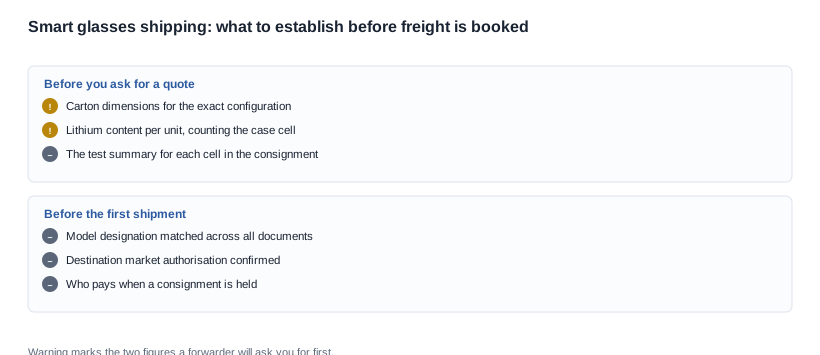
The questions to ask before you book are short, and each one either removes a stop or defines who pays for it.

The three dates: despatch, availability, and arrival
A consignment has more dates than a purchase order suggests, and the most common planning error is treating "delivery" as one of them.
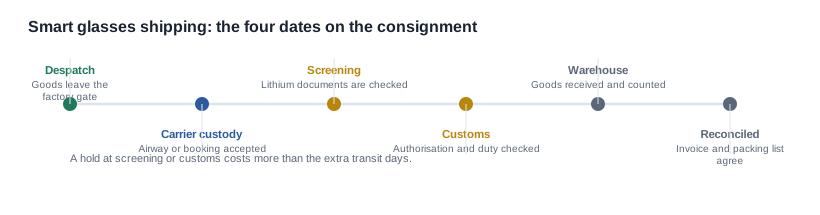
Despatch is the date the goods leave the factory gate. It is the supplier's date and the only one the supplier controls directly.
Availability is the date the consignment is usable for onward movement — in practice, the date the carrier has accepted it and the screening and documentation checks have cleared. For a lithium consignment this is frequently several days later than despatch, and it is the date that should appear in a buyer's plan, because it is the date the onward leg can start.
Arrival is the date the goods reach the warehouse, and it is the only date that involves your own broker, your own customs authority and your own receiving process.
Keeping these three apart is not pedantry. A plan that uses despatch where availability belongs will be optimistic by exactly the number of days the screening step costs, and that gap reappears on every shipment rather than on the first one. The questions to ask your forwarder are therefore about the holding points rather than the transit time: how long does screening take, what happens to the consignment if a document does not match, and who is notified.
Two commercial points sit alongside the dates. The first is the incoterm, because a price that stops at the factory gate and a price that arrives at your warehouse are two different products, and a shipment that stops at a customs desk is neither. The second is who pays when a consignment is held — the practical question, and the one that decides how much pressure your forwarder actually has. A buyer who has not answered it will discover that the demurrage is being charged to the party with the least leverage.
There is a third point that belongs in the same paragraph, and it is the one that decides how a buyer should report the cost of freight internally. Freight is not a percentage of the order value; it is a cost per shipped unit that behaves differently depending on whether the consignment is consolidated. A first order moving as a partial container carries the same fixed costs as a full one and spreads them over fewer units, which is why the freight per unit on a trial shipment looks alarming and why it falls sharply on the second. The mistake is to model freight as a percentage taken from the margin model and to discover at the second shipment that the percentage was derived from an unrepresentative consignment. The better approach is to model the freight per unit at the expected consignment size, separately from the percentage, and to re-derive it each time the consignment composition changes — which in this category means each time the case option or the colourway count changes the packed product definition.
A consignment planned end to end, and what we will and will not commit to
A first consignment and the forwarder's three questions
The example below is constructed. No client, no consignment and no outcome is claimed; the camera model with a charging case, the European destination and the first production run are all assumed, so that the sequence can be followed.
A brand is shipping its first production run of a camera model with a charging case into a European market, and its forwarder has asked for three things: the carton dimensions, the lithium content per unit, and the test summary for each cell in the consignment.
The first answer is the catalogue work. The frame cell capacity is published, the case capacity is published, and the charging method is not published for this model family — which means the case cell has to be requested for the ordered configuration rather than read off the page. The carton dimensions cannot be answered at all from published data, because no carton dimensions are published for any model, and that has to be requested together with the packed product definition.
The second answer is the lithium declaration, and it is the one that catches people. The unit contains two cells, not one: the frame cell and the case cell. The declaration has to be built around both, with a separate test summary for each, and the packaging instruction has to match the two-cell configuration rather than the single-cell instruction that a stock carton would carry.
The third answer is the date structure. The buyer stops using "delivery" and records despatch, availability and arrival as three separate fields in the plan, with the gap between despatch and availability owned by the forwarder's screening step. The incoterm is fixed at the point where the goods are available for onward movement, and the demurrage question is answered before the first booking.
The result is a first consignment that is planned rather than hoped for, and a forwarder who has everything needed to quote without asking a second time.
Where our position sits
We will supply the lithium documentation that applies to a configuration and tell you what is missing, and we will not quote a transit time or a lead time as a fixed number on this website. Transit belongs partly to the carrier and partly to your destination's customs authority; presenting a blended figure as our commitment is how a supplier ends up blamed for a customs delay it could not control.
Unit prices, production lead times and minimum order quantities are all not published as fixed figures and are confirmed per enquiry. What we will do is give you the battery configuration, the case configuration and the packed product definition, because those three together determine almost everything downstream. And on the one published weight in the range, we will be precise about what it covers: the catalogue publishes the MT6 glasses body at 158 g, including its 265 mAh cell and its camera and excluding the foldable charging case, whose own weight is not published. No frame weight is published for any other model.
For the document-level detail, battery transport requirements covers UN 38.3 and the test summary in depth. If your route depends on the charging case, charging solutions sets out which models ship with one.
Related reading
- Battery transport requirements — UN 38.3, test summary and packing rules
- Charging arrangements explained — why the case changes freight
- Certification checklist — destination market requirements
Tell us the destination, the mode you want and the configuration, and we will tell you which battery documentation applies and what we can commit to on our side of the journey.


