

Smart glasses sourcing risk reaches your schedule long before it reaches your margin, and it does so in a specific way: a quoted lead time is a single number standing in for six separate durations, each with a different owner, each with a different remedy. Only one of those six is the factory's, and the one that is the factory's is usually the one being quoted. This article takes the date apart, names the six parts, shows which decisions actually compress it, and gives you the questions to ask before you accept a number in writing.

The test for any quoted date is short. Ask where the clock starts, what has to be finished before it starts, and who is accountable for each part of the interval. A supplier who answers all three has quoted a schedule you can plan against. A supplier who answers only the first has quoted a build duration, and the difference between those two things is routinely three to six weeks of a launch window you believed you had.
Smart glasses sourcing risk: the sequence the six schedule parts happen in
Who is reading this and which date is on the table
The reader is a brand-side procurement manager, a channel buyer or an e-commerce seller, and the date on the table is one of three. Either a channel has been promised a stock date and the promise was made before anybody checked a schedule. Or a launch is being planned against a date that was set for a marketing reason — a trade show, a seasonal window, a retail reset — and the date is now the constraint rather than the objective. Or a first order went in, the delivery arrived late, and somebody now has to work out which part of the promise was missed and who carries the consequence.
The thing being managed underneath all three is not the factory's throughput. It is the buyer's own decision latency, which in this category is usually longer than the production run and much easier to control.
Why one number cannot carry a schedule
A quoted lead time covers, at most, the second of the six parts below. The rest is assumption. This is not a criticism of suppliers; it is how quoting works when a buyer asks for a date. What makes it dangerous is that the assumption is invisible in the quotation, so the buyer's plan absorbs the entire interval as if it were production time and then discovers the difference at the point where the plan stops being adjustable.
The practical consequence is a specific failure: the launch date slips, the channel complains, and the buyer's first instinct is to raise pressure on the factory. The factory was on time. The pressure lands on the part of the schedule nobody was tracking, and the next cycle loses another two weeks. A schedule that is decomposed at the start cannot make that mistake twice.
The six parts, in the order they happen
- Decision time. The interval between naming the model and releasing the build: specification, artwork and sample approvals. It is entirely the buyer's, and it is the part most often left unmeasured.
- Build time. The production run itself, once the build is released. This is the only part a supplier can compress by working harder.
- Evidence time. The interval needed for the documents the destination market requires. It belongs to the supplier to produce and to the market to define, and it cannot be compressed by enthusiasm.
- Movement time. Packing, handover to the forwarder and booking. It looks small on a calendar and is routinely two weeks when the carton count is higher than expected.
- Clearance time. The interval a consignment waits before release. It is a property of the destination, the paperwork and the inspection regime, and no party in your transaction controls it.
- Total elapsed time, which is the sum, and the sum is the only number a launch plan should be built on.
Where the catalogue's published rows land on this schedule
Our catalogue is unusually useful for two of these parts and misleading for a third, and it is worth being precise about which is which.
For build time, the published rows tell you what the unit is rather than how long it takes to make. Cell capacity, rated runtime and charge time are published per model, the charging interface is published for twenty-four of the twenty-eight entries and unpublished for four camera models, the case configuration is published for the camera models that have one, and the Bluetooth version is published for the audio and sport models. Each of those is a specification input, and each one is also an input to the schedule: a configuration that is still open on the day the build is released is a build that cannot be released.
For evidence time, the catalogue is close to silent, and deliberately so. It contains a company-level export-certification page, no per-model conformity rows, no certificate numbers and no CE, FCC or RoHS text at all. Nothing in that file can be used to estimate how long evidence will take for a model in a market, which is exactly why evidence time has to be requested as a number, with a start condition and an end condition, rather than inferred from a page.
For movement time, the published rows are quietly decisive and usually ignored. The charging interface determines whether a cable is in the box, and a cable in the box changes the carton and the carton count. The case configuration does the same thing more dramatically: our catalogue publishes a 1400 mAh charging case for the CY03 and the L1 Pro, and the CY05, 900 mAh or 1400 mAh for the L2 Utral and a 1200 mAh folding case for the MT6, publishes that the KY06 and the MT5 ship with a case whose capacity is not stated, and publishes that the V03 Pro has no charging case at all, while the S7 and the V06, and the V03 have no charging-case row published either. Whether a box contains one device or a device and a case is not a packaging detail; it is a material difference in unit volume, in carton count and in the time the forwarder needs.

The decisions that move a date, and the ones that only confirm it
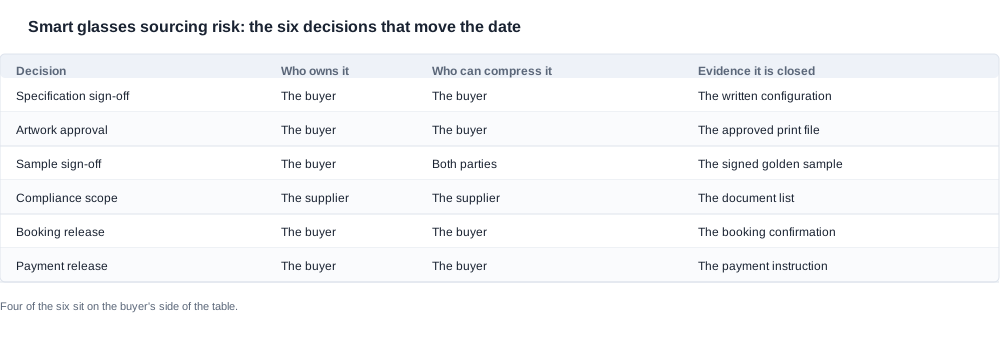
Six decisions, four of them yours
Look again at the ownership column in the chart above. Four of the six decisions sit on the buyer's side of the table: the specification sign-off, the artwork approval, the booking release and the payment release. Only one — the compliance scope — sits with the supplier, and the sample sign-off is shared. This is the single most useful thing to understand about lead time in this category, and it is the opposite of what buyers assume, because the assumption is that the schedule belongs to the factory.
The practical consequence is that raising pressure on the factory compresses at most one of six, and usually the one that was never the problem. The decisions that actually move the date are internal: who signs the specification, how long artwork takes to approve, when the payment instruction goes out, and whether the booking is released as soon as the units are ready or at some convenient point later in the month.
Two of these are pure process and cost nothing to improve. The specification sign-off is usually waiting on a marketing or a product decision rather than on a technical one, and moving the review date of that meeting is a calendar change. The artwork approval is usually waiting on a print file that is version-controlled badly; naming one owner and one turnaround time for artwork removes a week of waiting without a single argument with anybody.
The two parts that cannot be compressed
Evidence time and clearance time resist compression, and a plan that treats them as compressible will fail in a way that looks like a factory problem. Evidence time is a testing and documentation cycle with its own dependencies, and it shortens only if the scope is smaller — fewer markets, fewer configurations, fewer variants. That is a legitimate commercial decision, but it has to be made deliberately, and it is usually cheaper made before the order than after.
Clearance time is a property of the destination and of the paperwork, and the buyer's only levers are the quality of the documents and the choice of broker. A consignment that clears on the first presentation has saved a week that no amount of factory effort could have recovered. The realistic way to protect clearance time is to have the transport classification and the cell documentation agreed before the booking rather than assembled after it, because every model in this range runs on a lithium cell and a device that ships with a charging case carries a second cell that changes the declaration.
The notice period that turns a negotiation into a notice
The other thing that belongs in this section is a clause rather than a process. A release notice for a delivery slot, a notice period for changing the booking, and a notice period for changing the artwork are all cheap to obtain and all convert a future conversation into a scheduled event.
A programme that has them can respond to a slipped date by re-planning. A programme without them responds to a slipped date by discovering it. The difference is worth more than the effort of asking, and asking is a single clause in a purchase order rather than a negotiation that has to be won.

Checking a quoted lead time before you sign
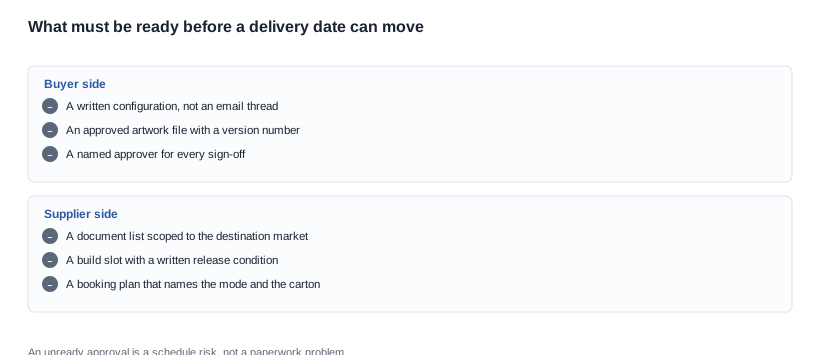
The three questions to ask of any date
Before a quoted lead time is written into a plan, it should survive three questions.
- Where does the clock start? "Thirty days" means thirty days from what — the deposit, the artwork approval, the sample sign-off, the purchase order, or the written configuration? In this category the difference between the first and the last of those is routinely two to three weeks, and it is the buyer's own delay being counted as the supplier's.
- What has to be finished before it starts? The answer should be a list, not a shrug. If the answer includes "when the compliance scope is confirmed", then the date depends on a document list that has not been written.
- Who is accountable for each part? A date that has six parts and one owner is a single-part date wearing six-part clothing.
These three questions are the shortest useful form of how to evaluate a quoted schedule, and they are the questions to ask before you order rather than after the first shipment.
What to ask when the supplier says "four weeks"
A number without a start condition is not a commitment, and the follow-up questions are specific. Which day does the count begin, and what must be received by that day for the count to start. Is the four weeks the build alone, or the build plus the documentation, and if it is the build alone, what is the documentation interval. Does the four weeks assume a specific quantity, and what changes if the quantity is different. Is there a build slot, and what has to happen to release it. And what happens to the date if the specification changes after the count starts.
The last question is the one that matters most commercially, because a build slot released against a configuration that later changes is a slot that has to be re-released, and the re-release is a new conversation with a new date. A clause that treats a configuration change as a new order for scheduling purposes, while keeping the commercial relationship intact, is worth more than a few days of negotiation over the number itself.
The detail that quietly adds a week
One class of configuration question adds time reliably, and it is the one most often left open because it feels minor. The charging method is published for twenty-four of the twenty-eight entries and is not published for the L1 Pro and the CY05, and the CY03 and the MT6. For those four, a buyer planning a carton has to ask, and until the answer arrives the cable decision, the tooling decision and the packing sequence are all suspended. That suspension is invisible in the schedule because nothing has started yet, and it appears later as unexplained time between the deposit and the build release.
The same is true of the Bluetooth version for the camera models, which the catalogue does not publish. A buyer whose product depends on a companion application needs to know which version the module will be, because that determines the validation work, and the validation work sits on the buyer's side of the schedule. A request for that figure is one line in an enquiry and can save a week of testing that would otherwise have started against a guess.

A two-market launch, week by week
The schedule the timeline assumes
The timeline below is a worked launch for a two-market programme, written as a planning exercise rather than as a client project. It assumes a camera model with a charging case, one European market and one United Kingdom market, and a first order in the low thousands of units.
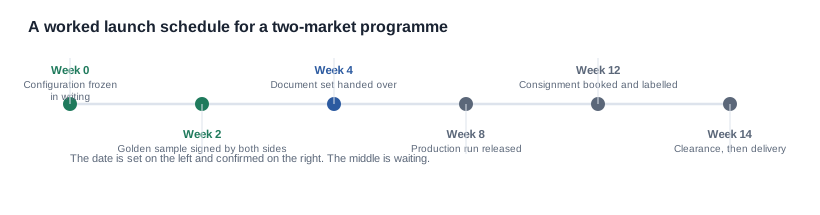
Read it from the left and the date is being set. Read it from the right and the date is being confirmed. The middle is waiting, and the waiting is the part that is usually invisible in a quoted lead time.
The first two weeks are entirely the buyer's. The configuration is frozen in writing in week zero, and the golden sample is signed by both sides in week two. Nothing in the factory's part of the schedule has started at that point, and the entire programme is still movable, which is why this is the cheapest place to lose two weeks and the most expensive place to lose them.
The two weeks that disappear
There is a predictable failure in this shape of plan. The document set is handed over in week four, and the production run is released in week eight, and there is a four-week gap between them that appears on no one's list. In practice the gap is the evidence time — the conformity work for a second market that was scoped late, because the market list was confirmed after the sample rather than before it.
The fix is not to work faster during the gap. It is to move the market list forward to the specification stage, where it belongs. A buyer who writes the destination markets into the specification at week zero has handed over a document request that can begin in week two; a buyer who confirms the markets in week three has handed over a request that can begin in week five, and the four-week gap has moved to the front of the programme where it is visible.
The second predictable failure is the booking. The consignment is booked and labelled in week twelve and clears in week fourteen, and the two weeks in between are clearance time. That interval cannot be compressed by the factory, and it can be made worse by a documentation error in week four — the kind of error that is easy to make when the transport classification is agreed in the same week as the booking.
What changes if the second market opens late
A useful test of a schedule is to remove one of its inputs and see what breaks. If the second market opens after the sample is signed, the programme needs a decision about whether the first market's build waits. It should not: a market addition is a configuration addition, and adding a configuration to a build that has not been released is a short conversation, while adding one to a build that has been released is a re-release with a new date and possibly a new inspection.
This is where the notice period earns its keep. A contract that says a configuration change after the build release requires written approval from both parties, and that the schedule effect is priced, turns a future argument into a present decision. Without it, the change happens anyway and the schedule absorbs it invisibly.
What our catalogue can and cannot tell you about timing
Here, we publish the rows our documentation supports, and we mark the rows that are open. On timing specifically, that means we publish the charge time for all twenty-eight entries — at or under two hours for twenty-six of them and about one hour for the D17 and the ZH12 — and we publish the rated runtime for every camera model: 5 to 8 hours for the V03 Pro and the V03, and the S7 and the V06, 6 to 8 hours for the KY06 and the MT5, and about 7 hours for the L2 Utral and the L1 Pro, and the CY03 and the MT6, and the CY05.
Two limits belong next to those numbers. First, a published charge time has no starting state of charge and no end-of-charge criterion, so it cannot be used to plan an interruption or to compare two models in a shift schedule. Second, and more importantly for a buyer planning a launch, production lead time is not published in our documentation. Neither are minimum order quantities, unit prices or capacity figures. A quotation that appears to carry them as standing numbers is one worth interrogating, because a number that cannot be verified is a schedule risk with a decimal point on it.
What we do publish is enough to write a precise specification and a fair acceptance method, and that is the part of the schedule a buyer controls.
The sourcing risk section covers how risk is carried across the chain, and the lead time overview sets the wider schedule context for the category. The cost breakdown covers the four lines that belong under a quotation, and the glossary defines the terms — configuration freeze, acceptance period, claim period — that this schedule depends on.
If you want a schedule for a real configuration, send the model, the configuration, the quantity and the destination markets, and ask us for the four figures a plan actually needs: what we need from you before the count starts, what the build interval assumes, what evidence the destination market requires for that configuration, and what remains open. We will answer with a list and a dependency rather than a single number, because the single number is the part that was never the risk.


