

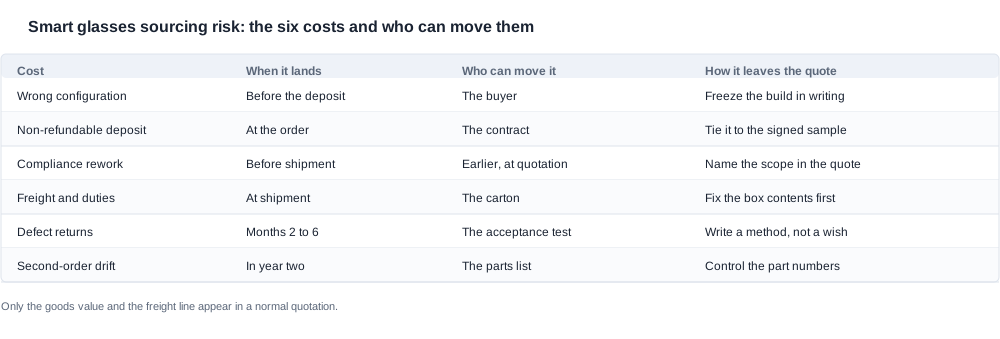
Smart glasses sourcing risk is not one cost. It is six, they arrive at different points in the programme, and only two of them appear in a quotation. The two that appear are the goods value and the freight line. The other four are real, foreseeable, and absent, which is the entire reason two quotations for the same model can differ by a wide margin and both be arithmetically correct. This article takes the six apart, fixes a threshold for each one, and gives you the four extra lines to add beneath any quotation you receive before you compare anything.
The practical test is simple. Take two quotations for the same model, at the same quantity, from two suppliers. If the goods value and the freight are the only lines that differ in scope, and one supplier's compliance scope is written down while the other is silent, then you are not comparing two prices. You are comparing one price against a guess. Adding the four missing lines to both sides takes about twenty minutes and is the single most useful thing you can do before you choose.
Smart glasses sourcing risk: the six costs, itemised
The reader, and the decision sitting on the desk
The person reading this is a procurement manager on the brand side, a channel buyer or an importer. The situation is one of three: two or three quotations are on the desk and only one can be signed; a new programme is opening and nothing has been specified yet; or a programme is already running and the first shipment produced a number nobody had budgeted for. In all three cases the underlying question is the same, and it is not about which product is better. It is about which configuration can be built, quoted, documented and shipped without the programme being rebuilt in the middle.
The thing being managed underneath is not a price gap. It is a schedule that a missing document can stop, a launch window that a border can close, and a channel that a defective file can cost twice, once in the units that come back and once in the relationship that has to absorb them. Procurement risk in this category is a list of ways a programme fails, and each of the six costs below is one of those ways, priced.
Where the six come from
The category has a particular shape, and the shape explains the cost profile. Our catalogue covers twenty-eight entries. Eleven of them are camera models, eight are audio models, three are sport models, and the remainder sit in the children's, display and bone-conduction lines. That spread matters for cost because the entries are not interchangeable in a bill of materials. A camera model carries a sensor, an image pipeline and a memory path. An audio model carries drivers, batteries on both temples and a codec path. The two are not variants of one device, and a price for one is not a price for the other.
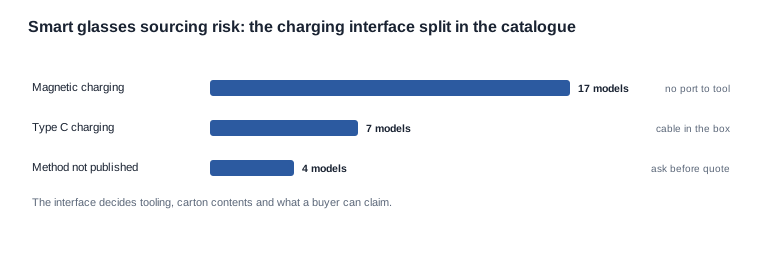
The second structural feature is the charging interface. Across the range, seventeen entries are published as magnetic charging, seven are published with a Type C interface, and four camera models publish a charging case capacity without publishing the charging method at all. Those four are the MT6 and the CY05, and the L1 Pro and the CY03, and they are worth naming here for a specific reason: their case capacities are published while their interface is not, so a buyer who needs the interface to quote a carton, a tool or a cable has to ask for it rather than read it.
The third feature is that most of the cost in a device is decided before anyone presses a button. Cell capacity, the rated runtime, charge time, the interface, the case configuration and the Bluetooth version are all published per model, and each one of them lands in a different part of the bill of materials. When a buyer and a supplier talk about "the same model" they may be talking about different configurations of it, and the difference between those two configurations is not a rounding error. It is the difference between a cost that was quoted and a cost that was discovered.
Why two quotations can differ and both be right
The reason two quotations diverge is rarely that one supplier is charging more for the same thing. It is that the two quotations have different scopes, and the scope difference sits in lines nobody put on the page. One supplier has run the conformity work for the destination market and quoted it; the other has not, and is quoting the same hardware without it. One supplier has quoted a case configuration and the other has quoted a bare device with a separately sold accessory. One has included an inspection window and a defect allowance, and the other has included neither.
None of these is a trick. They are ordinary consequences of a quotation being written to answer a question rather than to cover a programme. Which is why a buyer who compares the two on the goods line alone is measuring the one thing both suppliers quoted the same way, and ignoring the four things they did not.

The thresholds that separate a priced cost from an unpriced one
Reading the six costs against what the catalogue publishes
The table below is the working set. Each row states the cost, when it lands, who can move it, and what a quotation has to contain for the buyer to be able to price it. The last column is the one to use in an enquiry.
| Cost | When it lands | Who can move it | What a quotation must contain |
|---|---|---|---|
| Wrong configuration ordered | Before the deposit | The buyer | A configuration string, not a model name |
| Non-refundable deposit | At the order | The contract | The refund condition, written as a trigger |
| Compliance rework | Before shipment | The quotation stage | The market scope and the cost split |
| Freight and destination charges | At shipment | The carton | The box content, the mode and the incoterm |
| Defect returns | Months 2 to 6 | The acceptance test | The test method, not a description |
| Second-order drift | In year two | The parts list | A controlled part number list |
Two rows deserve more attention than the others, because they are the two where a buyer can act entirely alone.
The configuration row is the cheapest to fix and the most expensive to leave. Our catalogue publishes a model name and a set of published rows for every entry, and a model name is not a configuration. A camera model can exist with a case, and the catalogue's own rows show how much that choice moves: the CY03 and the L1 Pro, and the CY05 each publish a charging case of 1400 mAh, the L2 Utral publishes 900 mAh or 1400 mAh, and the MT6 publishes a 1200 mAh folding case. The V03 Pro publishes no case at all. These are the same hardware family with materially different box content, and box content is box content.
The acceptance row is the one that quietly decides the size of the returns reserve. "Quality acceptable" is not a test. "A random sample of a stated size, inspected against a written checklist, with a stated defect threshold, inside a stated number of days of arrival" is a test. The first one produces a dispute; the second produces a number.
The four lines to add beneath any quotation
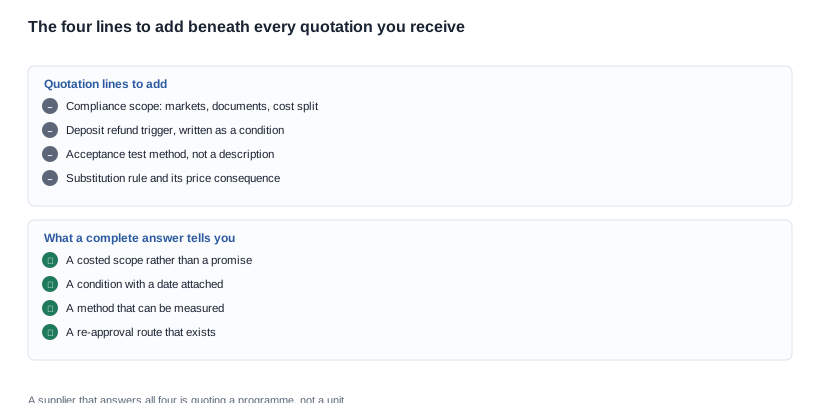
Before you compare two quotations, add the same four lines beneath both of them. Do not add them to one and not the other, because the whole point is that the answers are comparable.
- Compliance scope. Which destination markets are included, which documents are included for those markets, which are charged separately, and which are held for a different configuration. A quotation that says "certification included" without a market list is not scoped.
- The deposit refund trigger. Not a general goodwill clause. A condition: the sample is rejected, the conformity file cannot be produced for the named model, or the configuration changes after the artwork is approved.
- The acceptance method. A sample size, an inspection checklist, a defect threshold and a window. If the supplier cannot state the method, the returns reserve has to be assumed rather than calculated.
- The substitution rule. Which parts may be substituted without re-approval, which require written approval, and what happens to price and schedule if one is.
A supplier who answers all four is quoting a programme, and a supplier who answers none is quoting a number. A supplier who answers two is cheaper on the goods line and more expensive in aggregate, and the difference only becomes visible around month six.

Building the comparison sheet the quotation did not include
Six steps from a unit price to a landed cost
The arithmetic below is deliberately unglamorous, and it is the part most buyers skip. A unit price is not the total cost of ownership; it is a line in a document.
- Start with the goods value per unit, at the tier your real order reaches. Not the tier in the brochure. If your quantity sits in a different band, the first number is wrong and every number after it is wrong in the same direction.
- Add the itemised setup, artwork and tooling charges, and then amortise them across the quantity you actually intend to buy. Tooling that is not amortised is a one-off cost that reads like a per-unit cost, and it is the most common reason a small order appears unprofitable.
- Add the compliance scope you actually need, for the markets you actually sell into. In the European Union the relevant framework includes the Radio Equipment Directive (EU) 2014/53/EU and the General Product Safety Regulation (EU) 2023/988, which has applied since 13 December 2024. Neither of those is a line you can add later for the same price; they are configuration-level costs with lead times attached.
- Add the freight mode, the carton volume and the destination charges, on the incoterm you have chosen. A magnetic-charging model and a Type C model do not produce the same carton, and a model with a case in the box does not produce the same carton as one without.
- Reserve for returns and warranty, at the rate your own history supports, and at zero if you have no history yet, in which case treat the absence of a reserve as a known liability rather than a saving.
- Compare the result with the sell-through price, not with the other quotation. A comparison against the rival quote tells you who is cheaper. A comparison against your own price tells you whether the programme works.
The questions that turn a quotation into a costed scope
The four lines above are what you ask for. The following are what you ask, in the same order, to every supplier on the same day.
- Which model, and which configuration of it, is this price for? Name the case configuration and the charging interface.
- Which destination markets does the quoted compliance scope cover, and which documents does it include for each of them?
- What is the deposit, what triggers a refund of it, and how long does a refund take?
- What is the acceptance test, and against what method is a unit judged a defect?
- Which parts may be substituted without re-approval, and which may not?
Then one question that is almost never asked and almost always worth asking, and which belongs in the questions to ask before you order: what is not included in this price? A supplier who answers that question accurately, even if the answer is long, is telling you how their process works. A supplier who says nothing is excluded is telling you the price is provisional, and you should treat it as such.

Where a sourcing risk turns into a cash cost
The three failures that arrive as surprises
The configuration that was decided last. The specification was written after the quotation, in a hurry, and it turned out to describe a different build from the one priced. The loss is not the unit price difference; it is the tooling, the artwork and the schedule that have to be redone. The prevention is one page, and it is the configuration string. The criteria for deciding that a configuration is written are simple: it names the model, the case configuration, the charging interface and the market.
The compliance scope that was never scoped. A designation, an artwork file or a market changed after the file was closed, and the work reopened. This cost cannot be compressed by anybody, including the supplier, because it is a testing and documentation cycle rather than a production cycle. The prevention is to name the markets in the quotation and to make a change to the scope a priced event rather than a free conversation.
The returns that were booked as a quality problem. The largest single cost in the six, and the least visible to the factory, because it lives in your data and not in theirs. It happens when a listing, a sales brief or a channel description promised a capability the documentation does not support. Both sides then spend a quarter investigating a question that one paragraph in the specification would have answered. The prevention is to make the published file the ceiling of what anybody says about the product, which is also the shortest answer to the red flags a buyer is told to look for in a specification review.
The cost that only appears at the second order
Second-order drift is the cost with the longest fuse. The first batch is built with attention because everything is new. The second is built while other work is running, and the difference shows in finish consistency, in the firmware build and in the packaging print registration. The customer finds it. You find it in the returns rate. The factory sees it in a defect tally that reads normal, because each individual difference is small.
The mitigation is the cheapest document in this article and the one most often missing: a controlled parts list with part numbers, plus the inspection records from every run. A factory with no records cannot improve against anything, and a second order with no parts list is a second order built from memory.
The tool question belongs in the same paragraph. Where a private mould or a custom temple shape is involved, somebody has to own it. If ownership is not written down, the second order cannot be produced, and the only route forward is a new tooling charge that the buyer believes was already paid. That is the single most expensive of the six and the easiest of the six to prevent.

What can be moved, and what cannot
The five lines worth pushing on
Not every term in a smart glasses sourcing risk agreement is negotiable, and the ones that are not are the ones that get argued about most.
The configuration freeze date is negotiable, and moving it later has a real price that should be quantified rather than absorbed. The deposit refund trigger is negotiable in the sense that its absence is a decision you can make by choosing a different supplier. The cost split when a regulatory requirement changes mid-programme is negotiable and is the one most often granted silently in the supplier's favour. The definition of a defect is negotiable in wording and non-negotiable in effect, because the definition determines the returns reserve. The notice period for releasing a delivery slot is negotiable and is worth having, because it converts a schedule change from a negotiation into a notice.
Two things are not negotiable in any useful sense, and it is better to plan around them than to argue about them. The testing and assessment work itself is a per-model, per-market cost with a lead time, and a buyer who argues hardest about the fee usually loses the bigger prize, which is the scope. And the time a model takes to clear a market is a property of the market, not of the relationship.
A worked comparison, written as a worked example
This is a hypothetical comparison, not a client project, and no figures are claimed. The point is to show the order of the arithmetic rather than to state a result, and to show which criteria a buyer should apply before the ranking is made.
Suppose a channel buyer needs a camera model for one European market and one United Kingdom market, with a charging case in the box, at a quantity that sits in the middle price tier. Three suppliers quote. All three quote a goods value and a freight line. The differences are in the scope: one has priced the conformity scope for both markets, one has priced it for the European market only, and one has not priced a conformity scope at all and has noted that it is "to be advised".
The naive comparison reads the goods value, picks the lowest, and orders. The scoped comparison adds the compliance line to the second quotation, adds a commissioning cost and a lead-time penalty to the third, amortises the setup and artwork charges across the real quantity, and then asks each of the three what is not included.
The answer that matters is not the total. It is that the second and third quotations now have a cost and a schedule attached to them, and the lowest goods value is no longer the lowest programme cost. Nobody in this worked example was misled. The first quotation was simply a narrower one.
The practical conclusion is the same in every comparison we have seen: the suppliers whose future costs are knowable are the ones that answered all four of the extra lines. The difference between a knowable quotation and an unknowable one is often smaller than the cost of one bad shipment, and it is invisible until month six.
What we publish, and what a quotation from us will contain
Concretely, a quotation from us will name a configuration, set out the setup charges as separate lines and state the compliance scope, and it will list the scope lines it leaves out rather than leaving them blank. Unit prices, minimum order quantities, production lead times and defect rates are not published in our documentation, and a quotation that appears to carry them as standing figures is one worth interrogating.
We also do not publish a certificate number we cannot find, and our catalogue contains no per-model conformity rows and no CE, FCC or RoHS text at all. That is a limitation of the published material rather than a claim about our certifications, and it is why model-level conformity evidence for any given configuration is something we have to produce and hand over rather than something you can read off a web page. Where a document exists for a model, we will say so. Where it does not, we will say that instead of issuing a company-level declaration in its place, because a file that appears complete and is not is the most expensive kind of gap there is.
The sourcing risk section covers the assessment behind these six costs. The six hidden costs article takes the four that arrive after the order in detail, and the common mistakes piece covers the avoidable version of the same failures. The pricing comparison template gives you the columns to put these answers into.
If you want to start the arithmetic on a real configuration, send the model, the configuration, the quantity, the destination markets and the delivery window. We will tell you which parts of the scope exist, which are open, and which of the six costs your particular programme is most likely to meet first.


