

Getting started in wholesale smart glasses is a decision about operating model rather than product, and the first thing to get right is which of two businesses you are actually building.
A wholesale operation that resells a manufacturer's catalogue is a distribution business with a thin margin and a heavy stock risk. A wholesale operation that adds private label, packaging or a brand is a product business with a documentation burden. They require different capabilities, they fail in different ways, and the sequence of decisions that gets you to a first order looks quite different in each case.
Our published range supports either, and the configuration space is wide enough that the temptation to take all of it is strong. Six families, twenty-eight entries: camera entries at 8 MP and 13 MP whose published cell capacities fall in the region of 220 mAh to 290 mAh and whose rated runtimes fall in the region of five to eight hours, audio entries with single and dual cell arrangements, sport entries, a children's tier, a bone conduction platform, an electrochromic platform and an AR platform. The customisation record is held per category rather than per model, so the counts differ: camera entries carry seven recorded axes, audio entries five, sport entries five and the children's tier two, and the platforms that carry no model designation are recorded separately from those four. What to ask a supplier is which of the recorded items apply to the models you are actually taking, and how many of them you are prepared to staff.
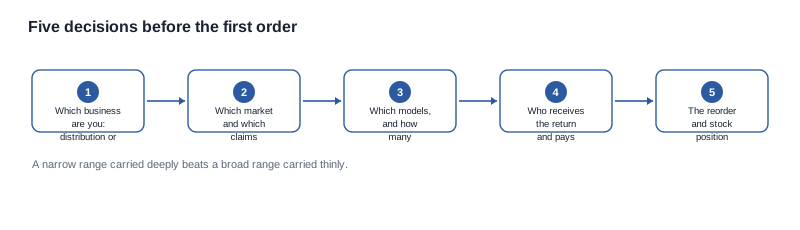
The reason the order of decisions matters more than the decisions themselves is that each one narrows the ones after it, and choosing them out of order produces a range you cannot support. The three commercial rows that usually come with a programme, the unit price, the minimum order quantity and the lead time, are not published on this site; they are quoted per enquiry, because each of them depends on the configuration you select, the mix you take, the quantity, the packaging, the documentation scope and the destination market.
Smart glasses wholesale getting started: five decisions in the order they constrain each other
1. Which business are you? Distribution, meaning you resell what exists at a margin and carry the stock risk on your balance sheet, or a brand, meaning private label, packaging and a documentation burden you carry. Everything downstream depends on this and it is worth spending a week on. The tell is which risk you would rather have: a wholesaler who dreads unsold inventory and a wholesaler who dreads a compliance question in a new market are in different businesses.
2. Which market, and which claims will you make there? This comes second, and it comes before the model, which inverts the order most buyers instinctively follow. The documentation position has to support the market and the claims, and in this category the documentation position is not something you can read off a product page. Not one per-model certification row is published in the range, and the export certification page carries ten patent certificate images, of which eight are design patents and two are utility models, none of them tied to a model list. So the market and the claims are what you need to bring to a supplier, not what you take from one. A distributor who is unclear about this discovers it at the border, which is the worst possible place to discover it.
3. Which models? Every model is a separate setup, a separate documentation set, a separate packaging variant and a separate case variant. A narrow range carried deeply beats a broad range carried thinly, and the published configuration space in our range is wide enough that the temptation to take all of it is strong. Four camera entries publish no charging method at all, eleven camera entries publish no Bluetooth version, three entries carry no case row at all while one explicitly has no case, and colour options are published for only two entries. Each of those is a reason to check the rows before you take the model rather than after.
4. What is the operating model for the after-sales? Whether the distributor or the manufacturer receives the return changes the logistics of every unit that comes back, and it has to be agreed before the first order rather than at the first claim. The related question is who pays the freight in each direction, and it is the question that gets renegotiated under pressure if it was left vague.
5. What is the reorder and stock position? The published lead times are confirmed per enquiry rather than published, and the stock availability discussion separates availability into three layers that have to be distinguished: the base model, the configuration and the shipping state. A buyer asking "how soon can you ship" without specifying which layer they mean will get an answer that is true and useless.
The five decisions are worth writing on a single page, because the value of the sequence is that each one closes options for the next. The market decision closes the claims you can make, which closes the models you can list, which closes the documentation you need, which closes the range you can carry, which closes the stock you have to hold and the reorder you have to promise. Written in that order, the sequence takes a day or two. Written in the reverse order, it takes a quarter and produces a range you cannot support.
There is one temptation to name here, because it is the one that costs the most in the first year. It is the temptation to choose the models first, because the models are visible and exciting and the documentation question is abstract. Choosing models first is not wrong. It is simply that the model list you end up with will be a list of what the supplier sells rather than a list of what your market and your claims allow. In a range with twenty-eight entries and configuration combinations across charging method, case position, colour and resolution, the number of combinations a buyer can technically take is large. The number that can be documented in one market with the claims you want to make is much smaller, and it is the second number that should decide the range.
The mirror image of that temptation is the opposite failure, which is to start with the documentation and spend three months closing it before anything is shipped. Documentation work is easier against a specific model than against a general programme, because the question "does this document name this model" only has an answer once you have a model. So the order is: market and claims first, then a short model list, then the documents for that list, then the range confirmed. The documents get closed after the model and before the order, not before the model and after the range.
None of this needs a large document. It needs one page with five answers, each with a date and a name against it, and it needs to exist before the first quotation rather than after it. A wholesale programme that has written those five answers can predict most of its first-year problems. One that has not will meet all of them, and it will meet them in the order the mistakes were made.
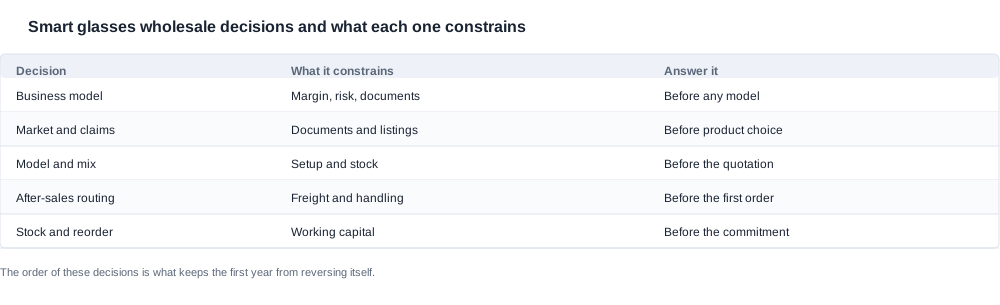
The five things to establish before the smart glasses first order
These are the five items that, if they are missing when the first order lands, will cost you a return shipment, a held consignment or a lost customer.
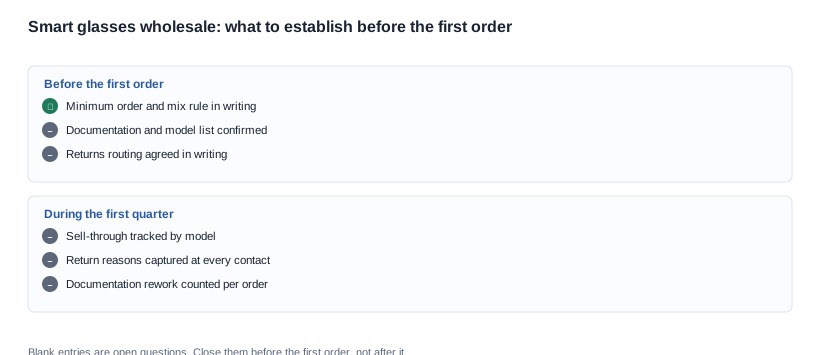
- The model list on every document that will cover your units, per market. Not the document, the model list printed on it. The catalogue publishes no per-model certification row, which makes this the single most important line in the file and the one most often skipped.
- The traceability in the form of a batch or serial identifier issued with the shipment, at configuration granularity rather than at order granularity. Without it, a return claim cannot be tied to a production run, and the argument about whether the fault is a batch fault never gets settled.
- The claim procedure in a form your receiving team can follow, including the evidence required, who inspects, and the time limits on the claim. A claim procedure that lives in an email thread is a procedure nobody follows.
- The returns route and who pays the freight, in both directions, including the case of a unit that comes back once the warranty period has expired but which carries a genuine fault.
- The reorder lead time for the specific configurations you carry, and what happens if a component is substituted. The second half of that row is the one that decides whether your availability promise survives a supplier's component problem.
The trade-off in settling these five before the first order is that they are the five items most likely to change afterwards, and change is cheap on day one and expensive in month four. That is the argument for settling them early rather than a reason to skip them: the cost of moving a decision earlier is a conversation, and the cost of moving it later is a return.
There is a sixth worth adding if you are carrying anything that ships with a battery: the transport and handling position, which for a battery-powered product is a real workstream rather than a line in a shipping form. Our range publishes no cell chemistry, no cycle life and no replaceability for any entry, so the information you need for your own logistics planning has to be requested and written down, and it is the information a forwarder will also ask you for.
Two of those five need more than a written answer on day one, and both are worth a scheduled review in the first quarter.
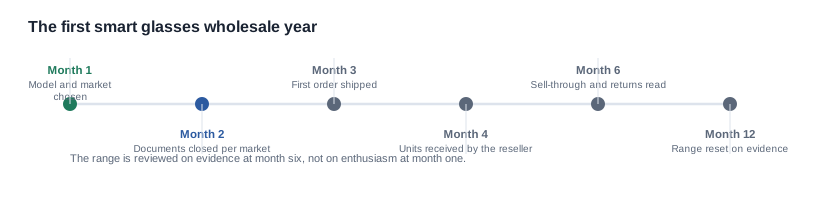
The first is the model list. Documents change, suppliers correct a certificate, and a model that was covered at the time of the first order may not be covered at the time of the third. In this category that happens for a specific and predictable reason: the configuration changed. A new colour, a different case or a different charging interface can move a product out of a family document and into a position where it needs its own. So the model list should be re-read at every reorder rather than treated as a one-off check, and it should be re-read against what you are about to ship rather than against what you shipped last time.
The second is the claim procedure. The procedure you write before the first order is a hypothesis, and the first ten claims will show you which parts of it are wrong. The failure mode is not that it is wrong. It is that it is wrong quietly, that nobody updates it, and that by the third quarter every claim is being handled by whoever happens to answer the message that week. A short monthly review of the last ten claims, with one line on what was awkward about each of them, is enough to keep the procedure current, and it is the cheapest quality improvement available to a small wholesale operation.

What most often goes wrong in a first smart glasses wholesale year
1. Taking too many models. The setup cost is per configuration and the working capital is per entry in the range. A range of eight models at low volume is eight setups and eight inventories, and in wholesale the breadth of the range is charged for on every single order rather than once, because the setup cost per configuration is the part that a volume discount cannot remove.
2. Under-pricing the packaging. Print minimums, per-language artwork and the case variants all recur per unit, and they are frequently quoted as a one-off because they were a one-off when the artwork was created. Add to that the fact that nowhere in our catalogue is there a translation row at all, which turns every additional manual language into a new artwork and a new print run rather than a reprinted insert.
3. Building the listing on adjectives rather than rows. The published rows in this category are thin, and the claims a distributor wants to make are the ones the published data often cannot support. An ingress rating appears on exactly two entries in the whole range, both of them IP54. No microphone specification is published for any entry. There is no capacitive-touch row anywhere in the catalogue. Only one entry publishes a frame weight, and it covers the glasses alone. A listing built on "waterproof", "hi-fi" or "noise cancelling" is built on words that a competitor, a regulator or a customer can ask you to substantiate.
4. Ignoring the fit. Frame dimensions are not published for any entry in the range, and the weight is published for one. Fit is the largest single driver of returns in this category, and it is the one field where the published data is most useful precisely because it is almost entirely absent: you have to ask for the dimensions and then measure them yourself.
5. Not setting up the field data. A distributor that collects structured information at the point of a support contact, meaning the model, the batch, what happened and what was done, turns returns into data. One that does not has anecdotes, and anecdotes cannot be used to narrow a range or to argue a supplier point. The three records do not need a system; they need a discipline, and the discipline is cheaper than the returns it prevents.


Building a smart glasses wholesale shortlist and its criteria
A wholesale range should be chosen from a shortlist of three or four candidate entries, and the criteria should be written before the quotations arrive so that they cannot be reverse-engineered from the answer you liked.
Criterion one: the published rows are complete enough to brief a factory and to reorder. Only when the capacity, the case position, the charge time, the Bluetooth version and the charging method are all published can the configuration be quoted and reordered without a round trip of clarification. Four camera entries publish no charging method, eleven camera entries publish no Bluetooth version, and the case position differs across entries that otherwise look similar. Those are not excluded, but each one is a candidate that will cost more attention per order, and in wholesale that attention is the expensive part.
Criterion two: the claims your channel will make are supportable. If the channel sells on ruggedness, it needs an ingress rating and only two entries have one. If it sells on lightness, it needs a weight and one entry has it. If it sells on audio character, it needs a measurement and none exists, though three entries do carry a surround-audio description on the listing. Where the claim cannot be supported, the second option is usually the cheaper one over a year.
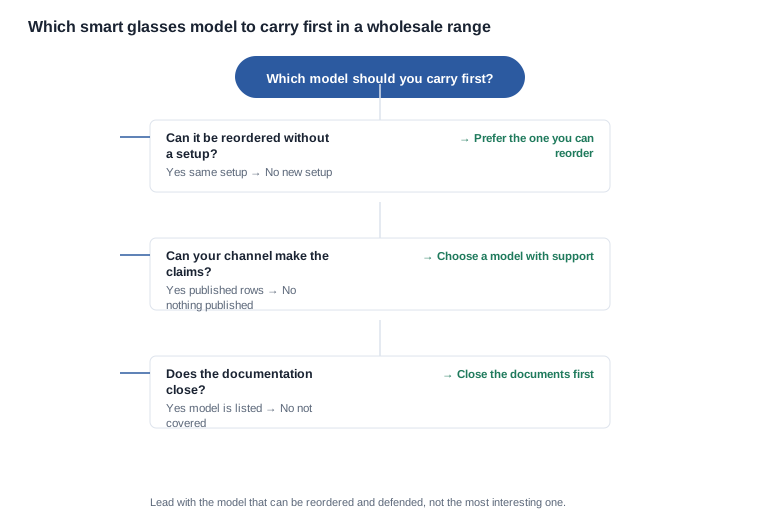
Criterion three: the documentation closes in the first market. Ask for the document set for the candidate model and compare what the model list on each one says with the model you have chosen. A model that closes cleanly in one market usually closes cleanly in others, and one that does not will cost you rework on every order in every market.
Criterion four: it can be reordered without a new setup. A model that already sits on a setup we have run before will reorder on a cycle governed by component availability. A model needing a new setup, which in practice means a colour that is not published as an option or a configuration outside the current range, carries a reorder cycle that somebody has to schedule. Which one you lead with is a decision about the promise you are going to make to your own resellers.
The due diligence on the shortlist itself is one exercise rather than many. Ask every supplier the same questions in the same order, in writing, and compare the specificity of the answers. A supplier that can tell you which published rows are fixed for the quoted configuration and which they will re-derive is giving you a quotation you can plan around. One that treats every row as re-derived is building a product rather than quoting one, and the schedule and the price will say so.
The questions to ask a smart glasses supplier when you start
Five questions get a wholesale conversation moving in the right direction, and the way they are answered matters more than the answers themselves.
- Which models and configurations are available, and what are the published rows for each? Not the marketing summary. The rows. If the answer is a brochure, you have a sales conversation rather than a supply conversation.
- Which documentation exists for the exact models, and what do the model lists say? Our catalogue publishes no per-model certification row, so this has to come from the supplier in writing.
- What are the minimum order quantities and the lead times for the configurations we would carry? These are confirmed per enquiry rather than published, and the answer should distinguish the base model from the configuration from the shipping state.
- What is the returns and claim procedure, and who is the first line? Including the freight and the evidence required.
- What can we publish in our own listings, and what can we not? A supplier that answers this question precisely, down to which rows are absent for which models, is saving you from a listing problem six months later.
There is a way to run that first conversation that materially improves the answer you get, and it is the same discipline that runs through this article. Send the questions in advance, in writing, and ask for the answers to name the model and the market. A supplier who replies with a general description of the range has told you they will customise, which is true and useless. A supplier who replies with "for this model in this market, these rows are published and these are not" has told you something you can build a range on.
The other habit worth building on day one is to write down the answer at the time you receive it, with the date and the name of the person who gave it. In a category where the published data is uneven and the documentation position varies by model and market, the single most valuable artefact you will own twelve months later is a dated record of what was said. Prices change, configurations change and documents get corrected, but a dated answer tells you whether the thing has moved or whether your memory has.
The last of the five questions deserves more weight than the other four, because it is the one that protects you after everything else has been agreed. A supplier who is precise about which rows they cannot support is telling you that they would rather you sold something defensible than something you will have to take down.
The wholesale overview page sets out the programme as a whole, how wholesale works covers the mechanics, designing the wholesale operation covers the cost structures in more depth, and stock availability deals with the three layers of availability.
A wholesale programme runs on two things: control of the per-order fixed costs and a real grasp of the mix you are selling. Both are operational questions, and both are questions a supplier can help with. We will tell you which parts of the operation sit with us and which sit with you, and we will itemise a quotation so the per-configuration lines are visible. The commercial terms we will put in writing, once you name a configuration and a volume, are the unit price for it, the minimum order quantity that applies, the production lead time and what documentation scope is included. Nothing on this page substitutes for those four, because each of them is a function of the others.
If you tell us the market, the customer and the number of models you are considering, we will narrow the range and tell you what is published about each.
Related reading
- Wholesale overview
- How wholesale works
- Designing the wholesale operation
- Wholesale stock availability
Tell us the market, the customer and the number of models and we will narrow the range.


