

A stated minimum and an effective minimum are different objects, and the gap between them is where wholesale programmes quietly lose money. The stated minimum is the number a supplier chooses to publish, because it is the easiest number to publish. The effective minimum is the largest constraint that actually applies to your order, and some of those constraints are inputs the buyer never sees — a component lot, a print run, a battery cell batch, a certification batch. A stated minimum is therefore a lower bound on the effective one and never an upper bound. A buyer who treats the published figure as the whole structure will discover the remainder, usually when a purchase order is already waiting on a production slot that will not open.
There is no published minimum order quantity in this catalogue, and this article does not pretend otherwise. What can be done is to describe the layers a minimum is built from, show which of those layers the catalogue itself constrains, and identify the questions that turn a single number into a structure a procurement team can plan around. CYNRIN does not publish a minimum order quantity for this range, and we will not publish one here; what we will do is map the structure against the published rows so that a buyer can see exactly which parts of the floor are settled by the catalogue and which parts have to come from a supplier.
The catalogue's shape is what makes this worth doing properly. Listed smallest first, three children's models, three sport models, eight audio models and eleven camera models make up the named part of the range, and three entries sit outside it with no formal SKU at all. Every one of those families constrains a minimum differently, and the constraint is not always the same kind of constraint twice.
One further point belongs at the front, because it changes how the rest should be read. A floor is not a barrier to be negotiated away. In a healthy wholesale relationship it is the mechanism that makes a supplier's production predictable, and the buyer's interest is in understanding it rather than in removing it. A floor a supplier can explain and quote is usually lower and more stable than a floor that exists only as a commercial condition, because an explainable floor can be planned around while an unexplainable one can only be discovered.
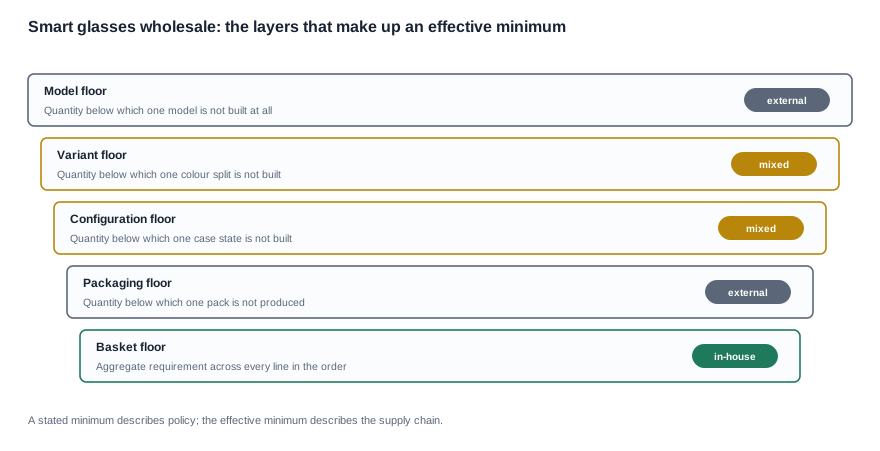
Smart glasses wholesale: five layers inside every minimum
The first layer is the model floor: the quantity below which the supplier will not build one model at all. This is the layer most suppliers mean when they publish a minimum, and it is the layer that changes least between orders.
The second layer is the variant floor: the quantity below which one colour split inside one model will not be built. This layer appears only where a model actually has variants, and in this catalogue the published colour information is limited to two models, one with three colour options and one with four. For every other model the colour split is a matter for negotiation rather than a matter of record, and a buyer cannot assume that a colour split inherits the model floor.
The third layer is the configuration floor: the quantity below which a particular case configuration or charging arrangement will not be built. This layer is where the camera range becomes complicated, because it contains six different case states inside eleven models — a published 1400 mAh case, a published pair of 900 and 1400 mAh cases, a published foldable 1200 mAh case, a case published as existing but with no capacity given, three models with no case row at all, and one model has no charging-case row.
The fourth layer is the packaging floor: the quantity below which one packaging configuration will not be produced. Packaging interacts with printing, and printing interacts with the outer pack, so this layer frequently behaves like a print run minimum rather than like a product minimum.
The fifth layer is the basket floor: the aggregate requirement across every line in the order, which may or may not be the sum of the line floors. A supplier with a per-model floor, a per-colour floor and a basket floor produces a real constraint set, and the effective requirement is whatever combination actually binds.
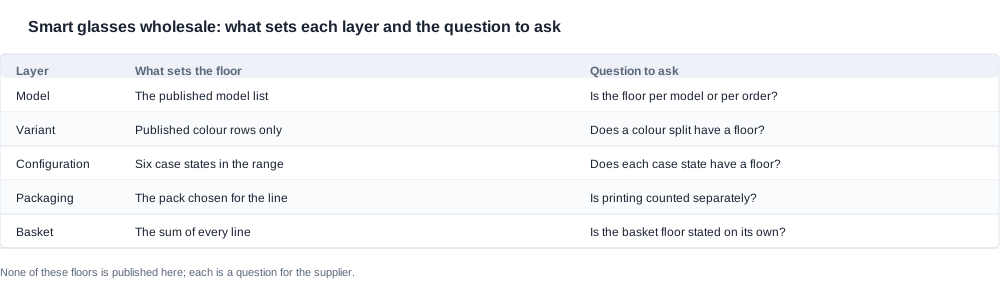
A buyer who knows only the model floor knows roughly a fifth of the structure. That is usually enough to start a conversation, and it is rarely enough to plan a first order.

Smart glasses wholesale: why the stated minimum and the effective minimum differ
The difference between the stated and the effective minimum comes from inputs the buyer never sees, and in this category there are at least four kinds.
The first is the component lot. A model whose case, cable or component is bought in supplier lots may have to be ordered in multiples of that lot, whatever the seller's own policy says. The buyer sees a model floor and inherits a lot size underneath it.
The second is the print run. Artwork, outer cartons and inserts are often produced in runs whose minimum is set by the printer rather than by the seller. A buyer who treats the packaging floor as a product floor will discover the run minimum when the artwork is ready.
The third is the cell or battery batch. Cells are usually bought in batches with their own minimum, and a model whose published cell configuration is specific — a paired 55 mAh configuration, a 290 mAh cell, a 40 mAh cell in the children's models — inherits the batch behaviour of that cell.
The fourth is the certification batch. Where a model needs a document or a test that is produced in batches, the effective requirement can be set by the batch rather than by the order. This is the layer that most affects a buyer planning a first shipment into a regulated market, and it is the layer least likely to be disclosed in a quotation, because it is a property of the supplier's process rather than of the product.

The general rule follows from those four. The stated minimum describes the supplier's commercial policy; the effective minimum describes the supplier's supply chain. A buyer planning against the first and discovering the second has not been misled by anybody — the figure was simply about something else. The remedy is to ask which inputs the floor depends on, and to get the answer in writing before the purchase order rather than after it.
There is a second reason the two diverge, and this one is behavioural rather than structural. A supplier who expects a small first order will quote a floor that is easy to accept, because a floor that discourages the order does no work. The floor the buyer should plan against is the one that would apply if the buyer were ordering again in a year at steady volume, and getting to it requires a direct question.
Smart glasses wholesale: the catalogue facts that set each layer
The catalogue constrains several layers directly, and a buyer can read those constraints rather than guess at them.
On the variant layer, the published colour coverage is the constraint. Two models publish colours; the rest do not. The consequence for a minimum is specific: for the two models with published colours, ask whether each colour carries its own floor, and for every other model, ask how a colour split is treated before splitting one.
On the configuration layer, the case map is the constraint. Five camera models publish a case capacity, two further camera models publish a case but give no capacity for it, three camera models publish no case row at all and one has no charging-case row. A basket that mixes those states carries a configuration floor for each distinct state, not one floor for the model family.
On the certification layer, the catalogue's position is unusually clear and unusually awkward. The catalogue text names no CE, FCC or RoHS wording, and there is no per-model certification row in it. The separate product detail record treats the camera, audio and sport categories the same way, publishing no certificate number at model level, and says nothing at all about the children's category. Those two sources do not agree, and the reconciliation is not the buyer's job: a buyer needs the certificate number for a specific model and variant, in writing, before the model can be listed in a market that requires it. For the two models that publish an IP54 marking, the catalogue publishes the marking itself but no third-party test report reference, and the internal product record notes the same absence, so an IP claim cannot be carried into a market-facing description without documentary support.
On the customisation layer, the product detail record carries a different count of customisation dimensions for each category: seven for the camera category, five for the audio category, five for the sport category and two for the children's category. That count is not a published minimum and it is not a promise about what can be changed, but it does indicate how much of a specification a single order can plausibly cover, and therefore how many separate specification layers a minimum has to hold together.

Smart glasses wholesale: the four questions that turn a number into a structure
A minimum becomes usable when four questions have been answered in writing. Each of them has a specific answer, and each of them is answerable before an order is placed.
The first question asks what the floor is attached to. Is it per model, per colour split, per case configuration, per packaging configuration, or for the basket as a whole? A supplier answering "the minimum is per model" to a basket of ten lines has answered a question about one layer and left four unanswered. The follow-up that exposes the rest is simple: ask what happens if one line of the order drops below the quantity the buyer planned for it.
The second question asks when the floor applies. Does it apply to the first order only, or to every order including the reorder? Some floors are launch conditions and others are standing conditions, and the difference decides whether the buyer is buying a floor once or carrying it forever. This question is also the one that exposes the batch constraints, because a batch-driven floor is by definition a standing condition.
The third question asks what the floor depends on. Which component lots, print runs, cell batches or test batches sit underneath it, and are those inputs per order or per batch? The honest answer is often a description of the supplier's process rather than a number, and it is still useful, because it tells the buyer which parts of the floor will move if the buyer's own order pattern changes.
The fourth question asks what is waivable, and on what condition. Minimums are usually conditional — waived for a repeat order, waived for a pre-payment, waived when the buyer takes a wider basket, waived for a configuration the supplier already runs. A buyer who knows the conditions before the order can design the order to satisfy one of them, and a buyer who asks afterwards has no leverage at all.
A fifth question is worth adding for a wholesale programme that intends to reorder. Does the floor apply to the mixed basket or to each line inside it? This is the question that separates a programme that can reorder from one that restarts, and it is asked far more often than it is answered.
The five questions, condensed into the form they can be sent to a supplier in, are these:
- What is the minimum attached to: model, colour split, case state, pack, or the basket?
- Does it apply to the first order only, or to every order including reorders?
- Which component, print or certificate batches does it depend on, and are they per order or per batch?
- What would waive it, and on what condition would the waiver apply?
- Does it apply to the mixed basket or to each line inside the basket?
A supplier that answers all five in writing has given you a structure. A supplier that answers only the first has given you a number, and a number cannot be checked, cannot be planned around and cannot be renegotiated when the shape of the order changes.

Smart glasses wholesale: where the minimum actually binds
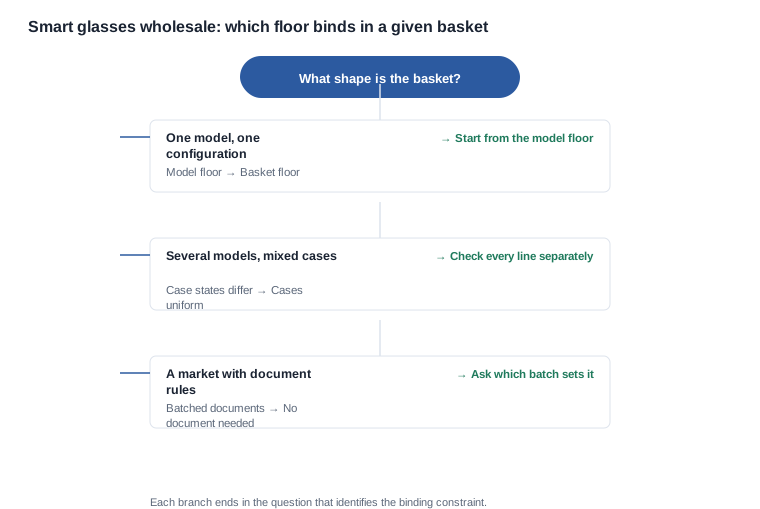
In practice the binding layer depends on the shape of the basket, and there are three situations a buyer should recognise.
The narrow basket binds on the model floor. One model, one configuration, one colour. Everything else about the order is irrelevant to the floor, and the only question that matters is whether the buyer's volume for that model reaches the stated figure. This is the simplest case and the one where a published minimum is genuinely informative.
There is a simple test a buyer can run before committing to a basket, and it costs nothing. Take the planned order and reduce one line at a time to see whether the supplier's answer about the floor changes. If reducing a line by a small proportion alters the floor applied to another line, the floors are coupled and the basket behaves as one constrained object rather than a set of independent lines. If reducing a line changes nothing else, the lines are independent and the basket can be managed line by line. Most mixed baskets turn out to be coupled somewhere, and the coupling usually sits in the configuration layer rather than in the model layer, which is another reason to ask about case states before the order is placed.
The wide basket binds on the configuration floor. Several models, several case states, several colour splits. Here the aggregate can look comfortable while one line inside it falls below its own floor, and that line is what the supplier will hold. Buyers who have been surprised by a floor usually have been surprised by a line, not by the total.
The regulated basket binds on the certification floor. A model destined for a market that requires documentation, where the document is produced in batches, can carry an effective minimum that has nothing to do with units and everything to do with the batch. This is the layer where a buyer should ask the sharpest question, because it is the layer most likely to be invisible in a quotation and most expensive to discover after the goods have been built.
There is a fourth situation where no minimum applies at all. Three catalogue entries have no formal SKU — the AR model, the photochromic model and the bone-conduction model. They cannot be ordered by name, so they cannot be counted in a floor, and including them in a minimum discussion produces a number that describes nothing. A basket containing one of those entries has an open line rather than a large line.
Smart glasses wholesale: what is published and what stays unquoted
The published side of this article is the structure, and it is a real structure rather than a placeholder. The catalogue publishes 28 models in four families, publishes a case map covering six states inside the camera range, publishes charging methods for all but four camera models, publishes colours for two models, publishes a charge time for every model and a runtime for every model, and publishes exactly one weight figure in the whole range. It publishes no per-model certification row, and the export certification page it carries shows company-level certificate images rather than anything model-specific.
The unpublished side is equally clear. There is no published unit rate, no published minimum order quantity, no published lead time, no published warranty period, no published production capacity, no published certificate number and no published test report reference in this catalogue. We do not fill those gaps with estimates in an article aimed at procurement teams, because an estimate in a buying document is a commitment nobody authorised.
None of this is an argument for a smaller order. A structured floor is not a restriction on ambition; it is a statement of which parts of an ambitious order are genuinely fixed, and a programme that knows that can put its negotiating effort where it changes something. The unstructured alternative costs the supplier as well as the buyer: the supplier guesses at what the buyer needs, the buyer guesses at what the supplier requires, and both discover the gap when the goods are already on a ship.
The questions in this article are the deliverable. Send a model list, a target market, a packaging configuration and a reorder horizon, and we will answer against the same published rows, identify which of the five layers each constraint belongs to, and say plainly which parts we can confirm and which parts require the supplier's own process to be described. Where a figure is needed and the catalogue does not carry it, the answer will name the question to put to the supplier rather than an invented figure.
Three related pieces of reading sit beside this one: whether a minimum is set per model or per order addresses the first of the four questions directly, how a case approach changes the shape of an order changes the configuration layer, and how a mixed basket is decomposed into lines handles the case where several floors apply at once. The wholesale programme entry point is where a buyer opens with a model list rather than with a number.
A minimum is not a number, it is a set of constraints attached to different things. Ask which thing each constraint is attached to, when it applies, what it depends on and what would waive it, and the floor stops being an obstacle discovered late and becomes a parameter the programme is planned around.


