

Smart glasses wholesale payment terms are not a financing detail, and they are not a discount mechanism either. They are the mechanism that decides which risk sits with which party in a programme that has not yet proved itself. A deposit that falls due before the specification is written pays for work that may have to be redone. A balance that falls due before inspection passes pays for goods nobody has checked. The question worth asking is not which payment structure a supplier is comfortable with, but which risks the buyer is prepared to carry and which it is prepared to transfer — and a payment schedule is only as good as the triggers written into it.
This catalogue publishes no payment terms, no deposit percentage, no balance timing and no credit arrangement, and none is invented here. What follows is the practical working of payment terms in this category: what each milestone actually buys, what has to be frozen before it can be paid for, what the inspection gate has to produce, the structures a supplier may offer and the risk each one moves, and the wording that turns a schedule into an agreement.
The reason this matters more here than in a simple hardware trade is that a wholesale order in this category has a long middle. It begins with a model list, passes through a configuration freeze, an artwork approval, a production window, an inspection, a documentation pack and a consignment, and ends with a channel that will find out what it can actually sell several months later. The catalogue's published detail is what makes the middle worth planning: 28 models, distributed as eleven camera models, eight audio models, then three sport models and three children's models, with six different case states inside the camera range, charging methods published for all but four camera models, colour splits published on two models, and no per-model certification row anywhere in the range.

Smart glasses wholesale payment terms: what the money is actually buying
Every payment in a schedule buys one specific thing, and a schedule in which two payments buy the same thing is a schedule with one payment too many and a gap somewhere else. The test is simple to apply to any structure a supplier puts forward: for each milestone, name what the supplier has delivered at that point, and name what the buyer has verified.
The first milestone usually buys a production slot. It is the smallest payment in the schedule and the one that most often arrives before anything has been defined, which means the buyer is paying for capacity against an instruction that may still change. The second milestone usually buys finished goods — the largest payment, and the one most often tied to a date rather than to a result. The third milestone, where the schedule has one, buys the remaining risk: the difference between a shipped consignment and an accepted one.
What a buyer is really negotiating is the point at which the risk of the specification being wrong passes from the buyer to the supplier. Today that point is usually at the end, because the buyer wants the goods before paying, and the supplier wants the money before shipping, and the difference between those two positions is carried by whoever can least afford it. The whole purpose of a payment schedule is to place that point deliberately, and the questions to ask are always the same three: what event triggers this payment, what evidence confirms the event has happened, and who carries the risk between the trigger and the evidence.
A milestone list is also where a buyer can see whether a supplier is pricing risk or pricing convenience. A schedule whose triggers are all administrative — the purchase order acknowledged, the deposit received, the goods ready — moves money without moving risk, because none of those events says anything about whether the goods are correct. A schedule that includes a result, such as an inspection passed or a document set accepted, is a schedule in which the money follows the work. The questions to ask of any structure offered are therefore not about the percentages but about the events, and a buyer who is shown only percentages should ask for the events before agreeing to anything.
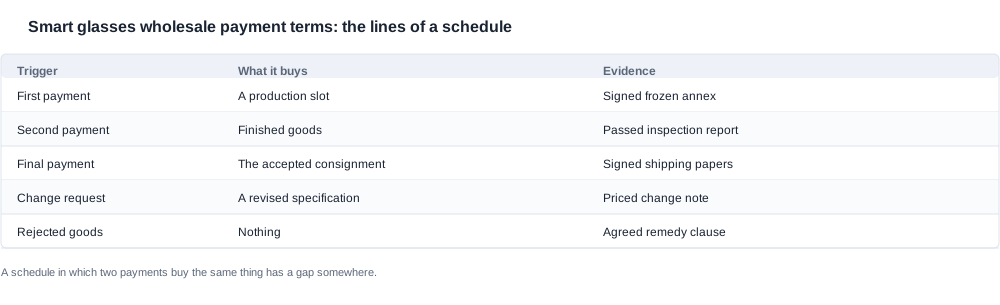

Smart glasses wholesale payment terms: the first trigger and the specification behind it
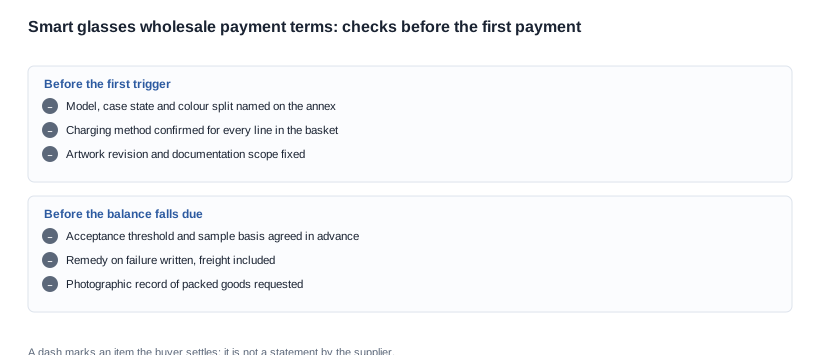
The first trigger should sit behind a frozen specification, and "frozen" has a specific meaning here that goes beyond agreeing a product. The specification is frozen when the model, the configuration, the colour split, the packaging artwork, the documentation scope and the acceptance criteria are all written down under a revision number that both sides reference.
The catalogue shows why this matters, because the configuration inside a model name is not uniform. Seven camera models carry a charging case and they do not carry the same one: three publish a 1400 mAh case, one publishes two capacities of 900 and 1400 mAh, another publishes a foldable 1200 mAh case and two publish a case with no capacity given for it. Three camera models carry no case row in the catalogue at all, and one is published with no case at all. The charging arrangement divides the range once more, with four camera models publishing no charging-method row at all. Two models in the whole catalogue publish a colour split, and three entries have no formal SKU and therefore cannot appear in a specification at all.
A payment made against a specification that names only the model is therefore a payment made against an undefined product. This is the practical meaning of the phrase "configuration freeze" that appears in wholesale agreements: every field the buyer intends to rely on has to be named before the first money moves, and the fields that the catalogue does not publish have to be confirmed by the supplier in writing at the same time.
Two consequences follow. The first is that a change request arriving after the first trigger is a change to a paid-for specification, and it should be treated as a new event with its own price and its own lead-time effect rather than as a courtesy adjustment. The second is that the specification annex and the payment schedule are the same document viewed from two directions: the annex says what is being bought, and the schedule says when each part of it is paid for.
Smart glasses wholesale payment terms: the balance and the inspection gate
The second and largest payment should attach to an inspection result rather than to a date, and the difference is not a formality. A date-based balance pays for whatever is in the carton on the day. A result-based balance pays for goods that met a threshold the buyer set in advance.
For the result to exist, the inspection specification has to be complete before production rather than after it. In practice that means four things: the defect classes that trigger a failure, separated into cosmetic and functional categories because they have completely different commercial consequences; the sample basis and the acceptance number; the evidence, which means a photographic record of the packed goods and of a sample of the units; and the remedy, which is where most schedules stop short.
The remedy is the part that determines whether an inspection result is worth anything. If a consignment fails, does it get reworked, replaced, credited or rejected, and who carries the freight in each case? For a rejected consignment of battery products the return freight is a material cost and it is frequently unallocated, which means it falls on whoever asserts the claim, which in practice is the buyer. The allocation of that cost should be written down before it is needed, not argued afterwards.
A partial result needs its own rule, because an inspection rarely produces a clean pass or a clean fail. A consignment in which every unit passes the functional threshold but some units fail the cosmetic threshold is the normal case rather than the exception, and what the buyer does with those units is a commercial decision the schedule should already contain: does the buyer accept them at a discount, does the supplier rework them at its own cost, or does the buyer take them into its own channel at a discount and absorb the presentation cost. Each of those three answers has a different consequence for the balance, and choosing between them after the goods have arrived is a negotiation the buyer has already lost.
There is a second point about the inspection gate that belongs in the payment structure rather than in the quality plan. If the balance falls due on the day of shipment and the inspection happens after the goods have arrived, the inspection has no financial force behind it, whatever the contract says. The schedule and the inspection therefore have to be designed together, and the question to put to a supplier is whether the acceptance threshold is a condition of the final payment or simply a claim window that opens after the money has gone.

Smart glasses wholesale payment terms: three structures a supplier may offer
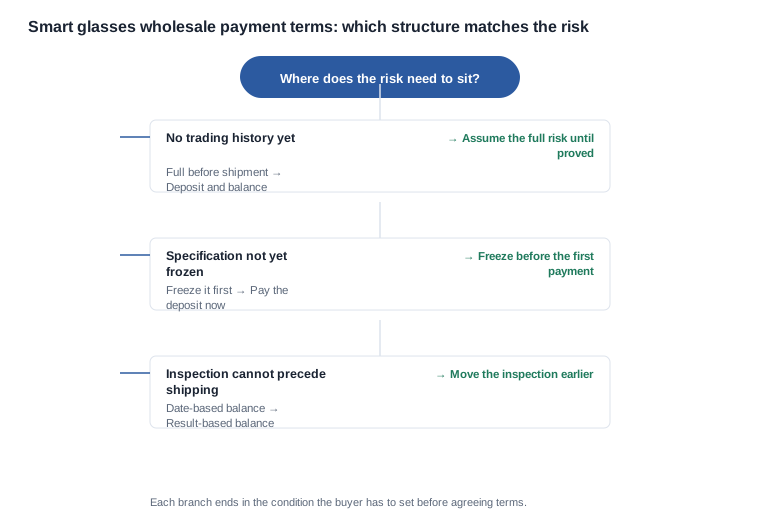
Three structures cover most of what a supplier in this category will put on the table, and each one places the risk differently. The useful comparison is not which structure is preferable in the abstract but which risk each one leaves with the party that can carry it.
The first structure is payment in full before shipment. It is the simplest to administer and the one that puts the whole of the specification risk, the inspection risk and the freight risk on the buyer. It is sometimes the only structure available to a first-time buyer with no trading history, and sometimes it is available because the supplier has quoted a rate that already reflects it. The question to ask is what the rate would be under a different structure, because the structure is usually priced into the number rather than offered alongside it.
The second structure is a deposit with the balance due before shipment. It is the most common arrangement, and it is the one that requires the most care, because the deposit is paid against an open specification unless the annex is frozen first and the balance is tied to an inspection. Without both of those, the structure looks like risk sharing and behaves like payment in full with extra steps.
The third structure is a deposit with the balance due after the goods are delivered and accepted. It is the one that puts the least risk on the buyer, and it is correspondingly the one that a new buyer is least likely to be offered without a trading history, a reference or a credit arrangement. Where it is offered, the acceptance criteria become the commercial centre of the relationship, because the balance is the only lever the buyer holds.
A fourth instrument sometimes appears for larger or newer programmes, in the form of a documentary credit or an escrow arrangement. It is worth naming because it changes what the supplier needs from the buyer and what the buyer needs from the bank, and because the documents it requires have to match the specification annex and the inspection record exactly. The operational cost of that matching is the reason a credit instrument is not automatically the lower-risk option for a small programme.
One further variable sits across every structure, and it is the one most often left implicit: the currency the rate is denominated in, and what happens to it between the quotation and the order. A schedule that references a rate without fixing the currency leaves the buyer exposed to a movement it cannot pass on if the channel sells in another currency. The practical requirement is small — the currency named in the schedule, the date at which the rate is fixed, and what happens if the order date moves outside the quotation's validity — but it has to be written down, because the alternative is a rate that changes silently between the agreement and the purchase order.

Smart glasses wholesale payment terms: what to write into the agreement
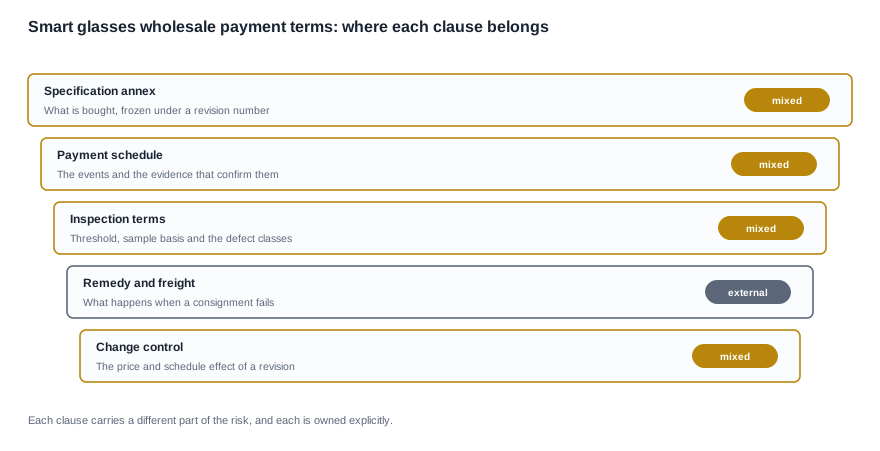
The payment schedule is the easiest part of a wholesale agreement to write and the part that most often says too little. Seven items belong in it, and each of them exists because of something that has gone wrong in this category before.
- The specification annex reference and revision number that the payment schedule is attached to, so that the money and the product cannot drift apart.
- Each payment trigger stated as an event, with the evidence that confirms it: signed specification, passed inspection report, signed shipping documents.
- The acceptance threshold, the sample basis and the defect classes, attached as part of the payment conditions rather than as a quality annex somewhere else.
- The remedy on a failed consignment and the freight allocation for a rejected one, stated separately so that neither is inferred from the other.
- The change-control rule, naming what a change after a trigger costs, who approves it, and how the payment schedule reacts to it.
- The point at which title and risk pass, and the relationship between that point and the payment trigger, since a structure that transfers risk at shipment and pays after delivery transfers risk without securing the money.
- The currency, the validity period of the quotation the schedule refers to, and what happens to the schedule if that validity lapses before the order is placed.
Two further provisions are worth adding to a programme that intends to reorder. The first records that the specification annex for the repeat order is the annex from the original order unless a revision is issued, which keeps the reorder an administrative event. The second records the condition under which the payment schedule itself is revisited, so that a change in the commercial basis happens by agreement rather than by default.
Smart glasses wholesale payment terms: the questions that settle the structure
The questions below settle a payment structure faster than any amount of general discussion, because each one is answered with a specific fact rather than a position.
There is a further question that belongs in a due-diligence conversation rather than in the agreement, and it is the one most often skipped: what happens to the schedule if the programme stops. A wholesale buyer who has built a channel and then changes supplier has a settlement conversation with the old supplier, and the size of that conversation depends entirely on whether the schedule defined it. Cancelling after the first trigger, cancelling after production, and cancelling after despatch are three different situations with three different outcomes, and only one of them is obviously expensive.
- What event triggers the first payment, and is the specification frozen before that event or after it?
- Which evidence confirms each trigger, and who produces it?
- Is the acceptance threshold a condition of the final payment or a claim that opens after it?
- Which defect classes trigger a failure, and how are cosmetic and functional defects separated?
- What is the remedy on failure, and who carries the freight for a rejected consignment?
- What does the rate look like under a different payment structure, since the structure is usually priced into the number?
- Does the schedule change if the specification changes after the first trigger, and how is that change priced?
- What is the quotation validity the schedule refers to, and does the schedule survive it?
The checklist is short on purpose. A buyer who cannot answer the first question has not yet bought anything, and a buyer who cannot answer the third has an inspection without a consequence.
What CYNRIN publishes for wholesale payment questions
The published side of this article is the fact set a payment schedule has to be built around: six case states inside the camera range, a charging method published for all but four camera models, colours on two models, a charge time and a rated runtime for every model, and the absence of any per-model certification row in the catalogue. We do not publish a deposit percentage, a balance timing or a credit arrangement for this range, because those are commercial terms rather than catalogue facts and they are not published values.
What we will do is answer a payment question against the same published rows and against a specific programme: which configuration the schedule has to reference, which fields have to be frozen before the first trigger, what a spec-versus-result inspection would need to cover for the models in the basket, and where the catalogue stops and the supplier's own commercial terms begin.
The structure of a schedule is therefore the order in which risk is transferred. The first payment transfers the risk of the specification, the second transfers the risk of quality, and the final payment transfers the risk of delivery — and a programme that has agreed where each of those transfers happens has already answered the question that matters.
Two supporting readings sit alongside this one: the pricing tiers article covers the structure of a tier table, which is what a rate attached to a payment trigger is usually read from, and container load pricing covers the freight questions that sit underneath a consignment. The procurement pricing and procurement logistics pages cover the commercial frame on either side, and the wholesale programme entry point is where that conversation opens.
Smart glasses wholesale payment terms are a risk-allocation schedule with events in it. Write the events, attach the evidence, put the acceptance threshold in front of the balance, and the structure stops being a formality and starts being the thing that makes the rest of the agreement enforceable.


