

Yes in principle, because the cost structure genuinely changes when volume changes. The useful part of that answer is not the per-unit figure — it is which cost elements move and which stay exactly where they were, because two of the largest costs in this category do not scale down at all, and the buyers who get caught are the ones who modelled a container as a simple multiplication.
We do not publish unit prices, a container quantity, a minimum order quantity, carton counts, pallet counts, lead times or shipping costs. Those are terms, and a published term that does not hold for your configuration is a trap rather than a help. What we can describe in full is the structure of how volume pricing behaves, which is the same for every supplier in this category and which is the thing you can actually plan against.
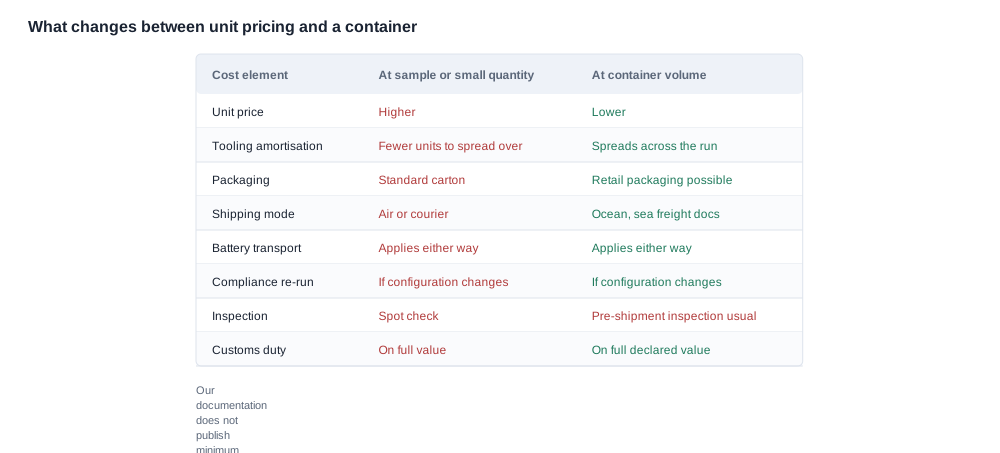
Do you have a container price, or do you have a unit price?
A container is a shipping method, not a price category, and this is the first thing to get straight before comparing quotations.
What a supplier can quote is a unit price, a quantity, a configuration, an incoterm, a destination and a date. What a container gives you is a cheaper freight rate per unit, because the freight cost is spread across a large quantity and because the handling cost of moving a full load is lower than handling many small consignments. The goods themselves do not become cheaper because they happen to fit in a box. The unit price falls for the reasons in the next section, and the freight rate falls for reasons that have nothing to do with the supplier's costing model.
That distinction matters at the point where buyers compare two quotations and discover that the "container price" and the "small order price" differ by less than the freight saving they were expecting. It also matters when a buyer builds a business case: a container is a decision about logistics, and the price decision is a decision about volume, and the two decisions can be made independently. A buyer with firm demand at a volume that fills a container has two good decisions available. A buyer with the same volume but a launch date in six weeks has only one.
The second thing worth saying is that "container load" is not a precise term, and different suppliers use it to mean different things. It can mean a full twenty-foot or forty-foot equivalent unit of the buyer's product, filled by the buyer's order. It can mean the supplier's own consolidation of several customers' orders into one shipment, in which case the buyer is on someone else's schedule and someone else's booking. It can mean a price band in the seller's internal system that happens to be associated with a full load. Any of the three is legitimate; none of them means the same thing, and a quotation that uses the phrase without defining it is a quotation you have to interrogate.
The practical request is therefore the same one we would make on any volume quotation: give us the unit price, the quantity, the configuration, the incoterm, the destination, the date, and — the part that is specific to a full load — the packing plan, so that we can see how the goods are actually going to be loaded.
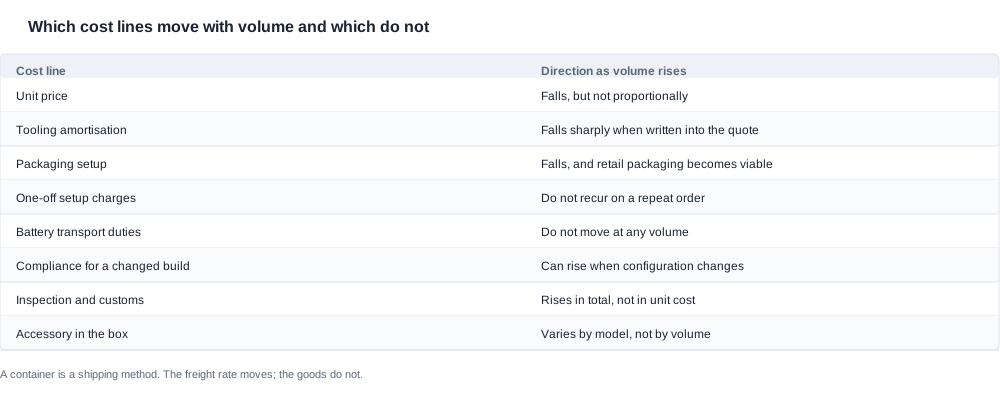
The right-hand column of that table is the one to spend time on, and it is the one most quotations never mention at all.

Do you know which cost lines fall as volume rises?
There are four that genuinely improve as the quantity goes up, and they improve for different reasons, which matters because they respond to different buyer actions.
Unit price. This falls, but not proportionally, because the factory absorbs its fixed costs across more units. A buyer who expects the per-unit price to halve at container volume is usually disappointed: the variable content of a product's cost — the electronics, the optics, the battery, the assembly labour — is a large majority of the total, and it does not move at all.
Tooling amortisation. This is the clearest example of a line that improves sharply. A mould cut for one run and spread across hundreds of units behaves very differently from one spread across a handful. This is the strongest argument for committing to volume early, and it is also the argument to get the amortisation basis written into the quotation rather than assumed. A mould cost spread over a projected first-year volume, when the real volume turns out to be a third of that, is a per-unit cost that was never real.
Packaging. Retail-grade packaging is often only viable above a certain quantity, because the setup — artwork, plates, print runs, the minimum order from a packaging supplier — is itself a volume business. This is one of the few places where a larger order changes what the customer experiences rather than what you pay, and it is a real commercial gain rather than a discount.
The one-off setup charges. The first-article approval, the firmware and app build, the documentation work, the sample round. These do not recur, which is the strongest financial argument for a repeat order and the reason a second order of the same build is cheaper per unit than the first.
Now the four that do not move, or do not move in the direction the buyer hopes.
Battery transport obligations. Every model in this range is battery-powered. The documentation, labelling, packaging and declaration requirements that follow from that apply identically to one unit and to ten thousand of them. A buyer who models a container as a per-unit price multiplied by a quantity has missed a fixed cost that will never amortise, and the same is true of the packaging that carries the battery information.
Compliance work, if the configuration changes. This is the one that catches people, and it connects to the point above. A volume order that adds a colour, a region, a firmware variant or a new label can re-open certification and documentation work that was closed for the earlier configuration. The scale of the order does not reduce that work; it only makes the change more expensive to get wrong, because a wrong batch is a wrong batch of a thousand rather than of fifty.
Inspection and customs valuation. Pre-shipment inspection is normal practice at this volume whether you ask for it or not, and duty is assessed on the full declared value. A container that improves your margin on paper can deliver a worse landed margin than a smaller shipment, and we will come back to this because it is the most counter-intuitive point in the whole subject.
The accessory in the box. This one is specific to this product category and it is easy to miss. The published data shows that charging method varies across the range — magnetic on seventeen models, Type-C on seven, and not published for the MT6 and the CY05, and the L1 Pro and the CY03 — and that the charging case is a different physical object depending on the model. Case capacity is published for five models, with two more having a case whose capacity is not published, and three having no case row at all. In other words, the packing list for a mixed-model container is not a constant, and the physical configuration of what you are shipping changes the carton it goes into. Ask for the packing list by model, not an average.
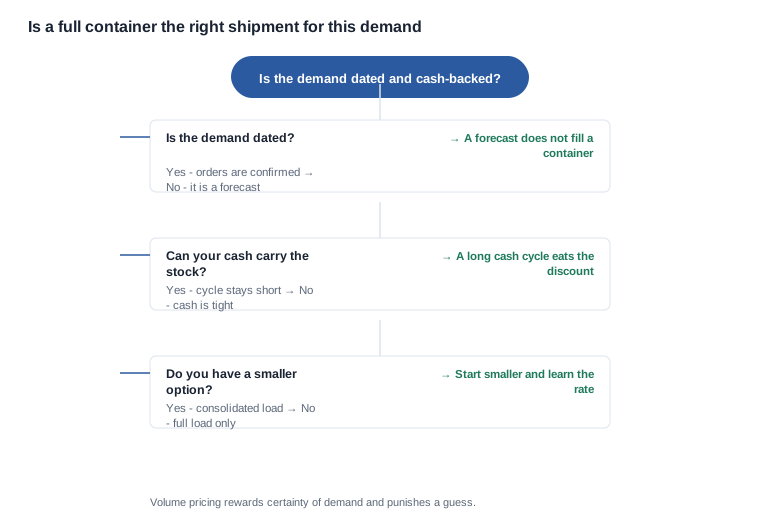

Do you have dated demand, or do you have a container you want filled?
Container pricing is worth asking about when the demand behind it is real and dated. It is a poor fit when you are filling a container to get a unit price rather than because you have the volume.
The reason is entirely about what happens when the container lands and your sell-through is slower than the shipment. Every unit in that container is inventory carrying cost, storage cost and working capital tied up, and the discount you negotiated is offset by the time it takes to move it. Volume pricing rewards certainty of demand and punishes a guess, and the punishment is larger than most buyers expect, because a discount of a few percentage points is usually smaller than the annual carrying cost of the stock the discount bought you.
There is a middle option that buyers frequently miss, and it is usually the right answer for a first container. Three shapes of it:
- Ship against confirmed channel orders. If your downstream has committed to volume you can see — a retailer that has placed orders, a marketplace seller with a confirmed replenishment schedule, a distributor with signed allocations — then the container is backed by demand and the working capital risk is much smaller.
- Start at a consolidated load. A less-than-container load consolidates your goods with others and reduces the per-unit freight without the commitment of a full unit. The trade-off is that the schedule is not entirely yours, and there is a risk of the shipment sitting while it waits for a consolidation window.
- Reserve the container rate for the second or third order. Take the first shipment at a volume you know you can move, establish the sell-through rate, and take the full container once the data is in. This costs you some of the volume discount on order one and buys you a much better-informed order two.
The decision in the chart above is essentially asking you to be honest about two things: whether your demand is dated, and whether your cash position can carry the stock. Both have to be true for a full container to be the right structure, and in practice a buyer who is confident on the first and optimistic on the second is making a wish.
If you are deciding between the three options above, the criteria that actually separate them are worth stating in the order you should apply them. The first criterion is the certainty of the demand behind the units, because a firm order justifies a commitment that a forecast does not. The second is the cash cycle you can carry without a facility, because a discount funded by a facility is a discount with a financing cost attached. The third is the schedule sensitivity, because a launch with a fixed date and a full container is a schedule with a long tail in front of it. The fourth is the learning value: which one gives you a reliable sell-through rate fastest? A consolidated first shipment that you can actually move often beats a full container that arrives before you know what your customers want.
Notice that these criteria do not point at the largest discount. They point at the lowest total cost of the decision, which is a different number and is usually much easier to defend in an internal review than a headline unit price.
There is a fourth option that is worth naming because it is unusual and it works for some buyers: negotiating the volume with the supplier instead of with the customer. A supplier who has agreed to hold a price at a volume you have committed to, with a call-off schedule across three or four releases, gives you most of the container economics without a single large shipment. The trade-off is that you have committed to the volume before you have proven the demand, and the supplier will want that commitment in writing. Which one is right depends entirely on which side of the table has the less certain forecast, and in most cases that is you.
There is also a timing dimension that deserves more attention than it usually gets. A full container has to be planned backwards from a shipping date, and the steps in front of it — specification lock, artwork, documentation, packaging production, the golden sample — each have their own lead time. A buyer who decides in month nine that they want a container for the following spring will discover that the packaging alone has to be ordered well before that. The volume decision and the schedule decision are the same decision taken twice.

Do you understand what a full container does to working capital?
The counter-intuitive case is worth walking through carefully, because it is where a good container deal can still produce a disappointing result.
Consider a landed margin. You buy at a unit price, you pay freight and duty on the declared value, and you sell at a retail or wholesale price. The arithmetic looks as though volume helps: the unit price is lower and the freight per unit is lower, so the gross margin per unit should be higher.
The problem is that duty is assessed on the full declared value. If your per-unit landed cost falls by a larger proportion than your per-unit selling price, then the duty you pay per unit falls too — which sounds like a further benefit. But if the selling price is set by the market and does not fall with your cost, then a falling landed cost widens the gross margin, and a wider gross margin on a larger quantity is exactly what turns a good business into a cash-flow problem: you have made more money on paper, sooner, in the form of stock, than you have cash.
The same effect appears on the working capital side in a simpler form. A container is usually paid for well before it is sold. A buyer who could turn a smaller quantity in six weeks and a larger quantity in nine has not improved anything by ordering the larger quantity; they have converted a fast cycle into a slow one and taken on the difference. The relevant measure is not the gross margin per unit, it is the cash cycle and the return on the cash committed.
There is a second-order effect that catches buyers who raise prices to protect their margin. If a container discount is what makes your price work in the market, then your price is being set by your cost structure, and the moment the discount is renegotiated — at a repeat order, at a renewal, in a competitive market where a rival drops price — the whole model moves. Buyers in this position often have a margin that looks strong on paper and no room at all underneath it. A useful sanity check is to ask what the business looks like if the container discount is withdrawn entirely, and if the answer is that the product does not work, the discount is not doing what the model says it is doing.
The commercial question that resolves all of this is not "what is the container price". It is "what is the landed cost per unit, at my destination, with my incoterm, including duty on my declared value, and what is the cash cycle". A supplier who quotes a unit price, an incoterm and a shipment plan has given you everything you need to run that model yourself. A supplier who quotes a "container price" and nothing else has given you a number with the freight built in and every other variable hidden.
Do you want a volume quotation, or do you want the structure first?
The structure is what we can give you, and the number is what a quotation is for.
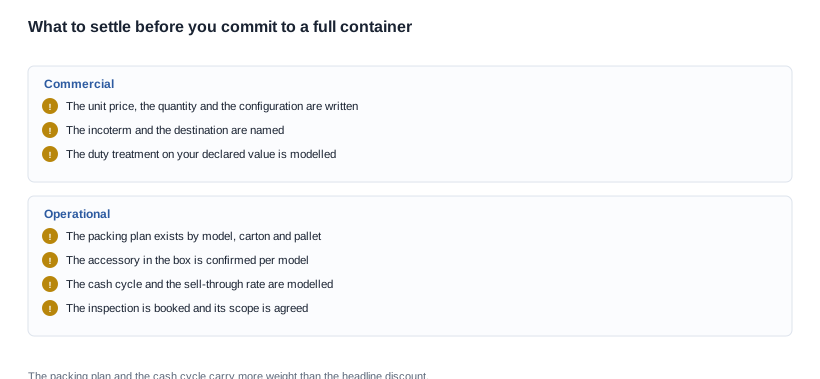
Those eight items are what a buyer should have in hand before committing to a full container, and they are the agenda for the conversation rather than a form to fill in. Two of them carry more weight than the rest. The packing plan, because it determines whether the goods fit the way you think they will and how many cartons and pallets you are actually handling, is not published by anyone and is a conversation rather than a document. The cash cycle, because it is the number that determines whether the discount was a saving, belongs entirely to you and not to the supplier.
The wider commercial structure is set out under wholesale terms. The modification-driven costs that affect a container run are covered under customization options, and the specification questions that have to be answered before any volume quote is meaningful are in smart glasses oem risk factors. Shipping and the trade terms are covered under oem logistics, the volume-versus-forecast decision is set out in inventory planning for a first run, and the platform detail for the class that most often starts a volume programme is on the bluetooth audio glasses page.
Where we can be specific is on which of the cost lines in the table above we can speak to, and which need a quotation. The battery transport position and the compliance-if-the-configuration-changes position are both answerable from the structure. The unit price, the container quantity, the carton and pallet counts, the lead time and the freight are not, until you have a specification, a destination and a date.
It is worth saying how we would negotiate this ourselves, because the useful negotiation in a volume deal is not conducted on the unit price. We would ask for four things in writing: the unit price at the volume with the configuration and the incoterm named; the amortisation basis for any tooling, so that a lower-than-planned volume is visible to both sides; the packing plan by model, so that the freight and the handling are modelled on the real cartons rather than on an average; and the payment and shipment schedule, so that the cash cycle is a number in the model rather than an assumption. With those four in place, the negotiation is about the risk allocation — who carries a component cost increase, who carries a short-ship, who carries a late delivery against a promotion date — and the unit price is largely arithmetic by that point.
For a buyer building a shortlist, this is a good way to separate suppliers. A supplier who answers all four has a costing model and a planning function. A supplier who answers one and deflects the other three has a price list, and the price list will still be there when something changes, but the thinking behind it will not. Due diligence in this category is mostly a matter of asking for the parts of the answer that take a little work to produce.
We would rather be asked for a structure than a number, because a structure is something we can answer and a number requires terms we have not agreed. Tell us the model, the configuration, the destination market, the incoterm you want and the volume band you are working with, and we will tell you which lines move, which do not, and which we cannot confirm until the specification is fixed. The three that will not move regardless of volume are the battery transport obligations, the inspection and the declared-value effect on duty — budget for those before you compare two quotations, because they are the ones that decide whether a container was a good idea.
Related reading
- Structuring a volume commitment — oem logistics and shipping
- What must be fixed before a quote — inventory planning for a first run
- Platform detail for the audio class — bluetooth audio glasses
Tell us the configuration and the destination, and we will tell you which cost lines we can and cannot confirm.


