

An entry-level comparison in this catalogue has to start with a disclaimer, because the word carries an implication our published material does not support. We publish no price for any product in this range, and we do not publish a tier structure either, so there is no price band here for a product to sit in. What can be compared is the published specification of the three products published as 运动眼镜, and the honest version of the question is therefore not "which is the cheapest" but "which of the three is the simplest to qualify, and which of them carries the most open questions". That is a different question, it is the one a procurement team can actually answer from published data, and it is the one this page works through. Nothing here is a recommendation and nothing here is a value judgement, because the commercial terms that would decide either are not published.
Sport smart glasses entry level options: what the phrase can mean without a price
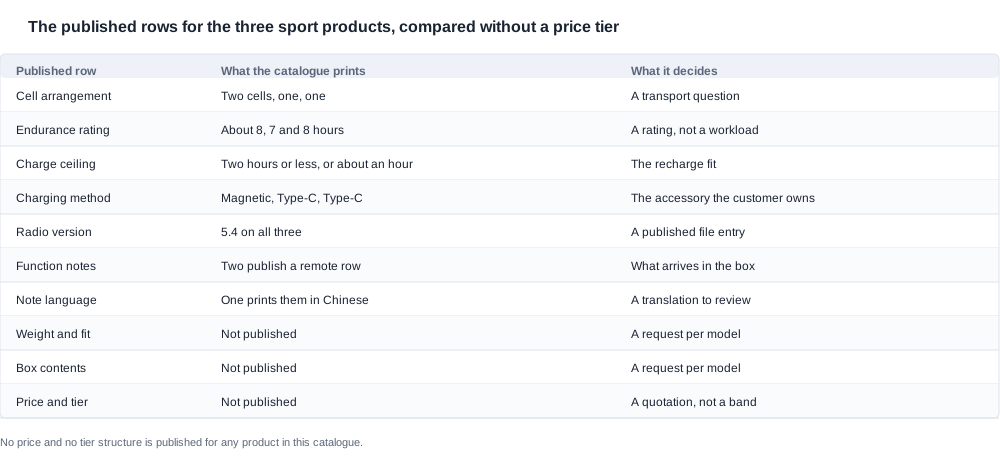
There are three products in this line, and the published rows for each are short enough to set out in full. Three products sit in this line, and their published rows are short enough to set out in full. One of them carries a pair of 70 mAh cells, an endurance rating of roughly eight hours, a charge limit of two hours at the most, a magnetic interface and Bluetooth version 5.4, with feature notes for a surround-sound configuration and a long endurance. The second shows one 115 mAh cell, a charge limit of roughly an hour, seven hours of rated endurance, a Type-C port and version 5.4, and two feature notes of its own. The third shows one 100 mAh cell, a charge limit of about an hour, with a Type-C port and version 5.4, and Chinese-language notes covering a photography remote and a stereo surround-sound arrangement; the endurance rating is approximately eight hours.
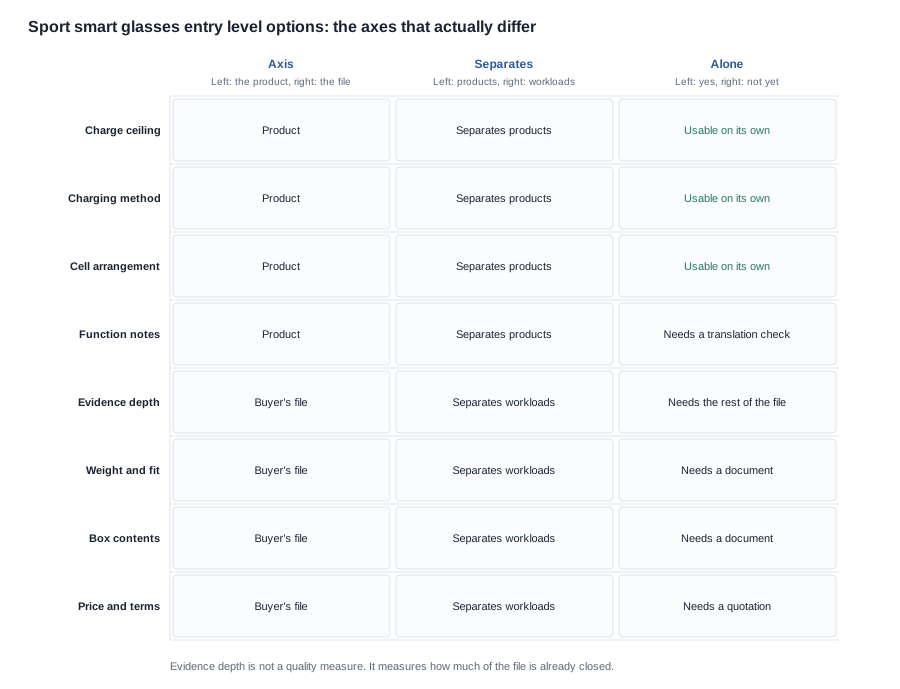
Read together, the three rows produce a structure rather than a ranking. The first axis is the charging architecture, and it splits the line cleanly: two products reach a full charge in about an hour over a Type-C port, and one is capped at two hours or less over a magnetic interface. The second axis is the cell arrangement, which also splits: one product carries two cells and two carry one. The third axis is the published function notes, and it splits a different way: two products publish a photography remote and one does not, and of the two that do, one prints its notes in English and one in Chinese.

Those three splits are the whole of the published comparison. Everything else that distinguishes a product in this line — the weight, the fit, the acoustic performance, the environmental behaviour, the box contents, the price, the minimum order, the lead time, the warranty — is not published for any of the three. That is the single most important fact on this page, and it has a direct consequence: a side-by-side comparison of this line can be built entirely from published data, but it cannot be completed from published data, and a buyer who expects the second to follow from the first will be disappointed.

The three products and the published rows that separate them
The table above is arranged by published row rather than by product, because the rows are what a comparison in this line can actually be made of. Two observations come out of it that are worth stating before anything else.
The first is that the published specification is more even across the three than the marketing of the category would suggest. The published endurances sit within about an hour of each other, the radio version is the same for all three, and the charging ceilings differ by roughly an hour rather than by an order of magnitude. A buyer who assumed that one of these products was a stripped-down version of another would be reading a distinction into the data that is not there. What the data does show is a product that charges faster and a product that carries two cells, and neither of those is a simplification of the other.
The second is that the difference between the two products that publish a photography remote and the one that does not is a difference in what is fitted rather than in capability, and that the two products with a remote are not otherwise distinguishable on the published rows. The remote is on a temple, and the audio notes are also on a temple, and the published rows say nothing about how either interacts with the other or how the frame carries both. That is an open question, and it is the kind of question a side-by-side comparison should surface rather than hide behind a table.
Those two notes on the second product, and the pair on the third, are the rows a buyer has to read most carefully before drawing anything from the table, and both of them are discussed below.
The third observation, which is about the data rather than the products, is that one of the three prints its feature notes in Chinese. A buyer building a range page in an English-language market has to decide what to do with a published row that is not in the language of the page, and a buyer who assumes the row can be rendered into an equivalent English descriptor is making an assumption the catalogue does not support. The correct handling is to ask the supplier what the note denotes and to have that answer reviewed, which is a small task and a cheap one to do early.

Comparing them on structure rather than on price
Because no price is published, the comparison that a buyer can build has to rest on structure, and there are three structural comparisons worth making. The first is the recharge fit, and it is the most commercially useful of the three: a deployment whose breaks are short can use either of the two products that charge in about an hour, and a deployment whose breaks are long can use any of them. The second is the accessory consequence, and it follows directly from the charging method: a Type-C product needs a cable the customer can buy, and the magnetic product needs an accessory that our catalogue does not describe, which means the channel has to stock it and describe it.
The third comparison is about what the customer receives, and it is where the published rows are least helpful. Two of the three publish a photography remote, which means a component in the box, and one does not. Our catalogue prints no contents list for any of them, so whether a cable is included, whether a dock is supplied, and what else travels in the pack are all open. A buyer comparing three products side by side on the published rows is comparing three electrical profiles and nothing else, and a buyer who produces a comparison page from those rows will have a page that is accurate, thin and not very useful to a customer.
A last point belongs with the comparison itself, and it concerns what happens to it afterwards. A comparison built from published rows is a snapshot of what is known today, and the snapshot goes stale the moment a supplier revises a configuration. A channel that circulates such a comparison internally should mark it with the date it was built and the documents it was built from, and should treat a change in any of them as a reason to rebuild it rather than as a footnote. How to choose between two candidate products is a decision made once; keeping a comparison honest is a task that repeats, and the second is the one that is more often skipped.
That is the honest limit of the exercise, and it is worth putting plainly because the alternative is a comparison page that promises a decision the data cannot deliver. The published rows can narrow a shortlist to a question; they cannot close the question, because closing it requires the weight, the fit, the box contents, the environmental position, the acoustic position and the commercial terms, and every one of those is a document that has to be obtained.

Evidence depth, and why it is the axis that actually differs
If the three published row sets are close to each other, the axis on which they genuinely differ is not the products but the buyer's workload. One model publishes a charging method, and one does not publish one at all. One model publishes a feature set in a language the buyer may not be working in. One model carries a cell configuration that has to be matched to a separate set of transport papers. These are not differences of degree in the product; they are differences in how much of the file the catalogue has already closed.
The practical value of that observation is that it tells a buyer where to spend the supplier conversation. A model whose charging method is published needs no conversation about the method and needs a conversation about the accessory and the box. A model whose charging method is not published needs a conversation about the method before anything else, because the accessory programme, the packaging and the support script all depend on the answer. A model with a published cell configuration needs a transport conversation; one without needs the cell question settled first.
It also gives a buyer a defensible way to describe an entry-level choice without using the word price. The entry-level candidate in this line is not the product with the smallest cell or the lowest published endurance. It is the product whose file is shortest to close, because that is the one a channel can launch with the least evidence to gather and the least risk of discovering a gap after the packaging is tooled. Which product that is depends on what a buyer already has open, which is why the comparison has to be done against a buyer's own file rather than against a published table.
It is worth being explicit about the thing this is not. Evidence depth is not a quality measure. A product with a short published file may be a simpler product or it may be a product whose documentation a supplier has not written, and our published material does not distinguish between those two cases any more than it distinguishes a durable product from a fragile one. A buyer who uses evidence depth as a proxy for quality will eventually be wrong, and the way to avoid being wrong is to keep the two ideas apart in the file: what the product is, and how much is known about it.
Turning the comparison into a shortlist a buyer can defend
The sequence below is what a side-by-side comparison in this line should produce, and it produces a shortlist rather than a verdict. The five steps are a filter, and the filter is applied to the deployment rather than to the products.
- Fix the deployment: the session structure, the environment, the markets, the age band and the volume.
- Apply the recharge filter: a short break between blocks narrows the choice to the two products that charge in about an hour.
- Apply the accessory filter: a channel that will not stock a proprietary magnetic accessory is looking at the two Type-C products.
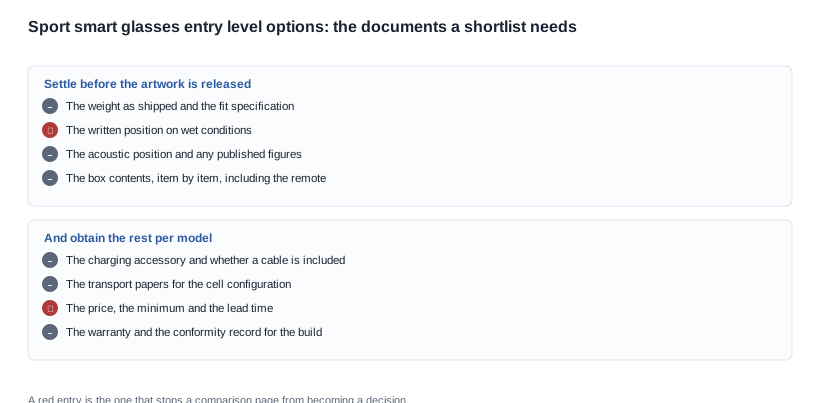
- Apply the evidence filter: for the surviving candidates, list what the catalogue has already closed and what has to be obtained, and order the outstanding items so that the ones that block the artwork come first.
- Obtain, in writing, per model, and score the answers against the same criteria so that the comparison is between two complete files rather than between two brochures.
A buyer should also be careful about one specific trap in this line, which is the temptation to treat the entry-level question as a product-quality question because the phrase sounds like one. A buyer who assumes the least documented product is the least capable product will sometimes be right and will sometimes be wrong, and the cost of being wrong is a range page that promises a step up and a product that does not deliver one. The published rows cannot settle it, because the published rows do not describe performance at all — they describe configuration, and a configuration is not a verdict. What settles it is the supplier's documentation for the specific configuration under consideration, which is the same document set in every case, and which is why the question of which product to launch with is a question about evidence rather than about specification.
There is one further comparison a buyer can make that is worth making before the documents arrive, and it is a comparison of the programmes rather than of the products. Two of the three products in this line would let a channel launch with the same set of accessories and the same support scripts; the third would not, because of how it charges. A channel that is running a narrow range has a real operational advantage in that, and it is an advantage that is invisible in a specification table and visible in a returns and support line six months later. It is also the kind of advantage that should be weighed against the product differences rather than treated as a tie-breaker, because a channel that saves an administrative step on one product and has to rebuild its accessory line for another has not saved anything.
The comparison also has to survive being read by somebody who has not been in the buying conversation, and that is a stricter test than it sounds. A page that names one product as the entry-level option on the strength of a published cell figure and a published endurance figure will be read as a recommendation, and a channel that circulates it will have made one whether it intended to or not. The fix is not to remove the comparison but to label it precisely: these are the published rows, these are the rows that are not published, and this is the order in which the outstanding documents have to be obtained. A comparison labelled that way can be circulated safely, and a comparison labelled as a ranking cannot.
The questions that close the surviving candidates are the ones this line does not publish: the weight and the fit, the environmental position, the acoustic position and the figures behind it, the box contents including the photography remote, the charging accessory, the transport papers for the cell configuration, the price, the minimum, the lead time, the warranty, and the conformity record for the build that will actually be produced. None of them is a question a catalogue can answer and all of them are questions a supplier can.
One more practical point belongs with a comparison of this kind, and it is about how the comparison is used internally. A side-by-side table is very easy to circulate and very easy to misread, because the visual form of a table implies that the rows are comparable and that the order of the rows means something. In this line neither is true: the rows are comparable only where the catalogue publishes them, and the order in which the products appear in a table is an artefact of how the table was built rather than a statement about the products. A comparison that is going to be circulated should therefore carry its own preamble, saying which rows are published, which are not, and what the table is not. That is a discipline rather than a document, and it is the difference between a comparison that saves a buyer time and one that has to be withdrawn later.
There is a related point about the criteria by which two candidate files are compared once the documents have arrived. A buyer who scores the answers against the same list for every candidate can see the real difference between two suppliers, which is usually not the product but the documentation discipline behind it. One supplier answers the question that was asked, names the model and the market, and says plainly when something is unknown; the other answers the neighbouring question and leaves the gap to be discovered. A buyer who has asked both the same questions has learned more about which one to work with than any published row could tell them, and that is the practical value of running the comparison properly rather than quickly.
The wider category treatment of the same question, across the whole range rather than this line alone, is set out in the entry-level comparison for the camera side of the range, and the general guidance on how to build a range from this catalogue is in building a product line from the smart eyewear range. Neither of those pages answers the sport line, and this page does not answer the camera line; the structures are the same and the products are not.
What we can offer from our side is the published half and a clear statement of where it stops. We publish the rows for the three products in this line, we publish no price and no tier, we publish no protection marking for any of them, and we will not name a best-value model in a category where the term would have to be justified by figures that are not published. Send us the deployment, the markets, the volume and the copy you intend to publish, and we will set the three published profiles against your requirement, show you which structural differences would actually change your programme, list the documents that have to be obtained for each candidate, and tell you where the published data stops.


