
AI camera glasses entry level options are a structural question before they are a price question, and this article treats them that way on purpose. It is not a price tier, and it does not contain one. We do not publish prices, price ranges, unit prices or a value ranking for any model in our camera range. What it does contain is the grouping that a published specification sheet actually supports, and the four cost drivers that decide whether a first order is cheap or expensive once freight, packaging, documentation and returns are counted.
That distinction is worth making explicitly, because "entry level" in this category is usually presented as a price band and the price band is the one thing that cannot be established from a catalogue. What can be established is the structure: which models sit on which frame cell, which carry a charging case and of what published capacity, which publish a charging interface, and which publish a resolution tier. Those groupings change the shipped cost of an order, and they are published.
Our camera range covers eleven models — the V06 and the L1 Pro, the MT5 and the MT6, the CY03 and the V03 Pro, the CY05 and the KY06, the S7 and the V03, and the L2 Utral — and they fall into four frame-cell groups and three published resolution placements. The who needs the V03 and the V03 Pro use case pieces work through two specific models in detail; what follows is the group-level view that a shortlist is actually built from.
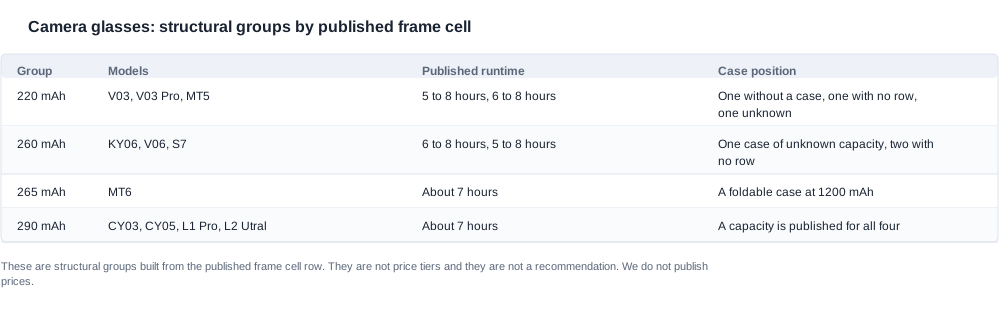
AI camera glasses entry level options: structural groups, not price tiers
The four groups in the table above are built from one published row, the frame cell capacity, and they are the most useful partition of this range for a first-order decision. Each group carries its own shipping profile, its own packaging consequence and its own documentation position.
The 220 mAh group holds the V03 and the V03 Pro, and the MT5. It is the smallest published cell in the range, and its three models behave differently on the rows that matter: the V03 charges magnetically and has no case row in the catalogue, the V03 Pro charges over Type-C and publishes no charging-case row at all, so the case question for that model has to go to the supplier, and the MT5 charges magnetically and ships a case whose capacity is not published. The lightest published cell does not mean the lightest parcel, and the reason is the case position rather than the cell.
The 260 mAh group holds the V06 and the S7, and the KY06. The KY06 ships a case with no published capacity. The V06 and the S7 have no case row at all, and they are also the only two camera models in the entire range with a published ingress marking, at IP54, with no report number attached to it in the source. The S7 additionally sits in the 13 MP tier, which makes this group the one where the resolution and the cell do not move together.
The 265 mAh group holds one model, the MT6, and it is unusual on three rows at once. It is the only model in the range that publishes a unit weight, at 158 g for the glasses unit including the battery and the camera and excluding the foldable charging case. Its case is a 1200 mAh foldable one, which is a packaging and transit question rather than a capacity question. And its charging method is not published, even though its case capacity is — one of four camera models in that position.
The 290 mAh group holds the L1 Pro and the CY03, and the L2 Utral and the CY05, all four with a published runtime of about seven hours. All four publish a case capacity: 1400 mAh on the CY05, the L1 Pro and the CY03, and 900 or 1400 mAh on the L2 Utral. All four publish a resolution tier, and that tier splits the group: 8 MP on the CY03 and the CY05, 13 MP on the L1 Pro and the L2 Utral. All four publish a runtime as a single figure rather than a band.
The published runtime behaves in a way that the cell does not, and it is worth noticing: the 220 mAh and 260 mAh groups publish a band of five to eight hours or six to eight hours, while the 265 mAh and 290 mAh groups publish about seven hours. A band and a single figure are not the same kind of claim, and comparing them to each other without noting which is which is a comparison error.
The four cost drivers that decide whether a first order is cheap
Because no price is published, the useful substitute for a price tier is the list of the things that move the delivered cost of an order. Four of them are decided by the rows in the table above, and a buyer who has grouped the range correctly already knows most of what is going to happen.
The first driver is the cell in the parcel. A case is a second lithium item, and the number of declared cells and their capacities are what set the freight mode and the transport documentation. Five camera models publish a case capacity, two ship a case whose capacity is not published, three have no case row and one is published without a case. That distribution — not the cell capacity alone — is what determines how many parcels are which, and it is the reason the smallest published cell group is not automatically the cheapest to ship. The charging case options analysis covers the case positions in detail, and the AI camera glasses shipping weight covers the parcel arithmetic.
The second driver is the packaging route. A case needs a cavity in the retail box, protection in the master carton and warehouse volume per unit. The models with no published case position have an unknown packaging route, not a light one, and the models with a foldable case have a route that differs from a rigid one. Packaging is a one-off cost per configuration, so the number of configurations in a first order matters more than the number of units in it.
The third driver is the documentation position. Four camera models publish no charging method, and those four are the CY03 and the MT6, and the L1 Pro and the CY05. A model whose interface is unpublished cannot have its in-box contents finalised, which means the packaging cannot be finalised either, which means the documentation scope cannot be finalised. This is an unusual cost driver because it delays rather than adds: it does not increase the unit price, it pushes the artwork and the order date.
The fourth driver is the returns profile. Two camera models carry a published ingress marking and nine do not, and a model with a marking is a model whose environmental claim is narrower than its absence. A model without a marking has no claim to defend but also no protection to rely on, and that asymmetry shows up in the returns data rather than in the invoice.
The four drivers are not independent, and the interaction is the part worth understanding. The cheapest-looking group by cell capacity is the group with the most unknown packaging. The group with the largest cell is the group with the most published case capacity, which means the most published documentation and the most lithium in the parcel. And the group with the published unit weight is a single-model group with a foldable case, so the one number a buyer can use for weight arrives attached to the one model whose package has a hinge in it.
Why a first order is decided by structure rather than by label
The label "entry" is applied to this category by people who have not read the published rows, and it produces decisions that cost money. The reasoning error is simple: a lower frame cell is assumed to mean a lower cost, and the assumption skips the four drivers above.
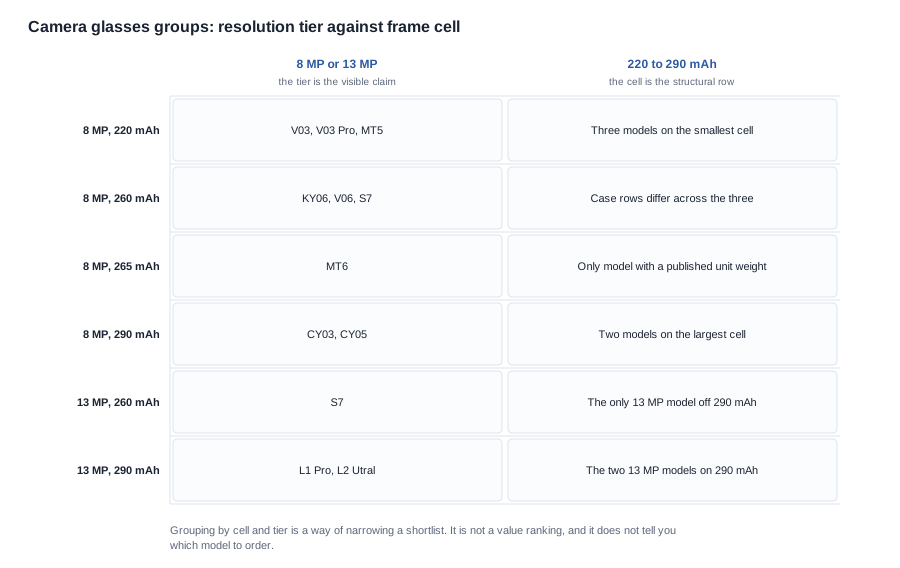
There is a second error, and it is the more common one in this category specifically. The label is applied to a resolution tier. Eight of our eleven camera models publish 8 MP and three publish 13 MP, and the two groups cut across the cell groups in a way that makes any ranking based on either row alone unreliable. The S7 is 13 MP on a 260 mAh cell; the CY03 and the CY05 are 8 MP on a 290 mAh cell; the L1 Pro is 13 MP on 290 mAh. If the entry decision is made on resolution, the parcel decision has not been made, and the two decisions are made by different people at different times.
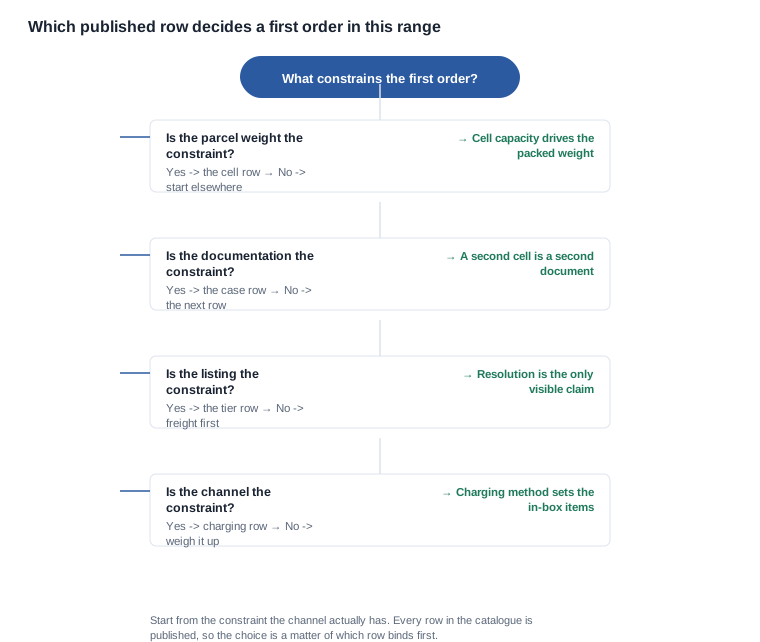
What replaces the label is a constraint. The method is to name the constraint that actually binds, and let the published rows do the narrowing. If the constraint is the parcel weight, start from the cell row and the case row. If the constraint is the documentation schedule, start from the charging method row, because four models leave the in-box contents open. If the constraint is the listing, start from the resolution tier, because it is the only published row a customer can see. If the constraint is the channel, start from the charging method and the case, because those decide what is in the box.
Each of those is a decision a buyer makes before an order and a supplier answers in writing. None of them is a recommendation, and none of them requires a price.
The two mistakes that recur most often in this category are worth naming because they are both visible in the paperwork. The first is comparing a model with a published case against a model with no case row and concluding that the second is lighter. It may be, but the comparison is invalid until somebody confirms what ships with it — a case is heavier than a cable in every configuration we have measured, and a "no case row" is an absence of information rather than a statement of emptiness. The second is treating the published runtime band as a floor. Five to eight hours is a band; planning a shift around the top of the band is planning around a figure the catalogue does not guarantee.
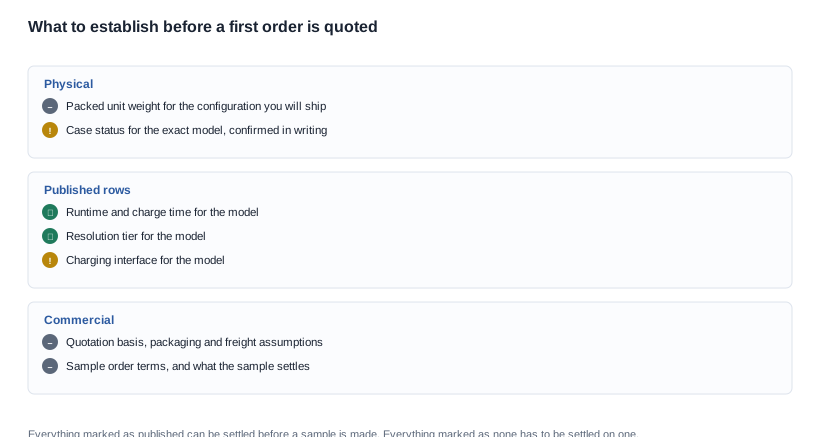
The method for choosing between the groups is short enough to state as a procedure. Write the constraint down first, in one sentence, with a number in it wherever a number can be written. Then take the group whose published row bears on that constraint, and note what the group still leaves open. Then decide which of the open rows has to be closed by a written answer from the factory and which can be closed by a measurement on a sample. Finally, write the decision into the shortlist with the open rows still visible, because a shortlist that hides an open row will be read later as a shortlist that has none. The criteria that make this method work are simple and they are worth checking before you start: the constraint is written down, the group is chosen from a published row rather than from a description, and every open row has an owner and a route to closure. When to run this procedure matters as much as how — before a quotation is requested, not after two have been received, because the quotations will already have been priced around assumptions that the procedure would have exposed.
There are trade-offs inside every group that are worth naming, because they are the ones that get forgotten once a model has been chosen. A larger published cell supports a longer published runtime, but it also puts more lithium in the parcel. A published case capacity makes the shipped unit a better proposition, but it also means two declared cells rather than one and a larger carton. A higher resolution tier makes the shelf label stronger, but it does nothing for the imaging specification, because no sensor model, no field of view and no video format is published for any camera model in the range. Each of these is a real trade-off with no published resolution, and each one is the kind of decision that a buyer should record rather than absorb.

The resolution and charging rows that cut across the groups
Two published rows cut across the cell groups and complicate any ranking built on cells alone, so they are worth setting out on their own.
The resolution tier. Eight models publish 8 MP — the MT6 and the KY06, the V06 and the V03 Pro, and the CY03 and the V03, and the MT5 and the CY05 — and three publish 13 MP — the L2 Utral and the L1 Pro, and the S7. It is a two-tier structure, and the tier is visible to a customer in a way that cell capacity is not. The consequence for a first order is that the tier is the claim the listing will make, and the claim has to be supportable. It is supportable as a shelf figure; it is not supportable as an image quality claim, because no sensor model, no field of view and no video specification is published for any camera model in the range.
The charging method. Five camera models publish magnetic charging — the V06 and the S7, and the V03 and the KY06, and the MT5. Two publish Type-C — the V03 Pro and the L2 Utral. Four publish nothing at all — the MT6 and the CY03, and the CY05 and the L1 Pro. This is the row with the largest practical gap between the published and unpublished states, and it is the row that decides the in-box contents.
The interaction between the two rows is the part a buyer should check rather than assume. The four models with no published charging method include three of the 290 mAh group and the single 265 mAh model, and three of them publish a 1400 mAh case or a 1200 mAh foldable case. So the models with the most packaging in the box are also the models whose box contents cannot be finalised from the catalogue. That combination is the reason the quotation request for this range has to ask about the interface and the case in the same message rather than as two separate enquiries.
There is one further row that deserves a place in a first-order decision even though it is not published for most models: the ingress marking. Two camera models carry IP54 and none of the other nine carries a published marking. For a channel whose environment involves water, that difference decides whether the environmental claim is a printed line or a question, and the AI camera glasses buying guide covers how the range-level decision should be made. The OEM ready minimum order discussion handles the related commercial point about what a first order commits a buyer to.
What we publish about entry positioning, and what we do not
A first order should be decided on structure and settled on quotation, and we will help with the first and not pretend to do the second.
We publish the eleven camera models and the rows that belong to them: the frame cell capacity, the rated runtime as either a band or a single figure, the charge time at two hours or less for every camera model, the resolution tier, the charging method for seven of the eleven, the case position in all four of its states, the ingress marking on the V06 and the S7 with no report number behind it, and the one published unit weight in the range at 158 g for the MT6 glasses unit excluding its foldable case. Every grouping in this article is derived from those rows.
We do not publish, and this article does not contain, a price, a price range, a unit price, a value ranking, a recommendation of one model over another for a given use case, a market share figure or a sales ranking. We will not describe a model as the best value in the category, because that is a comparison with competitors we do not publish and cannot evidence. And we will not convert a structural grouping into a commercial conclusion: the 220 mAh group is the smallest published cell group, and that is the entire claim we make about it.
What we can do is answer the questions a quotation request raises. We can tell you which models publish a case and which do not, which publish a charging interface and which do not, which carry the ingress marking, and which published rows would narrow a shortlist for the channel and the configuration you have in mind. MOQ, lead time, unit price, payment terms, packaging, sample cost, warranty and the treatment of tooling all arrive in a quotation, where they are specific and negotiable; our catalogue publishes none of them for any camera model, and we will not estimate them here.
If you are building a first order in this category, send us the channel, the target market, the quantity and the configuration you have in mind. We will tell you which of the four frame-cell groups and which of the resolution tiers fit the constraints you have stated, which rows will have to be requested from the factory before the packaging can be finalised, and what to ask. The which model to pick piece covers the reasoning in more detail, and the range is at AI camera glasses.
Related reading
- Which category it is — AI camera glasses buying guide
- The case positions in full — AI camera glasses charging case options
- The parcel arithmetic — AI camera glasses shipping weight
Send us the channel, the quantity and the configuration, and we will tell you which published groups fit the constraints you have stated.


