
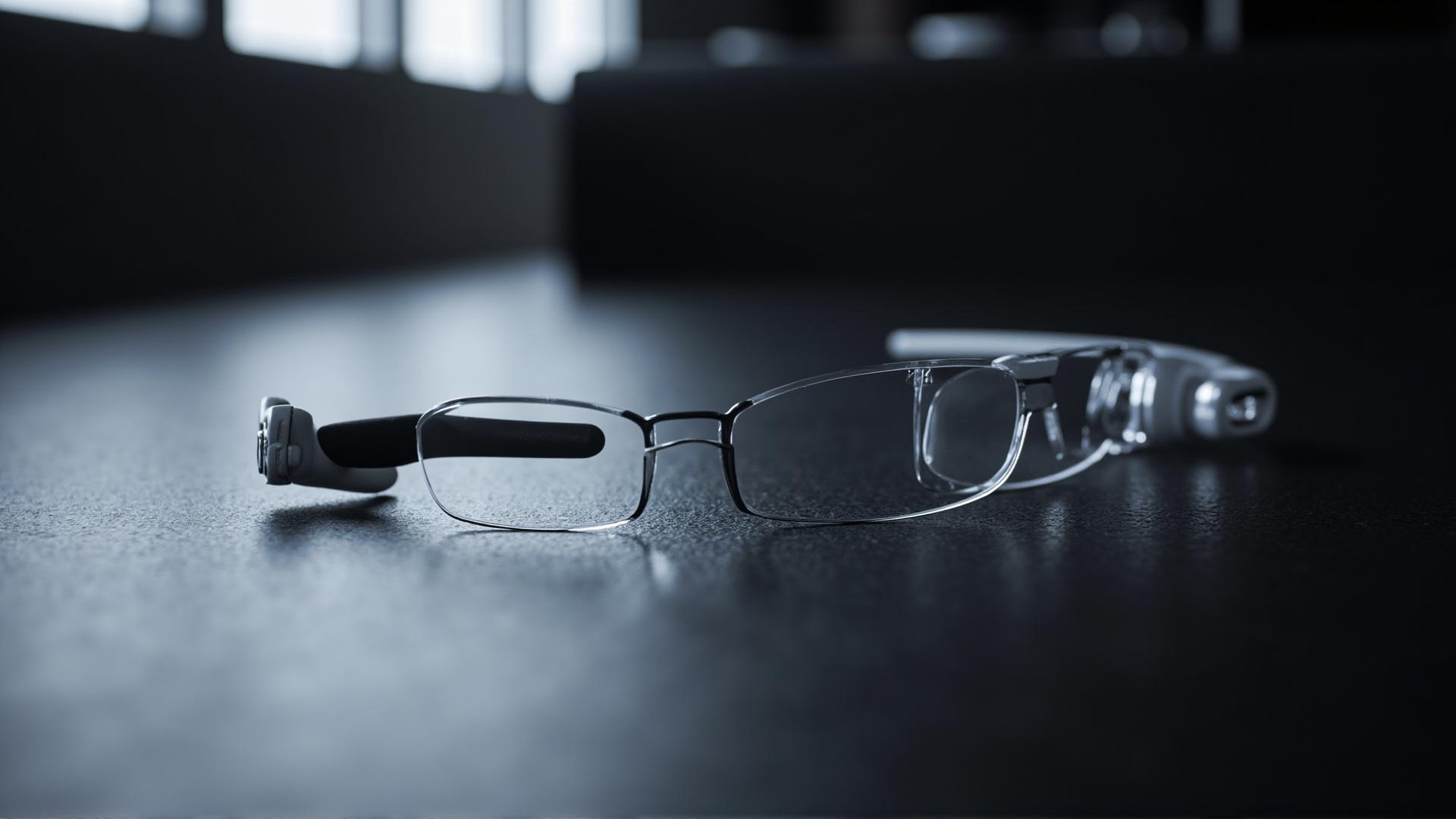
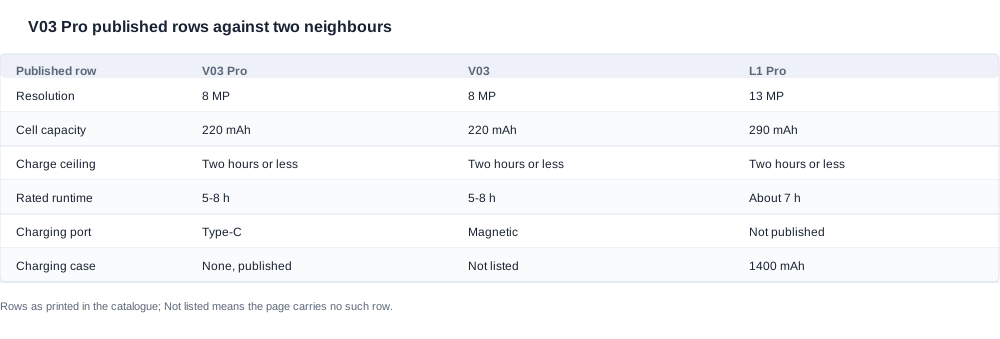
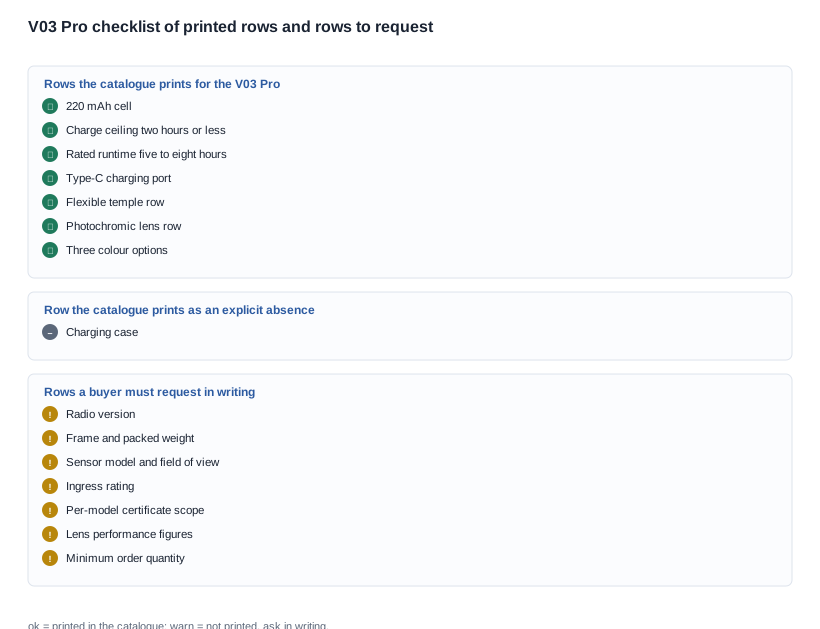
The V03 Pro is a documentation question before it is a product question. The catalogue prints five standard specification rows for this model — an eight megapixel a 220 mAh cell, a charge time of two hours or less, resolution class, a rated runtime of five to eight hours and a Type-C charging port — and three configuration rows on top of them: flexible temples, a photochromic lens and three published colours. It also leaves one row blank where a charging-case figure would normally sit: no charging-case row for the V03 Pro. Everything else a procurement file usually asks for — the radio version, the frame weight, the sensor and the field of view, the ingress rating, the certificate scope — is blank in the catalogue text.
That split decides how a value case has to be built. The V03 Pro can be evaluated against its own printed rows, and against the eleven camera models in the range, without a single assumption. It cannot be evaluated against the blank rows without written answers from the factory, so this article is organised as three things: what the printed rows decide, what a buyer has to request in writing, and how two quotations get put onto one basis before anyone compares them.
One boundary first, because it shapes every paragraph below. No price, minimum order quantity, lead time, warranty period, certificate number, weight or market figure appears here, because none of them appears in the catalogue. Where a buyer needs one, this article converts the need into a question and a control instead of into an answer. The article also makes no ranking claim: the V03 Pro is not placed above, below or ahead of any other model, because the published rows do not support that kind of order, and a shortlist built on a ranking we cannot support is a shortlist built on opinion.
V03 Pro published rows and the value case they can carry
The five standard rows and what each one settles
The resolution row reads eight megapixels. That settles the resolution band a specification sheet can print for the V03 Pro, and it settles nothing else: the catalogue publishes no sensor model, no field of view, no frame rate, no video format, no stabilisation behaviour and no low-light performance for this model or for any other camera model in the range. Eight of the eleven camera models print the same eight megapixel class, so the resolution row on the V03 Pro places it inside a band that does not separate it from its peers.
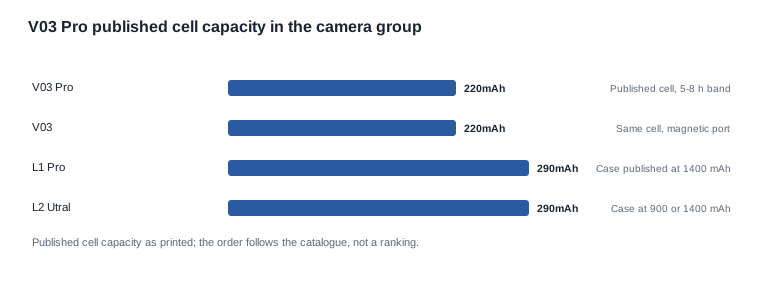
The cell row reads 220 mAh. What a buyer should take from that number is parcel and documentation, not endurance. 220 mAh is the lowest published cell capacity in the camera group, shared with the V03 and the MT5, while the remaining camera models print 260, 265 or 290 mAh. Cell capacity determines which lithium cell ships and which transport documents have to cover it, and because the catalogue prints a runtime row separately, the endurance question is answered on its own line rather than by inference from capacity.
The charge row reads two hours or less. That is a ceiling rather than a measured value, and it is the ceiling form used by twenty-six of the twenty-eight models in the range; only the D17 and the ZH12 print a different figure. No start state and no completion criterion are published, so the number bounds how long a recharge can take without describing how long it takes. It cannot be converted into a shift-planning figure, because a top-up and a full charge are not the same operation.
The runtime row reads five to eight hours. It is a band, not a point, and four camera models print the same band — the V06 and the S7, and the V03 and the V03 Pro. A band means the published figure moved with the workload, and no test condition is published for any model in the range, so the band cannot be mapped onto a duty pattern without an acceptance test of your own.
The port row reads Type-C. That decides which cable the end customer has to own and which connector a distributor's packaging has to accommodate. It is also the row where the V03 Pro separates from the V03, whose catalogue page prints magnetic charging instead: across the range, seventeen models print magnetic charging, seven print Type-C, and four publish no charging-method row at all.
The three configuration rows above the numbers
The flexible-temple row is published for the V03 Pro, and no other camera page in the catalogue prints that row. The camera pages that do carry configuration rows print something else: the V06 prints ergonomic-design, long-runtime, detachable-inner-frame and IP54 rows, the S7 prints ergonomic-design, a thirteen-megapixel row, a detachable-inner-frame row and IP54, the L2 Utral prints two variant names and a Type-C interface row, and the MT6 prints portability, light weight and its folding case. A flexible temple is a structural statement a buyer can show on a listing page, and it arrives with no motion range, no material and no cycle data, so it supports a description and not a specification.
The photochromic-lens row is published for the V03 Pro, and the catalogue carries a second, separate photochromic entry without a model name — 100 mAh, magnetic charging, about seven hours, Bluetooth V5.4 — which publishes no optical parameters either. Neither entry prints a transition time, a tint depth, a light transmission figure, a wave band or a temperature range. The row is therefore enough to build a product page around and not enough to write a performance claim on one. The questions worth putting to a factory before a lens claim reaches a listing are set out in our photochromic lens note.
The colour row prints orange, off-white and black. Only two camera models in the range print a colour row at all: the V03 Pro with three, and the V06 with orange, ice blue, black and black ice blue. For a buyer, the colour row decides how many listings a range can carry without a new colourway development, and it raises a question the catalogue does not answer — whether each colour is a separate order line, and at what minimum quantity per colour.
The charging-case row the catalogue leaves blank
The V03 Pro prints no charging-case row at all. That is an unanswered question rather than an answer a pack-out can be planned around, and it is a question a buyer has to put to the supplier in writing before the box can be specified.
Across the eleven camera models the case status falls into three states. Five print a case capacity: the CY03 and the CY05, and the L1 Pro each print 1400 mAh, the L2 Utral prints 900 or 1400 mAh, and the MT6 prints a 1200 mAh folding case. Two print a case without a capacity, the KY06 and the MT5. Four print no case row at all, the V06 and the V03, and the V03 Pro and the S7. Seven of the eleven camera models therefore publish a case, and for the remaining four the pack-out question is still open.
Note one pairing inside the range, because it bears directly on a quotation: the four camera models whose charging method is not published — the MT6 and the L1 Pro, and the CY03 and the CY05 — are the same four that publish a case capacity. A quotation that includes a charging case for the V03 Pro describes a configuration the catalogue does not print for this model, so it needs to be quoted and compared as a separate line rather than folded into the frame line.
The rows the V03 Pro leaves blank
The radio version is blank. None of the eleven camera models publishes a Bluetooth version, while the eight audio models do — V5.3 on the K01 and the K02, V5.4 on the other six. If an enterprise account's device policy requires a radio version, this is a written question rather than a catalogue lookup.
The weight is blank. The catalogue publishes a weight for one model only: the MT6's frames at 158 g, excluding its folding case. No frame weight is published for the V03 Pro, so freight modelling, packaging planning and any ergonomics statement have to start from a supplier figure rather than from the catalogue.
The ingress rating is blank. IP54 is printed for the V06 and the S7 and for no other model, so the V03 Pro cannot inherit a rating from the sport models. A deployment that needs an ingress figure needs it in writing, on the model, from the factory.
The certificate scope is blank, and the catalogue makes it clear that this cannot be read out of the front matter either. The catalogue text contains no reference to CE, FCC, RoHS, REACH, UKCA or GPSR anywhere, and it carries no per-model certification row. The export certification page in the front matter is an image page with no extractable text, holding ten patent certificates — eight design patents and two utility-model patents. A company-level certificate page and a per-model compliance scope answer different questions, and only the second one answers what a customs broker or a distributor's compliance team asks.
Two further absences are worth naming so that nobody assumes them into a specification: no model in the catalogue publishes a touch row, and no model publishes a translation row. The only published control-surface rows in the whole catalogue are the indicator light and button control on the AR-glasses entry, and a button is not a touch surface.
The V03 Pro against the V03 on the same printed rows
Set the two models side by side on the published rows and the differences are narrow and specific. Both print an eight megapixel resolution class, a 220 mAh cell, a charge time of two hours or less and a rated runtime of five to eight hours. The V03 Pro prints a Type-C port where the V03 prints magnetic charging; it prints three configuration rows where the V03 prints none; it prints three colours where the V03 prints none; and the charging-case row is blank for the V03 Pro and for the V03 alike. The full row-by-row reading is in V03 Pro against the V03.
That shape is useful to a buyer because it is additive: the V03 Pro is the V03 plus a published port, a published configuration set and a published case status. Which of those three additions a given channel actually needs is a sourcing decision taken from the requirement side, not from the model side, and it is the reason the V03 Pro rows read as configuration rather than as a ranking.
What a V03 Pro unit is made of, and what a buyer has to add
The components a supplier quotation has to itemise
The battery is 220 mAh and, on the published rows, one cell is documented per unit, because no charging-case row is printed for the V03 Pro. A procurement file still has to confirm that in writing: the cell chemistry, the UN38.3 test summary and the transport documentation that covers it, the number of cells in the export pack-out, and whether a Type-C cable is included, which the catalogue does not state. A case-equipped configuration changes that count. The CY05 and the CY03, and the L1 Pro pack a 1400 mAh case, the L2 Utral packs 900 or 1400 mAh, and the MT6 packs a 1200 mAh folding case, so those configurations travel a second cell and a second documentation trail. This is a structural difference between two pack-outs, not a price claim.
The lens is a photochromic element published as a row with no parameters behind it. A supplier quotation should arrive with a lens specification sheet: substrate, coating, the wave band the element responds to, transition times in both directions, the temperature range over which it changes, and whether the element is standard on this model or an option on it. The catalogue's separate photochromic entry publishes no parameters either, so there is no second row to cross-check against and the specification has to come as a document.
The temple is published as flexible with no motion data behind it. The accompanying specification sheet should state the material, the articulation count, the torque range and the tolerance data. None of that is printed, so the temple row supports a sentence on a product page and not a quality claim.
The three colours are published as a list, not as an order structure. A quotation should state whether each colour is a separate order line, the minimum quantity per colour, the lead time per colour, and whether the quoted terms apply to all three. That is a MOQ question the catalogue cannot answer, and a distributor will answer it either way.
The pack-out is the last line and the one most often left implicit. The catalogue publishes no carton dimensions, no unit gross weight and no pack contents for the V03 Pro, so the freight model and the shelf plan both start from a supplier figure. Ask for the export pack-out dimensions and weight, the accessory list, and whether the carton is the same for all three colours.
The document set a procurement file has to assemble
Putting the catalogue rows and the supplier documents side by side produces a complete file, and the two sets divide cleanly. The catalogue supplies the resolution class, the cell capacity, the charge ceiling, the runtime band, the port, the configuration rows, the colours and the published absence of a case. The supplier has to supply the per-model certificate scope and the test reports behind it, the radio version, the frame weight and the packaged weight, the sensor model and field of view, the frame rate and video format, the ingress rating if any applies, the photochromic performance figures, the carton specification, the warranty period, the minimum order quantity, the lead time, any tooling or NRE requirement, the quality-control plan and acceptance criteria, the defect remedy and the contractual terms. The silence in the catalogue is not a weakness of the model; it is the boundary of what a brochure can carry, and a procurement file is closed with documents rather than with a page.
Three quotations on one basis
Two V03 Pro quotations can differ in scope rather than in terms, so any comparison starts by forcing both onto the same six line groups. First, the configuration line: model, lens option and colour, because a quotation that omits it cannot be compared with one that states it. Second, the pack-out line: whether a charging case is included at any quantity, remembering that the catalogue prints no charging-case row for this model, so a quotation carrying one describes a different configuration. Third, the pack contents: cable, case, manual, spare parts. Fourth, the commercial lines: unit price, tooling or NRE, MOQ, lead time, warranty, Incoterm and payment milestones. Fifth, the documentation lines: certificate scope, test reports, the cell test summary. Sixth, the quality lines: acceptance sample, inspection point, defect remedy. A quotation missing any one of these groups is not yet comparable with another; it is describing a different scope, and the difference shows up later as a dispute rather than as a price argument.
The same discipline applies when the V03 Pro is set against a case-equipped model. That question is a pack-out question rather than a specification question, and it is worked through for the V03 Pro and the CY03 in V03 Pro against the CY03.

What the V03 Pro value case is paid for with
Runtime, the ceiling, and the band that does not settle
The runtime band of five to eight hours is the first thing a buyer has to live with, because it is the number a retail listing will quote and the number a channel's service terms will be built on. The charge ceiling of two hours or less is the second, and it is a ceiling: no start state and no completion criterion are published for any model, so it bounds recharge time without describing it. Together the two rows let a procurement team say that a recharge never exceeds a stated number of hours once the frame is low, and they do not let that team say how long continuous recording lasts across a full shift.
The 220 mAh cell is the third constraint. It is the lowest published cell capacity in the camera group, shared with the V03 and the MT5, and the catalogue prints it separately from the runtime row, which is exactly why endurance should not be derived from it. If a channel's proposition needs a whole-shift claim, the question that closes the row is the test condition behind the band and the acceptance tolerance around it.
The practical control is an acceptance test: run the intended duty pattern on the sample order, record what the frame delivers and how the cell responds, and attach that record to the file. A sample order is the only route by which any published band becomes a number a procurement team can stand behind.
The lens row with no numbers behind it
A photochromic lens published as a feature row and nothing else is the largest unpriced exposure in the V03 Pro specification, because the retail story and the returns exposure are both attached to the same row. Four questions close it: how long the element takes to darken and how long it takes to clear, how dark it goes and what it transmits at full tint, the temperature range over which it responds, and what it does behind a windscreen. The last one is a product-definition question rather than a laboratory question, because a lens that changes in a car and a lens that does not are different products carrying different customer expectations.
The answers should arrive as a written lens specification attached to the quotation and to the agreement, and the listing copy should be built to the level that document supports. The catalogue row supports a product page saying that the lens changes; it does not support a page saying how fast or how far it changes. The questions to put to a factory before a claim goes live are set out in the photochromic lens note.
The blanks every model in the range shares
Some gaps are not specific to the V03 Pro. No camera model in the catalogue publishes a sensor model, a field of view, a frame rate, a video format, stabilisation behaviour, low-light performance or storage capacity; only the MT6 publishes a weight; only the V06 and the S7 publish an ingress rating; and no camera model publishes a radio version. A procurement team that expects those rows in a brochure will find them missing on every model, so the sourcing request should carry them as standard items rather than as special asks, and a supplier that treats them as special asks is telling the buyer something about its documentation discipline.
Three gaps are specific to the V03 Pro: the published absence of a charging case, the printed photochromic row without parameters, and the colour row without an order structure. Each of the three can be closed with a document and a contract clause rather than with a catalogue lookup, and each of them is where the commercial risk concentrates for this model.
Where the exposure sits if the file is not closed
A lens claim that outruns the specification creates a returns and regulatory exposure that lands on the importer. A runtime assumption that was never tested creates a field failure and a service conversation. A missing certificate scope creates a blockage at the destination market and, for a distributor, a payment-term dispute. A radio version discovered after a device policy review blocks the enterprise channel. A colour split discovered at packing stage creates rework of both the listing and the carton, and a pack-out expectation that was never written down creates a mismatch between the product page and the shipment. Each of these is a documentation failure with a commercial consequence, and each has a matching control: a written specification, an acceptance test, a pre-shipment document pack, and a quotation that states all six line groups.
The buying situations a V03 Pro shortlist has to resolve
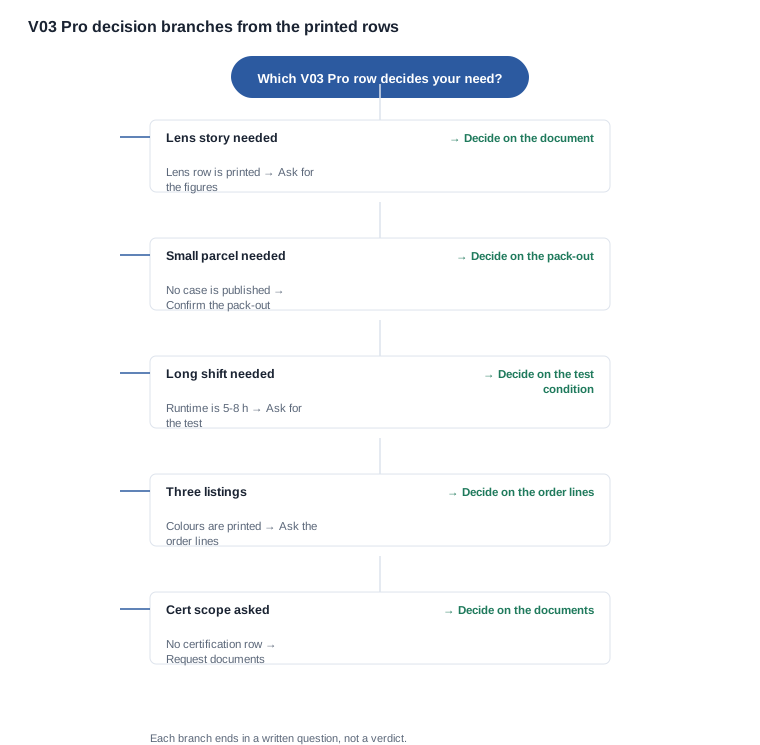
The scenarios below are a hypothetical walkthrough of a sourcing decision, not a client project and not a customer story. A brand is planning a camera range for a channel whose buyers are distributors and corporate accounts, and the shortlist has to survive both. Nothing in this section describes a real order, and none of the scenarios recommends a model; each one resolves to a deciding row, a written question, a control and a record.
The listing has to carry a lens story
The deciding row is the photochromic row, and the deciding question is what document stands behind it. A lens specification sheet answering the four questions above is the entry condition for this scenario; without it the listing can describe a changing lens but cannot state how it changes, and a colour or clarity complaint returns to the importer. Control: the specification attached to the agreement, and an acceptance sample recorded under stated conditions.
The parcel has to stay small and documentable
The deciding row is the published absence of a charging case, and it is the only row in the V03 Pro specification that is an answer rather than a gap. The deciding question is whether the quotation describes the frame-only pack-out, what the export carton measures and weighs, and how many lithium cells travel per unit. Control: the pack-out written onto the quotation, and a cell documentation pack covering every cell that ships.
The working shift has to be covered
The deciding row is the five-to-eight-hour band, and the deciding question is the test condition behind it. A supplier who cannot name the test condition has not supplied a number that can be planned with, whatever the catalogue prints. Control: an acceptance test on the buyer's own duty pattern during the sample order, with the result recorded in the file rather than summarised in a call.
The range has to become three listings
The deciding row is the colour row, and the deciding question is the order structure behind it: one line or three, the minimum quantity per colour, the lead time per colour, and whether the quoted terms apply to all three. Control: a quotation that splits the commercial terms by colour, or a written statement that a single set of terms covers all of them.
The enterprise buyer asks for a radio version and a certificate scope
Two rows are blank, and the answer to both is the same: a document. The certificate scope is the one a customs broker asks for, and the catalogue's export-certification image page cannot answer it because no per-model row exists. Control: a document pack delivered before the purchase order rather than after it, so that the compliance review and the sourcing decision run on the same file.
Each of the five situations resolves to the same structure — the deciding published row, the written question, the control, and the record kept in the file. That structure is what makes a V03 Pro shortlist comparable against another model without anyone having to state a preference for one.
Where CYNRIN stands on the V03 Pro value case
On the V03 Pro, our position is narrow and deliberate. The catalogue publishes five standard specification rows, three configuration rows, one colour row and no charging-case row for this model, and we will quote those rows as they are printed. We will not attach performance figures to the photochromic lens, we will not present eight megapixels as an image-quality claim, and we will not publish prices, minimum order quantities, lead times, warranty periods, certificate numbers, weights or lens figures that the documentation does not hold.
We will also not rank the V03 Pro against the other ten camera models. The published rows describe a configuration; they do not describe which configuration a given channel should buy, and a shortlist built on a ranking we cannot support is a shortlist built on our opinion rather than on evidence.
What we can do is convert a requirement set into a quotation basis. Send the channel, the target market, the pack-out requirement and whether the listing carries a lens claim, and we will map each requirement onto the published rows, mark the lines that still need a written answer from the factory, and issue a quotation that states the six line groups above so it can be set against another supplier's on the same basis. That is the whole of the V03 Pro smart glasses value for money case we can support from published rows: what the catalogue prints, what it leaves open, and what closes each open line.
The camera family as a whole is on the AI camera glasses range page, and the row-by-row reading of the two closest configurations is in V03 Pro against the V03.
Related reading
- The two closest camera models read row by row — V03 Pro against the V03
- The pack-out question taken in full — V03 Pro against the CY03
- What to put to a factory about a lens that changes — photochromic lens
Send the channel, the target market and the pack-out requirement, and we will map your requirement onto the published V03 Pro rows and mark what still needs a written answer.


