
Two 8-megapixel camera glasses sit side by side in this range, and the choice between them is not a question about cameras at all. The V03 Pro publishes a 220 mAh cell, a five-to-eight-hour rated runtime, a two-hour charge ceiling, a Type-C charging port, flexible temples, a photochromic lens and three colour options. The CY03 publishes a 290 mAh cell, an approximately seven-hour rated runtime, the same two-hour charge ceiling and a 1400 mAh charging case — and no charging interface row at all. One is the light, lens-led, colour-led product that charges over a standard port; the other is the larger-cell, case-led product whose charging accessory still has to be established.
Both publish the same 8-megapixel camera tier, and neither publishes a sensor model, a field of view, a video resolution or a frame rate, so image quality is not something the documentation can decide for you in either direction. What the documentation can decide is the parcel, the carton, the accessory, the feature a customer sees the moment they put the frame on, and the rows a purchase order has to close in writing.

V03 Pro and CY03: the two published rows that separate them
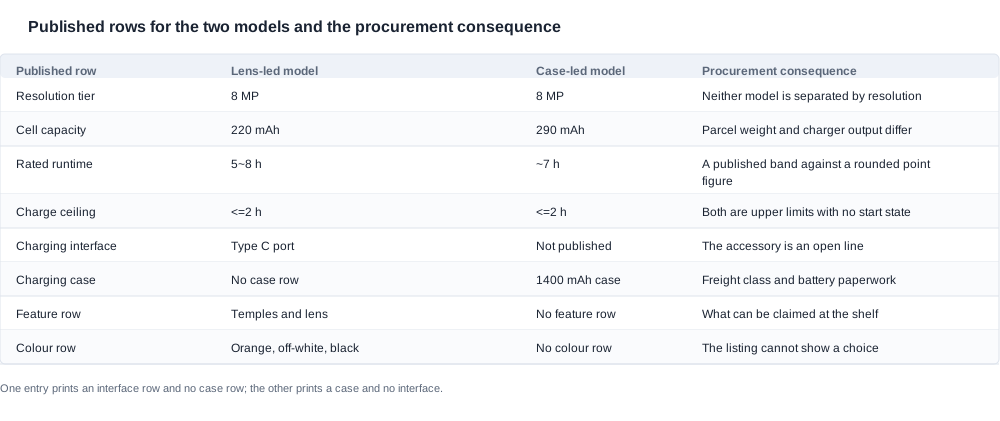
Everything below is taken from the published rows for the two models. The first two rows are the ones that change the parcel, and the last two are the ones that change what a shopper is shown on the page.
| Published row | Lens-led model | Case-led model | What the difference decides for a buyer |
|---|---|---|---|
| Resolution tier | 8 MP | 8 MP | Nothing on paper — both sit with the eight camera models published at 8 MP |
| Cell capacity | 220 mAh | 290 mAh | Parcel weight, charger output, and what the reserve power is spent on |
| Rated runtime | 5~8 h | ~7 h | A published band against a rounded point figure — two different claim types |
| Charge ceiling | <=2 h | <=2 h | Nothing — both are upper limits, with no start state published |
| Charging interface | Type C port | No interface row published | Whether the accessory is a standard cable or an unspecified one |
| Charging case | No row printed | 1400 mAh case | Parcel weight, freight class, and battery transport paperwork |
| Feature row | Flexible temples, photochromic lens, Type-C charging port | No feature row published | What the shelf claim can honestly say |
| Colour row | Orange, off-white, black | No colour row published | Whether the listing can offer a choice at all |
| Ingress protection | Not published | Not published | Only two models in the family publish a rating, and neither is one of these two |
| Certificate numbers | Not published | Not published | Remains open on both sides |
Read the cell and runtime rows together, because they are not the same on both sides. 220 mAh against 290 mAh, and a published band of five to eight hours against a rounded figure of approximately seven hours. Neither of the two figures carries a published test condition — the workload is not printed, the capture rate is not printed, and for the case-led model there is no statement about whether the case was in the cycle — so the two numbers are not directly comparable, and a quotation that gives one without the other is quoting half the picture.
What is identical on both sides is the charge ceiling, and that is a ceiling rather than a measurement. Two hours is stated as an upper limit with no starting state and no termination condition published, so it cannot be turned into a mid-shift interruption time or read as a turnaround figure for the case.
And the two entries are asymmetric in a way that is easy to miss. The lens-led entry prints an interface row and prints no charging-case row; the case-led entry prints a case and prints no interface row. A buyer who treats the two catalogue entries as equally documented will get one of the two wrong, because the gap sits on a different row in each.
The camera row does not separate these two models, and it separates neither of them from the rest of the family. Both publish an 8 MP tier. Across the eleven camera models in this range, eight publish 8 MP and three publish 13 MP. If your channel compares on resolution, this pair offers nothing, because the pair sits inside the same tier.
More importantly, neither model publishes the underlying capture specification. There is no sensor named, no field of view figure, no video resolution and no frame rate for either. That means a written claim about an "8 megapixel camera" is a claim about stills resolution, and nothing in the documentation supports a claim about video quality, about low-light behaviour, or about stabilisation. Two models in the same tier can produce visibly different results, and a shopper's comparison between them will not be settled by any published row.
This is where a sample stops being a nicety. If the product brief depends on capture quality at all — and for a camera glasses programme it usually does — the correct procurement step is to hold one unit of each model, shoot the same scenes under the same conditions, and record the results. That is cheap relative to a first production run, and it is the only step that converts an unresolved row into a defensible one. The written specification you hand to a distributor should be a specification you produced, not one you inherited.
One further shared gap, and it is a compliance gap. The catalogue contains no CE, FCC or RoHS wording that we can point to, and the export certification page in it is an image page showing ten patent certificates: eight for appearance designs and two for utility models. A patent is not a market-access compliance mark. If your market requires compliance documentation for this product, that documentation is not in the catalogue for either model, and it has to be requested as part of the supplier's compliance file before the order is placed rather than after the goods are in transit.
Question one: does the order carry a charging case
If the customer is expected to leave the frame off the charger for a full working day, the case-led model is the one that can carry that claim. The lens-led configuration has no charging-case row on the page. The case-led configuration publishes a 1400 mAh charging case. That is not a preference; it is the difference between a product that can sit in a pocket for two days and a product that has to be plugged in at the end of one.
The size of the difference is worth understanding properly. The case is a second lithium cell, not a plastic shell. It changes the parcel weight, the volumetric calculation for freight, the battery transport documentation that has to cover both cells, and the packing labour. A buyer who compares on unit cost alone is comparing the wrong line. The right comparison is the total cost of the delivered parcel — the frame plus the case, plus the freight and paperwork that follow it.
The larger cell on the case side is not there by accident, and it does not replace the case. The case-led configuration carries a 290 mAh frame cell against the 220 mAh on the lens-led one, and it still publishes the case as a separate item. The reserve power works in two stages: the frame is sized to cover the working day, and the case carries what is left over once the day is not. A buyer who reads the bigger cell as "and no case needed" has the catalogue upside down.
The counter-argument is a real one and belongs in the same decision. The Type-C frame ships with a cable the customer may already own, in a smaller carton, at a lighter shipping weight, and with a battery declaration that on the published rows covers the frame cell alone. For a direct-to-consumer channel where freight is a meaningful share of the landed cost, and where the customer charges overnight like they charge a phone, that configuration is easier to run. The question to ask is not which model is better, but how often the customer genuinely needs a second day of power without a wall.
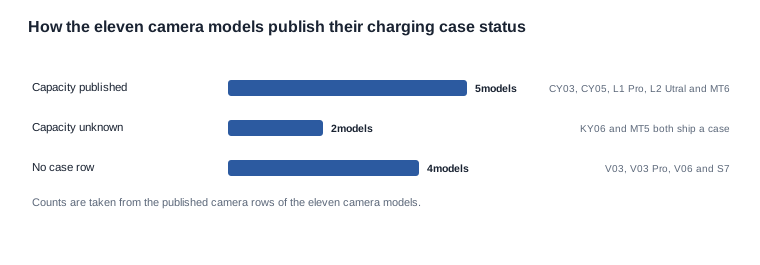
Across the whole camera family the case status splits three ways, and it is worth knowing which one you are in. Five models publish a case capacity. Three of them publish 1400 mAh — the L1 Pro, the CY05 and the CY03 — while the L2 Utral publishes 900 or 1400 mAh and the MT6 publishes 1200 mAh in a folding case. Two models ship a case without publishing its capacity. Four of the eleven camera models print no charging-case row at all — the V03 Pro and the V06, and the V03 and the S7 — and whether a case is supplied at all is an open item to put to the supplier. A supplier who says the case is optional is describing a different commercial arrangement from one who says the case is in the box, and the difference has to be in the quotation, not in an email.
Question two: the lens row and what it does not license
If the visible difference the customer notices first is a lens that responds to the light, then this comparison points one way, and there is no equivalent row on the other model. The published feature row for this configuration lists three things: flexible temples, a photochromic lens and a Type-C charging port. The case-led model's catalogue page carries no feature row at all, and in particular no row naming a lens of that kind.
Now the part that has to be handled carefully, because it is where this category produces its worst claims. The catalogue prints one thing about this lens: the name. It does not print the driving method, and it does not print a single photochromic performance parameter — not one figure: no transition time, no depth of tint, no light transmission figure, no temperature range, no cycle life. Any number a buyer receives on this feature therefore comes from somewhere other than the published documentation, and that is exactly the number that ends up on a product page and in a customer's expectation.
The practical consequence is a hard boundary on the listing copy. You may describe the lens as photochromic, because that is the name the catalogue prints. You may not describe how quickly it changes, how dark it becomes, what conditions trigger it, or how long it keeps working, because none of those are published. A channel that writes "adapts instantly to any light" has written a claim that no document in our file supports, and that claim is what generates the returns. The commercial risk is not legal exposure; it is a mismatch between the page and the product that shows up in the reviews within weeks.
There is a way to close this gap without waiting for a catalogue revision, and it is worth the effort. Hold a sample, put it through a doorway from shade into direct sun, and time the transition with a stopwatch. Do the same in the opposite direction. Record what you observe, in words, with a date and a condition, and use that description instead of a performance number. You will end up with something like "noticeably darker a second or two after direct sun, then clearing over several minutes indoors" — a claim you can defend because you watched it happen, and it is more useful to a shopper than a specification line with no method behind it.
One more caution about the lens. A photochromic configuration is not a neutral feature in a photography context — the catalogue says nothing at all about how a tinted state affects captured images. If your channel sells the product as a camera first and a lens second, make sure the customer hears about the lens before they buy, not after. It is the single most common source of the "the pictures look dark" complaint on this class of product, and one line of copy prevents it.
Question three: the interface row, the carton and the parcel
The interface row quietly decides your packaging, and on this pair the row appears on one side only. The lens-led entry carries a Type C charging port on its three-item feature list. The case-led entry prints no charging interface row at all — its catalogue page carries the resolution, the cell, the charge ceiling, the runtime and the case capacity, and stops there.
That asymmetry is a procurement question, not a cosmetic one. A Type C port is a standard interface that most customers can charge with a cable they already own and that most fulfilment operations can handle without special tooling. An unpublished interface is an open accessory line: the contact or the cradle has to be specified, quoted and procured as an item in its own right, and until the supplier puts it in writing you do not know whether the charging accessory is a standard USB-C cable, a proprietary contact, or something supplied with the case.
Ask for it as a separate line. Ask any supplier quoting either model for the accessory's minimum order quantity, for the lead time on the contact or the cable as a separate line, and for whether that accessory can travel in the same carton. A supplier who folds the accessory into the finished good quotes a delivered cost that a supplier who bills it separately does not quote at all. The per-unit accessory quantity is the figure that decides whether a configuration is viable at your volume, and it is the one number that never appears in a first quotation.
The carton follows the interface and the case. The lens-led configuration is a frame plus a cable. The case-led configuration is a frame plus a second cell in a moulded tray, plus whatever the charging accessory turns out to be. That is a different carton, a different insert, a different drop-test expectation, and a different packing line time. If your supplier quotes the frame unit cost but not the packaged unit cost, you are not comparing the same object.
Freight is the line where this comparison becomes a total cost conversation. We are not going to put a freight rate on this page, and no supplier should put a landed cost on a page either, because the answer depends on your carton dimensions, your destination and your incoterm. What we can tell you is which configuration carries more of the variables: the case-led model carries a heavier parcel and a second cell in the battery paperwork; the lens-led model carries a smaller parcel and one cell, but it may carry a separate accessory line that has to be counted, stored and re-ordered.
The rows a procurement file has to close before the order
These are the open items on both models, written as the questions a buyer sends in one message. A supplier who answers every one of them in writing has done the due diligence; one who answers three has not.
- The capture specification — the sensor, the field of view, the video resolution and the frame rate — for each model, none of which are printed for either.
- The photochromic performance figures for the lens-led configuration, or a written statement that the feature name is the only thing available.
- The endurance test conditions and where the charge ceiling starts — is the two-hour figure measured from empty, and under what workload each runtime figure was taken.
- Which charging interface the case-led model uses, a row its catalogue entry does not print at all, plus the charging indicator behaviour and the input specification for both.
- Case inclusion, case recharge time and the accessory minimum order quantity, and confirmation of whether the lens-led configuration can be supplied with a case at your quantity.
- Frame weight, temple length and lens dimensions for both, measured and stated.
- Ingress protection — only two models in the family publish a rating, and neither of them is one of these two.
- Certificate references: the numbers, the issuing bodies, the validity dates and which models each document covers, and whether the exact model designations appear on those documents.
- Storage capacity, file format and overwrite behaviour for the camera.
- The minimum order quantity, the lead time and the packaging specification per configuration, quoted per model and per colour.
Two of those lines deserve a warning. The first is the specification line, because a quotation that names a capacity without naming the conditions attached to it is not comparable with any other quotation. The second is the packaging line, because a per-unit accessory quantity that changes between the first quotation and the purchase order converts a viable configuration into a non-viable one at exactly the moment it is hardest to fix.
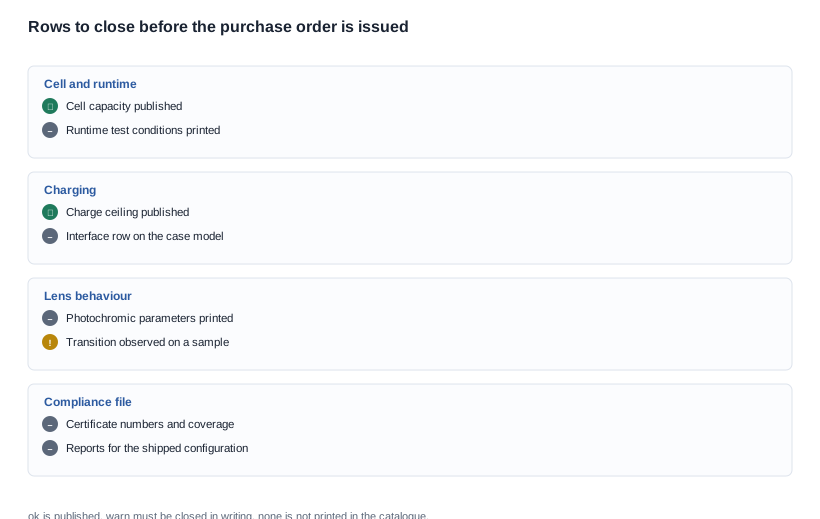
A shortlist built on these ten rows is worth more than a shortlist built on the visible features. The visible features are what a shopper compares in the first ten seconds; the ten rows above are what a distributor, a marketplace compliance reviewer or a returning customer will find out about later. When you are deciding which one to choose, criteria are what protect the channel, and the criterion that protects it is written down before the purchase order, not negotiated after it.
The verification sequence below is the part of the process that usually gets compressed, and it is the part that should not be. It is short, and every step is a question with a written answer attached.
- Hold one unit of each model and weigh both frames. The catalogue prints no weight for either model, and that missing figure decides whether the frame is wearable for a full session in the field your customer works in.
- Time the lens transition on the lens-led unit, in both directions. Ten minutes of work converts a feature name into a description you can publish. Record the condition and the date.
- Run the case routine end to end. Charge the case, run the frame flat, and work out how many times the case brings the frame back up in a working day. The arithmetic is trivial; where you stop is what changes the answer, and that answer is the one worth putting on the listing.
- Shoot the same scenes with both units — indoors, outdoors, in low light — and keep the files. This is what turns a resolution tier into a defensible image claim.
- Ask for the certification file and the packaging specification in writing, per model and per colour, and check the exact model designations on every document before it goes into the compliance file.
Signs that a configuration is not ready to order. A supplier who quotes a lens performance figure but cannot say where it came from. A supplier who will not confirm whether the case is in the carton at your quantity. A supplier who will not name the charging interface on a model whose catalogue entry does not print one. A supplier who offers a landed cost without stating the carton dimensions it assumes. A supplier who says the certificates cover the range without naming the designations on them. Any one of those is not a reason to reject the supplier, but all of them together is a clear sign that the order is being placed ahead of the information.
The line we draw on this comparison
These are two positions in a range rather than two grades of one product, and a range containing both is a range with a case-led configuration and a lens-led configuration — a distinction that matters more to the channel than the resolution tier does. We will not present an 8 MP tier as an image quality advantage over another model in the same tier, we will not put a photochromic performance number on a lens for which the catalogue prints only the name, and a charging interface that a catalogue entry does not print is not one we will describe. We do not publish a price on this page and we will not rank the two models; what we publish is the row, the gap and the question that closes it.
What we will do is tell you which rows differ, which are open on both sides, and which ones we can close for you on request — the lens performance figures, the measured frame weights, the packaging specification per configuration and the compliance documents that cover the exact designations on the order. Tell us the channel, the volume, the target market and the power the customer actually needs on day two, and we will map the published rows against that brief. The camera family these two models belong to is on the AI camera glasses range page.
Related reading
- The published row set for the lens-led model, read line by line — V03 Pro specifications and features
- The case-led model on its own terms — how the CY03 compares
- What to ask about a lens that changes — the photochromic lens guidance
- Where the open rows sit across the family — the rows the catalogue leaves open
Tell us the channel, the volume and the target market, and we will map the published rows against your brief.


