

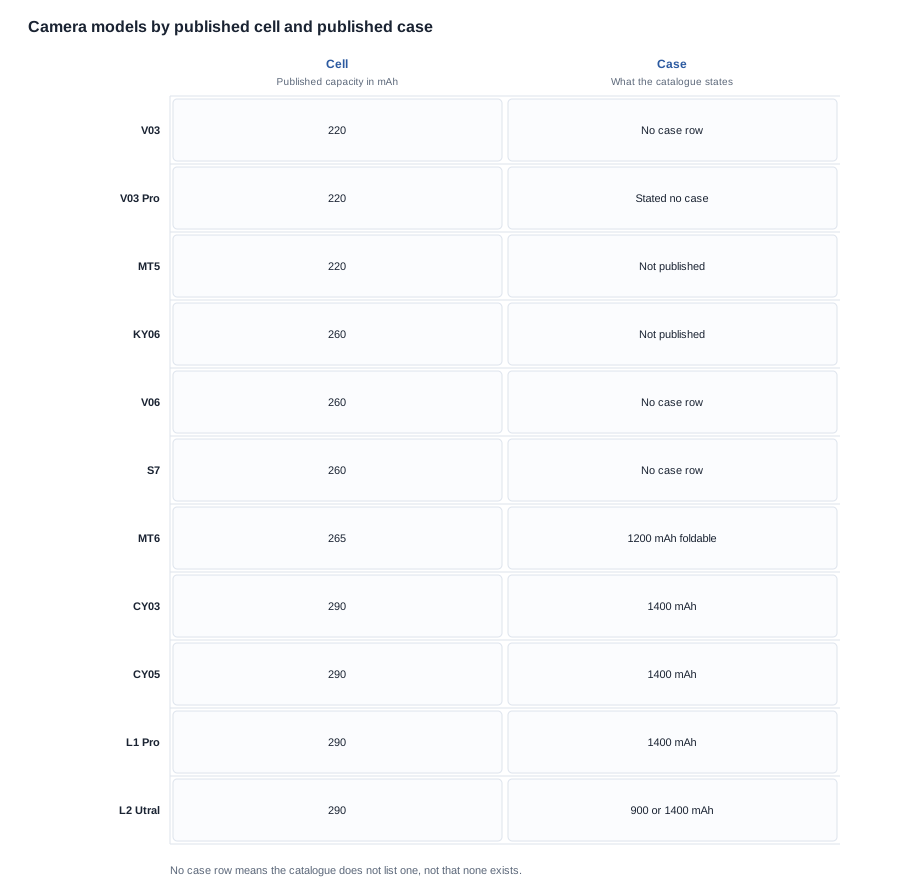
The CY03 publishes an 8 MP camera, a 290 mAh frame cell, a charge time of two hours or less, about seven hours of rated endurance and a 1400 mAh charging case. That places it at the top of the camera range on frame cell capacity, alongside the CY05 — which publishes identical rows, and whose difference from the CY03 the catalogue does not state. Every other model in the category differs from this one in at least one visible way. This one has a twin, and a comparison that does not resolve that fact will not settle anything. What follows is how to compare across the range using published rows, where the CY03 sits inside them, and which comparisons are simply not available.
Where the CY03 sits in the eleven-model camera range
The camera range publishes eleven models, and they group cleanly once you read them against the two rows that actually differ: frame cell capacity and what the catalogue says about the charging case.
The four models on the 290 mAh platform are the CY03 and the CY05, and the L1 Pro and the L2 Utral. All four publish a 290 mAh frame cell, a charge time of two hours or less, and about seven hours of rated endurance. The L1 Pro and the CY05, and the CY03 publish a 1400 mAh charging case; the L2 Utral publishes a 1400 mAh case as well as a 900 mAh option. Two of the four — the L1 Pro and the L2 Utral — are 13 MP, and the other two are 8 MP. This is the largest cell in the range, and it is the group a buyer is in when the priority is capacity rather than pixels.
The MT6 sits just below it at 265 mAh, with a 1200 mAh foldable charging case, an 8 MP camera and the same charge time and endurance figures. It is also the only model in the entire catalogue with a published weight, at 158 g, and that figure is the eyewear body including its cell and camera and excluding the foldable case. It publishes no charging method row. The MT6's published feature lines are portability, light weight and the foldable case, which makes it a different commercial object from the CY03 rather than a cheaper version of it.
The 260 mAh group is the V06 and the KY06, and the S7. The KY06 publishes a 6-to-8-hour endurance range and a case whose capacity is not published. The V06 and the S7 publish a 5-to-8-hour range, are published as magnetic, and have no case row at all — though both carry feature lines of their own: the V06 lists an ergonomic design, an extra-long endurance claim, a detachable inner frame and IP54 water protection across four colours, and the S7 lists an ergonomic design, a 13 MP sensor, a detachable inner frame and IP54 water protection. Both of them are the only models in the range with an ingress rating.
The 220 mAh group is the V03 Pro and the MT5, and the V03. The V03 publishes a 5-to-8-hour range, magnetic charging and no case row. The MT5 publishes a 6-to-8-hour range, magnetic charging and a case whose capacity is not published. The V03 Pro is the odd one out: it has no charging-case row, over Type C, and it is the only camera model in the range that publishes feature lines of its own — a flexible temple, a photochromic lens and a Type-C charging port, in orange, off-white and black.

The groups the published rows create
Reading the eleven models as groups rather than as a list is what makes the comparison usable, and it is worth being careful about how those groups are described. They are structural groupings based on published rows. They are not price tiers, and the catalogue publishes no price bands for any model.
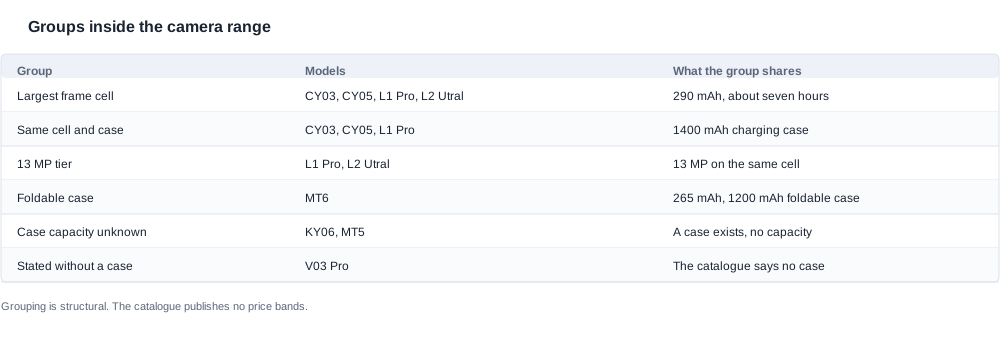
By frame cell capacity, the order is 290 mAh (L2 Utral and L1 Pro, and CY03 and CY05), 265 mAh (MT6), 260 mAh (KY06 and S7, and V06) and 220 mAh (V03 and V03 Pro, and MT5). Four distinct capacities across eleven models, which is a narrow spread — and that narrowness is itself a finding. It means the choice between camera models is not primarily a choice about power.
By resolution tier, eight models are published at 8 MP and three at 13 MP. The 13 MP models are the S7 and the L1 Pro, and the L2 Utral, and they sit in three different capacity groups. This is the more useful split of the two, because a pixel comparison is the one a customer can make unaided from a product page.
By case evidence, the range splits three ways. Five models publish a case capacity: the L1 Pro and the CY03, and the CY05 — each at 1400 mAh, the L2 Utral at 1400 mAh with a 900 mAh option, and the MT6 at 1200 mAh in a foldable form. Two models publish a case without a capacity: the KY06 and the MT5. Three models have no case row at all: the S7 and the V03, and the V06. And one model has no charging-case row: the V03 Pro.
That last split is where most buying errors happen, and the distinction between the third and fourth categories is not academic. "The catalogue does not list a case for the V03" is a statement about the sheet. "The catalogue states the V03 Pro has no charging case" is a statement about the product. Treating the first as the second leads you to plan an accessory that the source never promised, and treating the second as the first leads you to assume a case could be specified later for a model that does not have one.
By charging method, the range splits into magnetic, Type C and unpublished. The magnetic group is the V06 and the MT5, the S7 and the V03, and the KY06 among the camera models. The Type C group is the V03 Pro and the L2 Utral. The unpublished group is the CY05 and the CY03, and the L1 Pro and the MT6. A buyer comparing two camera models therefore cannot always compare their interfaces, and where one model publishes a method and the other does not, the absence is a gap in the sheet rather than a different interface.
The CY03 and CY05 twin and what it does to a range
The CY03 and the CY05 publish the same five rows on their respective catalogue pages, both are published without a charging method row, and neither publishes a feature row. Three explanations are possible, and each of them demands a different response.
They are one product under two names. If that is the case, running both fragments the channel, splits the sales history, creates two listings that a customer cannot distinguish, and doubles the working capital in a slow-moving line. The remedy is straightforward: run one model in the tier.
A commercial difference exists that was not recorded. A different minimum quantity, a different lead time, a different packing configuration, a different colour availability. In that case the difference is the only axis available for positioning, so get it in writing before you design the range around it — because a positioning axis that exists only in a conversation will not survive contact with a listing.
An unpublished technical difference exists. A sensor revision, a firmware branch, an enclosure change. In that case your differentiation is invisible to anyone reading the data, and the specification sheet for each model is incomplete in a way that surfaces later, usually when the two models are compared side by side by a customer.
This is worth resolving before you build a range, and it is structurally the same situation as the LC-105-1 and LC-105-2 pair in the audio category. Ask first, decide second. The CY03 versus CY05 price positioning analysis works through what each answer means commercially, and the AI camera glasses which model to pick piece covers the wider range structure.
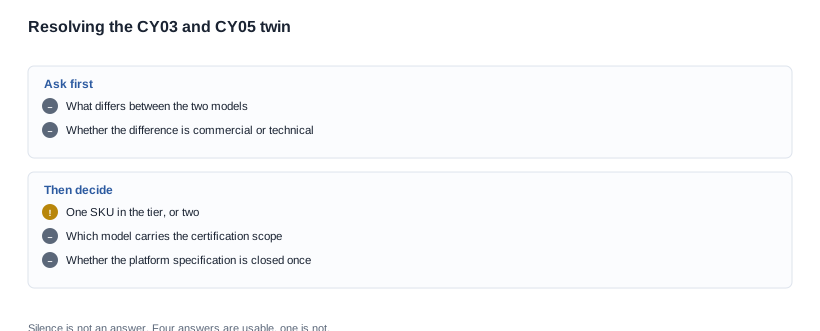
The resolution checklist is deliberately short, because the question has only one answer and it has to come from the supplier. What differs between the two models. Whether that difference is commercial, technical, or absent. Whether the documentation scope names both models or only one. Whether the camera specification is closed once for the platform or separately per model. And then the range decision: one SKU in the tier, or two.

What the CY03 cannot be compared on, and why
Some comparisons that buyers naturally reach for are not available for this model, and it is better to know that in advance than to build a shortlist around them.
Image quality cannot be compared from the sheet. Resolution alone is weak evidence. A sensor with small pixels can produce a worse image than one with fewer, larger pixels, and no sensor model is published for this model or for the CY05. No field of view is published, so framing is unknown. No video resolution or frame rate is stated, so the data alone does not even tell you whether this records video. The AI camera glasses imaging guidance covers why those omissions matter more than the resolution number does.
Fit and endurance cannot be compared from the sheet. No frame weight is published for this model, so comfort over a working day remains a sample judgement rather than a comparison criterion. The one published weight in the catalogue is the MT6 at 158 g, on a different platform with a different case arrangement, and it is not a proxy for the CY03 in either direction.
Durability cannot be compared at all. The CY03 publishes no ingress protection rating. The only two models with an ingress rating are the V06 and the S7, and that is a genuine structural difference between them and everything else in the range — but it is a difference you cannot use to argue for the CY03.
Compliance cannot be compared from the sheet. No certificate numbers are published, so no retailer's compliance file can be completed on the catalogue alone. The certification checklist covers what to request instead.
The pattern is worth stating as a rule for this category: what a comparison can settle is exactly what the published rows state, and nothing else. A comparison built on inference rather than on rows will fail at some point, and the point is usually a customer question.
The same rule applies to the due diligence that sits behind a comparison. A procurement team comparing camera models should be able to state, for each model, which rows are documented, which are not, and which document would close each gap — and that means the supplier has been asked in a form that can be answered in writing, naming the model. A comparison assembled from a catalogue PDF and a sales call is not a comparison a buyer can defend to a regulator, an insurer, or a customer who has read the same PDF.
How to structure a camera range around the published rows
If you are building more than one camera model, the published rows give you a workable architecture — and they give it in terms of what is documented, which is what makes it defensible.
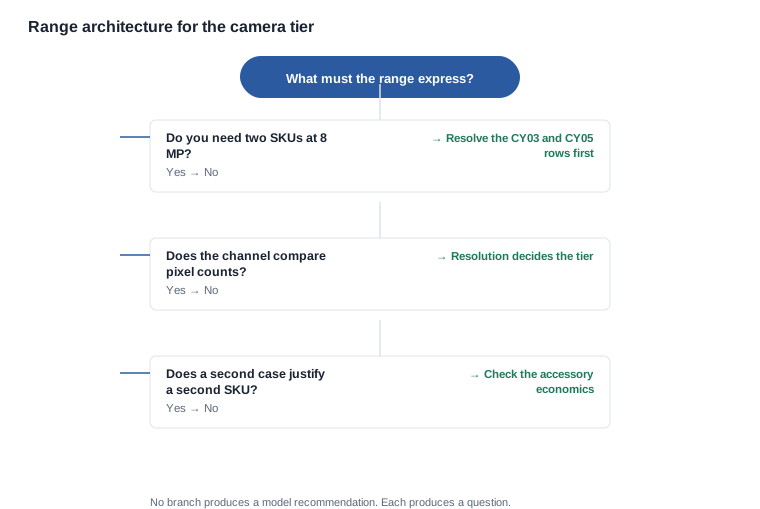
First, decide how many tiers the channel actually needs. A channel that compares pixel counts needs an 8 MP tier and a 13 MP tier, which means the CY03 and either the L1 Pro or the L2 Utral. A channel that sells the accessory as the proposition needs the 1400 mAh case, which the L1 Pro and the CY03, and the CY05 all publish. A channel that needs an ingress rating has a different range entirely, because only two camera models carry one.
Second, use the case as an accessory programme, not as a per-model decision. The 1400 mAh case covers three models and the L2 Utral shares it, which means one charging accessory, one set of instructions and one battery document can serve four SKUs. The MT6's 1200 mAh foldable case and the 900 mAh option on the L2 Utral are the two that break the programme.
Third, resolve the identical rows before you build the pages. A range that carries two SKUs with identical published rows has to carry a documented difference, and if it cannot, the range should be one SKU shorter.
Fourth, keep the unpublished rows visible in your own file. The sensor, the field of view, the weight, the video specification and the charging method for this model are all open items, and each of them is a question to put in writing before the order rather than a gap to absorb.
What a multi-model range costs on the commercial side
Every additional SKU in a camera range is not just another product page. It is another minimum order quantity, another lead time, another packaging specification, another set of artwork, another line in the quotation, another certification scope to confirm, and another set of units of working capital sitting in a warehouse.
The items that surprise buyers are rarely the obvious ones. The obvious one is working capital: a range with four SKUs holds four inventories, and the slowest of them sets the cash conversion cycle for the whole range. The less obvious one is documentation scope. If the certification documents name models rather than configurations, every model added to the range is a model added to a scope that has to be confirmed, and a scope question raised after a range has been assembled costs more than one raised before.
The third is packaging. A range that shares a 1400 mAh charging case can share one accessory programme, one battery document and one instruction set across four SKUs. A range that mixes in the 1200 mAh foldable case or the 900 mAh option breaks that, and the packaging specification becomes per-model rather than per-range. This is a design decision with a cost attached, and it is much cheaper to make it deliberately than to discover it during the first carton approval.
The fourth is the quotation itself. A multi-model request invites a blended unit price, which sounds like a discount and is usually an average across configurations with different costs. The commercial discipline is to quote each model separately, with its own minimum quantity, its own lead time and its own configuration string, and to treat any blended figure as a reporting convenience rather than as a price. Where a supplier offers a blended rate, ask for the per-model breakdown underneath it, because the blended number hides exactly the differences that determine whether the range works.
A fifth item belongs in the agreement rather than in the commercial discussion. If two models publish identical rows, the purchase order for each should name the configuration string and the scope of documentation that applies to it, so that a substitution between them is a visible event rather than an invisible one. A clause that says what happens when a delivery contains a different model than the order named, and who bears the freight, is worth more than a clause about warranty wording.
Building the comparison file so the decision survives
The comparison in this article is easy to perform once and hard to reproduce. That is normal, and it is worth fixing, because the person who builds a range is rarely the person who defends it eighteen months later.
The file needs four things. First, the published rows for every model in the comparison, with the page they came from, so that anyone can check them against the current catalogue. Second, the list of rows that are absent for each model, because the absence is a finding and not a blank space — and because the absence is what the next request should be based on. Third, the open questions, each with the date it was asked, the date an answer was received, and the exact wording of the answer. Fourth, the decision that was taken on the strength of it, and the reasoning.
That file is also the starting point for the next range decision, the next supplier conversation and the next compliance scope review. A range built on rows can be defended; a range built on impressions can only be re-argued. The CY03 smart glasses buyer review checklist turns the same discipline into the incoming-inspection form, and the specification list for this model is the row-level baseline.
The CY03 comparison boundary and what we will not infer
The CY03 is a well-specified mainstream camera platform whose one structural weakness is a twin it cannot be distinguished from in public data. If you need one model in this bracket, it is a defensible choice on published rows. If you are building a range, resolve the CY03-versus-CY05 question first, because everything else in the architecture depends on how many SKUs are actually in it.
We will not describe a difference that the catalogue does not state, and we will not present the shared endurance figure as a reason to prefer either model. We will not quote a frame weight for a model that has none, and we will not treat the two hour charge ceiling as anything tighter than a ceiling. The published CY03 specification list and the published CY05 specification list are the honest baselines, and the AI camera glasses range page is where the eleven configurations sit against each other.
Tell us the volume, the channel and the market, and we will tell you what separates the two models commercially if anything does, and which rows remain unpublished either way.
Related reading
- Where the CY03 sits in the camera range — AI camera glasses
- Why resolution is not image quality — AI camera glasses imaging
- How case capacity changes your economics — charging solutions
Share the target market, the quantity and the required configuration, and we will come back with what is available and what is not.


