

A buying team that opens a supplier file on this model is not looking for a verdict. It is assembling a procurement document that a quality inspector, a logistics planner and a compliance reviewer will each have to sign against. The published V03 Pro smart glasses specifications and features give that team a short, usable core: an eight-megapixel camera class, a 220 mAh cell, a five-to-eight-hour endurance band, a charge ceiling of two hours or less, a Type-C charging port, three feature rows, three colour names, and no charging-case row anywhere on the page. This article takes those printed lines one at a time, states what each one settles and what each one leaves open, and converts the remainder into a request list that can be sent to a supplier.
The catalogue behind these rows covers twenty-eight models spread across camera, audio, sport, children's, photochromic, bone-conduction and AR sections. That breadth is why a specification page written from a single row can mislead. A line that looks unusual in one section may be ordinary in another, and a line that is absent may be absent everywhere or absent only here. Before any row below is treated as a distinguishing feature of the V03 Pro, it has to be checked against the whole camera set, because that set is the only comparison a buyer of this model actually has.
Three questions run through the material: what the catalogue publishes for this model, what each published line fails to cover, and where the model sits among the eleven camera entries it belongs to. The fourth section answers the third question with the family distribution of resolution class, charging method, charging case and colour. The fifth turns the whole set into a file, a routing method and a checklist that has to be worked before any of it reaches a product page, a carton or a purchase order.
What the V03 Pro publishes
The catalogue prints this model with a camera resolution class, a cell capacity, an endurance band, a charge ceiling and a charging method, and one further row that carries a dash instead of a value — the radio version. On top of those come three feature rows, three colour names, and then a gap where a charging-case row would sit. Read as a set, they describe a camera product built around a single lithium cell and a wired interface, sold in three finishes, with a lens that reacts to light.
The label wording on this page is worth recording, because the catalogue uses the same duration word for two different quantities across the range, and a buyer who copies a figure between pages will move it onto the wrong axis. On this model's page the endurance value sits under a usage-duration label, the charge ceiling sits on its own charging-time line, and the cell value sits under an electromagnetic-capacity label. On three neighbouring camera pages the same duration word is used for endurance, with a separate charging-time line carrying the ceiling beside it. Neither reading is wrong; they are two conventions in one document, and a transcription error between them is invisible until someone tries to recharge the product.
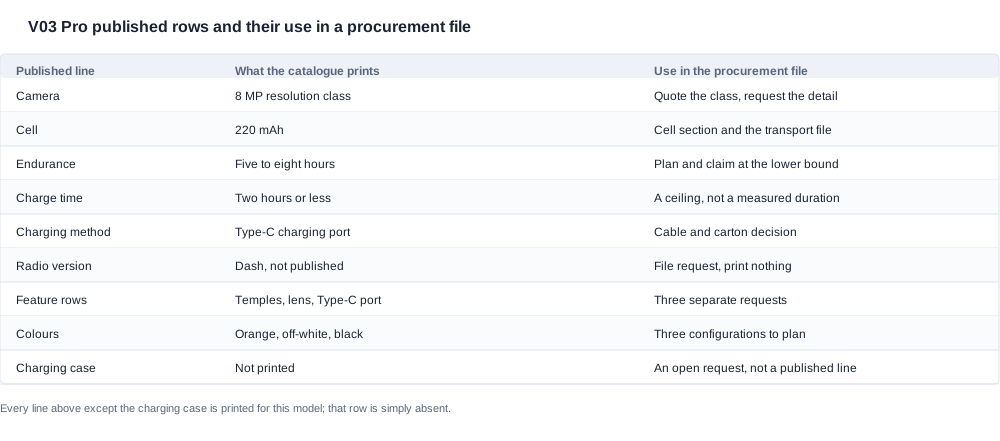
Set out below is the working transcription. The middle column is what the catalogue prints. The right column is what that line does in a procurement file, which is the only use a published row has until a document or a measurement replaces it.
| Published line | What the catalogue prints | Use in the procurement file |
|---|---|---|
| Camera | 8 MP resolution class | Quote the class as printed; request the sensor, the coverage, the frame rate and the storage arrangement |
| Cell | 220 mAh | Cell section of the specification and the transport document for the consignment |
| Endurance | Five to eight hours | Plan against the lower bound, and claim against the lower bound |
| Charge time | Two hours or less | A ceiling to schedule against, never a measured duration to quote |
| Charging method | Type-C charging port | Cable, adapter and carton decision for the brand owner |
| Radio version | Dash, not published | Technical file request; no version may be printed on a page |
| Feature rows | Flexible temples, colour-changing lens, Type-C charging port | Three separate requests, each with a different owner |
| Colours | Orange, off-white, black | Three production configurations to plan, label and stock |
| Charging case | No row printed on the page | The packing list still has a question open on it |
Three observations follow from the shape of that table. The camera line is the one the catalogue publishes least about, since a resolution class is the only part of a camera that can be quoted without a request sitting behind it. The charging interface appears twice, once inside the electrical block and once as a feature row, and the repetition is confirmation rather than extra information: it shows the port is a deliberate characteristic of the model rather than a production variant. The charging case is the one line on the page that is missing rather than printed.
That last point carries more weight than it usually gets. A row that prints a negative settles the packing list, the accessory programme and the shipping weight of the consignment on the day the file is opened, because there is no answer to wait for. A row that is simply absent settles nothing at all, and the difference between the two is not cosmetic. It converts an open item into a closed one, it fixes who has to act, and it removes a question that would otherwise sit unanswered in the supplier correspondence for weeks.
The three feature rows in full
The three feature rows are flexible temples, a colour-changing lens and a Type-C charging port. They are short enough to read in one pass, and each one carries a different kind of information, so a buyer who treats them as a list of selling points ends up defending all three with questions rather than answers.
- Flexible temples. The row states that the temples flex. It publishes no adjustment range, no hinge life figure, no temple length and no geometry. A supplier can answer those in a drawing with tolerances, and a bench can measure them, but neither can be inferred from the word itself. What the row does settle is that the product is not a fixed-geometry frame, which matters when one catalogue entry is sold to buyers with different head sizes, when a channel plans a replacement part, and when a freight class is being estimated.
- A colour-changing lens. The row names a lens that changes with light, and it publishes nothing alongside that name. There is no switching time, no tint depth, no light transmission range, no operating temperature range and no statement about what drives the change. The row is therefore a statement about a function rather than a specification of a behaviour, and a technical file that cites it without a mechanism behind it is citing marketing copy.
- A Type-C charging port. This row repeats the charging-method line from the electrical block, and the repetition is the useful part: it confirms that the interface is a designed characteristic of the model rather than a production variant. What it does not do is say what arrives in the carton. Whether a cable and an adapter are supplied, whether the port accepts a power bank directly, and whether the connector is rated for repeated insertion all remain open, and all three belong in the carton specification rather than in a marketing line.
The three colour names are a separate matter from the feature rows, because a colour is an instruction rather than a description. Orange, off-white and black are published, and in the camera set they are the only list of three; the V06 publishes four names, and the remaining nine camera models publish no colour line at all. Each published name is a production configuration, and each one carries its own artwork, its own label and its own conformity assessment. A brand that decides to carry all three inherits three sets of everything and no new platform, which is the cheapest form of range extension available in a section where the specification sheet is otherwise four rows deep.
The charging-case gap sits outside the feature rows and is the most consequential single absence on the page. No charging-case row is printed for this model. Because it is omitted rather than printed, the carton cannot be specified today: the parcel contents have to be confirmed, and any case is a new accessory decision rather than a pending answer. The same gap leaves the second cell unknown, which leaves the battery transport paperwork and the packing list open as well.
What none of these lines settles is the physical envelope. The catalogue publishes no frame weight for the V03 Pro, no dimensions, no lens measurements and no material list. The only weight figure published anywhere in the catalogue belongs to a different model — 158 g for the MT6 glasses body, excluding its folding charging case — and it cannot be transferred to this one. A shipment plan built on that number would be a plan built on another model's frame, and the error is the kind that only surfaces when a container is booked.
What the camera row leaves open
The camera row names a class and nothing else: the eight-megapixel resolution class. It is published, and it is a legitimate line to carry onto a specification sheet, because a resolution class is a comparable figure. What is not published behind it is everything that turns the class into a camera. The sensor model, the field of view, the video resolution, the frame rate, the video format, whether there is stabilisation, how the camera behaves in low light, and where the files are stored and in what format are all open.
That distinction matters more than it first appears, and it is a distinction that gets written wrong often enough to be worth stating plainly. The catalogue does publish a camera specification for this model — the eight-megapixel class — and it publishes one for every one of the eleven camera entries. What the range leaves open is the detail behind the class. A page that claims the catalogue publishes no camera specification for this model is not describing the record; it is describing a record that does not exist, and the correction has to be made before a buyer or an auditor makes it.
Three further absences belong on the same list because they affect the technical file rather than the product page. No radio version is published for any of the eleven camera models, so the protocol has to come from the supplier and cannot be written in from a neighbouring entry. No ingress row is published for this model; the IP54 marking appears on two camera models only, and neither of them is this one, so no marking is available to copy and no report reference can be requested. And no weight, dimension or material line is published anywhere on this page.
The request that closes the camera gap is short, and a supplier can answer it as a form rather than as a conversation:
- The sensor model behind the eight-megapixel class, and the field of view it covers.
- The video resolution and frame rate the camera records at, and the format the files are written in.
- Whether the camera is stabilised, and how it behaves in low light.
- The storage arrangement, how much footage the device holds, and what happens when storage fills.
- The radio version and the profiles the device exposes.
- Whether the eight-megapixel class applies to stills, to video, or to both.
The discipline this enforces is short, and it is the position we take on every model in the range: we publish the eight-megapixel class because the catalogue prints it, and we will not print a sensor model, a coverage figure or a frame rate that the documentation does not contain. A specification sheet that adds a sensor to this row has not been enriched; it has been falsified, and it will be corrected by the first technical reviewer who opens the supplier's own file.
That request is cheap to make and expensive to skip. A single written reply covering the camera detail closes the same gap for the whole camera family, because the eleven models publish the same class and the same blanks, so one exchange answers it for every model a channel might place on a shortlist. The trade-off is easy to state: an hour of correspondence now, against a disputed specification claim in a listing that a retailer has already indexed.

Where the V03 Pro sits in the camera family
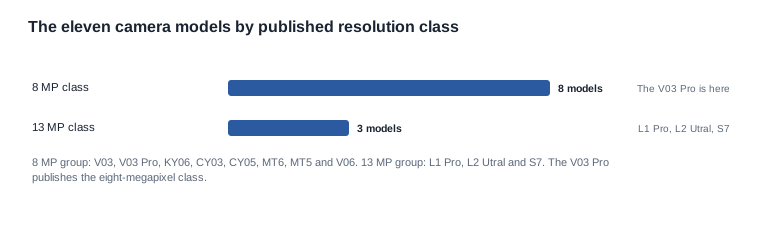
The camera section of the catalogue lists eleven models, and the published resolution divides them into two groups. Eight sit in the eight-megapixel class — MT6 and V03 Pro, MT5 and V06, and KY06 and CY05, and V03 and CY03 — while the remaining three sit in the thirteen-megapixel class: the S7, the L1 Pro and the L2 Utral. On this axis the V03 Pro sits in the larger group, so the single camera figure it publishes is the family's default rather than an exception to it — a useful thing to know before a buyer spends effort separating this model from the others on camera grounds.
The charging rows divide the same eleven models three ways, and this model's position among them is one of the more useful facts on the page. Five entries print magnetic charging: the V03 and V06, MT5 and S7, and KY06. Two publish Type-C: this model and the L2 Utral. The remaining four publish no charging method at all, being the CY03 and the MT6, and the L1 Pro and the CY05, each of which shows a charging-case capacity without stating how the frame or the case is charged. A buyer comparing two camera models on interface alone is therefore comparing two published interfaces with one blank, which is a weaker comparison than it looks.
The charging case behaves in three ways across the same set, and one of the three is a figure the catalogue prints. A capacity is published for five models: 1400 mAh on the L1 Pro, the CY03 and the CY05, two capacities of 900 mAh and 1400 mAh on the L2 Utral, and 1200 mAh on the folding case of the MT6. Two more, the KY06 and the MT5, list a case without stating what capacity sits inside it. Four models, the V03 Pro and the V03, and the S7 and the V06, print no charging-case row whatsoever, so their case position is unpublished rather than settled. The V03 Pro is the eleventh, and it sits among those four rather than outside them.
The endurance bands follow the same family-wide pattern of presence without conditions. Four models publish five to eight hours — the V03, this model, the V06 and the S7 — two print a band of six to eight hours, and five show roughly seven hours. All eleven publish a figure, and not one of them publishes the condition behind it, so a working-day number for any of them has to come from a measured unit rather than from the range sheet. The method for reading a band without a condition is set out in the battery comparison across the camera range.
Two smaller family facts change the order in which requests should be sent. Colours are published for two camera models only, this one with three names and the V06 with four, so a colour programme on any other entry starts from a blank rather than from a selection. And the only ingress protection in the whole camera set sits on the V06 and the S7, which means a marking copied from a neighbouring page onto this model is unsourced from the moment it is written. The surrounding entries are collected in the AI camera glasses range reference if a wider view is needed.
Sorting the family record by how each fact gets established turns it from a list of blanks into a work programme with owners attached:
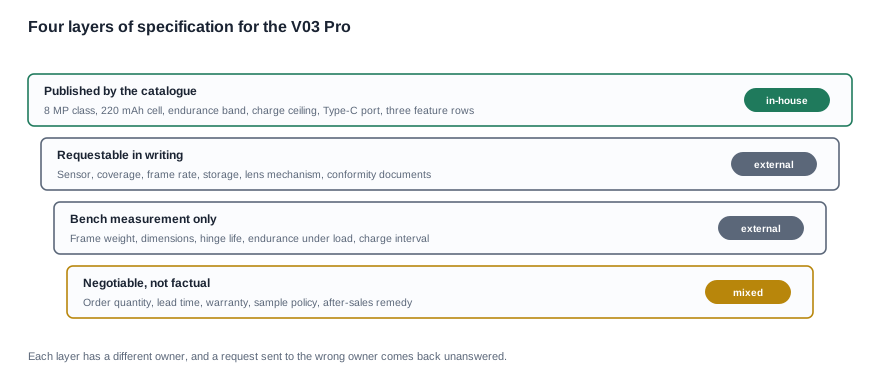
The V03 Pro smart glasses specifications and features
What a buyer should take from all of this is a method rather than a ranking. The published lines on this page are the model's confirmed baseline, and confirmed means exactly that the catalogue prints them: an eight-megapixel camera class, a 220 mAh cell, a five-to-eight-hour endurance band, a charge ceiling of two hours or less, a Type-C port, three feature rows, three colour names and no charging-case row. None of those needs a supplier to be confirmed. Everything else does, and each item needs a different kind of confirmation from a different owner.
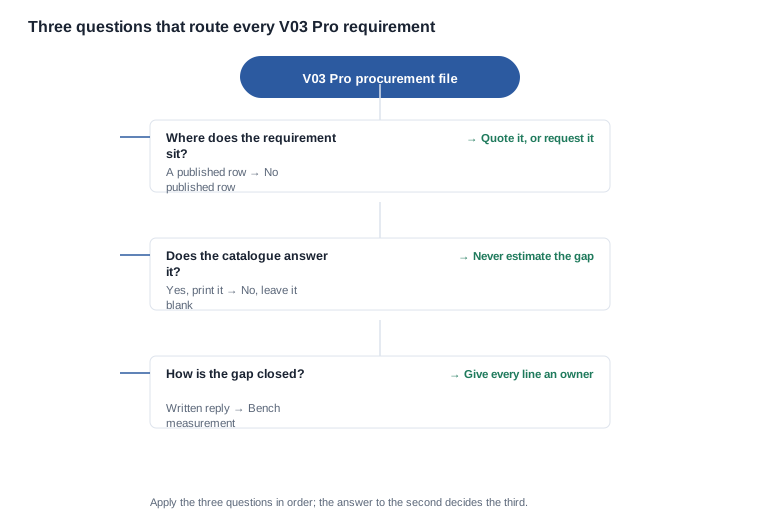
The three questions in that chart are the fastest way to sort a requirement list before it becomes a specification. Where a requirement lands on a printed line, it moves into the file as written. Where it lands on a line the catalogue does not print, it becomes a request with a named owner and a date, and it stays out of the marketing copy until it comes back. A gap that is estimated is the only kind of gap that cannot be closed later, because a figure that reaches a carton has already become a commitment the channel made on the manufacturer's behalf.
Conformity is the area where the published record is thinnest, and it has to be handled carefully because the vocabulary buyers use is far wider than the record itself. Neither CE, FCC nor RoHS appears anywhere in the catalogue text, and no conformity line is printed for this model or for any other. What a buyer can work from is the framework — the Radio Equipment Directive (EU) 2014/53/EU and the EMC Directive 2014/32/EU — and what has to be requested from the supplier is the evidence that this specific configuration sits inside it. The export certification page in the catalogue front matter carries ten patent certificates, and those sit at company level rather than at model level. A patent certificate and a conformity certificate answer different questions, and one cannot stand in for the other in a compliance file. The route through the request stage is set out in the camera range certification note.
The commercial side of the file is settled the same way. The catalogue publishes no order quantity, no lead time, no warranty term, no sample policy and no delivery schedule for this model, and none of those is a specification question. Each is a negotiation item that belongs in the purchase order and its annexes rather than in a request attached to a specification, and a technical file that arrives without them is a technical file that has been written twice. What a platform claim has to contain before it can be used on a page is covered in the OEM ready platform criteria.
For a shortlist, the comparison against the neighbouring entries is short, because the published rows overlap so heavily. The V03 and V03 Pro specification comparison sets the two entries side by side, and the charging options breakdown works through what a wired interface changes in the carton and in the accessory programme. The trade-off worth evaluating is not between two sets of published numbers — on cell capacity, endurance band, charge ceiling and resolution class the two entries are identical — but between the published feature rows on one side and the published absence of a charging case on the other. That is a sourcing decision, and it belongs in the shortlist criteria rather than in a marketing sentence.
Before any of it reaches a page, a checklist is worth more than a second reading of the specification. The four groups below separate what may be printed from what must be requested, what must be measured and what must never appear in copy at all. Each line in the last group is a place where a plausible figure would be easy to add and hard to defend. Each line in the first group is a place where the catalogue has already done the work, and a buyer who quotes those correctly saves a supplier a round of questions.
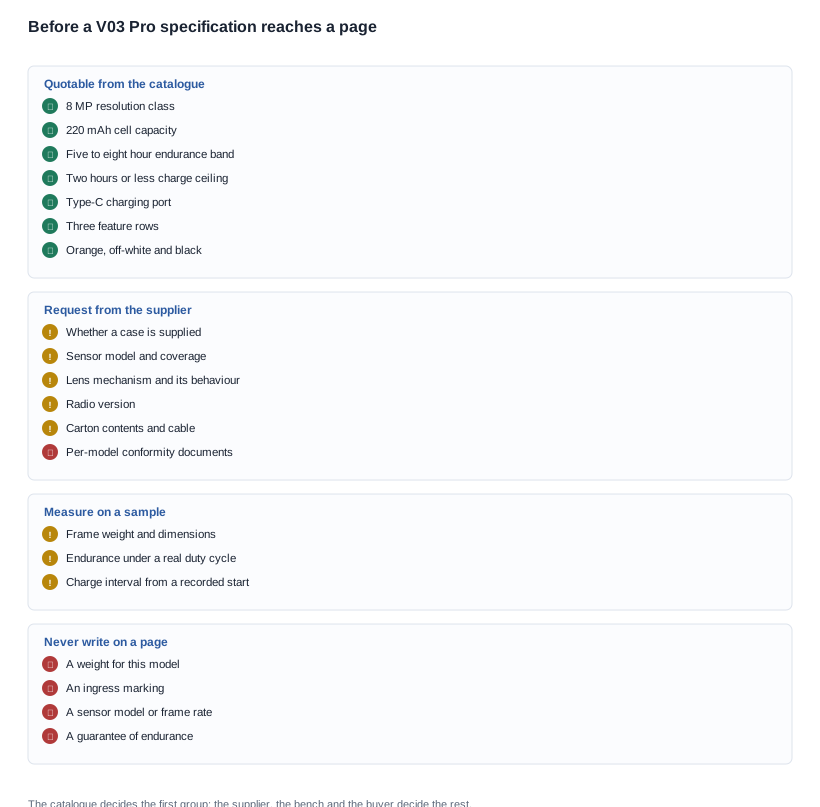
The V03 Pro smart glasses specifications and features therefore describe a model with an unusually legible electrical baseline and an unusually open optical one, and the procurement task is to keep the two apart. What the catalogue publishes can be quoted on a product page without qualification. What it does not publish has to travel as a written request, a bench measurement or a negotiated term, and it has to reach the supplier before the artwork goes to print rather than after it has been approved. A lens row without a mechanism behind it, a resolution class without a sensor behind it, and a charging interface without a cable behind it are the three places where this model is most often misread, and all three are closed by the same routine.
Related reading
- The published gaps for the same model — V03 Pro limitations and open items
- The neighbouring entry on the same platform — V03 smart glasses specifications and features
- The only other camera model with a published colour list — V06 smart glasses specifications and features
- How a charging case changes the shipment — AI camera glasses charging case options
- What a lens row has to become before it can be defended — photochromic smart glasses buying guide
The published rows go into the specification annex as written; everything the catalogue does not print goes out as a dated request with an owner attached.


