
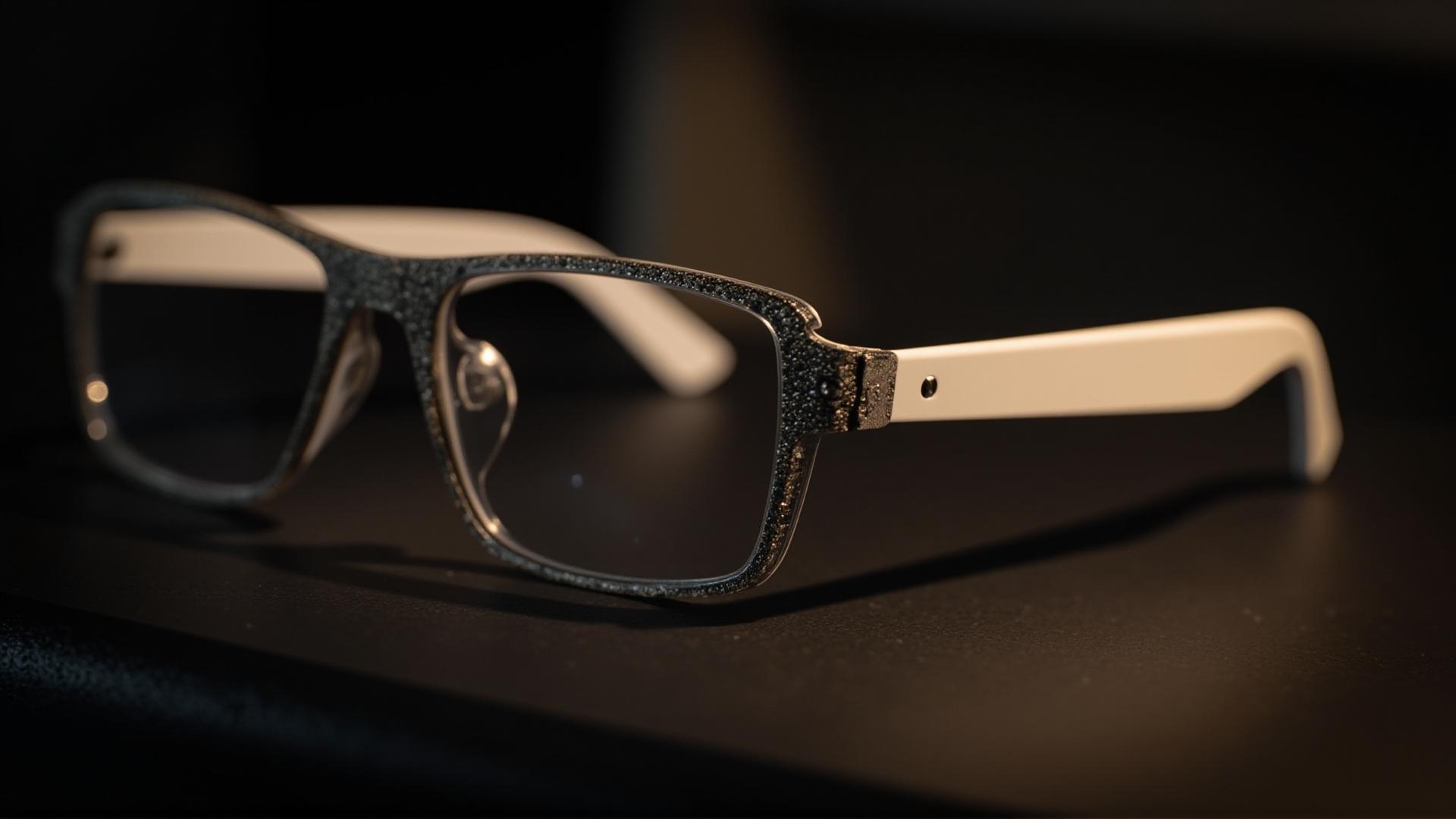
Two camera-glasses models in this range are built for two different jobs, and the way to choose between them is to settle the job first and let the model follow. The V03 Pro is published as a photochromic-lens configuration with flexible temples, three colour options and no charging-case row; the L1 Pro is published as a 13-megapixel model with a 290 mAh cell, an approximately seven-hour rated runtime and a 1400 mAh charging case. They are not variants of one idea and they are not graded versions of a single product. One is a lens-led configuration and one is a power-led configuration, and a buyer who compares the two on the resolution row is comparing the wrong number entirely.
This page is written for the person who has to defend the choice — to a business owner, to a marketplace compliance reviewer, or to a customer who has already asked why the two listings look nothing alike. It treats the choice as two customer journeys rather than two specification tables, because that is where the decision actually lives, and it sets out the criteria you should use before you order.

V03 Pro and L1 Pro: the two use cases they are built for
The mistake this comparison invites is to start at the specification table. Start instead at a working day, because the two models solve problems that arrive at completely different points in a day. One problem arrives the moment the frame goes on. The other arrives at hour six, when the frame is flat and the cable is not in the bag.
The first journey is the wearer who wants one pair of glasses for a day that moves between indoor and outdoor light. This customer already owns prescription glasses, has spent years putting them on and taking them off as the light changes, and has concluded that carrying two pairs is a nuisance. They are not shopping for a camera. They are shopping for the absence of a specific irritation, and the feature that answers it is a lens that changes with the light.
The second journey is the person who has to be recording all day and cannot stop to find a cable. This customer is filming first-person video for work, or building short-form content, or documenting a site visit. Their complaint is never about lenses. Their complaint is that the device stops before they do, and that they cannot hold a separate camera up while their hands are busy.
Three people have to defend this choice, and they need different things from the same decision. A brand owner is deciding which customer the product is for, and the two journeys above share almost nothing. A procurement manager is comparing two supplier quotations and needs to know which of the two differentiators can actually be evaluated from a document today. A channel buyer is writing the listing and needs to know that the visible differentiator and the felt differentiator are not the same one.
Here is the decision in one line. The differentiator you can evaluate today is the case, because a case capacity is a number you can read. The differentiator your customer will feel — the lens behaviour — is the one the documentation does not quantify. A buyer who optimises for the visible one is optimising for the thumbnail, and the thumbnail is not the purchase.
And here is the honest limit of the whole comparison. A customer who wants both a changing lens and a large reserve battery is not served well by either model, because the lens row is published against the 8-megapixel configuration and the case row against the 13-megapixel one. If your brief needs both, that is a question for us rather than a gap to engineer around, and it is much cheaper to ask before a range is designed than after. The right time to ask which one to choose is at the range-design stage, when a configuration can still be added to the roadmap, rather than at the reorder stage, when it cannot.
Use case one: the customer who already owns glasses
Start with the customer, because the customer is the reason the configuration exists. Picture someone who has owned prescription glasses for twenty years and has spent the last five of them swapping between two pairs as the light moved from a window to a street. They are not comparing cameras. They are comparing two pairs of glasses against the third pair that would remove the switching.
The lens-led model is the one published for that customer. The feature row published against this configuration names flexible temples, a photochromic lens and a Type C charging port, and a colour row publishes three options: orange, off-white and black. That combination is the merchandising story — a product that does a recognisable thing, offered in a choice of finishes, in a packaging format that stays simple because the frame charges over a standard port.
For this customer the specification rows are close to irrelevant, and that is the point. A 220 mAh cell with a five-to-eight-hour rated runtime is entirely adequate for a day of intermittent capture. A 13-megapixel sensor would not change the customer's experience at all. What changes it is whether the lens does the job the customer has been trying to solve with a second pair of glasses.
But the boundary on the claim is hard, and this is where the category fails most often. The catalogue prints the word photochromic and nothing else about the lens. No transition time, no tint depth, no light transmission figure, no temperature range and no service life are printed, and the driving method is not printed either. So you can build a listing around the existence of the feature, and you cannot yet build one around how fast it changes or how far it goes. If your channel briefs a copywriter before the numbers exist, the copywriter will invent them.
The commercially safe way to write it is observed, not claimed. Hold a unit, carry it through a doorway from shade into direct sun, and time what happens with a stopwatch. Do the reverse on the way back. Write down what you saw, in words, with the condition and the date attached, and use that sentence in the listing. "Visibly darker within a couple of seconds of direct sun, clearing over several minutes indoors" is a sentence you can defend because you observed it, and it is more persuasive to a shopper than a bare specification line with no method behind it.
One warning belongs in this journey rather than in the manual. A changing lens is not a neutral feature in a photography context, and the documentation does not say anything about how a tinted state affects captured images. If your listing leads with the camera and mentions the lens second, tell the customer about the lens before they buy. It is the most common source of the "the pictures came out dark" complaint on this class of product, and it is entirely avoidable with one line of copy.
Use case two: the customer who creates all day
Picture a different customer entirely. Someone filming a whole working day first-person, or a site supervisor who records inspection walks, or a seller producing short-form content for a catalogue. Their problem is not lenses. Their problem is that the frame dies before the work does, and that they cannot put a separate camera in their hand while they are using both of theirs.
The case-led model is published for that customer. It carries a 13-megapixel tier, a 290 mAh cell with an approximately seven-hour rated runtime, and a 1400 mAh charging case in the box. Its catalogue page publishes no charging interface row at all, so whatever charges it — a contact, a cradle or a lead — is an open accessory line that has to be confirmed in writing before the order. The case is the point of the configuration, and it is worth being clear about why.
A case changes the relationship between the device and the working day. A creator who cannot find a cable mid-session is a creator who stops recording, and the footage that was never captured is worth more to them than any difference in stills resolution. A 1400 mAh case turns a one-day product into a several-day product, and that change in the customer's day is larger than the megapixel difference — which is why a listing that leads with the case is usually the more persuasive one for this audience. When you assess a configuration for this customer, the reserve power is the first criterion and the resolution tier is the third.
The frame cell is larger here, and the case is still there. The case-led configuration carries a 290 mAh cell against the 220 mAh on the lens-led one, and it publishes the case as a separate item on top. That tells you how the reserve power is designed: the frame is sized to run the working day, and the case covers the part of the day the frame cannot. Reading the bigger cell as "and no case needed" is reading the catalogue upside down, and it is the most common misreading of a configuration like this one.
The resolution tier is real, and it is narrower than it looks. Of the eleven camera models published in this range, eight carry an 8-megapixel tier and three carry a 13-megapixel tier. This model is one of the three. That is a genuine difference in stills resolution, and it is also the only difference the documentation supports on the camera side.
Here is the limit you have to hold. A megapixel figure is a statement about stills, not about video. Neither model publishes the sensor, the frame rate, the video resolution or the field of view, so a 13-megapixel advantage cannot be converted into a claim about video quality, low-light behaviour or stabilisation from documentation alone. If your customer's brief turns on video rather than stills, this model cannot be signed off from the catalogue either, and the 13-megapixel tier does not change that. The honest way to use it is as the resolution entry point for a shoot-and-keep workflow, and then to test the output on a sample before the claim reaches a listing.
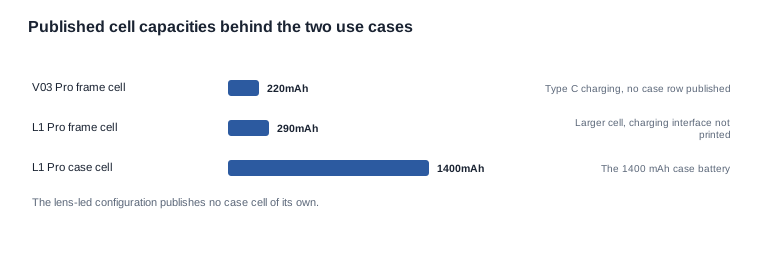
And here is the second limit, which is a commercial one. The case is a second lithium cell. It adds parcel weight, a second cell in the battery transport documentation, a moulded insert in the carton and a packing line time that the cable-only configuration does not have. For a channel where the delivered cost per unit is the number that decides whether the range works, that is a real line in the total cost conversation — and it is the line a buyer should ask a supplier to break out rather than absorb into a single unit figure.

The specification walk, in the order the decision gets made
The rows below are presented in the order the decision is actually made, not in catalogue order. A buyer working from the top down reaches a conclusion in minutes; a buyer working from the bottom up reaches a contradiction. If you are assessing these two models against a brief, read them in this order and the trade-offs explain themselves.
| Published row | Lens-led configuration | Case-led configuration | Why it comes at this point in the decision |
|---|---|---|---|
| Charging interface | Type C port | No interface row | Sets the accessory, the cable and the carton before any other cost is known |
| Cell and runtime | 220 mAh, 5~8 h | 290 mAh, ~7 h | The larger cell funds the reserve power the case then holds |
| Colour row | Orange, off-white, black | No colour row | Decides whether the listing can offer a choice at all |
| Charging case | No case row printed | 1400 mAh case | The last row, because everything above it assumes which configuration you are buying |
| Resolution tier | 8 MP | 13 MP | A stills differentiator that does not settle the use case on its own |
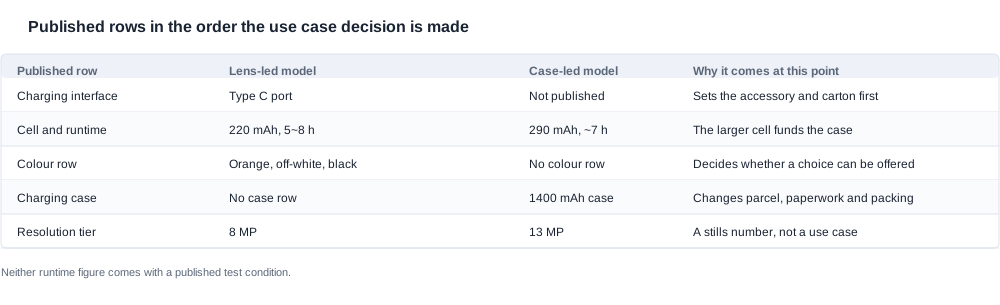
First, the interface — and on this pair it is published on one side only. The lens-led configuration prints a Type C charging port among its three feature rows. The case-led configuration prints no charging interface row at all, so whatever charges it has to be established in writing before the accessory can be quoted, let alone ordered. A Type C port is a standard interface that most customers already own a cable for; an unpublished interface is a proprietary accessory in waiting, and it should be priced, counted and lead-timed as its own line.
That is a procurement point, not a product point. Ask any supplier quoting either of these models for the accessory minimum order quantity, the lead time on the contact or the cable, and whether the accessory can ship in the same carton. A supplier who treats the accessory as part of the finished good will quote a delivered cost that a supplier who treats it as a separate component will not. This is one of the classic red flags in this category: the per-unit accessory quantity is never mentioned in the first quotation and turns out to be the number that decides whether the configuration is viable at your volume.
Second, the runtime, and the two figures are not the same kind of figure. The lens-led configuration publishes a 220 mAh cell and a five-to-eight-hour band; the case-led configuration publishes a 290 mAh cell and an approximately seven-hour point estimate. Neither figure comes with a published test condition — not the workload, not the capture rate, not whether the case was in the cycle for the second one — so the two are not directly comparable. A quotation that repeats one without the other is quoting half the picture, and a listing that turns a published band into a single number is making a claim the catalogue does not support.
Third, the colour row. Three published colour options against no published colour row is a merchandising difference with a procurement consequence behind it. A colour option is a separate packaging specification, a separate minimum order quantity per colour and a separate stock line that can go slow on one finish while another sells. A model with no colour row published is one packaging specification, one stock line and a simpler replenishment story. Decide this before you order, because splitting a run across colours after it is placed is where the inventory risk appears.
Fourth, and last, the case. The lens-led configuration prints no charging-case row at all; the case-led configuration prints a 1400 mAh case. This row comes last because it is the one that changes the parcel, the paperwork and the packing operation, and a buyer who reaches it without having settled the interface, the runtime and the colour has already made three decisions that the case will invalidate. Across the family, case status splits three ways — five print a capacity, two show a case without a figure, and four print no case row at all — so "it comes with a case" is never a safe assumption from a catalogue page.
The resolution tier, for completeness, sits below all four. Eight models publish 8 MP and three publish 13 MP, and this comparison is between one of each. It is a stills number, it is the easiest line for a shopper to compare, and it is the line least able to tell you which customer each model is for.
Proving the fit on samples before the order
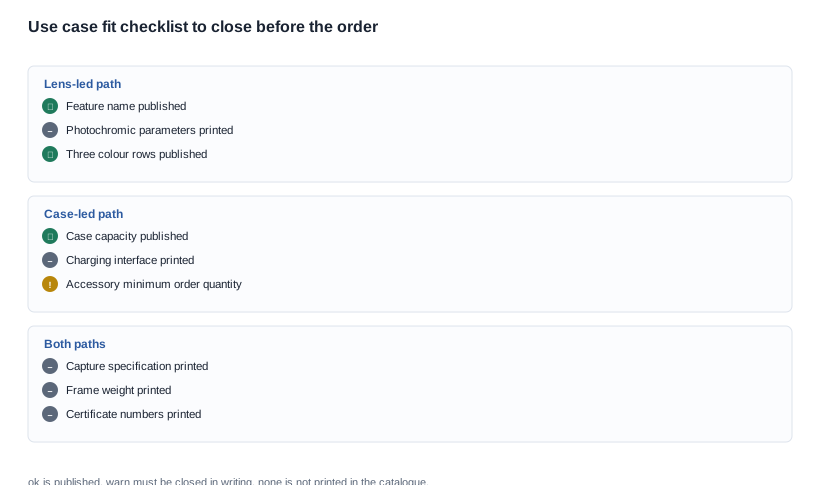
The questions below belong in one message to the supplier, not spread across three calls. A supplier who answers all of them in writing has done the work; a supplier who answers two has given you a brochure. These are the questions to ask, and they are the ones worth negotiating for a written answer rather than a verbal assurance.
- The capture specification for each model — the sensor, the frame rate, the video resolution and the field of view, none of which appear for either model in the catalogue.
- The photochromic performance figures for the lens-led configuration, or written confirmation that only the feature name is available.
- The runtime test conditions and the starting point for the charge ceiling for each model, including whether the case was part of the measured cycle.
- The frame weight and dimensions for both models, measured and stated, because that row decides whether either is wearable for a full session in your customer's working environment.
- The charging interface on the case-led configuration, which its catalogue entry does not print, together with the accessory minimum order quantity and the lead time on the charging cable or contact as a separate line.
- The case inclusion, the case recharge time and the packaging specification per configuration and per colour.
- The certificate numbers, the issuing bodies, the validity periods and the covered model schedule, including whether the exact designations appear on the documents.
The sample protocol is short and it is where the real answers are. Weigh both frames on the same scale and write the numbers down — weight is not printed for either model, and it is the row that decides whether the larger configuration survives a full session. Time the lens transition on the lens-led unit in both directions. Work the case through a full day: charge the case, let the frame run down, and count how many times the case brings the frame back up — the arithmetic is trivial, but the real number depends on where you stop, and the real number is what belongs in a listing. Shoot the same scenes with both units, indoors, outdoors and in low light, and keep the files.
Six ways this fit goes wrong, and what each one looks like. These are the pitfalls worth writing into your own process, because each one is a published gap that somebody treated as a published fact. The lens was sold as a performance, and the customer expects a fast, dark result that the product does not deliver — the symptom is a returns spike with a single cause. The 13-megapixel tier was sold as image quality, and a customer compares the output and finds a lower-resolution product is better in low light. The case was assumed to be in the carton, and the retail proposition depends on a reserve battery that does not ship. The charging interface was assumed to be a standard cable, and the accessory turns out to be a proprietary item with its own minimum order quantity. The weight was left out of a wearability claim, and the larger configuration comes off during a session. The two models were listed on one page, and a shopper compares them on a thumbnail and the wrong one wins the click.
The pattern in all six is the same, and it is worth naming. Each one is a published gap that somebody treated as a published fact. A catalogue row that is absent is not a row that says yes, and the procurement step that closes the gap costs a sample and a phone call. The signs that a supplier has done the work are simple: a written answer on every question above, a measured number where the catalogue has none, and a quotation that breaks the accessory and the packaging out instead of folding them into one figure. Those three signs are the difference between a due diligence trail and a brochure.
The answer for the two use cases
These two models answer to two different customers, and the use case fit is decided before the specification table is opened. We will not fill in a lens performance number for a lens the catalogue describes only by name, we will not present a 13-megapixel tier as an image quality claim without a capture specification behind it, and we will not describe a charging interface that a catalogue entry does not publish. We will also not rank them, because the ranking depends entirely on the customer your channel serves, and that is a brief we would need you to give us.
What we will do is map the published rows against the brief you send — the channel, the volume, the target market, and the power the customer needs on the second day — and tell you which rows already answer the question and which ones have to be closed with a supplier before the order goes in. When to ask that question is not when the purchase order is due, but when the range is being planned, because a configuration that is missing from the roadmap cannot be added at the reorder stage.
The camera family both models belong to is on the AI camera glasses range page, and the way a charging case changes the product is covered in how case capacity changes the product.
What to do next.
- Write the customer in one line — the wearer who wants one pair of glasses, or the creator who has to record all day.
- Send the seven questions in one message, and get the answers in writing.
- Weigh both frames, time the lens and count the case recharges on samples.
- Set the listing boundary for each model separately, so that a published row and an observed behaviour are never confused.
- Separate the pages and separate the propositions, and keep the shortlist honest about which model serves which brief.
Related reading
- Where the three 13-megapixel models sit against the eight-model 8 MP group — how the V03 Pro compares across the camera family
- The charging method behind both configurations — the charging options in this range
- The photochromic configuration and what it does not license — photochromic smart glasses
Send the channel, the volume and the customer, and we will map the published rows against your brief.


