
If you are sourcing AI camera glasses for a brand of your own, the charging method on the V03 Pro is the kind of detail that looks settled on a spec sheet and turns into a procurement problem two weeks later. The catalogue row for this model lists a 220 mAh cell, a battery life figure written as a range, a charging time written as an upper limit, and Type C as the charging method. That is a usable starting point. It is not a plan, because none of those four values tell you what happens when a buyer in your market plugs the glasses in at 11pm with a half-flat battery and needs them working for a two-hour shift the next morning.
This page works through what the V03 Pro charging specification actually publishes, what it leaves open, and how to convert the published row into questions that get answered in writing before a purchase order is signed. The same discipline applies to the wider camera group: the AI camera glasses product range is the reference point, and each model carries a different answer in the charging column, which is why a cross-model comparison often produces more questions than it solves.
What the catalogue publishes for the V03 Pro
The V03 Pro is listed in the camera group as the photochromic-lens configuration of the V03 AI camera glasses. That positioning matters for this page: the V03 Pro and the V03 share the same platform, the same 220 mAh cell, the same stated battery life, and the same stated charging time, but they do not share the same charging method. The only configuration-level difference in the V03 Pro row relative to the base V03 is the lens option, and the catalogue presents three colour choices for it. That makes the V03 Pro the only camera model in the range published with a photochromic lens, and the only camera model that publishes three selectable colour options alongside that lens.
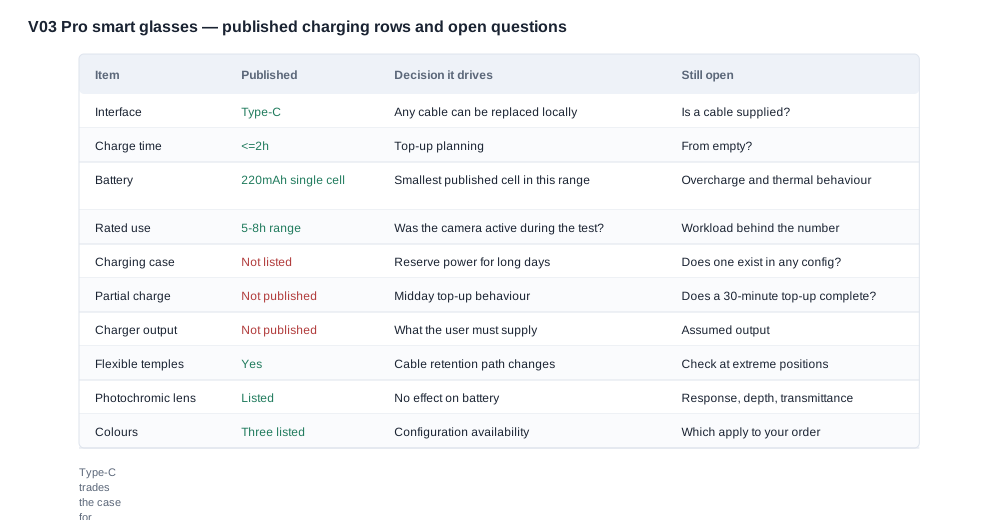
Here is what the published row contains, field by field, as it stands in the product PDF:
- Model name. V03 Pro, presented as the V03 AI camera glasses in the photochromic lens configuration.
- Battery cell. 220 mAh.
- Battery life. A range written as 5~8 h rather than a single number, which means the published value is a band, not a measurement.
- Charging time. An upper limit written as ≤2 h.
- Charging method. Type C.
- Bluetooth version. Not published for this model.
Two features of that list deserve to be called out before anything else. First, there is no charging case row for the V03 Pro, and there is no charging case row for the base V03 either. Several other models in the same camera group list a case capacity alongside the charging method, so the absence on these two rows is a visible gap in the range rather than a formatting quirk. If your programme assumes a pocket case that extends runtime between charges, the V03 Pro's published specification does not settle the question either way. Second, the Bluetooth version is blank. That is normal for the camera group as a whole, and it is exactly the sort of field that gets filled in by assumption later, when someone asks "is it 5.4?" and the conversation moves on. It is not published, so it should not appear in your internal comparison sheet either.
The lens configuration also shapes the charging story in a way that is easy to miss. The V03 Pro is the photochromic configuration, and photochromic lens behaviour is tied to ambient light. If a published runtime figure was measured under a particular ambient condition, the condition itself becomes part of the specification, because the same glasses in a bright retail environment are not the same test subject as the same glasses on a dim evening commute. We return to this in the third section, because the question to put to a supplier is not "how long does it last" but "under what light condition was that measured, and with what screen behaviour".
For the wider context of how this model sits alongside the lens options and the rest of the range, the specifications and features overview covers the published fields in more detail, and the photochromic buying guide covers the lens side. For the battery behaviour specifically, the V03 Pro battery life page works through what a 5~8 h band does and does not promise. The comparison with the base V03 is handled on the V03 Pro versus L2 Utral page, which is useful reading because the L2 Utral is one of the models in the group that does publish a charging case.
What the catalogue publishes, then, is a small set of facts with two notable omissions: no charging-case row, and no Bluetooth version. Everything else in this article is about turning the published values into a written specification.
Type C as the published charging method, and what that does not tell you
Type C is the charging method published for the V03 Pro. It is a genuinely useful piece of information, because it is the part of the charging specification that your customers, your fulfilment warehouse, and your packaging designer all need to agree on. It tells you that the charging interface on the V03 Pro is USB Type C, and it is the same interface family used across most modern consumer devices. A buyer sourcing accessories, a warehouse programming charging station labels, and a packaging team deciding whether to include a cable in the box can all work from that single fact without further questions.
What Type C does not tell you is nearly everything that matters once the unit is in a customer's hand. It does not say whether the port is on the temple, at the hinge, or at the end of a cable that runs to the battery. It does not say whether the glasses charge while worn, which for camera glasses is a question with real operational consequences, because a device that must be removed and set down to charge cannot be charged at a kitchen table during a work break without becoming an object that gets misplaced. It does not say whether the port is exposed or covered by a sealing flap, and a sealed port on an optical product interacts with ingress and cleaning routines in ways that a buyer should hear about before ordering rather than after. It does not say whether a proprietary magnetic contact is present alongside the port, which is the detail that determines whether a third-party charging pad or a case is even possible.
The same is true of the neighbouring model. The base V03 uses a magnetic charging method in the published row, with the same 220 mAh cell, the same 5~8 h battery band, and the same ≤2 h charging time ceiling. A magnetic method and a Type C port are not interchangeable from a sourcing perspective. Magnetic charging implies a dock or a pogo-pin arrangement that has to be sourced, matched, and matched to your packaging. It also implies that the charging contact position becomes a physical design constraint for any custom tooling, mould, or accessory you commission. The V03 Pro versus L2 Utral battery and charging comparison sets this against a third method, where the charging method itself is not published and the case capacity is published instead. Three models, three different states of knowledge about the charging interface, all with the same ≤2 h ceiling.
Then there is the ≤2 h itself. An upper limit is a bound, and a bound is useful for planning, but a bound cannot be used as a schedule. If a unit charges in 45 minutes rather than two hours, and a batch is charged in parallel on a shelf, a 2-hour figure would overstate your throughput. If a unit takes close to two hours, a 2-hour figure would understate your required dwell time. The figure also says nothing about the charger: no input current, no output current, no adapter requirement, no statement about whether a standard phone charger is acceptable or whether a particular wattage is needed. For a first bulk order, that is usually manageable. For a programme that expects to ship tens of thousands of units with a fixed warehouse workflow, it becomes a specification item.
We will not publish a charge time the catalogue does not state, so a buyer planning a replenishment cycle should ask for the test condition in writing before the order is confirmed. That sentence is the whole point of this page. The catalogue states ≤2 h. It does not state a charge time, a test current, a test temperature, or a test protocol, and any number that looks more precise than ≤2 h on a product page is somebody's estimate rather than a published figure.

The practical reading of the charging column across the group is this. The camera models published as 220 mAh, V03 Pro and V03, carry a ≤2 h charging time ceiling. The 290 mAh models, L2 Utral and L1 Pro, and CY03 and CY05, carry the same ≤2 h ceiling on a larger cell, which is a combination that invites the question of whether the larger cell charges at the same rate. Three of those four do not publish their charging method at all and publish a 1400 mAh case instead, and the fourth publishes Type C with case capacities of 900 mAh or 1400 mAh. The gap is the pattern: the camera group is published in terms of outcomes, battery life and charging time, and not in terms of the interface that produces them.
The right way to evaluate this is not to pick the most convenient number on the sheet. It is to establish which charging architecture your programme actually needs, and then ask the supplier in writing whether the model you have selected supports it. The checklist below is built for that conversation.
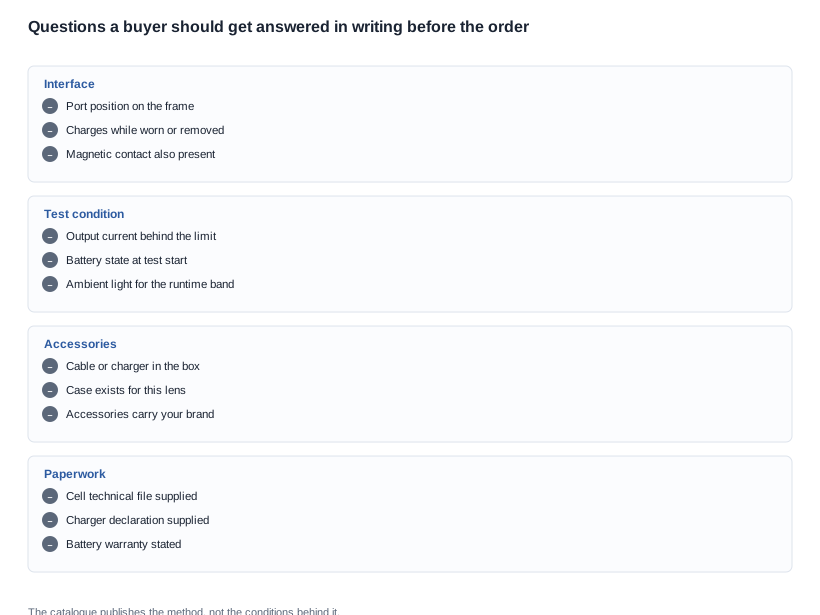
- Confirm the physical interface. Ask where the charging contact or port sits on the glasses, and whether the port is exposed or sealed.
- Confirm whether the unit charges while worn. Ask whether charging requires the glasses to be removed and placed on a separate dock.
- Confirm the charger specification. Ask for the input and output current, and whether a standard USB Type C charger can be used in your market.
- Confirm the test condition behind ≤2 h. Ask what output current, what battery starting state, and what temperature the published ceiling was measured at.
- Confirm whether a charging case exists for this configuration. Ask whether a case exists for the photochromic configuration, and if it does, request its capacity and its own charging method.
- Confirm the runtime band. Ask what the 5~8 h band means in test terms, what the low end corresponds to, and what the high end corresponds to.
- Confirm the accessories position for a private label programme. Ask whether a cable, a dock, or a charger is supplied, and whether it carries your branding.
- Confirm the Bluetooth position. Ask for the Bluetooth version in writing, and what the chipset supports, rather than assuming the newest revision.
- Confirm the tooling implication. Ask whether a magnetic dock, a moulded insert, or a printed charge instruction requires new tooling, and who owns that tooling.
- Confirm the warranty and the compliance boundary. Ask for the warranty period on the battery and the charging interface, and what the compliance file covers for the cell and the charger that ships in the box.
That last item is where a procurement conversation often gets skipped. The catalogue for this range does not publish FCC, CE, RoHS, or RED markings for the camera models, and the certification information available for the range is presented as a page of images rather than as a per-model line. That means the battery cell, the charger, and the radio in the shipped configuration need to be covered by documentation you actually hold before you commit, and the request should be specific: which file covers the cell, which file covers the charger, and which entity declares conformity for the finished unit in your target market. The AI camera glasses certification page sets out the difference between a document you have been given and a compliance claim you have only been told about.
The sample is the moment where these questions become testable. If a supplier can send a sample order with a charger and a dock that behave as described, the charging specification stops being an abstraction. A sample also settles the questions that no spec sheet can answer on its own: how the charging contact feels in use, whether the glasses charge while worn in practice, how long a unit actually takes from the state your customer will hand it over in, and whether the case and the cable fit the packaging you have designed. Ask for the sample before the quotation is finalised, not after, so that the answers are part of the purchase order rather than a conversation you remember later. The buyer review checklist covers the rest of the model-level review, and the how to customise page covers what can be changed for a private label programme.
The charging questions a buyer should get answered in writing
The reason a charging specification is worth this much attention is that it is unusually easy to fix late and expensive to fix late. The port position, the charger input, the test current behind the ≤2 h ceiling, and the existence of a case are all decisions that sit upstream of tooling, packaging artwork, and warehouse training. Change any of them after the mould is cut and you are paying for a change to a mould, a reprint, and a restock, and you are doing it with your own branding on the box.
So the questions to ask are not optional courtesies. They are the criteria by which two suppliers quoting the same catalogue row can actually be compared. Two quotations for the V03 Pro will look identical on price, and differ on the port position, the included charger, the case availability, and the documentation. The only way to see the difference is to ask for it in writing before you order, and to require the answer to appear in the quotation and then in the purchase order.
Here is what to ask a supplier on this model specifically, and how to evaluate the answer, in the order the questions pay off:
- Ask for the charging interface in writing, with a drawing. A photograph of the port on the temple is enough to start, and a drawing with a dimension is enough to design a dock or a moulded insert around it. If the supplier cannot produce either, you have learned something important about how the product is documented.
- Ask for the test condition behind the published figures. State it back to them: a 220 mAh cell, a 5~8 h runtime band, and a ≤2 h charging ceiling. Ask what each was measured under. The answer for runtime should reference screen time and usage pattern; the answer for charging should reference output current and battery state.
- Ask for the case question answered explicitly, with yes or no. Do not accept silence. If a case exists for the photochromic configuration, request its capacity, its charging method, and whether it is a separate purchase. If it does not exist, you need to know that before you write a product page that implies one.
- Ask for the radio version in writing. The catalogue does not publish it for this group, so request the chipset and the Bluetooth version the production units will carry.
- Ask for the documentation list, item by item. Which technical file covers the battery cell, which declaration covers the charger, and which conformity declaration covers the finished unit for the market you intend to ship into.
- Ask for the factory and quality control arrangements. What is the production site, who runs the incoming cell inspection, what sampling is applied to finished units, and what the acceptance criteria are for a batch that fails the charging test.
- Ask for the warranty position on the cell. A battery warranty is a specific term, and it is usually shorter than the product warranty. Ask what is covered, what the claim process looks like, and what happens to a unit that fails inside the warranty period.
- Ask for the commercial terms in the same conversation. MOQ, lead time, unit price at each volume tier, the quotation validity period, deposit and balance structure, payment terms, incoterms, shipment method, and what happens to the tooling and the artwork if the relationship ends.
That last point is where charging questions become commercial ones. If the charging dock is custom to your programme, the tooling is custom to your programme, and the ownership of that tooling should be written down. The same applies to the packaging insert that holds the glasses and the cable. A contract that leaves those two items unstated creates exactly the kind of dispute that a procurement team spends weeks resolving after the shipment has already landed.
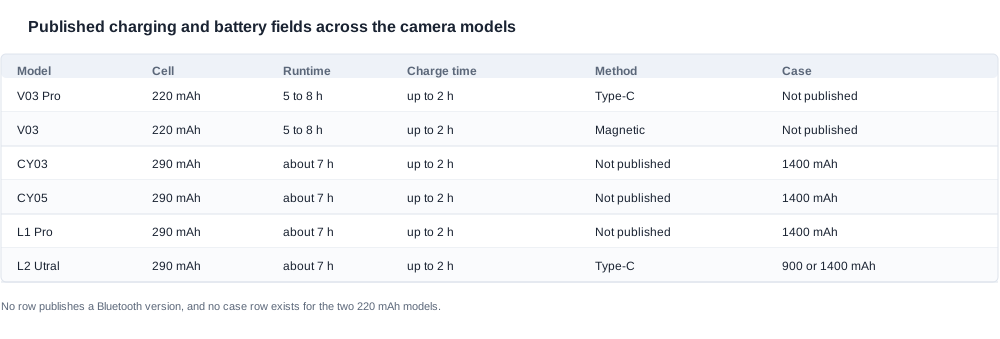
The table below shows the published charging and battery fields for every camera model in the group. Read it as a map of what is known and what is not, not as a ranking. The V03 Pro row is complete on cell, runtime, charging time, and method, and empty on case and Bluetooth. The rows below it are complete on cell, runtime, charging time, and case, and empty on method and Bluetooth. The V03 row is complete on method but empty on case. No row in the group publishes a Bluetooth version, so a comparison built on that column cannot be built at all.
| Model | Cell | Runtime | Charging time | Charging method | Case |
|---|---|---|---|---|---|
| V03 Pro | 220 mAh | 5~8 h | ≤2 h | Type C | Not published |
| V03 | 220 mAh | 5~8 h | ≤2 h | Magnetic | Not published |
| CY03 | 290 mAh | ~7 h | ≤2 h | Not published | 1400 mAh |
| CY05 | 290 mAh | ~7 h | ≤2 h | Not published | 1400 mAh |
| L1 Pro | 290 mAh | ~7 h | ≤2 h | Not published | 1400 mAh |
| L2 Utral | 290 mAh | ~7 h | ≤2 h | Type C | 900 / 1400 mAh |
Two cautions about reading this table. First, the runtime column mixes a band and an approximation: 5~8 h is a range, and ~7 h is a rounded figure. Neither is a measured value you can put in a product page as a guarantee, and neither tells you what the unit does when it is recording continuously rather than idle. Second, the charging time column is a ceiling across every model in the group, so it cannot be used to separate the models from each other. The only column that genuinely separates them is the charging method column, and the only column that separates the 220 mAh pair from the 290 mAh group is the cell capacity.
That is a thin set of differentiators, and it is worth saying plainly. If you are choosing a camera model on charging grounds alone, you are choosing between a Type C and a magnetic interface, and between two cell sizes. Everything that would make a model meaningfully different on this axis, the runtime under load, the real charge time, the case, the connector position, the charger, is unpublished. That is not a reason to skip the model. It is a reason to treat the unpublished rows as the actual specification work.
Putting the charging method into the purchase order
A charging method only becomes a contractual fact when it appears in a document with a signature on it. The progression should run from a written answer, to a written quotation, to a purchase order, to a technical file that the factory and the quality control team both work from, and finally to the documentation you hold for your own compliance and due diligence.
The written answer is the email or the message where the supplier confirms the port position, the included charger, the case position, and the test condition. Keep it. When the quotation arrives, the numbers on it should be traceable back to that exchange, and any number that appears for the first time in the quotation should be questioned rather than accepted. A price that has moved because a specification changed is fine. A price that has moved because a specification was discovered to be different is a lesson about the last order.
The quotation should carry the identity of the model precisely enough that nothing is ambiguous: the model name, the photochromic lens configuration and the selected lens colour, the quantity band, the unit price, the MOQ, the lead time, the deposit and balance terms, the payment terms, the incoterms, and the validity period of the quotation. Add a line for the accessories. State whether a cable ships in the box, whether a charger ships in the box, and whether either carries your private label. State whether a case ships, and if it does, its capacity. If the answer is that no case exists for this configuration, write that into the quotation as well, because a written negative is worth as much as a written positive and it is what protects you from a product page written by someone else.
The purchase order is where the unanswered questions become a risk you carry. Every item on the checklist above that came back with a clear answer should appear on the purchase order or in the technical file attached to it. Anything that came back vague should not be signed until it is resolved, because a vague answer at quotation stage becomes an argument at inspection stage, and an argument at inspection stage becomes a rejected batch, a delayed shipment, and a customer who is already waiting.
The trade-off to negotiate deliberately is between specification certainty and price. A supplier who will sign a written answer for the port position, the charger, the cell documentation, and the case position is doing more for your programme than one who quotes two percentage points lower and answers nothing in writing. That premium buys you a defect rate you can reason about instead of a defect rate you discover. The trade-off is real, and it is also the one most likely to be priced incorrectly, because the buyer who only compares unit price never sees the cost of the wrong carton arriving at your warehouse.
Quality control has a part in this as well. The charging test is a testable criterion, and it belongs in the inspection plan as a named check with a stated method: charge from a stated battery state, at a stated current, for a stated duration, and confirm the unit reaches the expected state. The acceptance criteria for that check should be written by you, because the factory's default criterion will be whatever passes its own process. Ask how many units in the batch are tested, whether the test is a burn-in or a sample, and what happens to a failed batch.
A final word on due diligence, because charging documentation is where due diligence usually gets skipped. The battery cell, the charger, and the radio each carry their own conformity obligations, and the finished unit you ship carries the obligation in your market. The catalogue does not publish FCC, CE, RoHS, or RED for the camera models, and the available certification information is an image page rather than a per-model row, so the burden of collecting the right file sits with you. Ask which entity produces the declaration, ask for the technical file, and ask for the test report identifier that matches the cell you are actually shipping. Ask also for the factory audit or the quality control report that covers the production site, and ask whether the supplier will accept your own inspection before shipment rather than only offering theirs. If the answer to any of these is vague, that is a finding, and it is a finding you can act on before you order rather than after.
The V03 Pro is a capable camera model with a published Type C charging method, a 220 mAh cell, a runtime band of 5~8 h, and a charging ceiling of ≤2 h. That is what the catalogue says. The gaps are equally clear: no case row, no Bluetooth version, no port position, no charger specification, no test condition behind any of the figures. A buyer who treats the published row as the specification will ship a product page that promises more than the catalogue states. A buyer who treats the published row as the starting point and closes the gaps in writing will ship a product page that holds. The difference between those two outcomes is not a better supplier or a worse one. It is a purchase order with the answers in it, or a purchase order without them.
- List every published charging field for the model you are quoting, exactly as the catalogue states it.
- List every field the catalogue does not publish for that model, and do not fill any of them from another model's row.
- Send the ten-item charging checklist to each supplier and require written answers.
- Request a sample order with the accessories you expect to ship and confirm the charging behaviour in hand.
- Put the answers into the quotation before it becomes a purchase order.
- Attach the technical file and the documentation list to the purchase order.
- Write the charging check into the inspection plan with your own acceptance criteria.
- Record the due diligence items — declaration, audit, quality control report, warranty terms — and review them again before the first bulk order repeats.


