
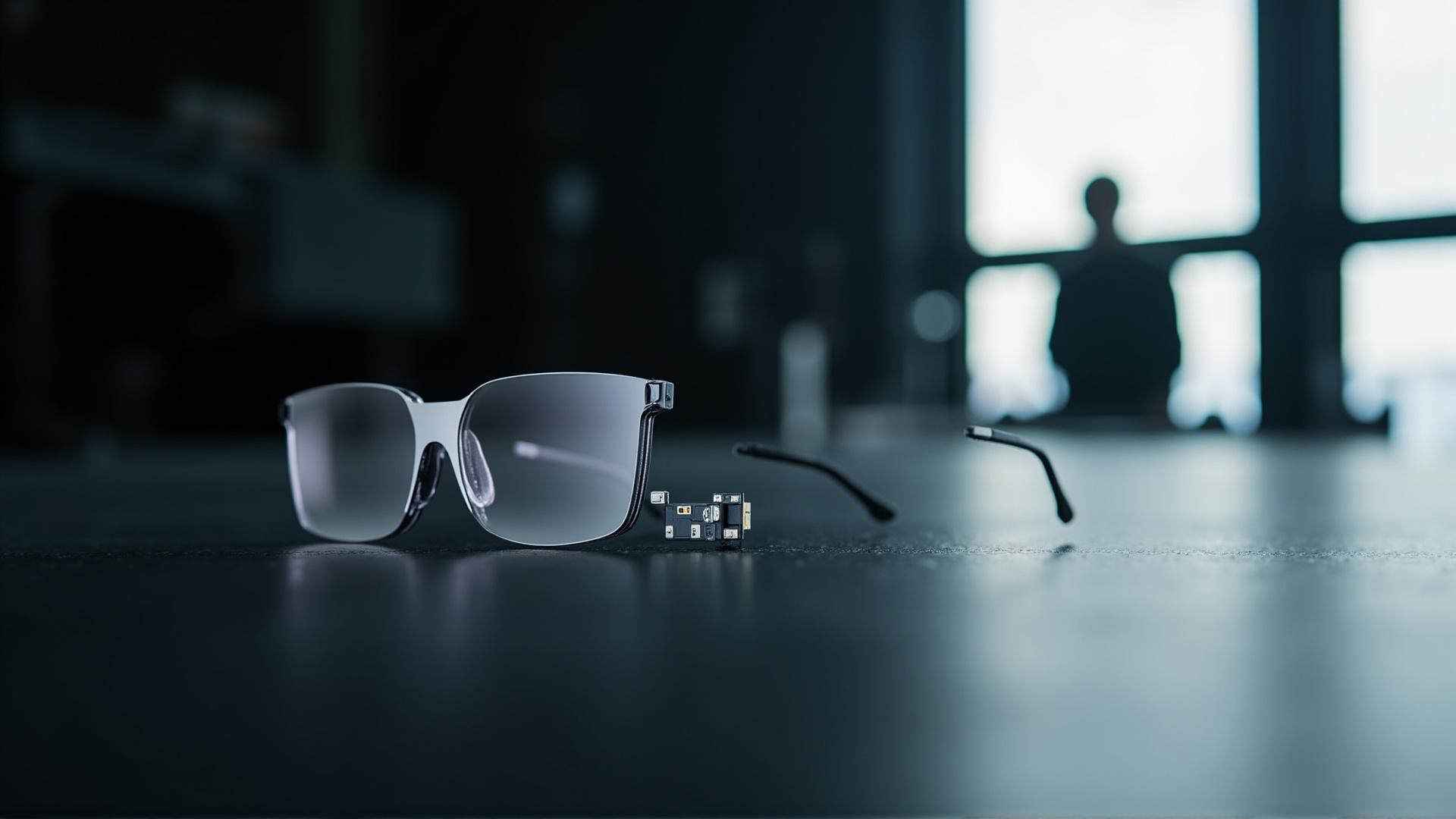
The hardest part of comparing the V03 Pro against the rest of the camera range is not that the numbers differ. It is that most of the interesting numbers are blank. Put the catalogue rows for the camera models side by side and you get a short, readable table with a handful of real values and a large number of cells where the catalogue simply says nothing. That silence is not a formatting problem to be filled in from a neighbouring model. It is the shape of what is actually published, and a buyer who fills those cells in from the model next door will build a shortlist on numbers the supplier has never stated.
So this page does something narrower and more useful than declaring a winner. It lays out the published rows for the camera group exactly as the catalogue publishes them, marks which of those rows genuinely separate the V03 Pro from the other models, marks the rows where it does not separate anything at all, and then converts the empty rows into the specific questions to ask a supplier before a quotation is signed. The AI camera glasses range is the reference point for the whole group.
Where the V03 Pro sits in the camera group
The camera group is the part of the catalogue that publishes a camera, a frame cell, an endurance figure, a charge time and a charging interface. Inside that group the V03 Pro sits in the lower half on hardware and in a position of its own on features. On resolution it is an 8 MP model, which is the larger of the two resolution classes in the group — the other models publish either 8 MP or 13 MP, and the 13 MP models are the S7 and the L2 Utral, and the L1 Pro. On cell capacity the V03 Pro is a 220 mAh model, and 220 mAh is the smallest published cell in the camera group; the larger capacities in the group are 260 mAh, 265 mAh and 290 mAh. On endurance it publishes a range of 5 to 8 h rather than a point figure. On charging it publishes Type-C.
That last point is worth pausing on, because it is where the V03 Pro separates from most of the group rather than from all of it. The charging interface across the camera group splits three ways. A set of models publishes magnetic charging. Two publish a Type-C port: the V03 Pro and the L2 Utral. And a set of models publishes no charging interface row at all, which means you know those models have a charging case and you do not know how the frame itself is charged. The V03 Pro sits in the two-model Type-C group, and it shares that group with one model rather than owning it.
On the feature side, the V03 Pro is alone. No other camera entry in the range carries a photochromic lens, and none of them prints a colour row next to one — the colour row appears on two pages in the whole family, and this is one of them. On the case question, neither the V03 nor the V03 Pro publishes a charging case row, while three of the 290 mAh models publish a 1400 mAh case and the fourth publishes two case sizes — so the case position runs across the cell sizes rather than along them. The flexible temple is another published feature row unique to this model within the camera group. The specifications and features page sets out the full published list, and the photochromic buying guide sets out what a lens of that kind does and does not promise a buyer.
What the catalogue does not publish for the V03 Pro is as important as what it does. There is no frame weight for this model. There is no ingress rating; the only two models in the whole catalogue carrying an IP marking are the V06 and the S7. There is no Bluetooth version for any camera model, so a shortlist column for radio version cannot be built at all. There is no camera sensor model, no field of view, no video resolution and no frame rate. And there is no certification row for any camera model — no FCC marking, no CE marking, no RoHS statement, no RED reference — so a compliance claim for this model cannot be sourced from the catalogue and has to be requested from the supplier as a document.
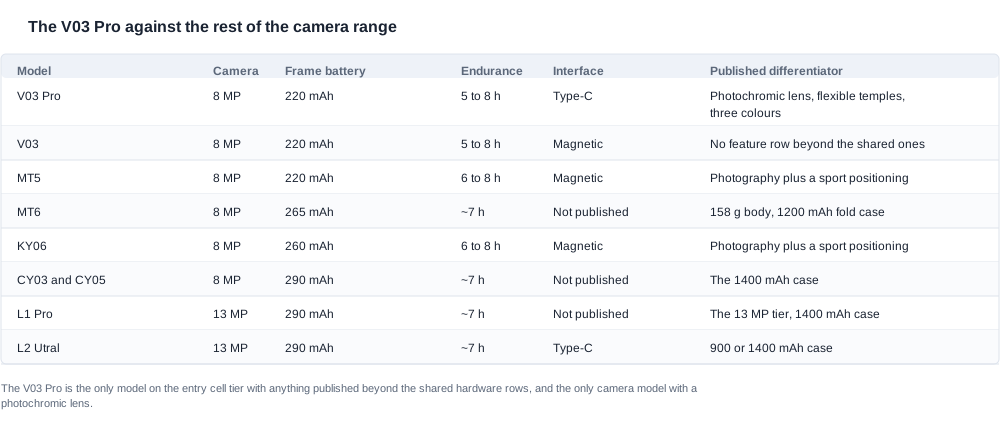
Two consequences follow for anyone building a camera glasses programme on this group. First, the comparison that a buyer actually wants to make — is this model the right one for my channel — cannot be answered by resolution, because eight of the camera models publish the same 8 MP and a tier of eight models is not a tier. It cannot be answered by endurance either, because the published figures come in three different shapes, and a range is not comparable to a point estimate. It can only be answered by the feature rows and the case position, which is exactly where the V03 Pro is most distinctive and exactly where most of the rest of the group is silent.
Second, the silence is not spread evenly. Most of the models that publish nothing about their charging interface publish a case capacity instead. That is a meaningful pattern for procurement: the question "how is the frame charged" and the question "what is in the box" arrive together, and both have to be settled before packaging artwork can be drawn. The photochromic lens explanation covers the lens mechanics on the feature side, and the OEM-ready platform note covers which models in the catalogue are positioned for an own-brand programme at all.

The published rows that separate the V03 Pro from the other camera models
Here are the published rows for the camera models this comparison covers, exactly as the catalogue gives them and grouped by what the catalogue prints for the interface. The empty cells are the point of the table.
| Model | Cell | Endurance | Charge time | Charging interface | Case |
|---|---|---|---|---|---|
| L2 Utral | 290 mAh | ~7 h | ≤2 h | Type C | 900 or 1400 mAh |
| V03 Pro | 220 mAh | 5~8 h | ≤2 h | Type C | — |
| V03 | 220 mAh | 5~8 h | ≤2 h | Magnetic | — |
| CY03 | 290 mAh | ~7 h | ≤2 h | — | 1400 mAh |
| CY05 | 290 mAh | ~7 h | ≤2 h | — | 1400 mAh |
| L1 Pro | 290 mAh | ~7 h | ≤2 h | — | 1400 mAh |
Three things in that table carry the whole comparison, and it is worth being precise about which is which.
- The charging method row separates two models from four. Only the V03 Pro and the L2 Utral publish Type-C. The V03 publishes magnetic charging. The CY05 and the CY03, and the L1 Pro publish no charging method row and instead publish a 1400 mAh case, which means the frame charging interface is an open question on all three. If your programme depends on a standard USB cable being the only thing a customer needs, that is a Type-C programme and the field is two models wide.
- The case row separates the V03 Pro and the V03 from the group. Neither of the 220 mAh models publishes a case row. The three 290 mAh models publish a 1400 mAh case, and the L2 Utral publishes two case options at 900 mAh and 1400 mAh. On the published rows, the V03 Pro sits with the smallest cell in the group and has no charging-case row printed at all, which leaves the pack-out question open rather than answered: the reserve power a case provides is something a buyer has to establish before the freight model can be built.
- The cell and endurance rows separate the pairs, not the models. 220 mAh against 290 mAh is a real difference in what the parcel weighs and in what the charger has to deliver, and 5~8 h against ~7 h is a difference in the kind of claim being made rather than in the hours delivered. Neither of those rows can pick a winner, because a smaller cell with a wider published band is not the same trade as a larger cell with a point estimate.
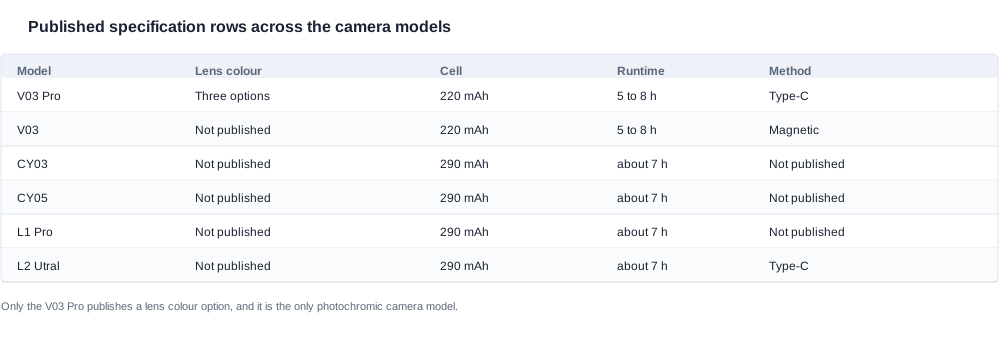
The rows that do not separate anything are just as useful to name, because a shortlist that ranks on them is ranking on noise. The charge time row is identical at ≤2 h across every camera model in the group, so it cannot discriminate. The resolution row divides the group into an eight-model class and a three-model class, and the V03 Pro is in the larger one, alongside the CY05 and the V03, the KY06 and the CY03, and the V06 and the MT6, and the MT5. The Bluetooth column is empty for every camera model, so it cannot be used at all. And the frame weight row contains exactly one published figure in the entire camera group, the 158 g published for the MT6 body, which means the V03 Pro's weight is simply not available for comparison.
We will not present a specification difference the catalogue does not publish, so a buyer comparing the V03 Pro against the rest of the camera group should ask for the unpublished rows rather than assume the newer model carries an advantage. That is the working rule for this whole comparison, and it is why the table above has more empty cells than filled ones.
The practical value of this model inside a range is still real, and it does not depend on any unpublished row. It is the combination that no other camera model offers: the smallest published cell, a Type-C port a customer can charge from a cable they already own, a photochromic lens with three colour options, and no proprietary charging accessory to design around. If the channel is one where the customer buys the glasses to wear outdoors and expects to put them on and start recording, that combination is the differentiator, and it is published rather than inferred. The V03 Pro best-for note works through which channel requirements that combination actually satisfies, and the customisation page covers what a brand can change around it.
The rows that do not separate the V03 Pro from the rest of the group
A comparison sheet is only honest if it names the rows that failed to separate anything. There are five of them here, and they are the rows a shortlist is most likely to be built on by accident.
- Charge time. Every camera model publishes ≤2 h. It is a ceiling, not a measurement, and it is identical across the group, so it does nothing to rank the models. Ask a supplier what the ceiling was measured at, not which model has the lowest one.
- Camera resolution. The V03 Pro publishes 8 MP, shared with eight other camera models. The 13 MP group is three models, and the V03 Pro is not in it. Resolution is a real specification but it is not a differentiator at this model's tier, and a comparison sheet that sorts by megapixels will place this model in a group of nine.
- Battery life shape. The group publishes three different shapes of endurance claim — a range, another range, and an approximation. The V03 Pro's 5~8 h cannot be compared line by line with a ~7 h point estimate on another model without the test condition, which is not published for either. The V03 Pro versus CY05 price positioning page works through why a comparison built on those two figures produces a price argument rather than a specification argument.
- Bluetooth version. Not published for any camera model. This is the cleanest example of a row that cannot be built at all, and it is also the row most likely to get filled in from a non-camera model in the same catalogue, where radio versions are published. A V5.x figure copied across from an audio model is a fabricated specification for this product.
- Frame weight. One published figure in the entire camera group, and it belongs to a different model. The V03 Pro's weight is not published, so it cannot be compared with anything, including with the model next to it in the range.
What does separate the V03 Pro, and what the sheet should be built on, is a short list: the charging interface and the case position, the photochromic lens, the three colour options, the flexible temple, and the smallest published cell in the group. Those five are published for this model and against at least one other model. Everything else in the sheet is either identical across the group, published only for other models, or absent everywhere.
There is a fourth category that a buyer should keep visually separate from all of these, because it is not a specification row at all: the commercial rows. The catalogue publishes no price, no MOQ, no lead time, no sample policy, no warranty term and no production capacity for this model or for any model in the range. A comparison sheet that ends at the specification table is therefore incomplete for a procurement decision, because the decision is about which quotation to open first. Those rows come from the supplier, and they come with the documentation that has to travel with them.
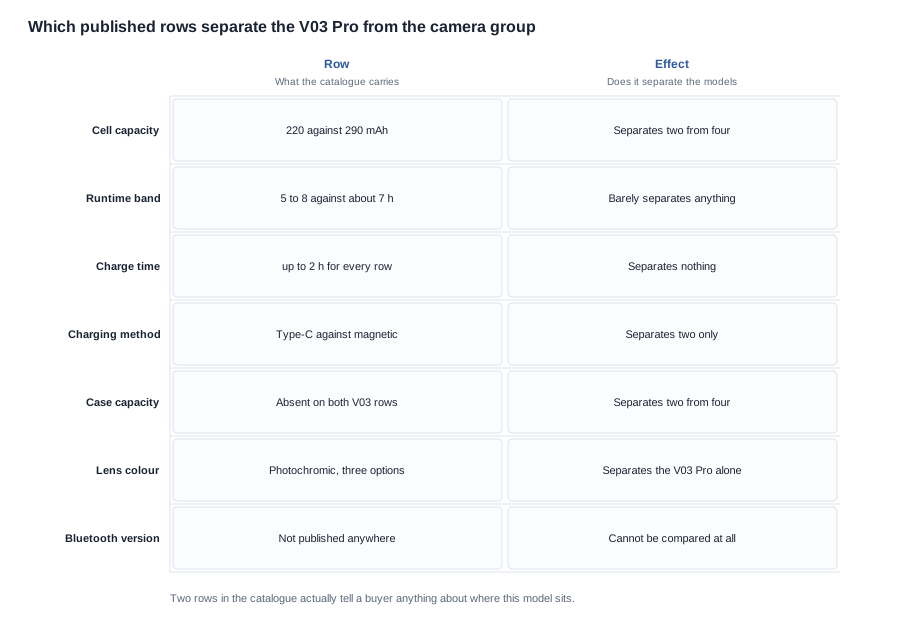
The matrix above is the honest version of the comparison, and it is deliberately short. Each line is either a row that carries a real separation or a row that cannot be used. Reading it as a buyer: two rows do the work, one row is a near-tie that still changes the bill of materials, one row identifies the model uniquely in the range, one row cannot be built for anyone, and the remaining lines describe a group rather than a model. A shortlist built from this matrix is two or three models long. A shortlist built from the full specification table would look like nine models and would not survive the first quotation.

A range-level comparison sheet for a camera glasses programme
Here is the sheet itself, in the form it should reach a procurement team. The first column is a published row, the second is what the catalogue says for the V03 Pro, the third is what it says across the rest of the camera group, and the fourth is the action the row demands.
- Charging interface. Type-C for this model. Magnetic for one group, Type-C for one other model, and unpublished for the remainder. Action: fix the interface in writing before packaging is drawn, because it determines the cable in the box and the charging instruction.
- Charging case. No case row for this model. A case capacity of 1400 mAh for three models and two options for another. Action: confirm the case position per model in writing, including whether a case is supplied at all for the models whose row is blank.
- Frame cell. 220 mAh for this model, the smallest published capacity in the group, against 260, 265 and 290 mAh elsewhere. Action: use the capacity to plan freight and parcel weight, and to set the charger output requirement.
- Endurance. 5 to 8 h for this model, published as a range with no test condition. Action: ask for the condition, and state on the product page only what the range supports.
- Charge time. ≤2 h for every camera model. Action: treat as a ceiling for planning and do not use it to rank models.
- Camera resolution. 8 MP for this model, shared with eight others. Action: do not use as a differentiator; use the lens and the colour options instead.
- Frame weight. Not published for this model; one figure published elsewhere in the group. Action: request the weight as shipped, and confirm it on a sample rather than from a data sheet.
- Ingress protection. Not published for this model; only two models in the catalogue carry an IP marking. Action: make no water or dust claim on the basis of this row, and ask for the rating if the channel requires one.
- Bluetooth version. Not published for any camera model. Action: request the radio version in writing for the production units.
- Certification. No certification row for any camera model. Action: collect the technical file and the declaration from the supplier before the order, and treat the certificate numbers as documents you must hold rather than claims you have been told.
- Commercial terms. Price, MOQ, lead time, sample order, payment terms, deposit, incoterms, shipment terms and warranty are not published for any model in this range. Action: put all of them on the quotation and into the purchase order, and treat a supplier who answers the specification questions but not the commercial ones as a finding rather than a negotiation.
Two commercial notes to carry into the same sheet. First, if your programme is a private label one, the packaging options page sets out what a model with no charging-case row changes in the carton, and the shipping weight page covers how a missing weight figure propagates into freight planning and into the packaging you choose. Second, a comparison that ends at the specification table is not yet a decision. The trade-off the V03 Pro presents is a smaller cell, a standard cable and a blank charging-case row against the reserve power and the in-box accessory that the 290 mAh models offer. That trade-off is real, it is visible on the published rows, and it is worth negotiating openly on price and packaging rather than pretending the sheet has already settled it. What to negotiate is usually not the specification but the package around it: the accessory in the box, the warranty length, the payment terms, and the speed of the first shipment.
The supplier conversation has a specific order to it, and the order matters more than the wording. Here is what to ask, and how to evaluate what comes back. Ask the specification questions first, because they determine what you are buying: the interface, the case position, the cell, the endurance condition, the weight as shipped, the radio version and the ingress position. Only once you know what the product is should you ask the commercial questions, because the commercial answers are conditional on the specification answers and will change if the specification moves. A supplier that quotes a price against an undefined product has not quoted you anything; a supplier that quotes a price against a written specification has quoted you something you can put in front of a customer.
The commercial terms themselves need to be on the quotation in writing, not on a call. Price at each volume tier, the MOQ, the lead time from the point the order is confirmed and the artwork is signed, the payment terms and the deposit percentage, the incoterms, the shipment method, the warranty period on the frame and on the cell, and the position on a bulk order of the same configuration. For a private label programme, the tooling question belongs in the same conversation: what physical tooling exists for this model, whether any of it is specific to your brand, and who owns it if the relationship ends. Put the tooling ownership and the artwork approval into the contract rather than leaving them to the behaviour of whoever happens to be in the room when the first bulk order is packed. Nothing about that tooling needs to be custom — a Type-C no-case product has a thin bill of materials — but the ownership terms should be settled before the first purchase order, not after a dispute.
The factory and the quality control arrangement belong on the sheet too, because the published rows are only as good as the process that produces them. Ask where the production site is, who runs incoming inspection on the cells, what sampling is applied to finished units, and whether the factory accepts a third-party audit or only offers its own report. Then write your own acceptance criteria for the checks that matter to this model: a charging test with a stated current and a stated battery state, and an endurance check against the condition you have had confirmed in writing. The catalogue's ≤2 h and 5~8 h are planning figures, and a process that checks against them is what turns a planning figure into a product fact. The criteria are yours to set, because the factory's default criteria are whatever passes its own process.
For due diligence, the risk is concentrated in the documentation rather than the hardware. A comparison of two camera models raises the question of which supplier can actually support the finished unit in your market: which technical file covers the cell, which declaration covers the finished product, which conformity assessment applies to the radio, and whether the audit trail exists for the production batch. None of that is visible in a catalogue row for this model, which is exactly why it belongs on the same sheet as the specification rows. A due diligence question asked before you order is a question with an answer; the same question asked during a distributor review is a delay, and asked during a regulatory enquiry it is a problem.
One working habit closes all of this. Keep the sheet as a single document with a column for the published value, a column for the confirmed value, and a column for the source of that confirmation, and keep the questions to ask attached to it. When a model is compared against the rest of the range, the published rows tell you where the differences are; only the confirmed column tells you which of those differences you can put on a product page. The buyer review checklist covers the model-level review that sits alongside this range-level sheet.
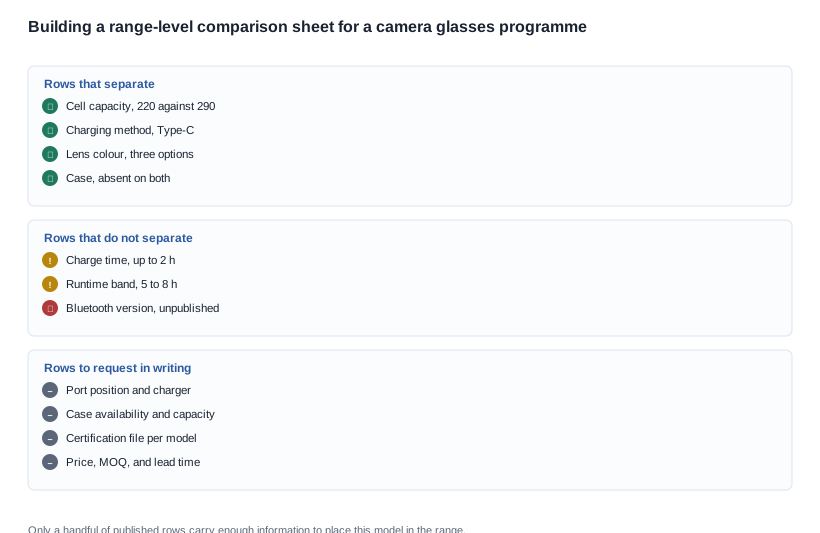
The last step in building the sheet is the one that protects it. Take a sample order of each shortlisted model, use them the way a customer would, and record what the samples do against what the sheet claims. That is how a test condition behind a 5 to 8 h band becomes a number you can write on a product page, how an unpublished charging interface becomes a known one, and how an absent weight becomes a measured one. Ask for the sample before the order is confirmed, not after, and require the answers to land in the quotation and then in the purchase order and the technical file. A specification that only exists in a comparison sheet is a specification that will not survive a returns investigation.
The camera group, with its two Type-C models, its three endurance shapes, its one published weight and its absent certification rows, rewards a buyer who asks precise questions and punishes one who fills the gaps by assumption. The V03 Pro is the model in that group with the smallest cell, a standard charging port, a photochromic lens and three colour options, and it is the model whose unpublished rows are the most important part of the decision. Close them in writing, and the comparison becomes a shortlist you can act on.


