
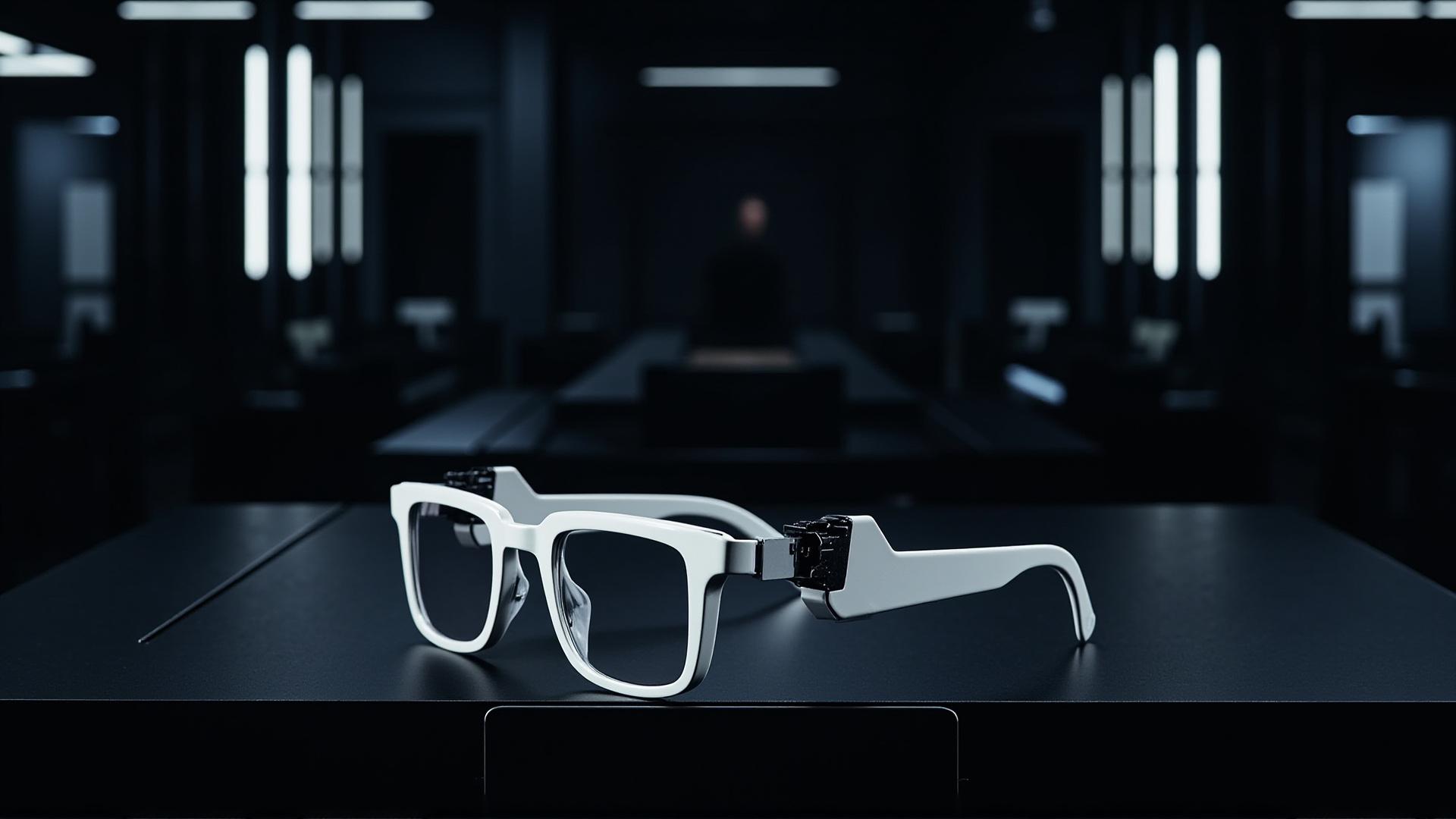
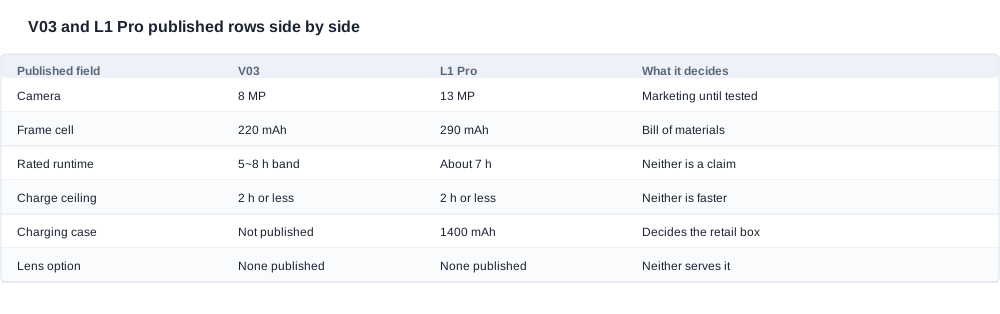
These two models sit at opposite ends of the camera range, and the difference between them is not the kind of difference a comparison chart usually sells. The V03 is the smallest platform in the range: 8 megapixels, a 220 mAh cell, up to two hours of magnetic charging, a rated runtime of five to eight hours, and no charging case published. The L1 Pro is the 13-megapixel tier: a 290 mAh cell, the same two-hour charge time, approximately seven hours, and a 1400 mAh charging case.
One of them is built for a customer who needs the box to be light and the price to be low. The other is built for a customer who needs the case and the resolution. Almost nothing about them is a middle ground.
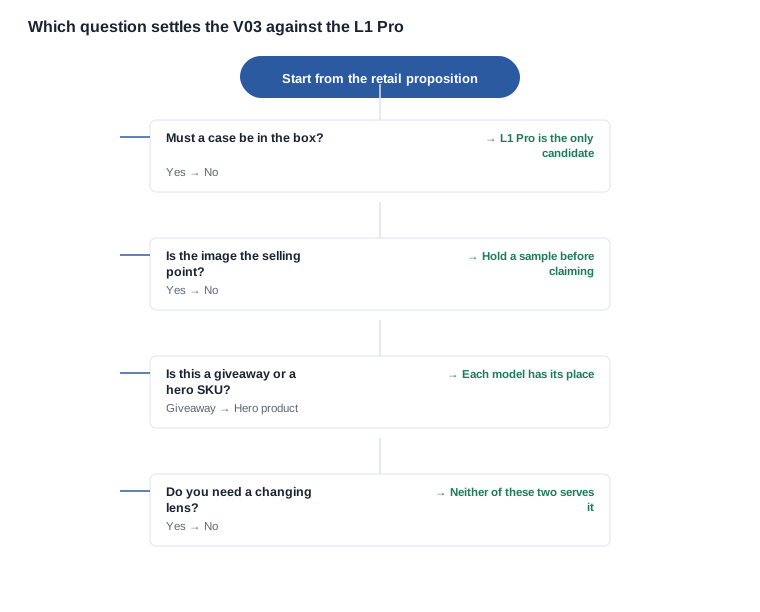
The first question: does the product need a case in the box?
If it does, the comparison is already over. The L1 Pro publishes a 1400 mAh case; the V03 publishes none. That is not a difference in specification quality, it is a difference in what the customer owns on the first day.
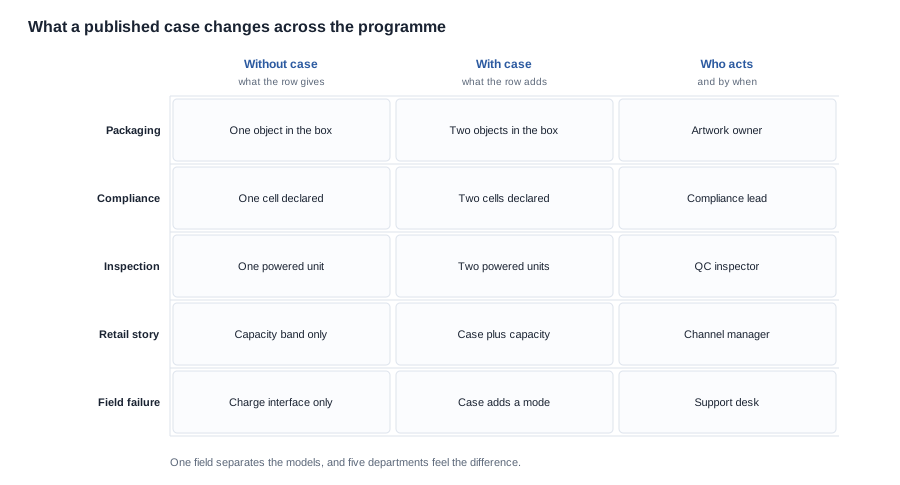
A case changes four things at once. It removes the anxiety of running out of power, which is the single most common objection to a camera product sold to consumers. It raises the achievable basket value at retail. It changes the packaging design, because the box has to be built around the case rather than around the frame. And it changes the shipping weight, which is a landed-cost line in an e-commerce model.
Each of those four has a cost that lands on a different department, and a buyer who treats the case as a retail feature rather than as a programme consequence will find the consequences arriving anyway. The packaging team inherits a second object to protect and a second cell to declare; the compliance owner inherits a second declaration for the destination market; the inspection plan inherits a second powered unit at incoming inspection; and the support function inherits a failure mode that a cable product does not generate. None of these are reasons to avoid a case. They are reasons to price one properly rather than absorb it into a unit price.
If your retail proposition depends on the case, the V03 is starting from behind. The camera family has several alternatives that publish one — the L1 Pro and the CY03, and the CY05 — each at 1400 mAh, the MT6 at 1200 mAh with a folding case, and the L2 Utral with a 900 or 1400 mAh option. The V03 and the V03 Pro are the only two camera models in the range with no published case, and the V03 is the smaller of the two. That makes it an outlier rather than the rule, and it is worth knowing before you design a box around it.
For a buyer running a range rather than a single SKU, the case question has a second-order effect that is easy to miss. A case raises the achievable basket value at retail, which changes the economics of a bundle or a channel promotion, and it changes them in a direction that interacts with everything else in the range. If the L1 Pro is the hero product and the V03 is the giveaway, the two sit in the same carton family, on the same listing page, and are often compared by the same customer. A customer comparing them will notice the absence of a case on the cheaper model, and the absence reads as a saving rather than as a design decision unless the listing says so.
That is why the case question is best answered before the artwork rather than after. The wording on the carton, the contents list, the accessory illustration and the unboxing sequence are all downstream of the answer, and each one is an approval with a date on it. Changing them after they are approved costs a reprint, a re-approval cycle and a plan for stock that already exists.
There is a version of this decision that resembles a close call and is not. A buyer who asks whether the V03 could be paired with a case is asking the wrong question, because a case the catalogue does not publish is an assumption, and an assumption in the accessory list becomes a claim on the carton, a claim the fulfilment team has to honour, and a shortfall the support team has to explain. If the programme requires a case, the honest shortlist contains the models that publish one, and the V03 is not on it.
The second question: does the image have to be the resolution story?
If it does, the L1 Pro is the only candidate in this pair, and the claim is weaker than the number suggests.
Thirteen megapixels against eight is the entire imaging difference, and nothing in the documentation supports it as a visible improvement. No sensor model, no field of view, no video resolution, no frame rate, no aperture, no pixel size is published for either model. A 13-megapixel sensor with small pixels can produce a worse picture than an 8-megapixel sensor with large ones, particularly indoors or at dusk, and our own documentation is explicit that a parameter comparison advantage of this kind should not be claimed externally until it has been checked against a competitor's unit in the hand.
It is also worth saying what resolution is not. It is not a proxy for the camera being new, and it is not a proxy for the lens being better, and it is not a proxy for the product being worth more. In this range the only models with a documented sensor are none of them, which means the imaging claim available to any buyer is limited to a number that describes a class of hardware rather than a result. A channel partner who asks which model produces better images is asking a question this catalogue cannot answer, and the honest reply is a sample comparison rather than a specification sheet.
That last qualification is worth more than the argument around it, because it describes the method rather than the conclusion. Two units, the same scene, the same light, the same settings, photographed by someone who is not the seller. The result either supports the claim or it does not, and either way the buyer now owns a fact instead of a specification sheet. A buyer who skips this step and writes "13 MP" on a product page has not claimed an advantage; they have published a number that a customer cannot act on and a reviewer can challenge.
So the L1 Pro's resolution is a reason to hold a sample, not a reason to write a listing. The camera imaging guidance sets out what to compare when you do.
And if the image is not the story, the V03's own feature set is worth reading. It publishes 8-megapixel capture, a low-power Bluetooth connection, a camera module, magnetic charging and an AI voice assistant, and the V03 Pro sibling adds photochromic lenses, Type-C charging, flexible temples and three published colour options on the same power block. A buyer who needs a lens that changes is not choosing between these two at all.
There is a third possibility that buyers miss because it looks like a detail. If the programme's differentiator is the interface rather than the imaging or the case, then the platform with the documented cable strategy is the more useful one, and the resolution gap becomes irrelevant. A magnetic interface and a Type-C interface are different accessory supply chains and different instructions, and a range that carries only one of them is a range that can ship a single cable type across every SKU.
V03 smart glasses vs L1 Pro: which buyer each model serves
Two buying situations, and the second one is where the L1 Pro earns its place.
A giveaway, a first unit, a price-led listing or a bundle inclusion: the V03. The smallest cell in the camera family, no case to design around, no case to ship, and a five-to-eight-hour rated range that suits a customer who captures in bursts. This is the V03's use case, and it is a legitimate one — the low bill of materials is exactly what makes a bundle or a giveaway work.
That case is worth stating in the buyer's own numbers rather than in adjectives. A giveaway has a fixed cost ceiling set by the marketing budget, and every gram and every second object in the box competes with the incentive value of the thing itself. A model with no case removes one packing volume, one cell declaration and one accessory line, and on a giveaway order those savings are usually a larger share of the total than the unit price difference between this pair.
The giveaway case has an additional property that the hero case does not: it is usually bought in larger quantities. A giveaway programme of several thousand units multiplies every per-unit saving by a factor that makes small differences material, and it multiplies the cost of an error by the same factor. A wrong assumption about the box contents on a giveaway order is not one customer receiving the wrong accessory; it is a fulfilment line that cannot close.
The second giveaway consideration is the failure profile. A giveaway is rarely used continuously, so the runtime band matters less than the charge cycle and the accessory count. The V03's magnetic interface means one object and one interface to describe, and its wide five-to-eight-hour band is less of a liability in a short-use context than it would be in a continuous one.
A creator's main tool: the L1 Pro. A customer who films through a day and expects the product to hold the footage, and whose channel sells on the specification, is the buyer the 13-megapixel tier and the 1400 mAh case are built for. The case is what makes that customer experience work, because it converts a seven-hour device into a working day.
The trade-off that comes with the hero product is worth naming, because it is the reason a range carries both. A hero product built around a case carries a second cell, a second declaration and a second failure mode, and it carries a higher bill of materials that the giveaway in the same range does not. That is not a flaw in the pairing; it is the reason the pairing works. A range with one model has to be either the giveaway or the hero, and it is usually worse at both.
The interface question deserves its own paragraph, because it is the one that is easy to leave to chance. A range that carries a magnetic model and a Type-C model has two accessory lists, two instruction sets and two sets of customer expectations about which cable belongs to which product. A range that carries only one interface type ships a single cable across every SKU, which lowers accessory inventory, simplifies the artwork and removes a class of support question before it is ever asked. Neither approach is wrong; the mistake is arriving at a two-interface range without having decided to.
And a buyer who wants both — the case and the photochromic lens — is not currently served by either of these two. The V03 Pro has the lens and no published case; the L1 Pro has the case and no published lens. That combination is a question to ask us rather than a gap to work around.
What the two models do not tell you
- Sensor model, field of view, video resolution and frame rate — not published for either.
- Frame weight, temple length and lens dimensions — not published for either. The 158 gram figure in this range belongs to the MT6.
- Runtime test conditions — not published for either, and the V03's five-to-eight-hour range is the widest in the family.
- The charging input and the charge indicator behaviour — not published for either.
- The charge-time starting point — not published for either.
- Ingress protection — not published for either.
- Certificate numbers, issuing bodies, validity periods and covered model schedules — not published for either.
- Storage capacity, file format and overwrite behaviour — not published for either.
- Minimum order quantity, lead time and price — not published for either, and our internal documentation currently holds three conflicting minimum order quantity figures that have not been arbitrated.
One practical note on how to ask. A list of nine items sent as nine separate questions produces nine partial answers, usually because the supplier treats each as a small request and answers the easy ones first. A list of nine items sent as a single request, with the destination market named and a date attached, produces one reply that either closes the set or states clearly which parts cannot be closed. The second format is the one that changes what you know at the end of the week.
Nine gaps, identical on both rows, and that symmetry is the most useful fact in the list. It means one diligence request closes both models, and a supplier who answers all nine for both in a single written reply has done something a supplier who runs two separate conversations has not. It also means the comparison cannot be settled on specification at all: whatever separates these two models is already visible in the four published fields, and everything else is either identical or unknown.
The reason this list is worth reading carefully rather than skimming is that each entry describes a claim a buyer might otherwise make. A resolution claim needs the sensor fields. A runtime claim needs the test condition. A weight claim needs the weight. An ingress claim needs a declared rating. A warranty claim needs a period and a remedy. Listing the gaps against the claims they authorise is a faster way to build a defensible product page than drafting the page and then discovering what it depends on.
Three of the nine deserve a different treatment from the rest. The runtime test condition should be requested as a written method rather than as a figure, because a supplier who sends a second figure without the method has made the problem worse. The certification set should be requested as documents that name the ordered model, because a general compliance statement covers neither model in particular. And the conflicting MOQ figures are an internal problem on our side; they should be arbitrated in writing before any quotation is treated as firm, because a buyer who negotiates against three different numbers negotiates against the lowest one and then discovers it was never real.

The judgement behind the fit
These two models serve two different customers rather than two different levels of the same customer, and a range containing both is a range with a giveaway and a hero product. We will not claim that 13 megapixels produces a better picture, because the figures that would support it are not published, and we will not pretend the missing case is a small detail when it is the thing the customer holds.
The same discipline applies to how the two answers are compared. The temptation, when two models sit at opposite ends of a range, is to score them on the difference between them, which rewards whichever model is more extreme. That rewards the wrong thing, because what a buyer needs to know is how well each model serves the programme it has been chosen for. A scorecard built on programme criteria produces a shortlist you can act on; a scorecard built on difference produces a shortlist you can only act on if the programme happens to match the range's extremes.
How to evaluate the two suppliers once they answer is therefore a documentation test rather than a specification test. The supplier who names the case as a priced line item, states the runtime method, attaches reports naming the ordered model, and closes the MOQ conflict in writing has given a buyer something worth comparing, regardless of which unit price is lower. Red flags are narrow and specific: a resolution figure offered with no sensor detail, a runtime figure offered with no method, and a compliance statement that names neither model.
Before you commit to either route, the shortlist should be written down with the deciding question attached to each model — case, resolution, interface, or programme role — because a shortlist without a stated question becomes a shortlist ordered by whichever quotation arrived first.
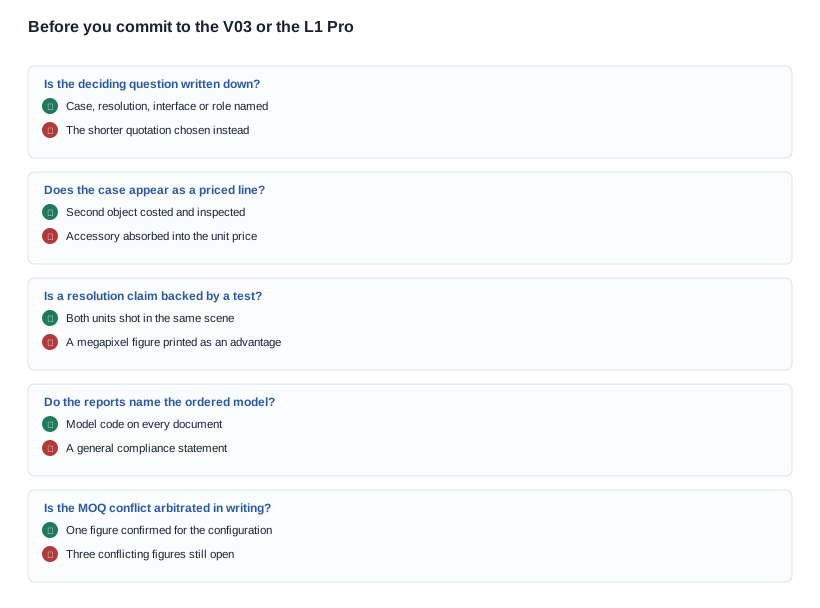
One last practical point, because the pair is often shortlisted for the wrong reason. Buyers frequently start from the resolution gap because it is the largest visible number on the sheet, work backwards from there, and end up defending a camera claim they have never tested. Starting from the case question instead produces the opposite result: the buyer establishes what the customer actually owns on the first day, and the resolution question becomes a sample question rather than a specification question. That ordering is not a preference; it is the only one in which each answer arrives while it is still cheap to act on.
Give us the channel, the volume and the target market and we will say which of these two fits a given brief and which we would rule out. The family is on the AI camera glasses range page, and the row-level detail behind the higher tier is in L1 Pro specifications.
Related reading
- Where the smaller platform fits — V03 best for
- The published rows behind the higher tier — L1 Pro specifications
- How a camera product should be tested — camera imaging
Send the channel, the volume and the target market, and we will rule models in and out by name.


