

A specification sheet is a list of rows, and most buyers read it too quickly — scanning for the headline number and moving on. Read row by row instead, and each line tells you two things: what you may state, and what you may not. This article walks the published rows of this model one at a time, states the reading for each, and marks clearly where the published material ends.
The model is a camera product in the eleven-model camera tier. Four power-related rows are published, a resolution class is published, and nothing else is.
L1 Pro specifications and features: the rows that exist
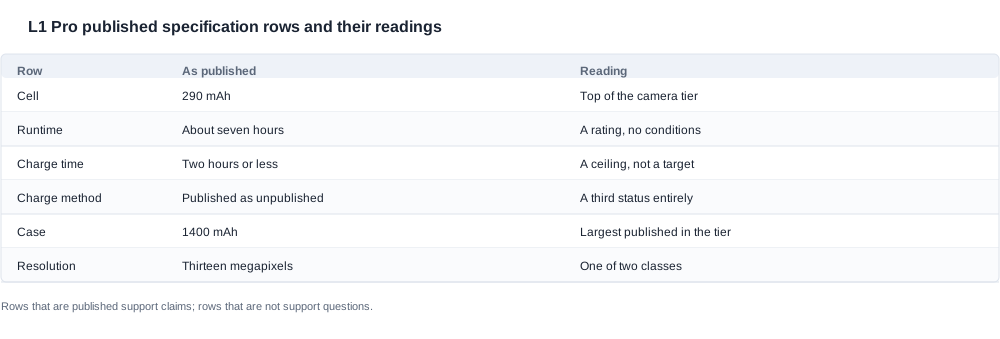
The published set is short enough to state in full, which is unusual and useful. Here it is, exactly as the catalogue gives it.
| Row | As published | The reading a buyer should take |
|---|---|---|
| Cell capacity | 290 mAh | Top of the camera tier; comparable across models |
| Rated runtime | Approximately seven hours | A rating with no test condition attached |
| Charge time | Two hours or less | A ceiling, not a target time |
| Charge method | Published as unpublished | A third status, distinct from both named methods |
| Charging case | 1400 mAh | The largest published case capacity in the tier |
| Resolution class | Thirteen megapixels | One of only two classes published in the tier |
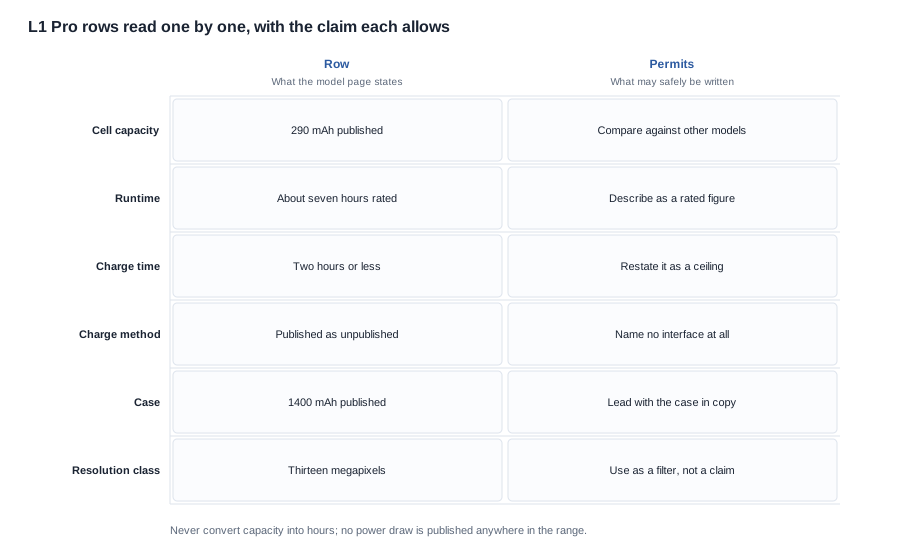
The charge method is a third status, and this is the row where a buyer is most likely to be misled. Count the charge-method row across the twenty-eight models and seventeen carry a magnetic entry while seven carry Type-C; the remaining handful describe no interface at all, and this model is among the remainder. The absence is therefore neither of the two named approaches, and no material of yours may name an interface for this model on the basis of what the catalogue says. The neighbouring L2 Utral publishes a Type-C interface while sharing this model's cell capacity, which makes the inference tempting and wrong; a shared cell does not establish a shared charge method, and the catalogue does not describe those models as one design family.
Where your packaging, listing or printed insert needs an interface, the only defensible source is a written confirmation from the supplier. Ask for it before artwork is frozen, put the answer in the purchase order, and record it with its date. A specification that names an interface it inferred is worse than one that admits the row is open, because the first looks settled and the second can still be tracked.
Reading the absent rows as a shortlist filter rather than as a warning is the more productive habit. Each missing row tells you which requirements this model can be judged against today, and by extension which parts of your own specification cannot be completed from published material alone.
That boundary matters more than the content. A row that is published supports a claim; a row that is not published supports a question. Nothing on the unpublished list is a defect — it simply cannot be stated, quoted or compared until a supplier answers.
The decision a buyer is really making when they open this sheet is a sourcing decision about evidence. Published rows let you move; unpublished rows make you ask. Some channels can ask quickly, because they have a supplier relationship, a sample on the desk and a documentation process that treats questions as routine. Others cannot, because their timeline is set by a packaging print deadline or a listing launch, and a question that arrives late is worth very little. Assess how long it takes you to close a row before deciding how urgently the gap blocks you — that assessment, rather than the gap itself, is what determines whether this model suits your process.
It also helps to separate the two kinds of unpublished row by who can answer them. Physical and interactive parameters — the interface, the weight, the indicator, the protection — can usually be answered by a supplier in a single exchange, and several of them can be confirmed by handling a sample in an afternoon. Regulatory and documentary matters take longer, involve third parties, and are not always answerable at all in the form you need. Sorting the list along that axis tells you which gaps close this week and which ones need to be planned around.
Reading the power rows
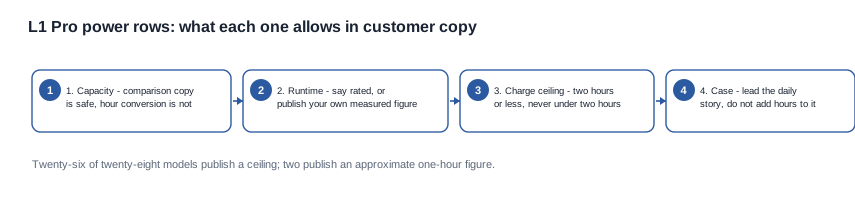
The cell figure is the easiest row to use and the easiest to misuse. Read across the camera tier, this is the largest cell figure published, held level by one model and exceeded by none. Everything else in the tier sits below it — the MT6 a little lower, the KY06 and the two sport photo models a step below that, and the V03 pair with the MT5 at the bottom of the range. That comparison is sound, because capacity is published for every model and nothing has to be derived.
What it does not support is any statement about how long the product runs. Converting capacity into hours requires a power-draw figure, and no power draw is published for this or any model in the range. A "290 mAh equals X hours" line in a listing is arithmetic the catalogue cannot back.
The same restriction applies to the case figures. Because no power draw is published anywhere in the catalogue, no published capacity — for a frame, a cell or a charging case — can be converted into hours. If your channel wants a day-count narrative for a mobile product, that figure has to come from measured units rather than from arithmetic on published numbers, and it is worth measuring early because it tends to end up in marketing whether or not it was planned for.
The runtime row is the one buyers most often over-read. Approximately seven hours is a rating, published without a workload definition, an ambient condition, a starting state or any indication of what the radio was doing. Two models in this same tier publish a runtime expressed as a range of five to eight hours or six to eight hours, which tells you something about how little precision any of these figures carry. Where your channel needs a number a user can plan against, the defensible route is to measure it on a unit under your own conditions and publish that alongside the rating.
There is a second limitation on the runtime row that is easy to miss because it is an absence rather than a caveat. No start-state, no partial-discharge behaviour, no self-discharge rate and no storage-retention figure are published, so the row describes a single rated condition and nothing else. For a channel holding inventory that matters: you cannot calculate what fraction of a shipped batch will arrive usable, and you cannot tell a customer what to expect from a unit that has been in a box for a month. Those are questions for the supplier, and they belong on the same list as the physical parameters.
A third and more common misuse is presenting the rating as a guarantee. A listing that says "seven hours of use" commits you to a figure our material states as approximate, and a customer who gets five and a half hours has a support contact rather than a satisfied buyer. A listing that says "rated at approximately seven hours" is both defensible and, in practice, less likely to generate the contact. The extra four words are the cheapest risk reduction on this row.
The charge time row carries a wording constraint that is easy to breach and expensive to breach. Two hours or less is a ceiling: it permits exactly two hours. It is not the same claim as under two hours, which excludes the two-hour boundary, and the catalogue's use of a ceiling across twenty-six of twenty-eight models shows the distinction is deliberate. Any material of yours that says "under two hours" for this model states more than the catalogue does.
The same ceiling reasoning applies to a second question buyers ask about this row: how long does a full recharge take from empty? The published figure answers the ceiling but not the conditions, because no start state, no completion criterion and no charge-rate behaviour are published. A unit charged from empty on a bench supply and a unit charged from a partial state will not behave the same way, and neither difference is visible in the figure. Where your channel describes a turnaround — for a returns process, for stock rotation, for a service bench — the questions to ask are the start state, the criterion for "charged", and the case's own replenishment time, all three of which are unpublished.

Reading the case row and the resolution class
The charging case is published at 1400 mAh, which is the largest figure published anywhere in the camera tier — the same capacity as the CY03 and the CY05, matched by the larger option on the L2 Utral's two-capacity row, and above the MT6's 1200 mAh folding case.
Read it as a second power source rather than as a runtime extension. The case is roughly five times the capacity of the frames, and a channel can legitimately describe the product as one whose day is carried by its case. What it cannot do is present 1400 mAh as additional hours, for the same reason capacity does not convert to hours above. And a channel promising the case is promising a second physical product with its own supply chain and its own failure modes.
Across the tier, case states come in three kinds, and stating all three is more useful than listing only the ones with published capacities. Five models publish a capacity, two more ship with a case whose capacity is unstated, and four have no case row at all — the V03, the V03 Pro and the V06, and the S7. An unpublished case row and a published capacity are different statements, and the distinction determines whether you ask a question or whether you already have your answer.
The distinction has direct buying consequences that are easy to miss. A model with an unpublished case row might ship with a case of any size, so a channel promising "with charging case" is promising something the catalogue has not sized. A model with no case row at all needs a different accessory line and a different description from a model whose case capacity is published. You do not know whether to plan for a case, and the honest answer is to ask the supplier before you build a package or a shelf plan around one. In a channel where the case is a headline feature, that question is worth more than any of the power rows.
The resolution class is a thirteen-megapixel class, and across the eleven camera models the published classes are eight megapixels on eight and thirteen on three. A boundary drawn on that basis is a genuine one, and among the rows printed on this page it is the only one able to support a preference on its own — provided it is applied as a filter and not read as a promise.
Be precise about what it is not. This model does publish a camera resolution class, so any claim that the catalogue carries no camera specification here would be false. What is unpublished is everything behind the class: sensor model, field of view, frame rate, video format, stabilisation, low-light behaviour and storage. A resolution class is a count, and a count is not a photograph.
The reason to be strict about this is that the class is the row most likely to be oversold. A buyer who writes "thirteen megapixels" in a datasheet has made a true statement. A buyer who writes "thirteen megapixels of crystal-clear photography" has made two statements, and the second one is unsupported by anything published. The gap between those two sentences is where product expectations get set, and setting them incorrectly on this row is expensive — because the customer who finds the second sentence untrue does not usually come back with a question.
There is also a comparison trap worth naming. Higher resolution is frequently assumed to mean better results, and on small sensors it can mean the opposite, because more megapixels on the same area implies smaller pixels and less light gathered per pixel. Our material publishes neither sensor size nor pixel size, so the class cannot be used to predict image quality even in general terms. It remains a perfectly good basis for choosing this model over an eight-megapixel option in a range where that is the published difference.

Where the boundary sits in practice
Draw the line at this point and the whole sheet becomes usable. On one side: what you can write in a listing, a datasheet, a tender response or a comparison table. On the other: what has to be asked, measured or confirmed before it can be written anywhere.
The published side supports short, factual copy. It supports a comparison against other camera models on capacity and on resolution class. It supports a case-led description of the product's daily use. It does not support performance claims, runtime guarantees, interface claims or protection claims — not because the product lacks these properties, but because the catalogue does not state them.
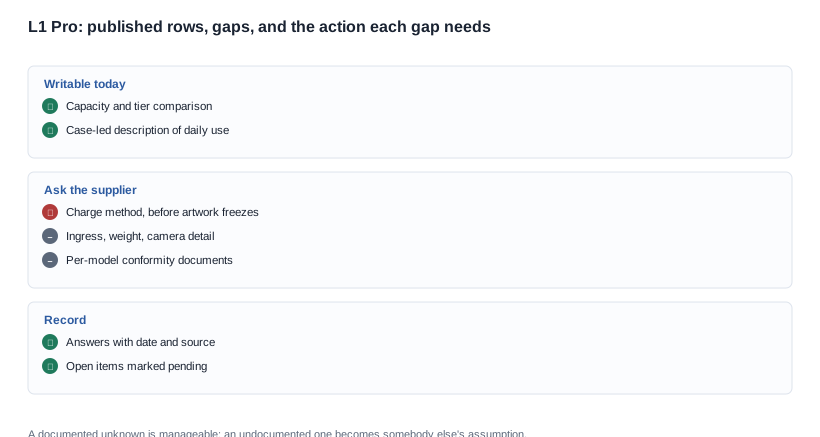
The unpublished side is not a defect list. It is a request list, and every item on it is answerable by a supplier in a single exchange. Ask for the charge method first, because it is the only gap that reaches artwork and listings that have already shipped. Ask for the ingress rating where a protection requirement exists, noting that only two models in the entire range carry a published marking. Ask for the weight where a fit calculation matters. Ask for the camera details where your channel will make video claims. Ask for the conformity documentation wherever a compliance review is attached, and remember that our published material contains no per-model conformity row and no conformity marking for any model.
Write those requests as evaluation criteria rather than as curiosities, because that changes what comes back. "What does the unit weigh" invites a single figure. "What is the unit weight, measured with and without the case, and what tolerance does your QC apply" invites something you can put in a specification. The same upgrade works on every row: ask for the measurement method, the condition it was taken under, and the tolerance or the sample size. A supplier who answers at that level is giving you evidence; a supplier who answers at the level of the question is giving you a number, and the two are not the same thing.
Two further habits make the boundary durable. Record which rows you have confirmed, with the date and the source, so a later order inherits an answer instead of repeating the enquiry. And state unconfirmed parameters as pending rather than leaving them silent, because a documented unknown is a manageable item while an undocumented one becomes an assumption the moment somebody downstream reads your specification.
Sorting the unpublished rows by what each one costs you is the practical way to work through them, and the order runs from expensive to negligible. The charge method comes first, because it is the only gap that reaches artwork, packaging and listings that have already shipped, where the correction is a reprint rather than an edit. The conformity documentation is a close second wherever a compliance review is attached, because arriving without it after a shipment stops the goods rather than merely annoying the reader. The ingress rating follows, since a protection requirement cannot be evidenced from what is published at all — and only two models across the entire twenty-eight carry a published marking, so this gap narrows a shortlist more than its position in the list suggests.
After those, the remaining gaps cost considerably less. The weight blocks a fit calculation but not an order. The camera details block a video claim but not a still-photo channel. The application behaviour blocks a connected-experience description but not a standalone purchase. Ranked that way, a buyer working to a tight schedule can order on the published rows and close the remaining items during production — provided the blocking two are settled before artwork is frozen.
The catalogue is the source of every figure above, and it is a source with visible edges. Reading within those edges is what turns a short specification into a defensible one.
One last check worth running before a specification is signed off: take each line of your own draft and ask whether it could be traced to a published row. Where the answer is yes, it is ready. Where the answer is that it was inferred from a neighbouring model, from a similar product elsewhere, or from what the category usually does, it is not — and the fix is either to delete the line or to mark it as pending with a supplier question attached. A specification that survives that check is short, and the shortness is the point: it tells you exactly which decisions are still open, which is more useful than a full sheet whose unverified lines nobody remembered to check.
That discipline also protects the next person. A short sheet with named gaps gets closed deliberately, one answered row at a time, and every answer survives because it was recorded. A full sheet with soft lines gets inherited as though it were fact, and the assumptions inside it travel onward until somebody downstream builds a decision on one.
We will not extend a short list of published rows with values we cannot evidence. A specification that says exactly what is known is more useful to a buyer than one padded with figures nobody can trace, and it is the only version of this sheet we are willing to publish.
If you want the underlying rows checked against your own specification, our camera range page lists the models and the model comparison places this one against its neighbours row by row.
Related reading
- The rows read against the range — L1 Pro compared across the catalogue
- What each row cannot support — L1 Pro limitations
- Working around the unstated interface — L1 Pro charging options
Send us the specification you are writing, and we will mark each row as published or supplier-dependent.


