
What age is appropriate for kids smart glasses is a question that looks like a product question and is actually a regulatory conclusion. Nobody can put a minimum age on a product page until somebody has classified that product in a specific market, and the classification — not the device, not the battery, not the feature list — is what produces an age band. This catalogue does not make that classification for you. There is no age rating, no age band, no minimum-age statement, no classification and no certification row for the three children's entries, and there is nothing on any page that can be read as an age recommendation. What is published is a short and specific set of rows for the A05, the A06 and the A07: a rated runtime of about twenty hours, cell capacity, magnetic charging, a charge time of two hours or less, a Bluetooth version on one of the three, and, on two of the three, six feature lines describing an electronic lens arrangement, a fogging unit, posture-and-distance prompts and lens clarity. None of those rows is an age, and the absence of an age row is the fact a buyer has to design around.
The reason this matters commercially is that the age statement is one of the few pieces of information on a listing that a buyer cannot correct later without redoing the work behind it. A price can be changed in a day. A certification file cannot. An age on a listing travels through the packaging artwork, the marketplace category rules, the retailer's own compliance review and the insurance question of who is responsible for the end user, and every one of those downstream checks reads the same number. If the number is wrong, the fix is not to edit the listing: it is to withdraw the stock, establish which market classification the product actually falls under, run the test programme that classification implies, and restate the age — which is a schedule measured in months and a budget measured in a test programme, not a content change.
So the useful answer to this question is a method rather than a number, and the method has three parts: which market's rules apply to this particular sale, what the product is actually doing, and what the published data can and cannot be used to support. Each part has a different owner, and the three together are what a procurement file needs before a launch decision. The rest of this page sets out what the catalogue publishes for this family, what it does not, and exactly which question has to be answered by whom.
What the catalogue publishes for the three children's entries
The published rows for the children's family are narrower than the published rows for the camera tier, and it is worth walking through them model by model because a buyer working on this question needs to know precisely which facts are citable and which are absent. The catalogue carries three children's entries: the A05 and the A06, both published as children's smart protection glasses, and the A07, published as children's smart audio glasses.
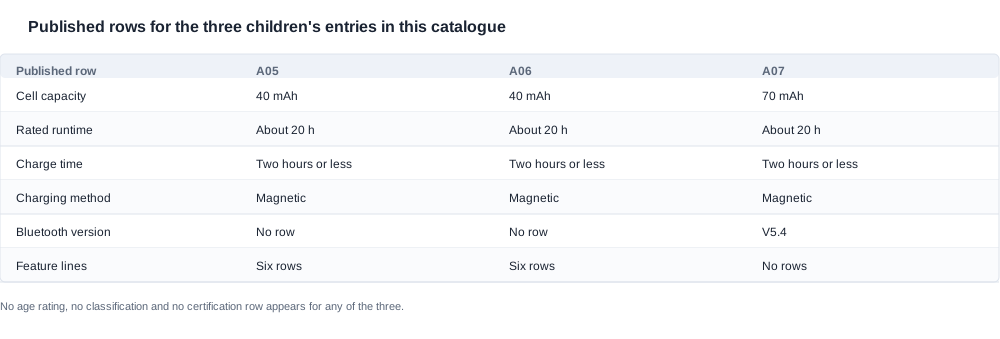
| Published row | A05 | A06 | A07 | Why a buyer needs it |
|---|---|---|---|---|
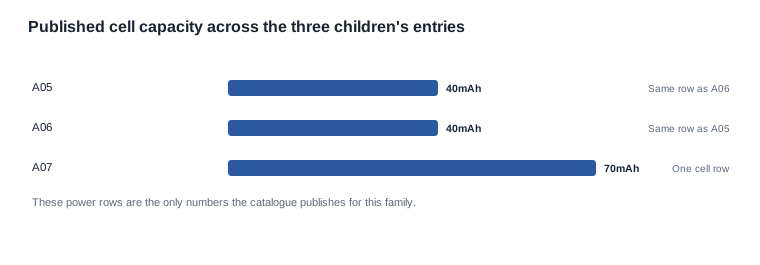
| Cell capacity | 40 mAh | 40 mAh | 70 mAh | Sets the charge interval and the charging stock |
| Rated runtime | About 20 h | About 20 h | About 20 h | Sets the gap between charges in a school day |
| Charge time | Two hours or less | Two hours or less | Two hours or less | Bounds the interruption a charge causes |
| Charging method | Magnetic | Magnetic | Magnetic | Decides what a channel stocks |
| Bluetooth version | No row | No row | V5.4 | Decides which companion hardware is in scope |
| Feature lines | Six rows | Six rows | No rows | The only published behaviour description |
The six feature lines on the A05 and the A06 are the rows that make the family interesting to a buyer and the rows that most often get misquoted. The catalogue lists a lens-based electronic arrangement, a fogging unit, correct posture and distance prompts, incorrect posture and distance prompts, lens clarity and lens fogging. The A06 publishes the same six lines. What those lines are is a description of a device that monitors posture and viewing distance and reports on lens condition; what they are not is a statement about eyesight, refractive error or any medical outcome, and a product page that turns a posture prompt into a vision claim has stepped outside what any published row supports — and outside what the frameworks for this product class would accept.
The A07 is the different case in the family, and the difference matters for a buyer deciding where to focus the compliance work. Its published rows stop at the hardware: a 70 mAh cell where the other two publish 40 mAh, the same rated runtime of about twenty hours, the same charge-time ceiling, magnetic charging and a Bluetooth version of V5.4 where the A05 and the A06 publish no Bluetooth row at all. The A07 publishes no feature lines, which means that any claim about what the A07 does beyond being an audio device has to come from a request rather than from the catalogue.
Two absences sit alongside these rows and both of them are frequently assumed rather than checked. There is no weight row for any of the three, which matters more here than anywhere else in the range, because the single published weight in this catalogue belongs to the MT6 — 158 g for the glasses assembly, excluding the folding case — and the MT6 is a camera model with a 265 mAh cell, not a children's product. It cannot be used as a reference point for a children's frame, and no other figure in the range substitutes for it. There is also no dimensions row for any of the three, so the physical question that a children's buyer asks first — will this sit on a smaller head, and what is the temple span — has no published answer at all.
What the catalogue does not publish about age
The honest inventory of the gap is short and specific, and it is better to state it plainly than to work around it. The catalogue publishes no age rating for the A05, the A06 or the A07. It publishes no minimum age, no recommended age band, and no statement about whether a given entry is intended for a child, a teenager or an adult. It publishes no classification of these products under any children's product framework, and it publishes no certification row for them — the family is the one category in the range for which the internal product record carries no certification information at all, as distinct from the wider catalogue where a company-level position exists and the per-model position is simply unstated.
It is worth being precise about that distinction, because it is easy to overstate and easy to understate. Across the whole catalogue there is no per-model certification row for any of the twenty-eight entries, and the catalogue text carries no reference to CE, FCC or RoHS. The company-level export certification page is a page of images showing ten patent certificates — eight appearance designs and two utility models — which is a statement about intellectual property, not about a product's conformity in a market. For the camera and audio families, the position is a general absence of per-model rows. For the children's family, the position is stronger still: the internal record provides no certification information, so there is no starting point for a buyer who asks what is held for these three models.
| Question a buyer will ask | What is published | What has to be requested |
|---|---|---|
| Minimum age | Nothing for any entry | A classification-based statement for the target market |
| Target-market framework | Nothing for any entry | The framework that applies to the specific sale |
| Children's conformity status | No record for this family | A per-model document list with issuing body and date |
| Frame weight | No row for these three | A weight for the exact assembly, case excluded |
| Temple span and dimensions | No row for any entry | A dimensioned drawing or specification |
| Test reports | No per-model row anywhere | The reports behind whatever is claimed |
| Warranty position | No row for any entry | Warranty terms in the quotation |
The second row of that table is the one that decides everything else, and it is the row most often skipped in a hurry to launch. The frameworks that a buyer in this category encounters most often are EN 71 in Europe and the CPSC and ASTM F963 regime in the United States, and each of them works by sorting a product into a class first and then applying a set of requirements to that class. The class is what determines which test programme applies, and the class is what determines whether an age band is part of the answer at all. A product sold as a general consumer device to teenagers is a different regulatory problem from a product sold as a toy to younger children, and the same physical unit can land in different classes depending on the claims made for it, the packaging, the marketing and the market it enters.
There is a second-order point here that procurement teams should not skip. The classification is not a property the device carries with it; it is a property of the product as offered in a market. The same A05 can be classified one way for a European sale and another way for a United States sale, and the packaging and the listing are part of what determines it. That means the age question cannot be closed once and for all at the factory level, and it also means a change of channel, a change of claim or a change of market can reopen it after the product is already on sale.

Three things to settle before any age statement
What follows is the part of the answer that is actually useful, because it replaces an unavailable number with three questions that have owners, answers and deadlines. Each is presented in the same three-part form the rest of this page uses: what the catalogue publishes, what it does not, and what has to be asked.
First — the market and the classification.
Published: nothing. The catalogue names no framework, no classification and no age band for any of the three children's entries, and it publishes no document for the family. Not published: whether the A05, the A06 or the A07 is a toy, a general consumer product, or something the framework treats differently again, in any given market. To ask: for a named model sold into a named market, which framework applies, which class the product falls into under it, what evidence supports that classification, and whether the classification changes if the claims or the packaging change.
Second — what the product actually does in the hands of the end user.
Published: on the A05 and the A06, six feature lines covering a lens-based electronic arrangement, a fogging unit, correct and incorrect posture-and-distance prompts, lens clarity and lens fogging; on the A07, no feature lines at all. Not published: the user age the design was developed for, the supervision expectation, the behaviour when the device is used without an adult present, and what the manufacturer of the software side considers a safe configuration. To ask: the intended user profile for the exact configuration, the supervision assumption behind it, the safe-use guidance that ships with the unit, and whether any guidance differs between the three models.
Third — what the published power and radio rows can and cannot support.
Published: a 40 mAh cell on the A05 and the A06, a 70 mAh cell on the A07, a rated runtime of about twenty hours on all three, a charge time of two hours or less on all three, magnetic charging on all three, and a Bluetooth version of V5.4 on the A07 only. Not published: the test conditions behind those runtime figures, the weight, the dimensions, the material composition, and any statement about how long a unit is expected to be kept before replacement. To ask: the runtime conditions, the weight and dimension of the exact assembly, the expected service life of the unit in a child's hands, and the replacement path.
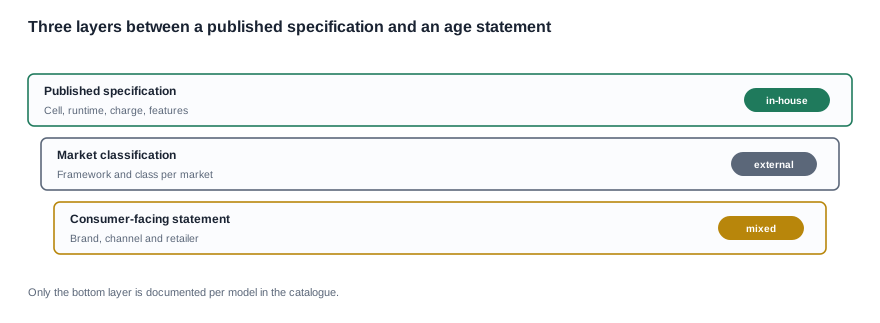
Those three layers are why the age question resists a short answer. The bottom layer is the only one this catalogue documents, and it documents it for the three children's entries in full. The middle layer is a classification decision that belongs to the market and to the party placing the product on it. The top layer is a consumer-facing statement that belongs to the brand, the channel and the retailer, and that each of them has to make consistently or the product fails a compliance review somewhere else in the chain.
Who has to classify the product, and who cannot delegate it
The practical consequence of the gap is a question about obligations rather than about products. A classification decision is made by the party that places the product on the market in the market concerned, and that party cannot pass it upstream to the factory and call the question closed. Where a buyer imports into the European Union and sells under its own brand, the buyer is the party placing the product on the market; where a distributor buys and sells under its own mark, the distributor holds the role; where a brand sells through a marketplace in a market where it has no establishment, the obligations attach to the seller that makes the product available. The two frameworks that bear on the radio side of any of these devices, the Radio Equipment Directive (EU) 2014/53/EU and the EMC Directive (EU) 2014/32/EU, sit alongside those duties rather than replacing them.
| Where the product is sold | Who normally holds the market role | What that party must be able to produce |
|---|---|---|
| Brand's own market, own mark | The brand or importer | Classification basis, documents, labelling content |
| Distributor's market, own mark | The distributor | The same, transferred with the batch |
| Through a marketplace, brand's mark | The seller that makes it available | The same, plus the listing content |
| OEM supply to another brand | The brand that owns the mark | A document set it can transfer with the units |
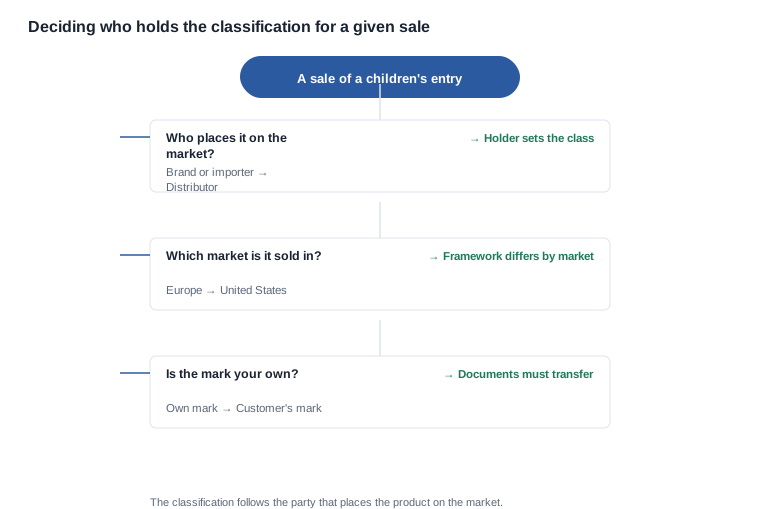
The table above is also a supply-chain question, not only a compliance one. A brand that buys from a factory and sells to a distributor needs the factory to produce something transferable: a document set that names the model, a classification basis that survives the change of mark, and labelling content that the distributor can use without re-deriving it. A factory that supplies units without those artefacts has not removed the buyer's obligation; it has simply moved it to a place where it will be discovered late, at a distributor who has no time to commission a test programme. This is the point at which the age question becomes a due-diligence item rather than a marketing one.
The reverse case is worth stating too, because it protects a buyer from over-paying for advice that cannot help. Nothing a factory says about age can bind a market surveillance authority, and no supplier's written assurance transfers a legal duty from the party that holds it. What a supplier can do is considerably more useful than that, though: it can describe the product accurately enough for the classification to be reached, it can state which test evidence exists for the exact configuration, and it can provide the technical file that a market role holder needs to make the decision. Those are the things to buy, and a request framed that way gets a useful answer.
What age is appropriate: the three-part answer for a procurement file
Published: three children's entries — the A05, the A06 and the A07 — with a 40 mAh cell on the first two and 70 mAh on the third, a rated runtime of about twenty hours across all three, a charge time of two hours or less across all three, magnetic charging across all three, a Bluetooth version of V5.4 on the A07 and no Bluetooth row on the other two, six feature lines on the A05 and the A06 covering a lens-based electronic arrangement, a fogging unit, correct and incorrect posture-and-distance prompts, lens clarity and lens fogging, and no feature lines on the A07. Not published: any age rating, minimum age, age band or recommended age; any classification of these products under any framework; any certification document for this family; any weight, dimensions or material composition; and any per-model certification row anywhere in the range, with the catalogue text carrying no reference to CE, FCC or RoHS and the company-level export certification page showing ten patent certificates — eight appearance designs and two utility models. Ask the supplier: the classification basis for a named model in a named market, the document set that exists for that exact configuration, the user profile and supervision assumption behind the published feature lines, and the runtime conditions, weight and dimensions that the catalogue does not carry.
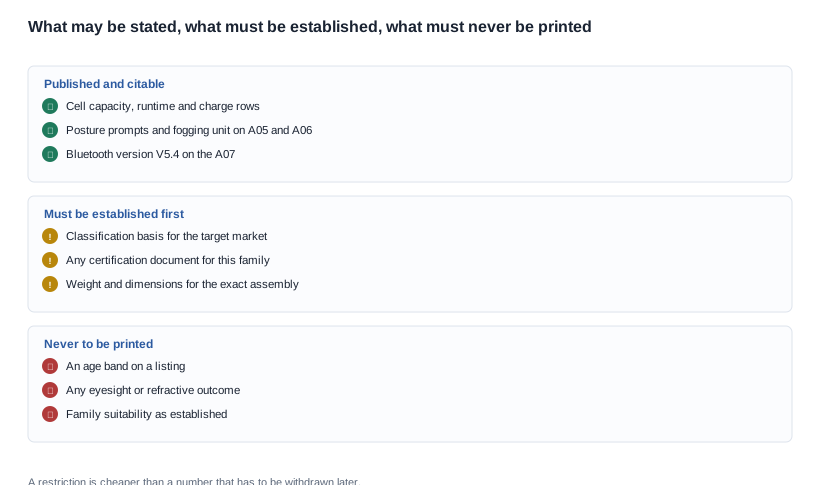
The wording rule that follows from this is narrow and worth enforcing in a review checklist. A product page may describe the published rows, may name the posture-and-distance prompts and the fogging unit as catalogue-listed features, and may state that a configuration is magnetic-charged with a published cell capacity. It may not print an age band, may not describe the device in terms of eyesight or refractive outcomes, and may not present the family's suitability as established. The first of those is unsupported because no row exists; the second is unsupported because it claims a medical outcome that the published rows do not address and that the frameworks for this product class govern; the third is unsupported because the family's certification position is not recorded at all.
For a buyer who has to put something on a listing before the work above is finished, our position is that the honest placeholder is a restriction rather than a number: no age statement, a narrower intended-user description that the supplier has confirmed in writing, and a documented plan to close the classification before launch. A number placed on a listing is easy to publish and expensive to withdraw, and a restriction costs a buyer some range in the short term while protecting the launch, the stock and the channel from a recall that would be far more expensive to manage.
Related reading
- The buyer-side checklist for this product class — children's product compliance buyer checklist
- The full document set this question depends on — children's product compliance checklist
- What each framework actually requires — children's product compliance requirements
- How to shortlist this family without relying on age claims — choosing kids eye protection glasses
- The programme view for a children's launch — choosing smart glasses for kids
Name the model, the target market and the channels you intend to sell through, and the three questions above can be turned into a dated request list rather than an open enquiry.


