

Smart glasses for kids parenting is decided by the claim set rather than by the feature list, because the person who signs the purchase order and the person who puts the product on in a school morning are two different people running two different tests. A buyer sourcing a family line is buying a listing that a parent will interrogate at a kitchen table, not a specification that a product manager will interrogate in a review meeting. The published rows tell you what the product is; they do not tell you what you are allowed to say about it, and in this category the second question decides whether the channel survives its first shipment.
Smart glasses for kids parenting: who signs the order versus who wears them
A family programme has three parties and only two of them are in the room when the order is placed. The brand owner or the channel buyer sets the target landed cost and approves the packaging. The parent approves the purchase at the point of sale and, without any training, decides whether the product stays in the house. The child is the third party and has no voice in the transaction, which is precisely why the regulatory weight sits on the seller's claim rather than on the user's preference.
That structure changes what a buyer has to get right. A specification review asks whether the unit does what the datasheet says. A claim review asks whether the family will believe it, and whether the seller can defend it when the child's paediatrician, the school's safeguarding lead, or a regulator asks for the paperwork behind it. The two reviews use the same document but produce different verdicts, and a buyer who has only done the first one has finished the cheaper half of the job.
The commercial exposure follows from the same split. A parent who feels misled does not file a warranty claim; a parent files a public review and returns the unit, and in a family category the review is read by other parents who are deciding whether to buy the same listing. A returns reserve is therefore not an accounting line in this programme, it is the price of the claim set. Price tiers and unit price talk get a buyer a shelf position; the claim set is what determines whether the first hundred units produce a review feed that supports the next order or ends the channel.
What the catalogue actually offers for this decision is narrow and, for that reason, useful to a buyer. It publishes three children's models, and it publishes them with a clear separation between the protective pair and the audio model. It publishes cell capacity, a charge time, a rated runtime and a charging method for each. It publishes no age grading, no per-model certification row, no weight, no frame material and no lens specification for any of them. The published rows are enough to build a defensible listing. They are not enough to build one on their own, and the rows that are missing are exactly the rows a parent asks about.
A buyer who treats that gap as a reason to look elsewhere has misread it. The gap is the same for every supplier in the category, because the missing information is the supplier's technical file and the supplier's certification, not the buyer's sales skill. The differentiator between quotations is not who publishes more, it is who will tell you, in writing and per model, which document answers which question, and who will let a two-unit sample be checked against the claims before the tooling is committed.
What a buyer has to decide before any model is discussed
Four decisions come before the model shortlist, and each of them removes models rather than adding them.
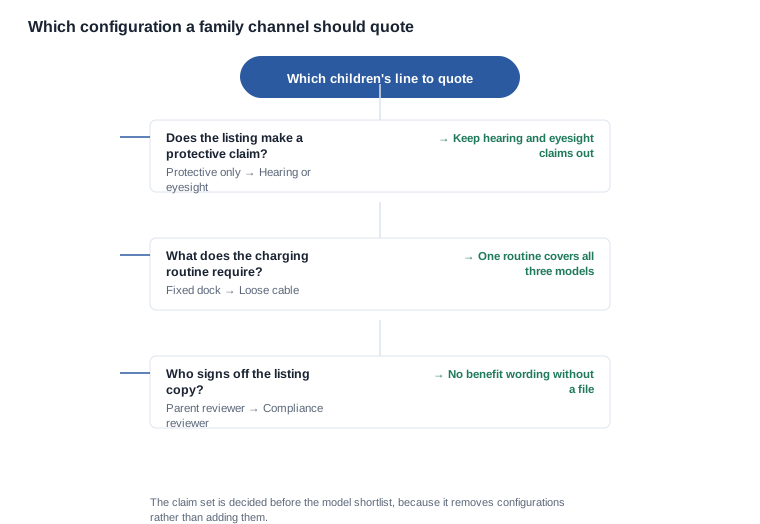
- The claim set. Which statements will appear on the packaging, the product page and the insert. A family listing that intends to say anything about eyesight, hearing or development cannot be supported by any row in our catalogue and is not a configuration we can quote.
- The age boundary. What the product is graded for, where that grading appears, and which claims are permitted for that age group in the destination market. This is a written document from the supplier, not an inference from the product name.
- The household routine. How the product is charged, where the cable or dock lives, and who does it. A routine that assumes technical confidence produces support calls and returns.
- The channel structure. One model or two, shared packaging or separate packaging, and whether the two share a purchase order. Every extra variant adds minimum order quantity pressure, packaging cost and compliance work.
Only after those four are settled does it make sense to compare a 40 mAh protective model with a 70 mAh audio model. The order matters because the price point is an output of the configuration, not an input to it — a target landed cost chosen before the configuration was costed is the single most common reason a family programme is reworked after the first order.

What the catalogue publishes for the three children's models
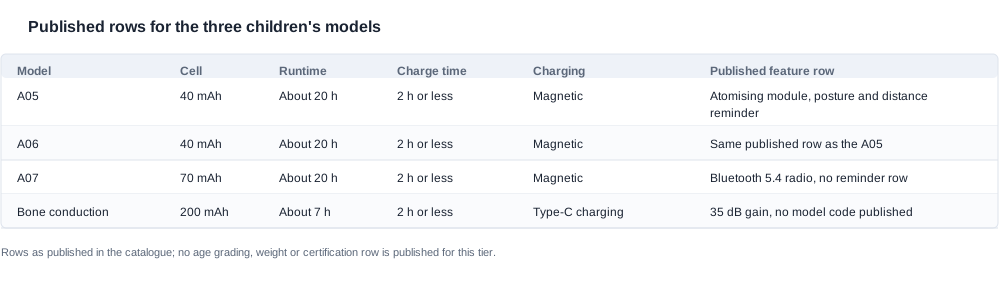
Two of the three published rows are identical, and the third differs in exactly two places. Getting that right matters, because a buyer who quotes "the protective model" without naming which of the two they mean will receive two quotations that cannot be compared, and a buyer who quotes the audio model as if it also carried the protective features will receive a sample that does not match the listing.
The A05 and the A06 publish the same parameters: a 40 mAh cell, a charge time of two hours or less, a rated runtime of about twenty hours, magnetic charging, a lens-type electronic atomising module intended to resist fogging, and a posture and distance reminder function. Neither publishes a Bluetooth version. The A07 publishes a Bluetooth 5.4 radio, a 70 mAh cell, magnetic charging and a rated runtime of about twenty hours, and it publishes no reminder row. It is a single cell; the two 70 mAh arrangements that appear elsewhere in the catalogue are two-cell configurations and are a different electrical proposition.
The twenty-hour figure is the one number that genuinely differentiates this tier, and it is worth understanding why before it goes on a listing. Roughly twenty hours on a 40 mAh cell is a low-average-duty figure, not a continuous one. It is consistent with a reminder function that fires intermittently and an audio or atomising module that runs in short bursts, which is exactly the duty pattern of a school day for a child who uses the product for a few hours rather than all of it. A listing that says "twenty hours of playback" would be a claim the catalogue does not make, and it would produce exactly the kind of parent review that ends a channel. The defensible phrasing is a rated runtime of about twenty hours under the supplier's own test condition, which is the condition the buyer must request.
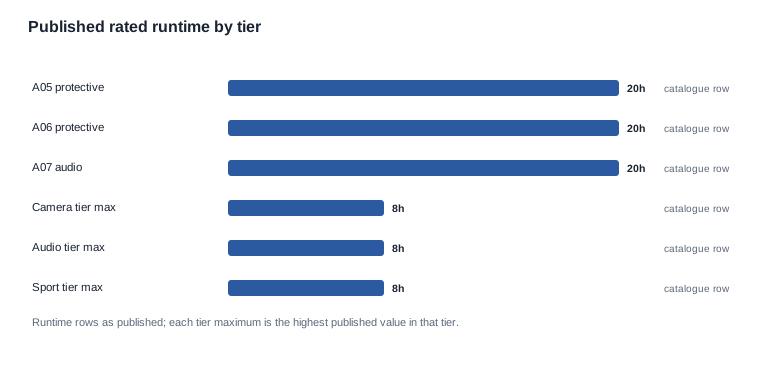
Against the rest of the catalogue the gap is stark. The highest published runtime anywhere in the camera tier is about eight hours, the audio tier peaks at about eight hours, and the sport tier peaks at about eight hours. Three to six hours of additional headroom is not a rounding difference at a 40 mAh cell; it is the difference between a product that is recharged at a fixed point in the evening and one that is recharged whenever a charging point happens to be found. For a family line that is not a specification preference, it is a returns driver, because the household that runs out of power mid-week returns the unit rather than charging it.
Two negative facts belong in the same place. No weight is published for any of the three, so a listing that quotes a weight is quoting something no supplier document in this tier supports. And the catalogue carries a separate bone-conduction entry, with a 200 mAh cell, roughly seven hours of runtime, Type C charging and a published amplification gain of 35 dB, which carries no model designation. It is not a children's model and it is not a variant of the A05, the A06 or the A07. A family listing that borrows a specification from it inherits a medical-device question that the category cannot answer.

The claim set a family listing has to survive
The claim set is the single most valuable document a buyer can extract from a supplier in this segment, and it is the one most often left unwritten until the packaging artwork is due. By that point the artwork is tooled, the minimum order quantity is committed and the changes are the most expensive ones available in the programme.
Three rules decide what can be written.
The product name is not a claim. Our catalogue names the A05 and the A06 as children's smart protective glasses and the A07 as a children's smart audio glasses. A product name is a catalogue label, not evidence, and it certainly does not support a listing sentence about protecting a child's eyesight, slowing a decline, aiding hearing or supporting development. A parent reading a page that implies one of those benefits will act on it, and the supplier who wrote the copy carries the consequence.
The reminder and the atomising module are features, not benefits. The published rows describe a posture and distance reminder and a lens-type electronic atomising module intended to resist fogging. Both may be described in those terms, and only in those terms. "Reminds the child to sit at a suitable distance" is a feature description that traces to a published row. "Protects the child's eyesight" is a benefit claim that traces to nothing, because no test method, no threshold and no report behind it are published for this tier.
The medical-device route is not available to this tier. A product that makes a hearing claim falls under medical-device requirements in most markets, and the applicable regimes include the European medical-device framework and the United States regulation on hearing aid devices at 21 CFR 800.30. A product intended for children may also fall under the European toy safety standard EN 71 or the United States children's product safety standard ASTM F963, depending on the age band and the market. None of these is a marketing option that can be exercised by the seller; they are conditions that determine what the seller may write. The published rows for the A05, the A06 and the A07 carry none of them, and the catalogue as a whole contains no CE marking, no FCC statement and no RoHS statement anywhere in its text, so none of these regimes can be evidenced from what we publish.
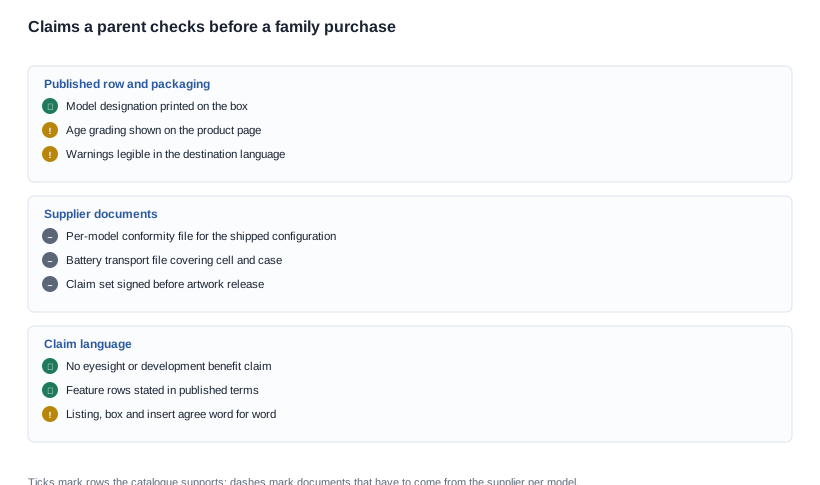
The practical consequence is a claim set with three layers. The first layer is the published rows, which can be stated directly: the capacity, the charge time, the rated runtime, the charging method, the radio version where one is published, and the two named feature rows. The second layer is the supplier's documents, which can be stated once they exist and are scoped per model: the conformity route, the test reports, the battery transport file, the age grading and the warning text. The third layer is everything else, and it does not go on the listing at all. A buyer who separates those three layers in the file has already avoided the most expensive category of mistake in this segment, which is a packaging reprint.
There is a fourth discipline that is not a claim and is easy to forget: the packaging and the product page must agree. A claim set that lives in the insert while the listing says something stronger is a document mismatch that a parent's comparison between the two surfaces will expose, and a parent who finds it will treat it as a deception rather than as a marketing error.

Qualifying a supplier before the first order
The qualification for a family line is shorter than for an industrial programme and harder to do properly, because the end user is a child and the feedback arrives as a public review rather than as a ticket. Four documents do most of the work.
The model designation table establishes which product is which. It maps every published row to a sellable model and states which configuration is the one being quoted. Without it, a quotation for "the protective model" is not a quotation at all, and the buyer cannot tell whether the unit arriving is the A05 or the A06.
The per-model conformity file is where the certification question actually lives. Buyers will ask for CE, FCC and RoHS because those are the marks their own quality process and their own channel require, and the correct answer from us is that our catalogue publishes no per-model certification row and contains no CE, FCC or RoHS text at all, so the documentary evidence must come from the supplier and must be scoped to the specific model and the specific configuration. A supplier that answers "we are certified" without a per-model document has not answered the question, and a buyer that accepts that answer has inherited an unusable technical file.
The battery transport file matters more here than in most categories, because the family programme ships a lithium cell and often a second one in a charging case. The transport documentation has to describe the exact cell and the exact case that will ship, and the case is the item most often missed, since a case is a second cell with its own declaration requirement. The requirement itself is set out at battery transport.
The claim set in writing, covering the age grading, the permitted claim language and the warning text, closes the loop. The commercial structure of the first order belongs at contract terms and pricing, and the sample stage is covered at samples.
A sample review for this tier has three parts and none of them needs laboratory equipment. First, the routine: hand the unit to a household, put it where the charging point will be, and see whether the twenty-hour claim survives a week of interrupted use. A unit that is returned to the household without a clear charging location comes back with a dead battery in it, and that is a product-handling artefact rather than a defect, but it is recorded as one. Second, the labelling: check the model designation, the age indication, the warnings and the feature descriptions against the claim set, word for word. Third, the packaging: check that the listing, the box and the insert agree, because a parent will read all three.
The four questions to put in the first enquiry are therefore simple, and they are the ones that decide which models make the shortlist. Which model designation is being quoted, and what appears on that model's published row. Which document answers the conformity question for that model and that configuration. What claim language is permitted for the destination market and the age band. What the warranty and returns position is for a product in this category, including who pays the return freight.
The red flags in this segment are not exotic. A model list without a designation table. A claim set that arrives after the artwork deadline. A certification answer that names a standard without a document. A sample that differs from the approved configuration in a way that does not appear on the datasheet. A returns policy written for a technical product and applied to a family purchase. Each of these is convertible into a line in the purchase order, and each of them is cheaper as a line than as a lesson.
Where the commercial terms for a family channel actually sit
In this segment the negotiation is about structure rather than about unit price, because the price of a family line is set by the configuration and the configuration is decided by the claim set. The blocks worth arguing over are the ones that decide whether the first hundred units produce a defensible review feed.
The variant structure. The A05 and the A06 publish identical rows, which makes them attractive to run as a single specification with different packaging, but it does not mean they are interchangeable in a channel. The variant count drives packaging minimums, artwork cost, and the number of separate stock-keeping units the channel has to manage. A buyer who wants both should ask whether the supplier can hold one artwork shell across them, and whether the minimum order quantity is per variant or per programme. That single question frequently changes the landed cost more than any discount request.
The age-band split. A household line and a school or institutional line are not the same programme, even when the product is. Institutional buyers ask for a different documentation set and a different warranty position, and a single SKU sold into both usually ends up priced for the harder of the two. Splitting the SKUs by buyer type costs artwork and lets each tier carry a different claim set and a different price tier.
The returns reserve. This is the block that is almost never quoted, and in this segment it is the one that matters most, because the return is made by a parent and converts into a public review rather than into a service ticket. Building it into the quotation as an explicit percentage of unit price, rather than discovering it in the first bad month out of margin, is a normal request and is usually granted.
The warranty and the fault route. A twenty-hour rated runtime is a rated figure, not a guarantee, and the agreement should say what happens when a household returns a unit at month five. A defect route that requires the household to describe the fault in technical terms will not be used; a route that works with a photograph and a description will be, and the difference shows up in the ratio of units that come back.
The sample and the tooling. Tooling is amortised across the first order and quoted as a separate line, and the sample cost is recovered or credited against the first purchase order. Both belong in the quotation rather than in an invoice after the fact, and both are cheaper to discuss before the claim set is fixed.
We publish the rows a buyer can order from, and we will not fill the gaps with industry averages. For this tier that means the cell capacities, the charging methods, the charge times and the rated runtimes, the published radio version on the A07, and the two published feature rows on the A05 and the A06. We do not publish a weight for any of the three, a per-model certification, an age grading, a lens specification or a test method behind the reminder function, and we will not estimate them or supply a typical value from another model. For the bone-conduction entry, the published row is the 200 mAh cell, roughly seven hours, Type C charging and the 35 dB gain, and nothing more.
What we will do is take the channel, the target landed cost, the number of configurations, the age band and the destination markets, and tell you which published rows apply, which claims the documentation supports, which documents have to come from the supplier per model, and which criteria belong in the purchase order. The family line itself is at kids smart glasses, the parental question set is at kids and parenting smart glasses, and the practical fault routes are at kids smart glasses troubleshooting.
What to send us. Send the channel, the target landed cost, the number of configurations, the age band and the markets, and we will return the published rows that cover that combination, the claim set the documentation can carry, and the questions that have to go into the first supplier enquiry.
Related reading
- The scenario's opening — parenting
- The family this model comes from — kids smart glasses
- The parental question set — kids and parenting smart glasses
- The fault routes — kids smart glasses troubleshooting
Tell us the channel, the age band and the target landed cost, and we will return the published rows that cover it and the claim set the documentation supports.


