

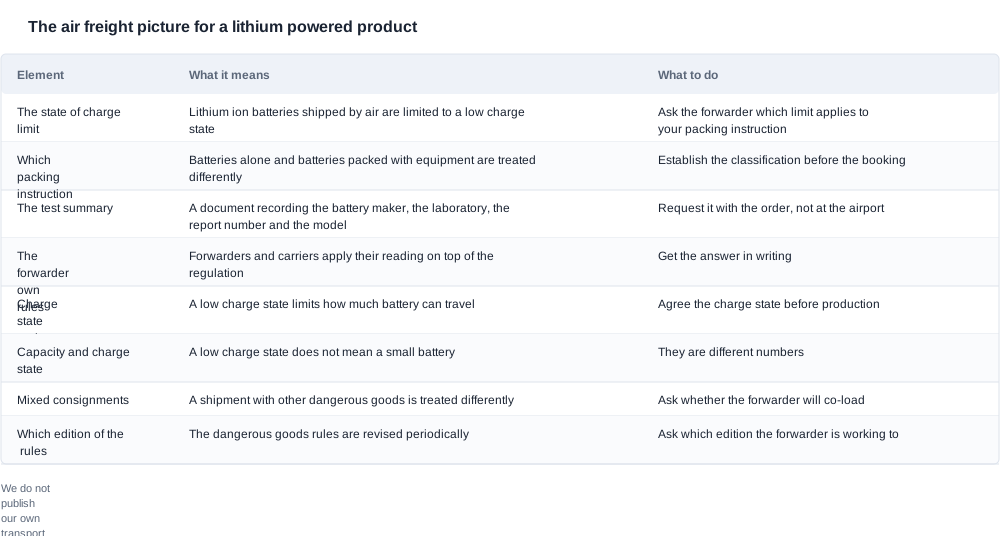
Lithium ion batteries moved by air are subject to a limit on their state of charge, and the figure that applies in practice to most shipments of this kind is 30 per cent of the rated design capacity of the cell. That is the number buyers ask for, and it is the correct number to quote. The commercially useful answer is longer, because the figure is a starting point for a conversation with your freight forwarder rather than a specification you can plan a production schedule around. Three things routinely get conflated: the published regulatory figure, the stricter figure a particular forwarder or carrier will accept on a particular routing, and a separate security or customs rule that may have nothing to do with dangerous goods. Only the second is the number a procurement file should be built around. This article sets out what the limit is, why it is written as a proportion, what it applies to, what it costs to satisfy, and which questions to ask before you commit to a purchase order.
What percentage charge is allowed for air freight: the number and its limits
Thirty per cent of the rated design capacity is the published figure, and the reference point is the cell's own specification sheet rather than whatever the cell happens to be holding at the moment of packing. That distinction is where a surprising number of consignments go wrong. A cell sitting at what a device reports as a third of its charge is not automatically a cell at thirty per cent of its rated design capacity, because a device indicator is usually scaled against a configured full-charge threshold, not against the nameplate figure on the cell. The measurement that counts is the nameplate one, and the nameplate figure is the one written on the test summary.
The limit applies across the lithium ion and lithium polymer family, and it applies irrespective of capacity. A 220 mAh cell and a 290 mAh cell are both subject to the same proportion. The physical battery in the carton is unchanged either way, which is the point: the restriction does not make the product smaller or lighter, it makes the goods harder to prepare. Anyone reasoning from a capacity table to a transport conclusion is reasoning from the wrong column.
The number is a ceiling, and a consignment that arrives at the origin above it does not become compliant through documentation. This is a physical property of the goods at the moment of tender. No certificate, no declaration and no letter from the factory converts a cell at ninety-five per cent into a cell at thirty per cent. That is the single fact that separates a shipment planned properly from one planned after the goods exist, and it is the reason the conversation belongs in the purchase order stage.
Three figures circulate, and buyers routinely treat them as one. The published figure is the regulatory baseline. The forwarder's accepted figure is that baseline or something stricter, depending on routing, carrier and the forwarder's own risk appetite. The security or screening rule a forwarder mentions in passing is a third thing entirely, and it may or may not relate to dangerous goods classification at all. Planning against the first when the operative number is the second is a classic procurement pitfall, and the resulting rework shows up as a hold at the origin rather than as a cost on the quotation.
The gap between the published figure and the operative figure is where the money sits. A forwarder who will not accept a consignment at the published ceiling because their carrier does not take that routing at that charge level is offering you a stricter, more expensive service. Ask them to name the figure and the reason in writing, then model both the rate and the preparation cost against the alternative routings.
Before you commit, establish which of the three figures your shipment is actually governed by. A short written confirmation from the forwarder naming the accepted charge level, the packing instruction, the aircraft type and the rules edition is the cheapest due diligence in this process, and it takes one email. Red flags in this file are always of the same kind: a supplier quoting the published figure as though it were universal, a forwarder who will not name a figure, and a quotation where the freight line is identical to one for goods with no cell in them.

Why the rule is written as a proportion, and what that changes for a procurement file
The restriction is a risk measure rather than an engineering one, and the whole of its logic sits in one sentence: a partly charged cell contributes less stored energy if it is involved in an incident. A lithium ion cell carries a great deal of energy in a small package, and the regime for air transport manages what happens in the worst realistic case rather than what happens under test. That is why the requirement is expressed against charge rather than against capacity, and it is also why a battery may be 290 mAh, travel at thirty per cent, and arrive as exactly the same physical cell it left as.
Writing the rule as a proportion of the cell's own rated design capacity is what lets it survive a decade of product change. A fixed energy figure would have to be rewritten for every new chemistry, every new format and every new size. A percentage scales automatically to whatever cell a manufacturer fits next, which is why the compliance position for a brand owner adding a second model to an existing programme is identical in structure to the first. The trade-off is that the supplier must be able to state the rated design capacity of the fitted cell, and a supplier who cannot state it is telling you something about its own quality records.
A cell discharged without a record of its rated capacity cannot simply travel at a number somebody chose. This is a short sentence with a long consequence. Discharging a cell is easy; demonstrating which capacity it was discharged against is an audit question, and it becomes one only when a consignment is examined. The practical protection is procedural: a change notification clause in the contract that obliges the supplier to declare any cell substitution, so that the test summary can be reissued before the shipment or the shipment can wait. The contract terms page covers where that clause belongs, and the quality consistency page covers the wider question of holding one specification across a production run.
The rule constrains energy in the cell, not the reading on a device screen. A unit that displays a full charge bar may be displaying full relative to a configured threshold rather than relative to the cell inside it. Buyers who plan to set the shipping charge state from a firmware setting are working to a number the rules do not use. Where a supplier proposes a firmware-side charge limit as the compliance mechanism, ask what the measurement reference is and who records it; an answer that does not name the rated design capacity is not an answer.
None of this is negotiable at the loading point, which is why it belongs in the commercial negotiation rather than in the logistics discussion. When a forwarder offers to handle the charge state as part of the freight service, establish the total cost including any third-party conditioning, and establish who carries the delay. A supplier who treats this as a freight detail rather than a production detail is describing an organisation that has not run a first shipment yet, and that is a due diligence signal in itself.
What the limit applies to: packing instruction, aircraft type and rules edition
Which packing instruction applies is the first fork, and it determines the charge limit, the documentation and the handling regime simultaneously. Batteries shipped alone and batteries packed with equipment are classified differently under the air transport rules for dangerous goods. A product shipped with its charging case falls on the second side, and the case has to be assessed in its own right because it carries its own cell. Establish the classification with the forwarder at the booking stage, in writing, rather than at the loading dock when the consignment is already moving.
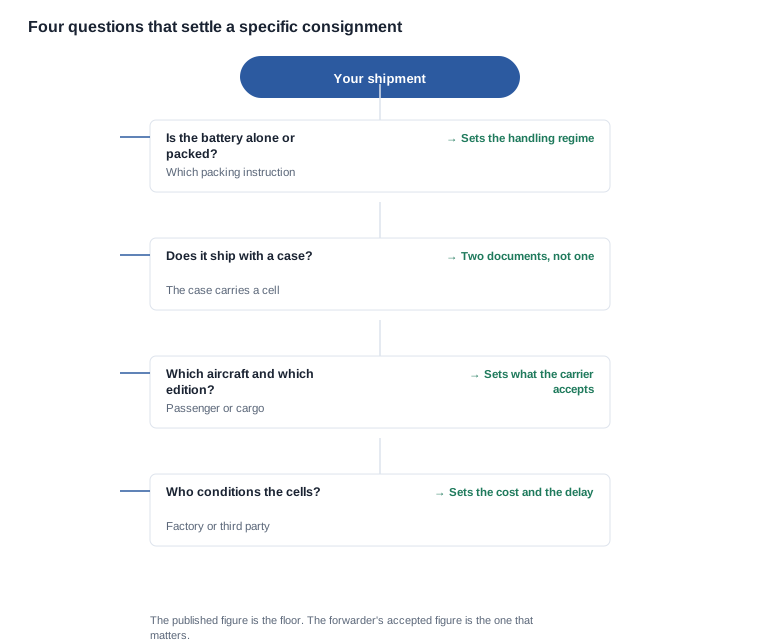
Passenger and cargo aircraft are treated differently for the same consignment. This matters commercially whenever a forwarder offers a road-and-air routing against a direct cargo service: the rate card comparison looks favourable and the handling difference is priced later. Ask for both legs to be quoted on the same classification, and which aircraft type each leg uses. Where a routing depends on a connection, the weakest link sets the accepted charge level for the whole journey.
Carriers apply their own reading on top of the published rules, and the carrier decides whether to accept the shipment. A forwarder can be entirely correct about the regulation and still be unable to tender the consignment, because acceptance is the carrier's decision. In a supplier negotiation this matters for warranty and liability: ask who bears the cost when a carrier refuses at the loading point. An agreement that assigns that cost to the buyer, for documentation the buyer never sees, is a red flag to raise before the contract rather than after the first refusal.
The edition of the rules in force on the day of tender is the edition that matters, and forwarders do work to different ones. The dangerous goods rules for air transport are revised periodically, and a forwarder quoting confidently from a superseded edition is a foreseeable and common occurrence. It is invisible until a consignment is refused. Ask which edition the quote is based on, and ask for it in the quotation itself, so that a change between quotation and tender shows up as a price change rather than a surprise delay.
The route itself is a trade-off, and air is not automatically the right answer. Sea freight has its own charge requirements, its own documentation and its own lead time. For a bulk order of a mature model where the market window is wide, sea freight may deliver a lower landed cost with an acceptable lead time. For a launch window measured in weeks, air may be the only viable option and the charge state becomes a cost of doing business rather than a decision point. The battery transport page covers the transport side of the picture, and the logistics page covers the broader decision about how goods move and on what payment and insurance terms.
A refusal does not usually mean the goods go home, and the true cost of one is worth modelling in advance. The realistic outcome is a hold, an inspection, and either a re-tender on a later flight or a move into a warehouse pending a decision. Each carries storage, handling, demurrage and insurance cost, charged to the party that tendered the goods, which is normally the buyer rather than the factory. The direct freight saving on a single consignment is very unlikely to exceed the cost of a hold. The figure that actually governs the commercial exposure is the freight rate multiplied by the probability of a preparation error on the first consignment, and that probability is high when the preparation was never planned.

Arranging the charge state before production, not at the loading dock
Conditioning a batch of cells down to a specified charge state takes time and frequently takes equipment the factory does not have, which means it is often a third party. In the trade this preparation has a name, and a buyer who recognises it can ask the right questions. For a modest MOQ the cost of conditioning can be a meaningful share of the freight value, and it never appears in the unit price of the goods. A buyer who builds a freight budget without asking how the charge state will be achieved will find the difference between the quoted freight and the actual freight, and it will not be a rate difference.
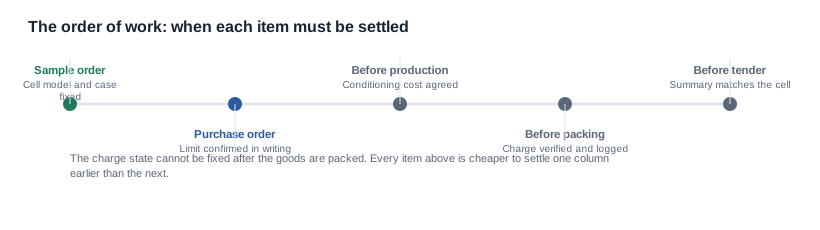
The charge state therefore has a lead time attached to it, and the lead time attaches to production rather than to logistics. This is the practical reason the question belongs in the purchase order conversation. A factory that has to discharge a whole lot, or route a lot through a third party, cannot start that until the lot is finished and packed, so the delay lands at the end of the production schedule and pushes the shipment date. Buyers who discover it at that point are negotiating against a date they have already committed to. Buyers who settle it at the order stage can either build the days into the schedule or choose a routing that does not require them.
Two questions to ask a supplier establish most of this in a single exchange. Ask who performs the conditioning, and how many days it adds to the lead time. An answer naming a third party and a number is a factory that has done this before. An answer that says the goods will simply be shipped is a factory that has not, and the difference will be discovered by the forwarder rather than by you. This question separates a shortlist more cleanly than almost any specification comparison.
Quality control has a role here that is easy to miss. The charge state must be verified at a defined point and recorded, and the record has to be traceable to the lot. A factory with a quality control procedure that includes a charge verification step will produce the record as part of normal production. A factory without one will produce a statement on a packing list, which is not evidence. Ask whether charge verification sits in the incoming or outgoing inspection record, and ask for an example of what that record contains.
The cost side belongs in the negotiation, and it is a negotiation rather than a fixed charge. Conditioning cost scales with lot size, so the same procedure is expensive per unit on a small MOQ and marginal on a bulk order. Ask for the cost as a stated figure and as a stated one-off, and ask whether it is rebated at higher volume. Suppliers who quote a single number without a break structure are usually quoting the small-lot figure, which is the one least likely to be the number on your actual order.
Negotiate the contingency rather than the base case, because the base case is rarely the case that costs you. A supplier who will state what happens when the lot cannot meet the charge requirement — a hold, a re-tender, a substitution — has given you something you can plan against. A supplier who treats it as impossible has given you a promise. When to raise these terms is early: before the sample order, not after the purchase order, because the commercial conversation is considerably easier while volume is still theoretical.
Put the arrangement in writing in the quotation rather than in an email thread. The total cost of a compliant shipment is the freight rate, the conditioning cost, any inspection or handling surcharge, and the probability-weighted cost of a hold. A supplier who provides that sum unprompted is giving you something you can negotiate against. One who provides only the freight rate is leaving the most variable element invisible, and the difference between the two behaviours is itself a useful criterion in a supplier evaluation.

The documents that travel with the consignment, and the substitution trap
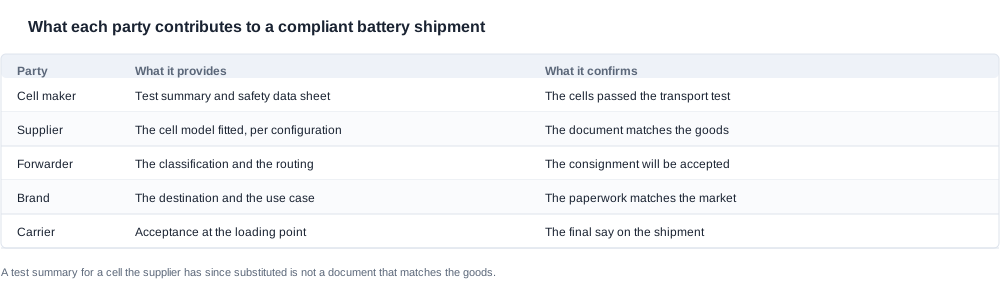
Alongside the charge state, air transport requires a test summary for lithium batteries, and it has been a mandatory document for shipments that began after the start of 2020. It records the battery maker, the testing laboratory, the report number and the battery model, and it is what allows the consignment to be accepted. A shipment file with a certificate of conformity, a safety data sheet and a declaration but no test summary is missing the one document that matters for the air leg.
That test summary comes from the United Nations Manual 38.3, and it is a different document from the product battery safety standard. The transport test standard covers overcharge, short circuit and elevated temperature and answers whether the goods may move. The product standard answers whether the battery is safe in the product. Most programmes need both, they are produced by different activities at different times by different organisations, and frequently by different suppliers. The confusion between them is common enough in buyer files that it is worth naming explicitly in your questions to ask: ask for the transport document by its own name, not for the battery certification.
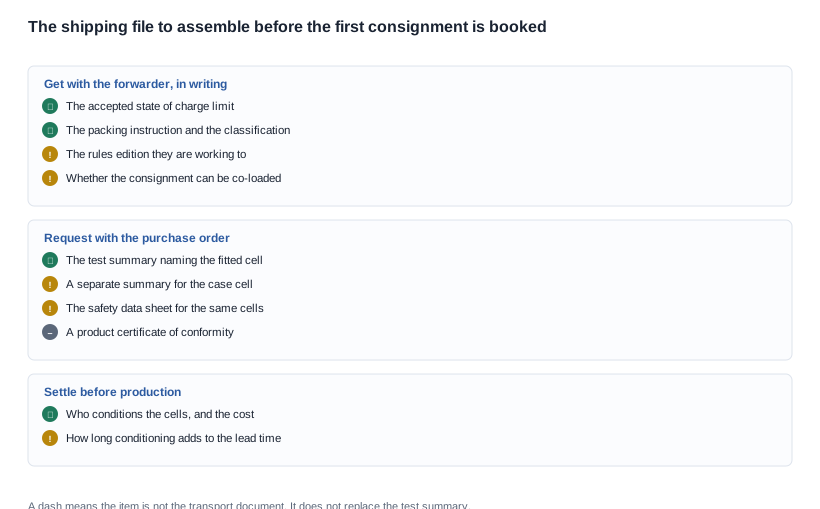
For a product shipped with a charging case, one document becomes two. The case carries its own cell and therefore needs its own test summary. A supplier who offers a single summary is either unaware of the requirement or has a case whose cell is covered by the product summary, and both are worth establishing in writing. The certification checklist page sets out the wider document set, and the market entry sequence page covers where the transport file sits in the order of work.
Substitution is the most common reason a correctly prepared consignment still fails, and nothing about the substitution is improper. Manufacturing substitutes cells for entirely legitimate reasons: a part is discontinued, a price moves, a second source is qualified, and the line has to keep running. The transport document, however, is issued against a specific cell model tested at a specific point, and a substituted cell is not covered by it. The consequence is not a compliance failure by the factory; it is simply that the file no longer matches the goods, and the mismatch is found at the origin rather than in the factory. A change notification clause is the only effective protection, because it converts a silent mismatch into a known one.
Ask specifically what happens to the documentation when a cell changes, rather than asking whether substitutions occur. Suppliers will tell you that substitutions do not happen, and some of them will mean it. The useful version of the question is: if the fitted cell changes between the sample order and the bulk order, what reissued documents do we receive, and how many days does that add? An answer with documents and days is a supplier with a procedure. An answer without them is a supplier whose first reissue will be improvised.
The document review belongs in quality control and in the purchase order, and it is cheap when it is early. A document that does not match the goods is a five-minute discovery in a factory and a five-day recovery at an airport. The same check as part of the pre-shipment inspection is free; after tender it is not. Ask whether that inspection includes a comparison of the fitted cell against the test summary, and whether the report is issued before the consignment leaves.
One practical note for a buyer planning a first shipment. The charge state is the only part of the entire air freight arrangement that cannot be solved with paperwork, and therefore the only part that has to be arranged with the factory. Settle it during the purchase order conversation, when the cell model and the case are being confirmed, and it is settled. Raise it after the goods are packed and you have a production delay on the far side of an international transit, a hold charge that lands on your account, and a launch date that has already been announced. That single question is worth more than every other document in the file combined.
What we publish, and what we confirm per enquiry
We will not publish our own transport files or our cell test summaries, and we will not tell you a document exists before the company has confirmed it. That is a deliberate position rather than an omission. A transport file is model-specific and cell-specific and is issued against a particular test report, so a published link would become wrong the moment a cell is substituted. The battery transport page sets out the framework, and the position on individual files is confirmed per enquiry against the configuration actually ordered.
We will also say that the MOQ, the production capacity and the lead times behind the shipping file are not published, because each is set by what is ordered, how much of it, which moulding is involved and where the factory sits in its own schedule. A buyer planning a first air shipment needs those figures before the first purchase order rather than after it, and they are provided per enquiry for that reason.
What we will do is tell you what to ask for against a specific order, and confirm the documentation position for the model and configuration you are actually shipping once the company has signed it off. In practice that means the cell model, the case model, the packing instruction, the destination and the rules edition your forwarder is working to. The published rows bearing on the freight question are the cell capacities and the charging interfaces, in the charging solutions and battery life pages, and the shipping terms in the payment terms page. A forwarder holding those figures plus the test summary will classify the consignment correctly.
We do not treat the absence of a published figure as a reason to fill the gap with an estimate. If a number you need is not published, ask for it against your configuration and it will be confirmed or declined explicitly. An invented number in a quotation is far more expensive than a missing one, because it moves the problem from a conversation you can hold to a consignment you cannot.
Related reading
- The documents a battery shipment needs — battery transport
- The difference between the transport and the product standard — certification checklist
- The shipment documentation as a whole — the market entry sequence
- How the goods move and on what terms — logistics
- The published battery rows — battery life and power
Tell us the model, the cell in it and the destination, and we will tell you what to request from your forwarder and what documentation we can confirm for the shipment.


