
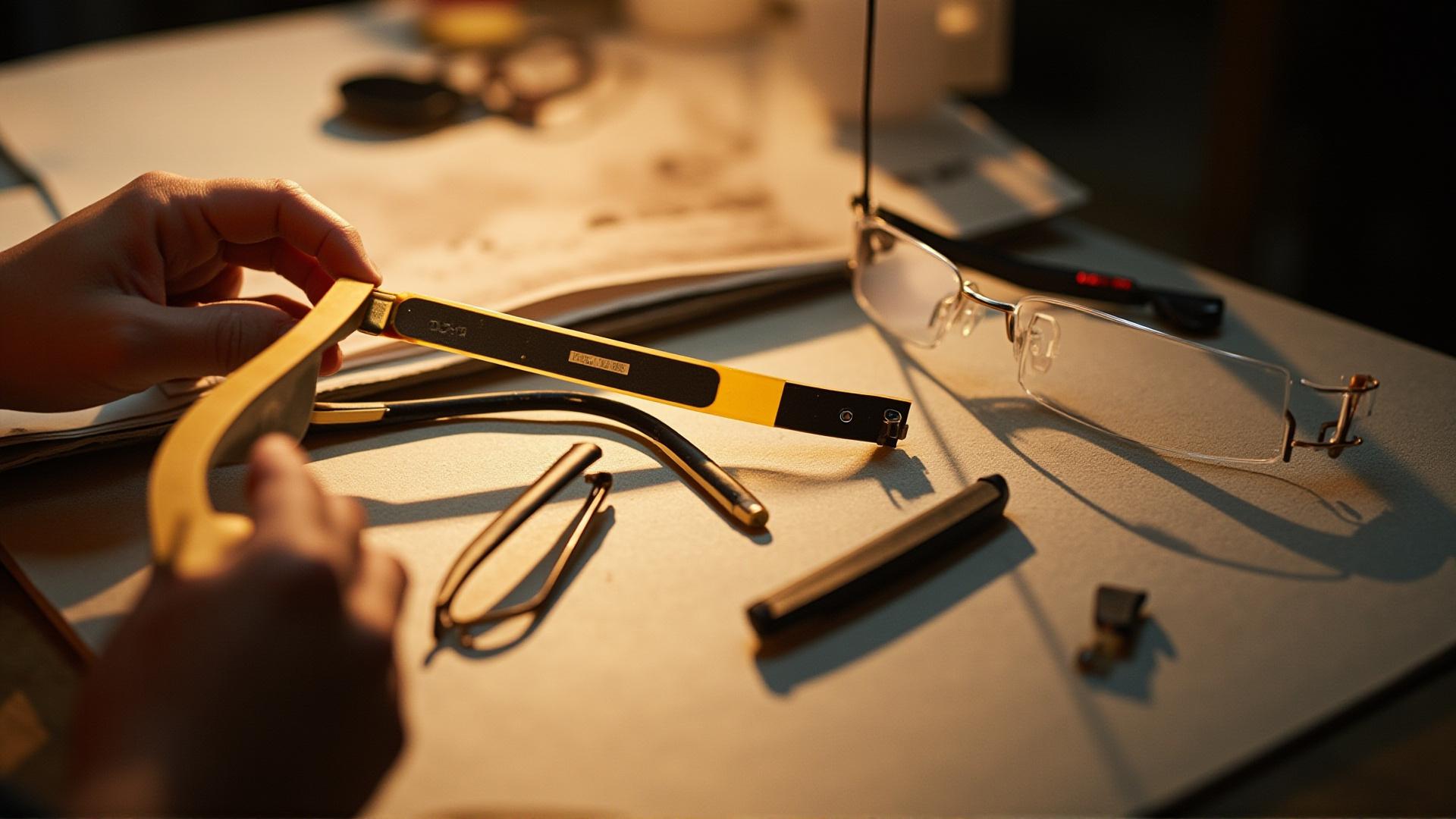
The K02's published row is Bluetooth V5.3, 90 mAh × 2 cells, magnetic charging in up to two hours, a rated runtime of approximately eight hours, and nothing else. No touch control, no translation capability, no sound claim, no temple description, no case, no colour list.
That is an unusual shape for a product, and it makes the buyer profile unusually clear. The K02 is for a brand that has decided not to carry a claim, and separately for a brand that wants the largest published capacity in the audio range. It is also, for one structural reason, a platform decision rather than a model decision, and that reason is worth more attention than the specification is.
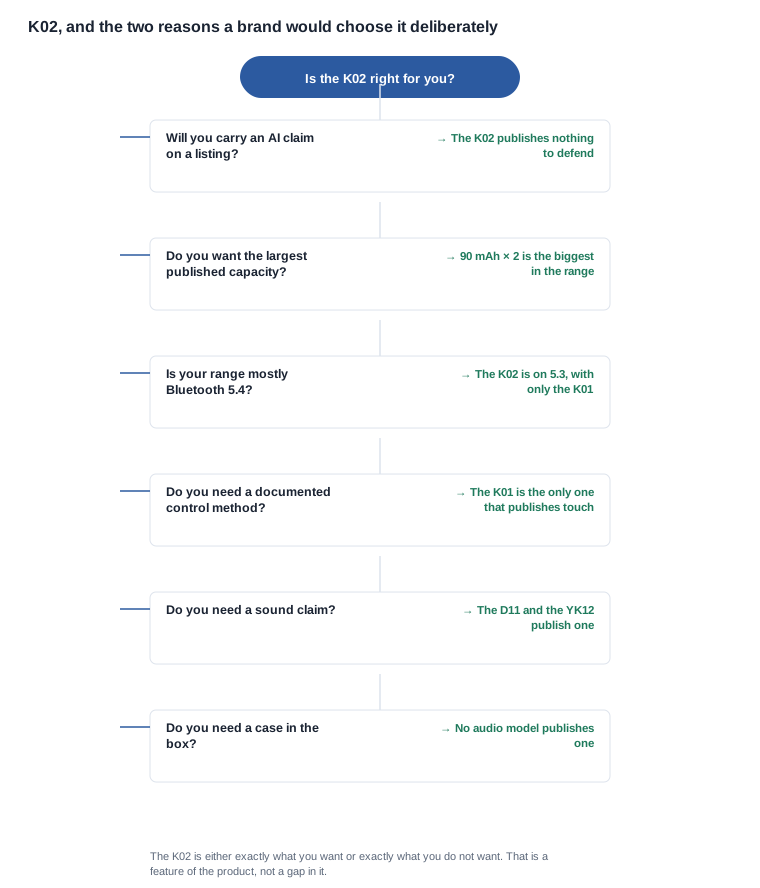
K02 smart glasses: what the published row does and does not settle
Four rows is enough to write a listing. It is also enough to stop, because four rows do not tell you what the product is — they tell you what the supplier is prepared to stand behind. In this category the distance between those two things is where most of the commercial risk sits, and the K02 is the model that makes the distance unusually visible.
Read the four rows together rather than one at a time. Bluetooth V5.3 places it on the older of the two radio versions in this range. Ninety milliamp-hour cells in a dual arrangement give the largest total capacity published in the audio family. Magnetic charging in up to two hours is shared with the K01 and with the 55 mAh × 2 models. Approximately eight hours is the top of the published runtime range, reached here on the largest published capacity, which is the one place in this catalogue where the two numbers happen to agree with each other.
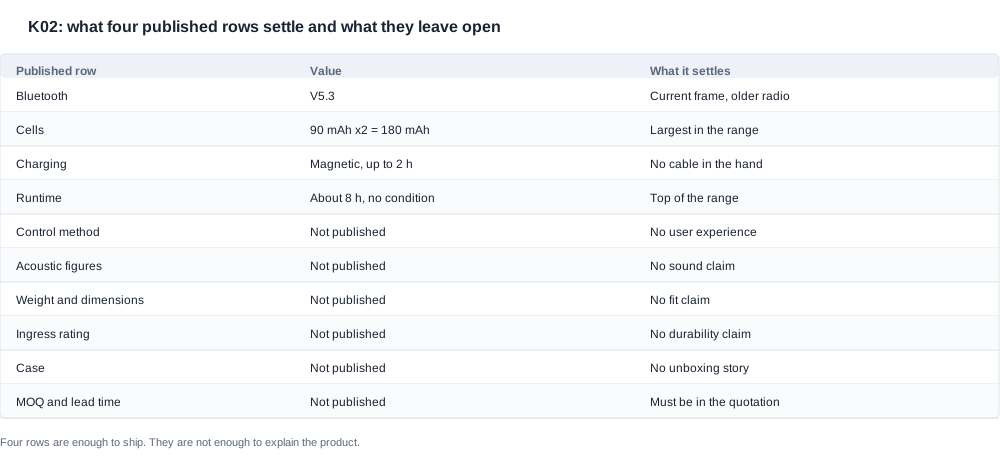
What the row settles: the product works, it is a current-generation audio frame rather than a legacy one, its energy budget is generous, and it does not require a cable in the customer's hand. That is a genuinely sellable set of statements, and a channel that only needs those four has everything it requires.
What it leaves open: almost every row that determines whether the product is comfortable, how it behaves outdoors, whether it is certified for the destination market, and how the customer operates it. No control method is published, and a product with no documented control has no documented user experience — which means your instruction leaflet cannot be written from the catalogue, your support script has no content, and your listing has nothing to demonstrate. That is not a minor gap. It is the difference between a product you can explain and a product you can only ship.
There is also a subtle commercial consequence in the absence of a colour list. A brand that intends to run three colourways needs three SKUs, three artworks and three listings, and the absence of a published colour list is not an obstacle to that — it is simply an unanswered question that has to be answered before the artwork budget is committed.
The first buyer: a listing that cannot go wrong
A brand whose listing style is one paragraph and a table, and whose legal team does not want an inherited AI claim on a consumer product, has exactly one model in the audio range that is genuinely plain. The K01 carries capacitive touch control and an AI translation capability, and our documentation records that capability at a lower evidence level than the parameters — it comes from our own website copy rather than the product catalogue. A listing that repeats it is restating our claim, and the risk lands on the brand carrying the listing.
The K02 removes that problem entirely. There is nothing in its published row that a customer can ask a question about, and nothing in it that has to be qualified in the copy. In a channel where the product is a price point rather than a feature, that is a real commercial advantage — a listing that is four rows long is faster to write, faster to translate into every market language you sell in, and much harder to get wrong. For a distributor operating in several markets with limited local compliance support, the translation cost of a long specification is a genuine expense, and this model is the shortest one available.
It also removes a support cost. Every unpublished row in this range becomes a question that arrives after launch, and the K02 has fewer of them than any other model in the audio family: no application, no control method, no acoustic figures, no temple, no colour list, no case. It still has the weight, the dimensions, the charge indicator behaviour, the ingress rating and the certification detail — but it has none of the feature-specific questions, and those are the ones that generate the contacts a support team cannot answer from a script.
The honest way to say this is that the K02 sells a reduction in exposure rather than a capability. For a brand whose risk appetite is low, whose channel is broad rather than deep, or whose first entry into this category needs to be quiet and reversible, that reduction can be worth more than a documented feature. For a brand whose channel rewards differentiation, it is worth nothing at all.
The second buyer: the largest published capacity in the range
Ninety milliamp-hour × 2 is 180 mAh, and it is the largest total capacity published anywhere in the Bluetooth audio range — against 110 mAh on the 55 mAh × 2 models and 100 mAh on the single-cell Type-C pair. The published runtime of approximately eight hours is at the top of the range with it.
A buyer whose customer is on the frame for long stretches, and who wants a number on the listing that reads well, is choosing the K02 for that reason. It is the only model in the family where the capacity figure and the runtime figure point the same way, and in a category where capacity and runtime routinely disagree, a buyer who is going to be challenged on the number will prefer the model where the challenge has the weakest answer.
The honest qualification is the one that applies to every runtime figure in this catalogue: no test condition is published for any model in the audio range, and the same 55 mAh × 2 platform produces both six-hour and eight-hour figures on different models. Our battery specification guidance covers the questions to ask, and the one to ask first is whether the figure was measured on continuous playback or on mixed use. A mixed-use figure is the one a customer actually experiences and it is almost always lower than a playback figure, so a brand writing the listing should know which one it is quoting before it quotes either.

The platform decision nobody sees until it is made
This is the part that is easy to miss and expensive to discover late, and it is a structural consequence of the radio version rather than of the model.
The K02 publishes Bluetooth V5.3, and it is one of only two models in the entire audio range that do. The K01 is the other. Everything else — the LC-105-2 and the G07, the D11 and the YK12, the YKC02 and the D12, and the LC-105-1 — is on V5.4.
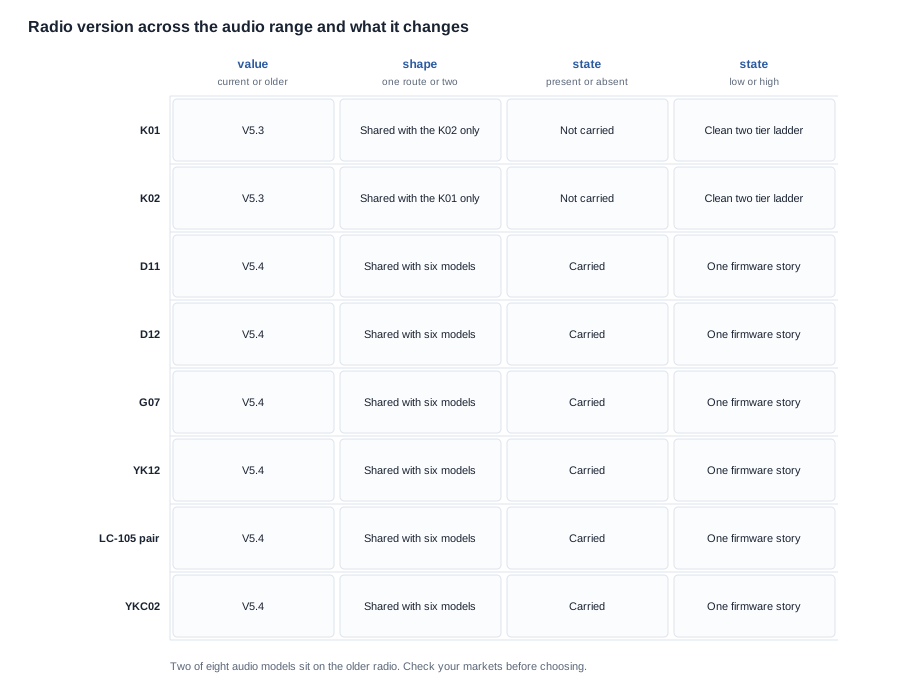
That has three consequences for a brand building a range. One qualification route rather than two, if the rest of the range is on V5.4. One firmware story, so a bug report and a firmware update affect every unit at once rather than splitting the installed base. One set of packaging and accessory decisions, including the charger and any compliance paperwork that references the radio.
And one consequence specific to European market positioning. V5.4 carries the encrypted-communication capability that maps onto the market-access conversation, and V5.3 does not. A brand whose brief has any European market-access reasoning in it has a reason to think twice about a V5.3 platform, and that reasoning is a platform decision, not a per-model preference, and it cannot be changed later without re-qualifying the whole range. Our Bluetooth connectivity guidance sets out what the version differences mean in practice.
The counter-argument is equally real: the K01 and the K02 together make a clean two-tier ladder on one platform, with a feature step between them and no extra qualification work. A brand building a small audio range around one platform has a perfectly good reason to choose the 90 mAh × 2 platform and live with V5.3, particularly in a market where the encryption question is not raised by the channel, by the retailer or by the customer.
The way to settle this is not to decide it in the abstract. Write down the markets you intend to sell in for the next two years, and check whether any of them raises the radio version as a question. If none does, the platform argument is theoretical and the plainness argument wins. If one does, the platform argument wins regardless of how much the plainness is worth to you, because the cost of re-qualifying is higher than the cost of choosing correctly now.

The missing rows, and how to evaluate around them
Where the gaps come from
A plain published row is usually a documentation decision rather than a product decision. The hardware almost certainly exists, the acoustic design almost certainly has a characterisation behind it, and the dimensions almost certainly appear on an internal drawing. What is missing is the step where internal data is released for external use — which is a commercial decision, sometimes made for good reasons and sometimes made years ago and never revisited.
That matters to a buyer because it means most of these rows are closer to available than they appear. The question worth asking is therefore not "can you publish a weight" but "does a measured weight exist for this model, and who signs for its release". Those are different questions with very different answers.
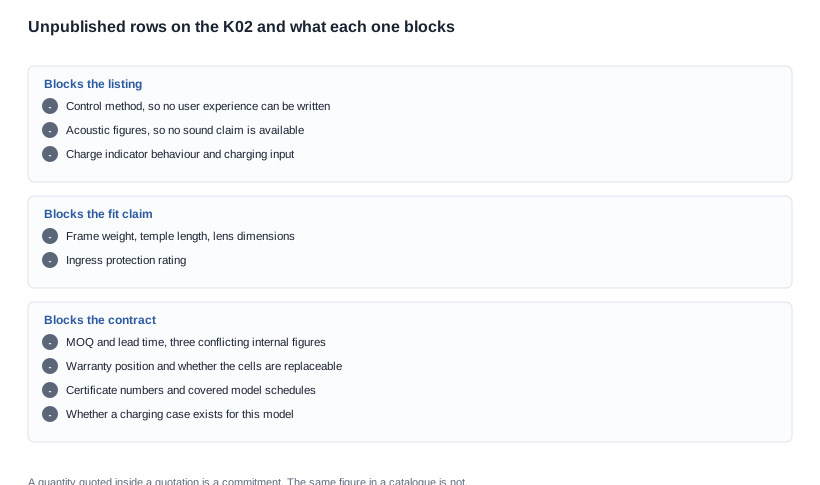
- The control method — not published, and a product with no documented control has no documented user experience.
- Frame weight, temple length and lens dimensions — not published, and fit is the largest driver of returns in this category.
- Acoustic figures — no leakage, driver size, frequency response, microphone count or pickup distance published.
- The charge indicator behaviour, the charging input and the charge-time starting point — not published.
- Whether the cells are field-replaceable, and how a partial failure is handled — not published.
- Runtime test conditions — not published.
- Ingress protection — not published.
- Certificate numbers, issuing bodies, validity periods and covered model schedules — not published.
- Whether a charging case is available — not published, and no model in the audio range publishes one.
- Minimum order quantity, lead time and price — not published, and our internal documentation currently holds three conflicting minimum order quantity figures that have not been arbitrated.
That tenth row deserves a note rather than a complaint. Three conflicting internal figures is a real condition and we are not going to resolve it by picking the most convenient one. If a minimum order quantity matters to your decision, ask for it in writing as part of the quotation, because a supplier who quotes a quantity in a quotation is making a commitment and a supplier who quotes one in a catalogue is not. The same applies to lead time, which on this model is the number most likely to be estimated rather than planned, and an estimated lead time that turns out to be optimistic by three weeks is the single most common cause of a launch date that slips after the marketing is already booked.
The fifth row is worth a second look. A dual-cell model where the cells cannot be replaced is a model that is repaired by replacement, and a replacement cycle has a warranty consequence. Ask whether the cells are serviceable and, if they are not, what the warranty period actually is, because a one-year warranty on a frame whose endurance is the reason the customer bought it is a different commercial proposition from a two-year one.
What to do with a gap list
A plain model A plain model is easier to buy is easier to buy and harder to evaluate, which is an uncomfortable combination that buyers rarely expect. There is no feature to test, so the sample programme tends to collapse into "it arrived and it works", and that test tells you nothing about the rows above.
What to do instead is straightforward. Treat the missing rows as the acceptance criteria. Agree in writing, before the sample ships, that the unit is accepted against these five checks: measured frame weight and temple length; measured cell capacities against the published figure; charge time measured from the stated starting state; a runtime measurement on a stated workload; and the accessories present in the carton against the agreed packing list. Record each as a number or a yes-or-no, and write down who signed.
Then add the two checks that are specific to a product with no control method. Confirm with the factory how the frame is operated at all, and get it in writing, because a product with no published control almost certainly has one and the absence is a documentation gap rather than a functional one. If the answer is that operation is by a button or a gesture that is not published, that is a question for the instruction leaflet as well as for your support team, and it is the question most likely to generate a contact in the first month.
Finally, do the ordinary commercial diligence properly, because with no feature to investigate there is more time for it. Ask for the certificate position per destination market, ask whether the declaration of conformity names this model or only the company, ask for the quality control record format that will travel with the shipment, and ask for the warranty position in the same terms as the rest of the range. These are routine questions with routine answers on every model, and on a plain model they are the entire diligence story.
Two of them deserve more weight than routine. The certificate question matters more here than it would on a feature model, because a plain product has no other way to differentiate itself in a retailer's compliance file — if the documentation is thin, the product is harder to list regardless of how good it is. And the warranty question matters more because the eight-hour figure is the reason the customer is choosing this model, so the boundary between "battery underperforming" and "battery failed" is a question your support team will be asked to answer within the first hundred returns. Get that boundary in writing.
There is one further check worth doing on any plain product, and it is the one buyers skip. Ask the factory to confirm the shipped configuration in a sentence you can paste into your own technical file. Not a list of features — a sentence: what the customer receives, what they have to do to operate it, and what they need to have nearby to charge it. For a model with no published control method, that sentence is the only description of the user experience that will exist, and if it cannot be written, that is a finding.
What we will and will not confirm for the K02
The K02 is a deliberate product for a deliberate buyer, and the two things it is good at — the largest published capacity and the absence of anything to defend — are the same reason it is not for everyone. A brand that wants a feature, a sound claim or a case is looking at a different model, and we will point you at it rather than sell you the plain one.
The plainness has one commercial consequence that is easy to underestimate. A four-row specification translates into every market language you sell in at almost no cost, and it does not need re-review when a marketing team rewrites a listing. For a brand operating in several markets with limited local compliance support, that is a running expense avoided rather than a one-off saving. The same brand will eventually want to add something — a colour story, a case, a feature claim — and the useful question to ask before it does is whether the brand is prepared to carry the review load that comes with it, because the first addition is always the one that costs the most.
The second consequence is that a plain model is easy to replace. If a competing supplier offers a similar plain frame at a lower landed cost with a stated interface and a stated charge time, this model's four published rows do not defend the price. The defence has to be commercial — the unit cost, the lead time, the packaging, the warranty — rather than editorial, and it is worth establishing which of those your relationship actually rests on before you place a bulk order.
We will not publish prices, minimum order quantities or lead times, and we will not add a feature to this model in a listing to make it look like the K01. Where our own documentation disagrees with itself we would rather tell you that than present an average as a fact.
Tell us the channel, the volume, the target market and how many models you plan, and we will come back with what is available and what is not. The family is on our Bluetooth audio glasses range page, and the K01 against the K02 comparison sets out the sibling relationship in full if you are deciding between them.
Related reading
- The same platform with a feature on top — K01 against the K02
- The gaps on this model — K02 limitations
- What the radio version changes — Bluetooth connectivity
Tell us the channel, the volume and how many models you plan, and we will come back with what is available.


