

The K02's limitation is not a weak specification. It is that the published specification is closed: five rows, no feature line, and nothing behind any of them that a channel can put on a page. Every other limitation in this article follows from that one fact. A buyer who treats the K02 as a thin product will discount it for the wrong reason; a buyer who treats it as a documented five-row platform will price, brief and defend it correctly, and will know exactly which six questions to put in writing before the first order.
That distinction matters because the gaps fall into three separate classes. Some are structural — the model publishes no descriptor a customer can read. Some are measurement gaps — the row does not exist for any model in the range, so it constrains the tier rather than the K02. And some are commercial gaps — price, minimum order quantity, lead time, warranty and certification, none of which we publish, for the same reason we do not publish them for any model. A channel that treats all three as one problem will spend its effort in the wrong place.
What the K02 does not publish, and why that is the real limitation
A closed set of five rows
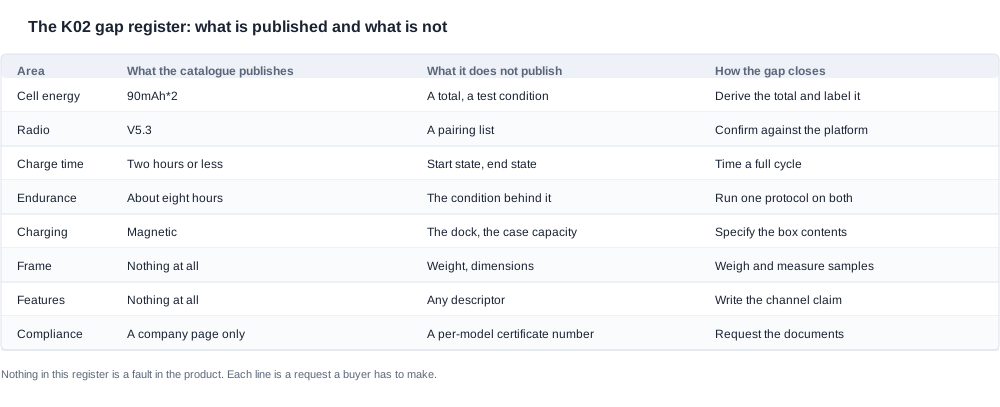
The K02's catalogue page carries five specification rows: a Bluetooth version of V5.3, a cell configuration of 90mAh*2, a charge time of two hours or less, about eight hours of stated endurance, and magnetic charging. There is no sixth row. There is no feature line, no weight, no dimension, no acoustic figure, no ingress rating and no per-model compliance entry.
Compare that with the range around it. The D11 adds surround sound and a long-battery-life descriptor. The G07 adds an ultra-slim, detachable temple. The YK12 adds surround sound and a slim temple. The LC-105-2 and the D12, the K01 and the K02, and the LC-105-1 add nothing at all. The published K02 specification list sets out the five rows in full, and the K02 comparison piece works through how those five rows sit against the rest of the audio range.
So the limitation is not that the K02 publishes little. It is that what it publishes is all it will ever publish, and a channel whose page depends on a descriptor has no source for one.
Three kinds of limitation, and they are not the same problem
A structural limitation is a gap in what the product can be described as. A measurement limitation is a gap in what can be verified. A commercial limitation is a gap in what has been committed. All three look identical on a specification sheet — a blank cell — and they have completely different remedies and very different lead times.
The structural gap is closed by writing. A channel that wants a descriptor for the K02 has to author one, and the constraint is that it has to be defensible: it can describe the cell arrangement, the charging method and the radio version, because those are documented, and it cannot describe lightness, loudness or water resistance, because they are not. The measurement gap is closed by a sample and an afternoon. The commercial gap is closed by a supplier, in writing, on the terms of a quotation.
Getting this order right saves a buyer a lot of wasted effort. It is common to spend weeks trying to resolve a measurement gap that only a supplier can resolve, or to negotiate hard on a price that was never going to be published, while the structural gap — the one the buyer can close alone — is left until artwork is due.

The structural limitation: a model with no feature line
What the audio range publishes and what the K02 adds to it
Five of the eight audio models publish no feature line, so the K02's silence is not unusual. It is, however, consequential in a way that a rarity would not be, because the buyer who has already chosen a feature-led model cannot simply copy the approach.
A page built on a descriptor has a template. A page built on five specification rows has to be built from the specification, and the specification of the K02 contains no adjective that a competitor cannot also print, because the competing models in the audio range publish the same rows or better ones. The cell arrangement of 90mAh*2 is the largest published in the range, which is a genuine differentiator, but it is a number rather than a story, and it needs a claim around it that the buyer has to write and the supplier has to support.
Where the differentiation burden lands
On the buyer. This is the practical consequence of a model with no descriptor: the work that a feature line would have done — the part of the product page that says why this one and not the next — moves onto the buyer's own brand assets, and that work has to be done before the artwork is due rather than after.
It is not a fatal position. A private-label channel with its own packaging, its own product photography and its own editorial voice can build a page on the specification, and the absence of a rival's wording on the frame is itself useful to a brand owner. It is, however, a position that costs time and it should be costed into the plan rather than discovered when the copy is due.
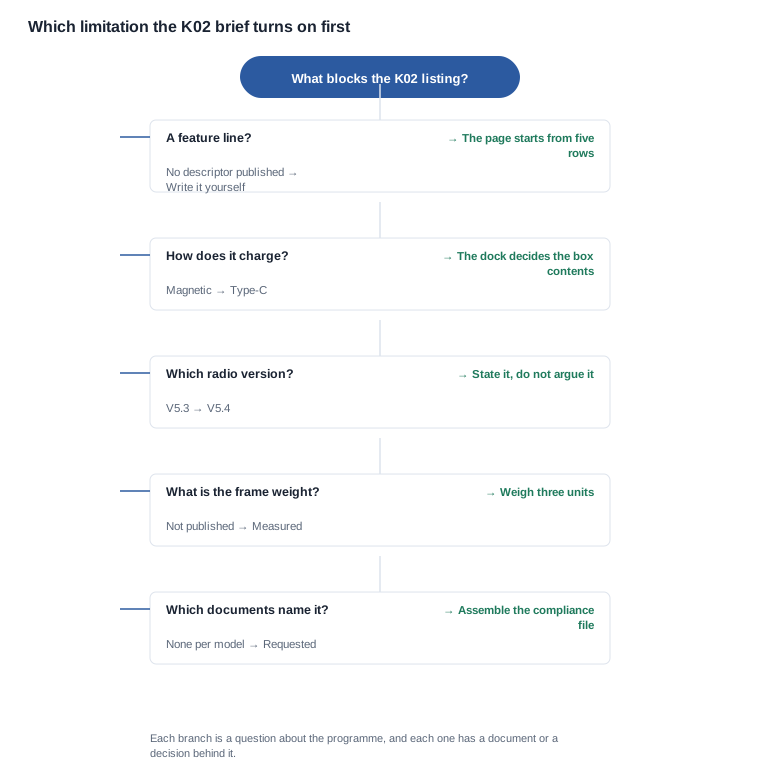
The practical discipline is a short rule for the copy: every claim on the K02 page has to trace back to one of the five published rows, or to something the buyer has measured or had confirmed in writing. A claim that traces to neither is a liability sitting on a listing, because the channel cannot answer a customer question about it and cannot repeat it in a support reply.
The measurement gaps: weight, acoustics, ingress and the control method
Six rows no audio model publishes
Frame weight, frame dimensions, acoustic figures, microphone pickup, ingress rating and charging case capacity are absent from the entire audio range. Not from the K02 specifically — from all eight models. That is an important distinction, because it changes what a buyer should do about it.
A gap that affects one model is a reason to choose a different model. A gap that affects the whole tier is a shared constraint, and it has to be solved at the tier level: as a standing request to the supplier, as a measurement protocol run on every sample, and as a rule in the documentation the channel keeps. Nothing in the K02's published position is weaker on these six rows than the D11's or the G07's.
The two that bite hardest commercially are weight and acoustics, because they are the two that appear on almost every consumer product page in the category. The audio range weight comparison sets out why the single weight published anywhere in our catalogue belongs to a different model and cannot be carried across, and the battery specification guidance covers how a rating without a condition should be handled.
Why the one published weight cannot be borrowed
Our catalogue publishes one weight, and it belongs to the MT6: 158 grams for that camera model's eyewear body, including its battery and its camera, and excluding its foldable charging case. The MT6 is a camera model with a 1200 mAh foldable case, not an audio frame, and a number that describes it cannot describe the K02.
This is the single most common way a K02 listing goes wrong. A weight figure from another model gets carried into a copy block, and from there into a comparison table and a support reply, until it is impossible to say where it came from. The rule that prevents it is simple and worth writing into the brief for whoever writes the page: no number reaches the copy without a source attached to it, and the source has to name the model and the measurement.

The commercial gaps: price, MOQ, lead time, warranty and certification
What we do not publish and why
We do not publish unit prices, order quantities, lead times, capacity figures, warranty periods or certificate numbers for the K02 or for any other model. The reason is not secrecy. It is that every one of those figures is conditional — on a quantity, a configuration, a destination market and a date — and a published figure carries none of those conditions with it. A buyer who picks up a published minimum order quantity and plans around it has planned around a number that was never true for their order.
So the commercial gaps on the K02 are not gaps in the product. They are the ordinary terms of an OEM transaction, and they are resolved in a quotation against a stated quantity and a stated configuration, which is what the OEM ready platforms programme is built for.
What the export certification page establishes
Our catalogue carries exactly one export certification sheet, and it sits at company level rather than at model level. What sits on that sheet is imagery rather than text. Nothing in the catalogue names a standard against a particular model, and nothing names one as pending either — so a buyer is left with a page and nothing on it that can be attached to a product listing.
That matters for three specific requests a buyer will have to make in writing for the K02: the radio conformity documentation for each destination market, the battery transport test summary for the cell configuration ordered, and the supplier's own statement of which model the documentation covers. The certification checklist turns these into a document list, and the K02 certification status sets out exactly what our page does and does not establish. Until those arrive, the K02 carries no compliance claim that can go on a box, a label or a tender document.
Turning each gap into a procurement action
A four-way classification for every gap
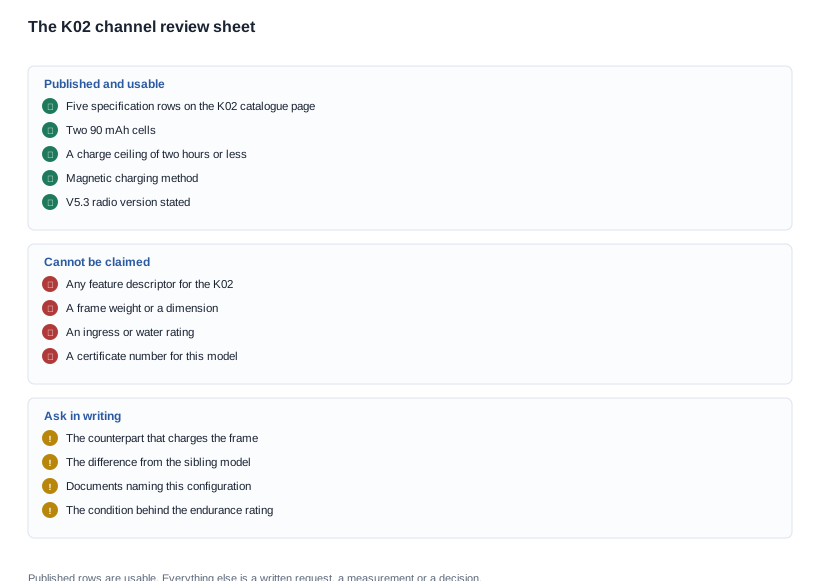
Every blank cell in the K02's published position falls into one of four buckets, and each bucket has a different owner and a different deadline. Working through the register this way is what turns a list of gaps into a work plan.
- Published and usable. The five rows. These can be quoted in a specification annex, in a product page and in a tender response without any further work. They are the only part of the K02's position that needs no supplier involvement.
- Measurable on a sample. Weight, dimensions, the packed unit weight, the acoustic behaviour, the control method, the charge cycle from a stated starting point. These need units, not promises, and a sample order gets them. The sample evaluation route covers how to structure one so the answers transfer to a production unit.
- Supplier-only, in writing. Minimum order quantity, lead time, production capacity, warranty period, the certification position, the accessory set, the packaging specification. These have to arrive as terms in a quotation and belong in the agreement.
- Buyer's own decision. The claim the page will make, the accent of the copy, the packaging design, the accessory strategy. These are not gaps to be filled by anyone else, and they are the ones with the longest internal lead time because they involve artwork, artwork revisions and legal review.
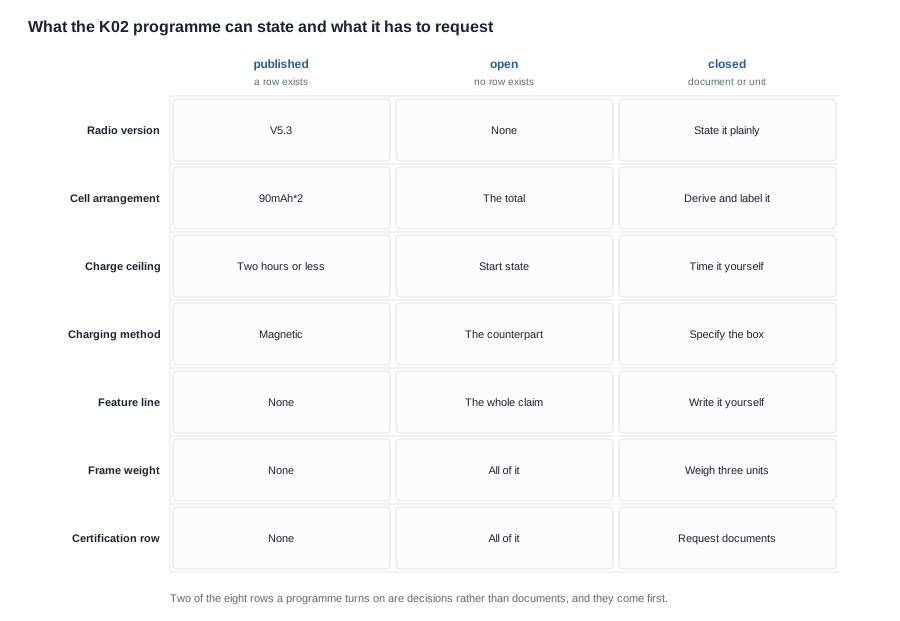
The ordering rule that falls out of this is worth keeping: the supplier-only items should be requested first, because they have the longest supplier lead time and they determine whether the decision is worth making at all. The measurable items can be requested in parallel, since a sample order usually takes as long as the supplier's response anyway. The buyer's own decisions come last, because they are the only ones that are entirely under the buyer's control.
The questions to ask, in the order that costs least
Six questions, asked once, in the same words for every model being compared, close most of the K02's open position:
- What is the minimum order quantity, the lead time and the warranty period for the K02, quoted separately from the other models?
- Which documents name the K02 for the radio conformity and battery transport requirements in our destination markets?
- What is the endurance test condition behind the published figure of about eight hours?
- What does the charging counterpart look like, what is the case capacity, and what ships in the box?
- What is the frame weight and the packed unit weight, and are these measured on production units?
- What is the difference between the K02 and the K01, in the catalogue's own terms?
That last question is the one most likely to be answered with a marketing line rather than a specification. The K02 versus K01 specification comparison explains why that pair publishes identical rows and why the answer has to be a documented difference rather than a description.
Four ways the K02's open position turns into a commercial incident
Each gap has a characteristic failure, and recognising the shape of a failure is faster than diagnosing it afterwards.
A weight figure arrives from somewhere else. The symptom is a product page carrying a gram figure that no one in the business can source. The root cause is that the one weight in our catalogue belongs to a different model and was borrowed to fill a gap. The prevention is a single sentence in the copy brief: no number enters the page without a named source, and the source names the model it was measured on.
The endurance rating becomes a working-day promise. The symptom is a channel selling a full shift and a field result that does not match. The root cause is that the published figure of about eight hours carries no test condition, and the same cell configuration produces a two-hour spread elsewhere in the range. The prevention is to treat the condition as a precondition of the order rather than a request that can be declined.
A certification claim outruns the file. The symptom is a tender response or a label that names a standard nobody can produce a certificate for. The root cause is a company-level page being read as a per-model document. The prevention is to name the model on every piece of documentation and to keep the certificate numbers in one place so they can be checked before they are printed.
Two models with identical rows are stocked for different reasons. The symptom is a range where the customer cannot tell the products apart and a slow-moving unit ties up working capital. The root cause is that the difference lives in someone's head rather than in a document. The prevention is the one-sentence proposition test: if the sentence for the K02 and the sentence for its sibling are the same sentence, one of them does not need a shelf.
A hypothetical programme, worked through the register
Take a hypothetical channel that plans to list one audio model in a single market. Nothing in that description identifies a real project, and the numbers below are the published rows, not order quantities.
The programme starts with the five rows and writes the page around them: the cell arrangement of 90mAh*2 is the largest published in the audio range, magnetic charging is named, the radio version is stated plainly, and the charge ceiling of two hours or less is written as a ceiling. Nothing is claimed that the catalogue does not support, and the artwork is scheduled against that constraint.
The supplier-only items go out as one written request in the same week: minimum order quantity, lead time, warranty period, the certification position for the destination market, the battery transport test summary for the cell configuration, the endurance test condition, the charging counterpart and the case capacity. Two of those answers will decide whether the programme continues, and they are the two with the longest supplier lead time.
The measurable items are handled with a sample order in parallel: weight, dimensions, packed unit weight, the charge cycle from a stated starting point, and the acoustic behaviour in a representative environment. The results go into the technical file rather than the page, so that a support question months later has an answer behind it.
The buyer's own decision — the claim the page makes and the packaging around it — is taken last, because it is the only part of the plan entirely under the buyer's control, and it can absorb a delay in the supplier's response. By the time the artwork is due, the page is written, the file is complete and the claim traces to something.
What the K02 programme can state, and what it has to request
The K02's five published rows are the whole of what we can support in writing, and a channel which plans around exactly that is in a stronger position than one which plans around an assumption. We will publish the cell configuration, the radio version, the charge ceiling, the stated endurance and the charging method for the K02, and we will keep publishing them in the same form for every model so that any comparison a buyer builds is fair.
We do not publish a weight, a dimension, an acoustic figure, an ingress rating, a price, a minimum order quantity, a lead time, a warranty period or a certificate number, and we would rather tell a buyer that plainly than quote a figure that cannot be traced to a document. That applies to the K02 exactly as it applies to every other model in the catalogue, and it is why the Bluetooth audio glasses charging options, the K02 battery life analysis and the sport smart glasses programmes all carry the same standard of evidence.
What we will do is quote against a specified quantity and configuration, state which configurations exist and which do not, and tell a buyer up front which figures have to come from a written request and which can be established with a sample.
Related reading
- The five rows in full — K02 smart glasses specifications and features
- The K02 against the audio range — K02 smart glasses how it compares
- The closest comparison available — K02 smart glasses versus K01
- The range overview — Bluetooth audio glasses
Send us the quantity, the destination market and the claim you intend to make, and we will tell you which rows already answer it and which have to be requested.


