
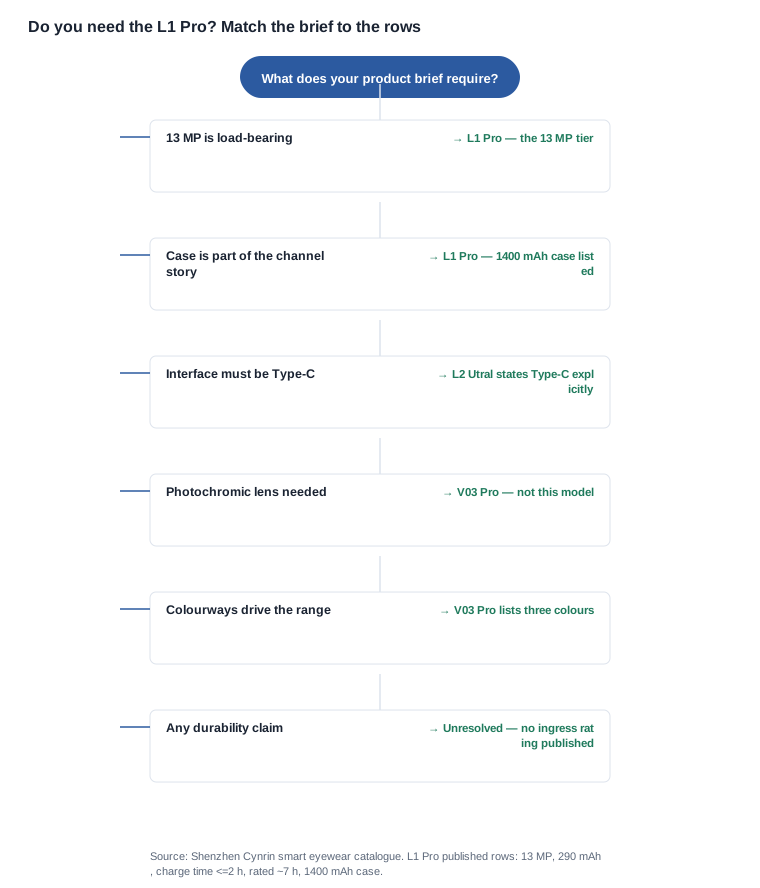
You need the L1 Pro if your proposition leads on image resolution, or if a 1400 mAh charging case is central to your channel story. You need a different model if the interface standard matters — this model does not state one — or if colourways or a photochromic lens drive your range, since neither is published for it. Above all, do not buy this model for an image quality claim: no sensor model or field of view is published, so 13 MP is a tier label rather than a performance statement.
Those four sentences are the decision. This article is the reasoning behind them and the order to ask the questions in.
L1 Pro smart glasses: what five published rows settle
A 13 MP camera. A 290 mAh battery. Charge time of two hours or less. Rated use of roughly seven hours. A 1400 mAh charging case.
Five rows, and they are internally consistent. That consistency is worth more than a longer list: a short specification that does not contradict itself can be published as it stands, whereas a longer one frequently cannot. For a brand that intends to put a table on a product page and a leaflet in the box, that is a meaningful property.
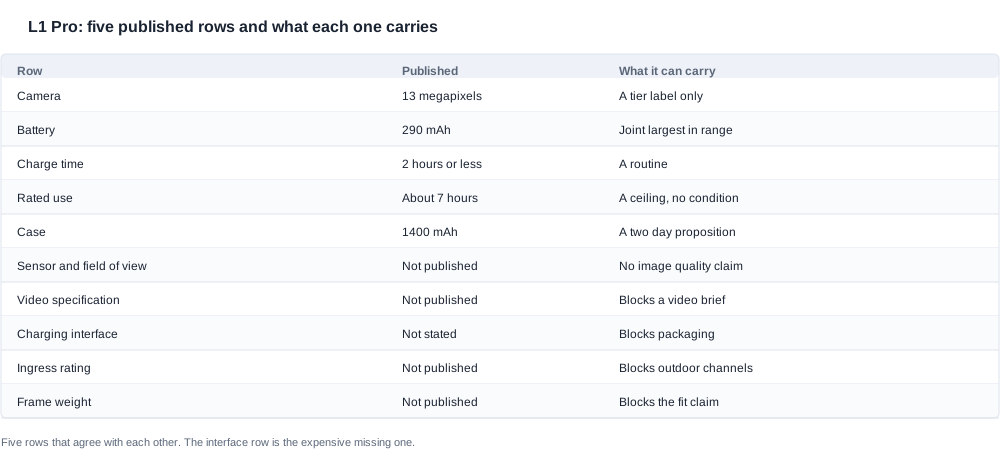
What those five rows settle: this is a top-tier camera frame, not an entry model. 290 mAh is the joint-largest frame cell in the camera range, shared with the CY03 and the CY05, so it is a heavy-use frame rather than a light one. The 1400 mAh case is the largest case capacity published anywhere in this range, so the format is a genuine two-day proposition rather than a token accessory. And 13 MP places it at the top of the resolution tier, alongside the L2 Utral and the S7.
What those five rows do not settle, and what is missing is consequential for a camera product: no sensor model, no field of view, no video resolution or frame rate, no frame weight, no ingress rating, no certification number, and no stated charging interface at all.
That last one is unusual and it is the most operationally expensive gap on the model. Every other missing row here is a claim you choose not to make. An unstated charging interface is a packaging decision you have not finished, because the charger in the box, the print on the box and the instruction leaflet all have to agree with an answer that does not exist yet.
Where this model is the right answer
Resolution is the tier you sell on. 13 MP places it at the top of the camera range, and for a channel whose listings lead on a resolution figure, that is the argument. It is a weak argument in the sense that any resolution number is a weak argument, but it is a usable one, and it is the number the customer in that channel is actually comparing.
The case is part of the product story. A 1400 mAh case supports the sample-then-wear-daily proposition and removes most of the recharge anxiety that a frame alone creates. It also changes your shipping weight, so model it before you commit — and model it with the case in the carton, not beside the product, because dimensional weight is calculated on the packed volume. See charging solutions.
Capacity supports heavy use. 290 mAh at the joint top of the range suits users who record more heavily than the five-to-eight-hour figures of smaller-cell models imply. Combined with a 1400 mAh case, the arithmetic supports a customer who forgets about the product for two days, which in this category is the difference between a wearable and a gadget.
And it is the right answer when your channel does not compare interfaces. Some channels sell on resolution and case capacity and nothing else. For those, the missing interface row costs nothing, and a model that states its tier clearly is easier to list than a model that offers a menu of options.
The decision to make here is a shortlist decision, not a preference decision. For any buyer in this category the useful first move is to write down the four or five requirements that would disqualify a model outright, and eliminate on those before comparing anything. On this model the disqualifiers are known and checkable: an unstated charging interface, no published colours, no ingress rating, no published weight. A shortlist built by disqualification is defensible; a shortlist built by preference is not, because the second one changes every time a salesperson demonstrates a different model.
The trade-off to negotiate explicitly is case capacity against landed cost. A 1400 mAh case adds volume, weight and a second component to inspect at receiving. Against that, it removes the recharge objection that a camera product cannot survive without, because a customer whose camera is flat when the moment arrives is a customer who stops using it. In most channels the case is the cheaper way to buy that behaviour, and the arithmetic is available from the charging solutions guidance rather than from guesswork.
And the criteria to apply before you commit are all answerable by one supplier in one email. Interface, colour list, ingress rating, frame weight, sensor model, video specification, certificate position. A supplier who answers six of the seven is a different supplier from one who answers none of them, and that difference is worth more to a buyer than any single row on the specification table.
Where it is the wrong answer
Your supply chain standardises on Type-C. The interface is not stated for this model. The L2 Utral states Type-C explicitly and offers comparable case options, so the two requirements — a stated interface and a large case — rarely point at the same product. Do not design packaging, chargers or compliance paperwork around an unstated interface, because each of those is expensive to change after tooling and cheap to change before.
Colour drives your range. No colours are published for the L1 Pro. The V03 Pro lists three, which makes it the model in this range where a colour story is actually available. If your channel is built on choice, this model is the wrong place to start.
Your proposition needs a photochromic lens. Not published here. The V03 Pro is the only camera model in the catalogue that publishes one, and a photochromic lens is the closest thing to a genuine differentiator anywhere in this range — it is visible to the customer without any measurement being attached to it.
You need a durability claim. No ingress rating exists for this model. If your channel is outdoor, sport, or any context where water is part of the normal picture, that is disqualifying rather than inconvenient, and the sport range water-resistance analysis explains what a marking means where one does exist.
And you need a fit claim. No frame weight is published for this model or any other in the camera range. Comfort is the first objection in most eyewear-adjacent channels and the second most common reason for returns in this category generally. Until a weight is measured on a production sample, the fit claim cannot be written.
There is one more way to be wrong on this model that does not show up as a specification gap. Buying it for a channel that already carries a different camera model, because the published rows look favourable in isolation. The rows are good in isolation and that is exactly the trap: this model is judged against nothing, and the comparison that matters is against whatever the channel already sells. Before you commit, write the incumbent's rows next to these five and look for a reason a customer would switch. If the only difference is one resolution step with no stated interface and no stated weight, the switch will not happen and the inventory will sit.
A due diligence process that requires a complete file on day one will disqualify this model, and that is a legitimate outcome rather than a failure. The conditions exist for the whole range, so the practical question is whether your process can carry an open row for the launch period. If it can, this model is competitive. If it cannot, decide that now and buy a model that can be filed rather than one that has to be argued for.

The honesty problem with 13 MP
This deserves emphasis because it is where camera buyers most often over-read a specification, and it is the single most likely place on this model for a listing to become inaccurate.
A 13-megapixel sensor with small pixels can produce a worse image than an 8-megapixel sensor with large ones, particularly indoors, at dusk, or in any condition where the light is the constraint. Without a sensor model, you cannot know the pixel size. Without a field of view, you cannot know the framing — a narrow field gives a tighter, more magnified result from the same sensor, and two frames with identical resolution figures can present completely differently. So the number supports a resolution statement and nothing about picture quality.
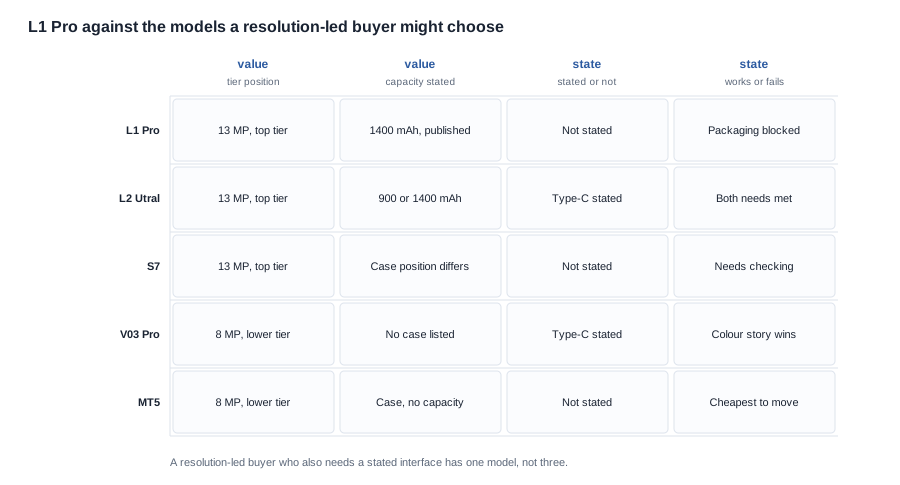
If your listing is going to say "high quality camera", you need evidence we do not currently hold, and inventing it is the single easiest way to generate a claim that fails under review. If it is going to say "13 MP", that is accurate. The AI camera glasses imaging guidance sets out why this distinction decides whether a camera claim holds up when a retailer or a regulator asks for the evidence behind it.
There is a second honesty problem sitting behind the first, and it is about video rather than stills. No video resolution or frame rate is published for this model or any other in the range. A buyer whose customer expects to record clips is relying on a capability that no documentation in this catalogue confirms, and the honest position is that a camera product with an unstated video specification cannot be signed off against a video brief. Ask for it, and if the answer exists, it may well be adequate — but "may well be adequate" is not a basis for a purchase order.
How to evaluate a camera model without a sensor specification
Since the published rows will not settle the question, the sample programme has to. This is not a long test and it is not expensive, but it has to be designed deliberately rather than left to a week of casual wear.

Take photographs in four lighting conditions and keep them. Outdoor daylight, outdoor shade, indoor with a window, and indoor with only overhead lighting. That set is the minimum that shows whether the sensor is good enough, because the failure mode of a small-pixel high-resolution sensor is not a bad photograph — it is a good photograph in daylight and a poor one everywhere else. If the sample only produces good results in daylight, you have learned something that a specification sheet would not have told you.
Shoot the same subject at the same distance in every condition. That controls for framing and isolates the variable you care about. Print or view them at full size rather than on a phone screen, because phone screens forgive almost anything.
Test the frame rather than the optics. Walk for a minute, then take a photograph without stopping and without adjusting anything. Then take one with deliberate movement. The difference between the two tells you about stabilisation, which is not published for any model in this range and which is the difference between a wearable somebody keeps and a wearable somebody tries once.
Time the interaction. How many presses to wake it, how many to capture, how long from press to shutter, and what happens if the wearer presses twice. A camera that needs two presses in motion will be pressed twice in the shop, and the customer will conclude it is slow.
Fill it and see. If storage is removable, the question is simple. If it is not, ask what happens when it fills — overwrite the oldest, refuse to capture, or stop recording silently. The silent stop is the worst of the three and it is the one most likely to be discovered by a customer rather than by a test.
And weigh the packed unit across several cartons. Frame weight is not published; packed weight is measurable in an afternoon, and it is the number your freight model actually needs.
Then run the receiving check that a camera model deserves and almost never gets. Open three cartons from the same delivery and compare the contents against the packing list: the frame, the case, the cable, the leaflet, and any accessory the listing implies. Record what is actually present rather than what was expected. A case that is absent from one carton in three will not show up in a sample order, because a sample order is one carton that somebody checked, and it will show up in your returns, where the customer does not distinguish between a missing accessory and a broken product.
Finally, decide the acceptance criteria in writing before the bulk order rather than after it. State which measurements must match the sample, which accessories must be present in every carton, and what the remedy is if they are not. A quality control record that lists quantity and appearance will not settle any of these questions, and a purchase order that does not specify them leaves the buyer with whatever arrived.
What we will and will not put in writing for the L1 Pro
The L1 Pro is a well-chosen platform for a resolution-led channel proposition and a poor choice for an evidence-led one. The five published rows are internally consistent and the 1400 mAh case is a genuine commercial asset rather than an accessory.
We will not fill the missing rows with industry-typical values. That is the rule we apply on every model in this catalogue and it is worth stating why: a typical value is a number nobody measured, and the first person to rely on it is your customer. We will not describe 13 MP as image quality, we will not state a charging interface we have not been given, and we will not present a category-level marking as a test result for this specific model.
We will also be direct about the trade-off rather than selling around it. If your channel needs a stated interface, this model is wrong and we will point you at the one that states it. If your channel needs colourways, it is wrong and there is a model that lists them. If your channel needs an ingress rating, it is wrong and no camera model in this range has one either. Naming the disqualification is more useful to a buyer than a longer description of the strengths, and it costs nothing to say before the sample order rather than after the first production run.
On the commercial set, the position is the same for every model here: minimum order quantity, lead time, price, incoterms, payment terms and warranty are not published, and the first three should be settled in a quotation rather than in a catalogue because a figure inside a quotation is a commitment. Ask for the technical file and the certificate position per destination market, and ask whether the declaration names this model or only the company.
Tell us the channel, the price point, the markets and whether the interface matters, and we will narrow this to one model and name the rows you will still be missing. Where we cannot answer a row, we would rather say so now than find out with you.
On how to evaluate the answers once you have them, the order is worth stating. Take the rows that describe what the customer gets — interface, sensor, video, weight — first, because those decide whether the product can be listed. Take the rows that describe the transaction — minimum order quantity, lead time, incoterms, payment terms, warranty — second, because they decide whether the purchase is workable. Take the certificate and declaration rows last, because they are necessary in every market but rarely the reason a buyer chooses between two models. Checking them in that order keeps a compliance question from displacing a product question, which is the most common way a shortlist goes wrong.
On negotiation, the useful question is not about unit price. It is about which of the five published rows the supplier is willing to stand behind in the contract. A supplier who will put the interface, the case capacity and the rated use into the purchase order has made a commitment that survives a receiving dispute. One who will not has left you with a brochure, and the red flag that follows is usually a lead time given as a range rather than a date. Ask for the rows in the contract, then ask for the lead time in weeks rather than months, then ask what happens if it slips — and take the answer to the delay clause, because a late shipment without a defined remedy is a buyer financing the factory.
Finally, the honest way to close. If the model is wrong for your channel, the cost of knowing that early is one email and the cost of knowing it late is a production run. We would rather rule a model out for you than place an order we do not think serves you, and the camera range entry-level analysis covers where a lighter alternative sits if the tier is not what your customer is asking for.
Related reading
- Where the 13 MP tier sits across the range — AI camera glasses
- Why resolution is not image quality — AI camera glasses imaging
- How case capacity changes your economics — charging solutions
Share the target market, the quantity and the required configuration, and we will come back with what is available and what is not.


