

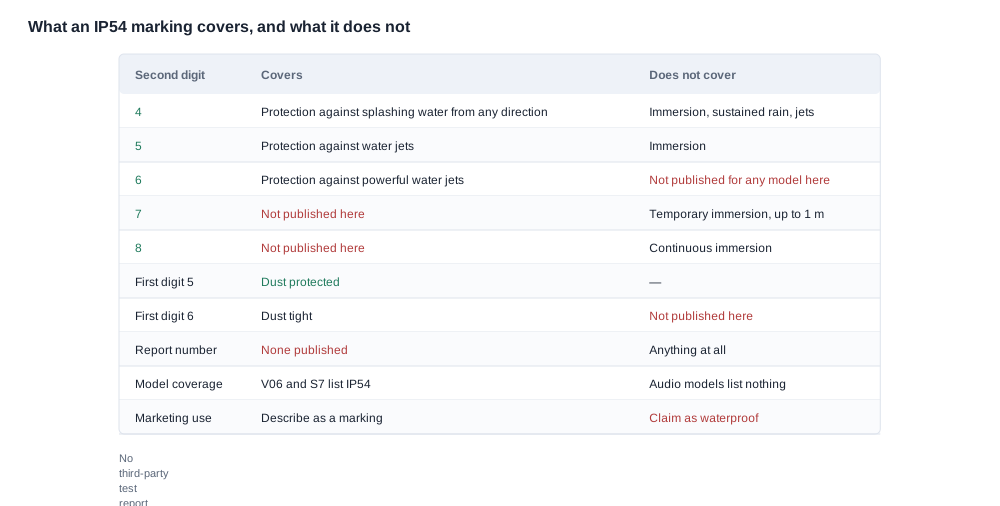
Sport smart glasses water resistance in this catalogue means one thing and nothing else: an IP54 marking on the V06 and the S7, no marking at all on the YKC02, the D17 and the ZH12, and no test report number published for any model in the range. That is a narrower position than most buyers expect, and it splits into two questions that are easy to confuse — what IP54 would cover if it were evidenced, and what a marking without evidence is worth in a listing.
This article is written for the buyer who has to decide what a listing may say, and for the supplier conversation that has to happen before a listing exists. The distinction that runs through it is simple: a marking is a statement about a product, and a claim is a promise to a customer. Only the first one is available from the published rows.
Sport smart glasses water resistance: the position by model
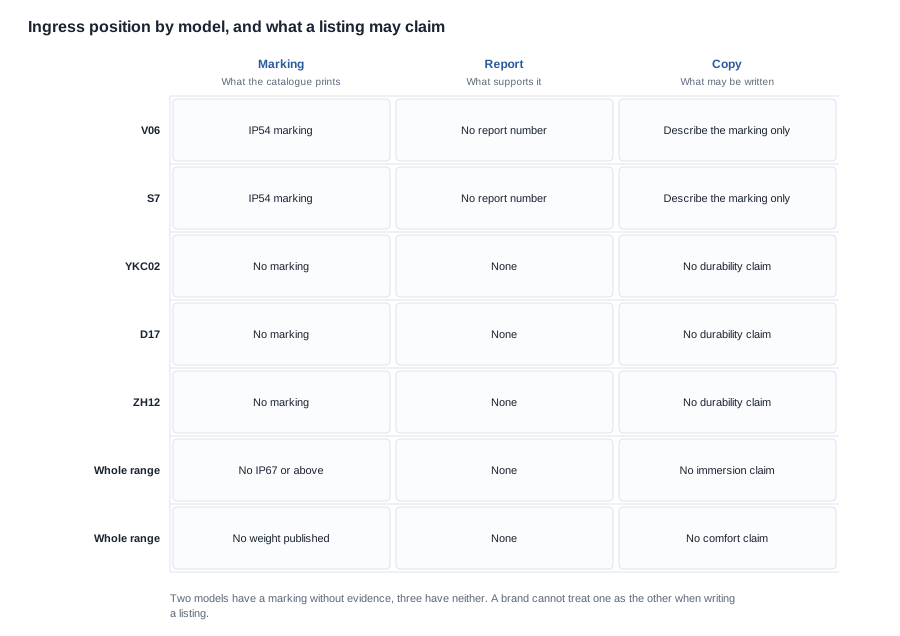
The V06 and the S7 carry an IP54 marking. Both also publish an ergonomic frame and a detachable inner frame, plus a camera — 8 MP on the V06 and 13 MP on the S7. Those two models are the only ones in the range with a printed ingress position at all.
The YKC02, the D17 and the ZH12 carry no ingress marking. That is a weaker position than an unevidenced marking, because there is not even a marking to describe. It matters commercially because a brand that lists three sport models together will find it very easy to let the V06 and S7 position bleed across onto the other three, and the resulting listing will make a claim about a product that has no printed basis for it.
Two further gaps constrain what any of these models can be sold as. No frame weight is published for any model in the range, so a product positioned for sport cannot carry a comfort claim built on a number. And no rating above IP54 is published anywhere, so nothing in the range supports an immersion claim at all.
How to evaluate a supplier's answer on this point is straightforward: a written statement naming which models carry a marking is checkable, while a blanket assurance that "the sport glasses are IP54" is not, and in this range it is also incorrect.
A useful way to run the per-model question is to put it in the quotation request as a table rather than as a question. A supplier answering a list of ten questions returns prose with gaps in it; a supplier filling in a table returns either ten cells or an explicit statement that a cell cannot be filled. The format matters more than the wording, because a blank in a column invites the follow-up while a blank in a sentence does not. Ask for the model, the marking, the report number, the laboratory, the date, and the scope — whether the report names that model or a family — and let the supplier fill in what exists.
The same table should be returned to you with the quotation, not later. A supplier who cannot complete it before quoting has told you that the position will not improve afterwards, and that is information you want while you still have alternative suppliers on the list.
The reason this question has to be asked per model rather than per family is a merchandising one as much as a legal one. A channel that lists the group on a single comparison page will naturally merge the columns, because a customer comparing three products does not want to read a disclaimer. The result is a table in which the V06 and the S7 show IP54 and the other three show a blank, and every customer reads the IP54 as a family property. That table is where the misstatement happens, and it is worth deciding deliberately how it is built before the listing is written rather than discovering the problem when a retailer asks.
There is a second reason to hold the boundary, and it is about the audio models. The YKC02 is published with surround sound and long endurance rather than a camera, and a product whose value proposition is audio has no reason to lead with ingress protection. Marketing it on a claim the documentation does not support would be trading a genuine differentiator for a borrowed one. How to evaluate which model suits which channel is a different question, and it is covered in the buying guide, but the shortlist should be built before the listing copy is written rather than after.
A third consideration applies to any private-label programme. If the brand's own artwork, packaging and manual are being produced, then the ingress wording appears in three places rather than one — the listing, the packaging, and the manual — and all three have to say the same thing. A mismatch between a package claim and a listing claim is the kind of error that surfaces as a complaint rather than as a correction, and it is much cheaper to align all three before the print run than after it.
What IP54 covers, and what it excludes even when evidenced
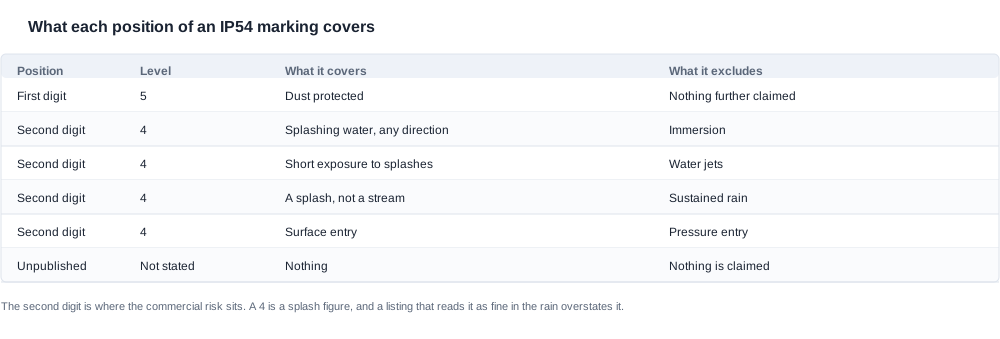
The first digit of an IP rating concerns solids and the second concerns water. A 5 in the second position denotes protection against water jets; a 4 denotes protection against splashing water from any direction. A 5 in the first position denotes dust protection.
So an IP54 marking covers splashing water. It does not cover immersion. It does not cover a sustained downpour. It does not cover water jets, and it does not cover water under pressure. Nothing in this catalogue is published at IP67 or above, so no model supports an immersion claim.
That distinction matters more than it appears, because "water resistant" in a retail listing is usually read by a customer as "fine in the rain", which is a stronger claim than a 4 in the second digit supports. The same marking on a phone is commonly described as splash resistant rather than waterproof for exactly this reason, and the convention exists because the two words are not interchangeable in a claim.
A third boundary is the liquid itself, and it is the one that matters most in sport. An IP54 marking is normally understood to be evaluated with fresh water. Sport products are used with sweat, which carries salts, and with pool and sea water where the buyer is swimming rather than training. A buyer whose channel is a swim club or a surf brand is therefore asking a different question from a buyer whose channel is running, and neither question is answered by the marking as published. The defensible position is that the marking describes splashing water, and that a channel built around immersion has to commission its own evidence.
A fourth boundary is temperature. Cold makes a seal behave differently and makes a cell behave differently, and a marking obtained at room temperature says nothing about behaviour after a unit has been left in a vehicle overnight. This is not an unusual use for a sport product and it is not a subject on which any published document in this range offers a position.
There is a fifth boundary that buyers in this category consistently under-weight, which is the difference between a marking and a serviceable product. A sealed unit that has taken water can often be recovered by opening it, drying it and returning it to service. A unit that was never opened because the marking said it was fine has usually been discarded by the customer, and the whole value of the unit is gone. In other words, the absence of evidence does not only create a claim risk; it creates a waste problem, and in a channel that handles its own returns that waste shows up in the cost of goods rather than in the warranty line. It is one more reason to resolve the question before the product reaches a customer rather than after.
It is also worth separating the marking from the packaging. A retail box that says something stronger than the marking — even as a design convention carried over from a previous product — is a marketing asset that outranks the specification in the customer's mind. Ask whether the artwork can carry a narrower statement, because changing a box is expensive after a print run and trivial before one.
There is a second boundary that is easy to miss. A marking describes the assembled product as tested, which means it says nothing about the product after a customer has opened it, fitted an inner frame, or attached an accessory. A brand shipping a remote alongside an IP54 frame has created a mixed object, and the frame's marking does not extend to the second item in the box. Where an accessory has no published ingress status of its own, the listing should not imply that it inherits one.
The missing test report is the larger problem
No test report number is published for any model in the range. That means IP54 here is a catalogue marking rather than an evidenced rating — a statement about what the catalogue says, with nothing behind it in the documentation.
This creates two distinct risks for a channel, and they surface at different moments. In a specification sheet, a marking without evidence invites the follow-up question from a technical buyer or a retailer, and the honest answer costs credibility. In marketing copy, a durability claim is the kind of thing that surfaces in a warranty claim, and at that point the buyer needs a document that was never obtained.

The evidence chain that avoids both problems has seven steps, and the third one is the one most brands skip. Asking for the report number and receiving a number closes the question. Asking whether a report exists and receiving a written "no report exists for this model" closes it just as well, because it is now a documented position rather than an absence. Silence is not an answer, and it is the one response that leaves the buyer carrying the risk.
A distributor who has not resolved this before accepting the goods carries the exposure personally. Under most distribution agreements, a claim published by a reseller that overstates the product is a breach by the reseller, and the remedy is usually withdrawal of the listing rather than a small credit. The practical consequence is that a distributor's real defence is a written record of what the supplier said at the time of the quotation, which is why step four of the chain — the written confirmation where no report exists — matters more than it first appears. It is not documentation for its own sake; it is the evidence that the claim was made on the supplier's position rather than the distributor's imagination.
There is also a compliance dimension worth separating from the commercial one. Market surveillance authorities in several jurisdictions treat an unsubstantiated durability claim on a consumer-facing listing as a separate matter from a product defect, and the remedy can include withdrawal of the listing without any return being involved at all. That is a different cost from a warranty claim, it is faster to arrive, and it is much easier to prevent.
Once the position is documented, the claim has to be written against it rather than around it. A listing that says "IP54" and nothing else is defensible for the V06 and the S7 and indefensible for the other three. A listing that says "IP54 rated" adds an implied test that the documentation does not record. The general handling of markings without reports is in IP ratings and durability, and the evidence side of a sport programme is covered in how to test before ordering IP rating smart glasses.
What a listing may say, and what it may not
If the claim is needed, describe the marking accurately. The defensible wording is: this model carries an IP54 marking in our catalogue, which denotes protection against splashing water and not immersion or sustained rain. That sentence survives a technical buyer's follow-up and it survives a warranty claim, because every part of it is something the supplier can point at.
Do not write "waterproof", "rain-proof", "sweat-proof" or "safe for any weather" for any model in this range. We will not supply copy that does, and the reason is not pedantry: each of those phrases is a claim about a condition the product is not specified for, and each of them is written into a listing where it becomes a term the customer believes they were given.
The same discipline applies to the three unmarked models, where there is even less to work with. For those, the honest position is sport-oriented rather than weatherproof. That is a weaker proposition for a channel that competes on specification, and it is a stronger one for a channel that intends to keep selling to the same customer next season. The trade-off is real and it is the buyer's to take.
Channel wording is worth handling separately, because the same product needs three different sentences in three different places. On a comparison table, "IP54" beside two models and a dash beside the other three is accurate and needs no footnote. In a product detail page, the fuller sentence about splashing water and not immersion or sustained rain belongs in the specification block rather than the headline, where it will be read. In a paid listing, the honest version is a sport-positioning statement — built for outdoor training rather than for immersion — because that is a claim the product can actually stand behind and it is more persuasive than a hedge.
The test for any wording is whether a customer could reasonably rely on it to make a decision they would not otherwise make. "IP54" in a comparison table passes, because the customer is choosing between products and the marking is being compared like any other specification. "Waterproof for any weather" in a headline fails, because the customer is being told they can leave the product somewhere it cannot survive.
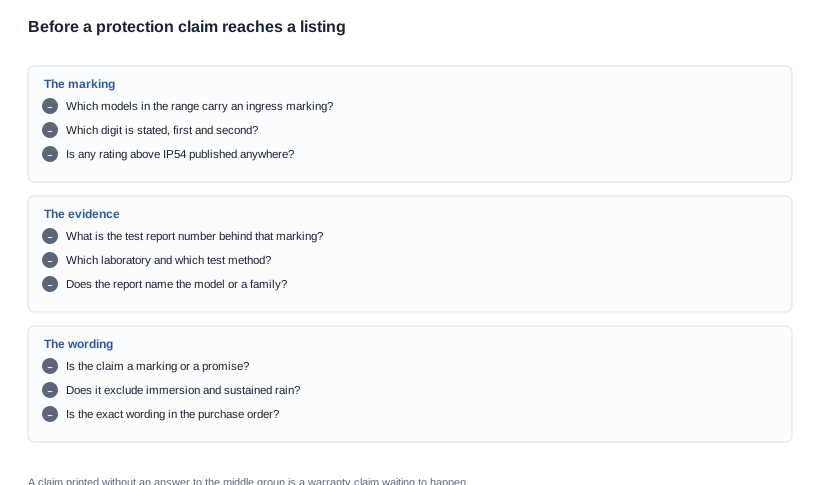
The three questions to ask before any protection claim reaches a listing are: which models in the range carry an ingress marking, what is the test report number behind that marking, and is the exact wording recorded in the purchase order and the technical file. All three belong in the request for quotation, because all three take longer to obtain than the listing takes to write.
The question a buyer should take back to the supplier
Whether durability is central to your proposition determines which of these is a footnote and which is the whole negotiation. If the product is sold on being ready for the outdoors, then the absence of evidence across the range is not a documentation detail — it is the difference between a proposition and a hope, and it should be resolved with the factory before the purchase order rather than discovered during the first claim.
What to ask for, in order:
- Which specific models carry an ingress marking, in writing.
- The test report number, laboratory and test method behind each marking.
- Whether the report names the individual model or a product family.
- A written confirmation where no report exists, so the absence is documented.
- Any rating above IP54 that the factory holds but the catalogue does not print.
- The agreed listing wording, recorded in the purchase order and the technical file.
- Who owns the risk if the channel's copy overstates the marking after the listing is published.
That last question is the one most buyers skip and the one that determines whether the protection argument ends up as a negotiation or a dispute. Ask it before the deposit, and the answer is usually that the brand owns the copy and the factory owns the product, which is exactly the arrangement a listing needs.
In practice the negotiation that produces the best outcome looks like this. The supplier states the marking position per model in writing. The brand agrees a single sentence that may be used, and that sentence goes into the technical file, the packaging artwork and the listing template together. The factory confirms that the configuration described in the sentence is the configuration it will ship, and that a change to the enclosure or the sealing would be flagged as a change to the documented position. That last clause is the one that keeps the claim honest two years later, because most of the drift in a protection claim comes from an engineering change rather than from a marketing decision.
A buyer who has that clause in the purchase order can sell durability language with a clear conscience, because the number of variables that can invalidate it has been reduced to one, and that one is contractually visible.
If the answer is that no report exists anywhere in the range, there is a constructive route rather than simply dropping durability from the proposition. A brand can commission the test on its own units, at its own cost, and then hold evidence for the configuration it actually ships rather than for whatever the catalogue prints. That is a real cost and it belongs in the quotation as a line item, but it converts an undefensible claim into a defensible one and it is the only route that ends with a channel able to say something specific about durability. The alternative — sourcing a different model that already carries evidence — is worth shortlisting at the same time, and the criteria for comparing the two are the same criteria used everywhere else in this category: what is published, what is evidenced, and what has to be obtained in writing.
We state the marking as a marking and refuse to convert it into a claim. We will not describe any model in this range as waterproof, we will not estimate a report number, and we will not extend the V06 and S7 marking to a model or an accessory that carries none.
Tell us whether durability is central to your proposition and we will tell you which models here can carry it, and what we would have to obtain to carry more. The related position on compliance evidence is in v03 pro smart glasses certification status, and the range these models belong to is on our sport smart glasses page.


