

Smart glasses payment terms matter to two different buyers for two different reasons, and the second reason is the one buyers misjudge. The first buyer is the one protecting cash: they are deciding how much money to have unrecoverable while a supplier they have never worked with builds a configuration they have not seen. The second buyer is the one protecting margin: they have a delivery record, a consistency record and a re-order forecast, and the terms themselves have become the thing that is costing them money.
What neither buyer gets from order size alone is leverage. A large order moves the price tier and it does very little else. The thing that changes what a supplier will accept is verified history — evidence that the previous order was received, checked and paid for. That is the axis along which payment structures should be designed, and it is the reason "who needs these terms" is answered differently at the first order and at the sixth.
Smart glasses payment terms: the negotiating capital is history, not order size
Why a larger order does not buy better terms on its own
A supplier's exposure in this category is made of three things: the work in progress, the material committed to the programme, and the risk that the finished goods do not match what was ordered. Only the third is reduced by a buyer's reputation, and only the first two are reduced by a buyer's cash.
That is why order size moves the price and leaves the structure alone. A ten-fold increase in quantity does not make the goods more likely to match the approved sample, and it does not make the material arrive sooner. It does, however, make the deposit larger in absolute terms, because deposits are usually a percentage of the order value. A buyer who negotiates a percentage down while multiplying the volume has made its exposure worse, and this is the single most common way a procurement team loses money on a successful negotiation.
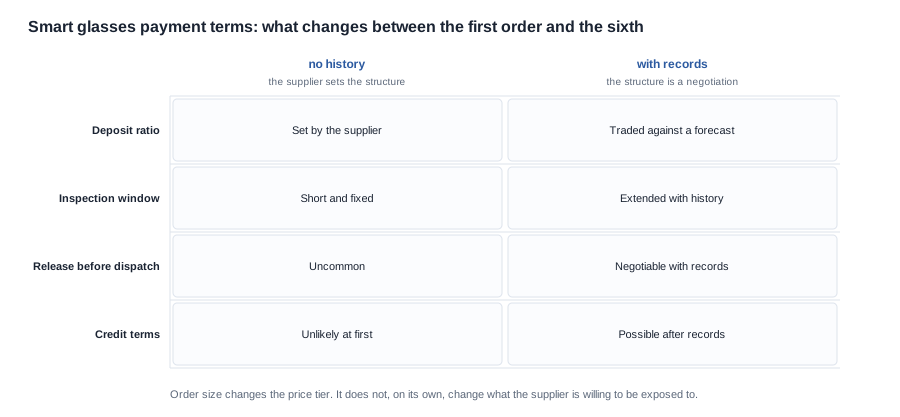
The other half of the answer is that a supplier's willingness to offer a favourable structure is a function of what has already gone right. A buyer with three deliveries received on time, inspected, accepted and paid has something to trade: the certainty of the next order. A buyer with one order that went badly has something to trade too, and it is not a favourable structure.
The four stages and what each one can be traded for
The stages are not dates; they are levels of verified history, and each one opens a different negotiation.
- Before the first order. There is no history, so the structure is set by the supplier and the buyer's only lever is the composition of the order: a smaller scope, a later stage, or a structure that ties the money to something the supplier values.
- After one order delivered and paid. The buyer now has a record and the supplier has a reference customer. This is where the inspection window and the release point become negotiable, because the risk the structure was protecting against has been tested once.
- After a consistent record across several orders. Consistency, not delivery, is the asset. A buyer who can show that units from three consecutive orders matched the approved configuration is asking for a structure that assumes consistency, and the evidence for that assumption now exists.
- At the point where the relationship is stable. Terms stop being a negotiation and become an operating parameter. At this point the question is no longer how to obtain a better structure but whether the current structure is still the right one for a business that has changed.
The mistake at stage two is moving straight to stage four. A buyer who skips the record and asks for credit terms on the second order is asking the supplier to fund a relationship that has not yet demonstrated anything, and the answer will be a worse structure rather than a better one.

The three payment structures and the exposure each creates
Full payment before shipment
The buyer pays the whole order value before the goods leave. In exchange the supplier carries the entire working capital position on this buyer's order, which is why it is usually available and why it is often the default on a first order.
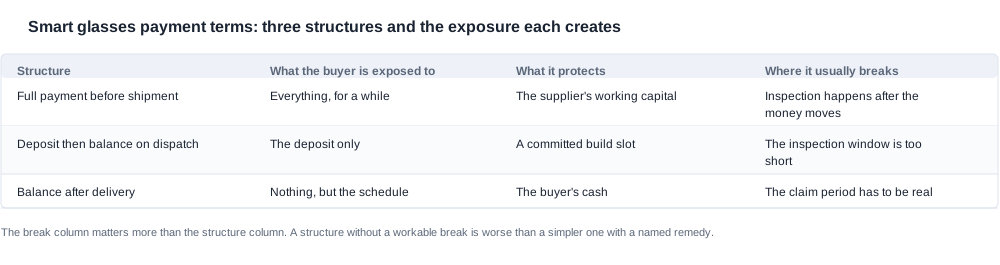
The exposure sits in the interval between the money moving and the buyer being able to see the goods. If the inspection happens after dispatch, the buyer has paid for goods it has not seen, and the remedy is a claim rather than a refusal. This structure is cheap for the buyer in cash terms and expensive in risk terms, and it is the one most likely to be presented as standard and accepted without a condition attached.
A deposit with the balance on dispatch
The buyer pays a percentage on order and the balance once the goods are ready to ship. This is the most common structure in this category, and it is also the one where the detail decides everything: whether the balance is released on dispatch, after a document check, or after the buyer's inspection, and how many days that inspection window is.
Two questions settle whether the structure is protective. How long is the window between the goods being ready and the balance being due? And who is allowed to release the balance — a named person on the buyer's side, or an automated term? A structure whose release point is a date rather than a decision is a structure that releases money whether or not the goods are right.
Balance after delivery
The buyer pays after the goods arrive and are accepted. This is the structure the supplier resists hardest and the one that protects the buyer's cash most completely. In exchange the supplier is carrying the whole programme until acceptance, which in a category where lead time and capacity are unpublished is a substantial request.
The break in this structure is the claim period. If the buyer has a right to inspect and reject, and the window for doing so is defined, the structure works. If the payment falls due on arrival and the claim route is undefined, the buyer holds a claim it cannot make, which is worse than a structure that looked better than it was.
The two structures that are rarely quoted, and when they are available
Two further structures appear in this category often enough to be worth naming, because they change the buyer's exposure more than the headline percentage does.
The first is payment against a document set rather than against a date — the balance released when the shipping documents, the inspection record and the packing list are all in the file. It costs the buyer nothing in cash terms and it converts an open-ended inspection argument into a document checklist, which is the difference between a dispute and a delay. It is almost always available once the relationship has produced one clean delivery, because it requires the supplier to trust that the buyer's document list is fixed.
The second is retention on the final instalment, where a small percentage is held back for a defined period after delivery. It is the structure that protects a buyer whose real fear is not a defective unit but a supplier that stops answering after the invoice is paid, and it is the one that matters most in a category where the catalogue publishes no per-model conformity evidence and no consistency record: the only assurance a buyer can hold at the end of a programme is a sum of money that has not yet been released.
Both are rarely available on a first order, and both become available quickly once the first delivery has been received, inspected, accepted and paid. A buyer who asks for them at order one will usually be refused; a buyer who asks for them at order three is usually granted them, and the cost of not asking at order one is a programme that runs the whole way on the supplier's terms.
Turning payment milestones into evidence, not just dates
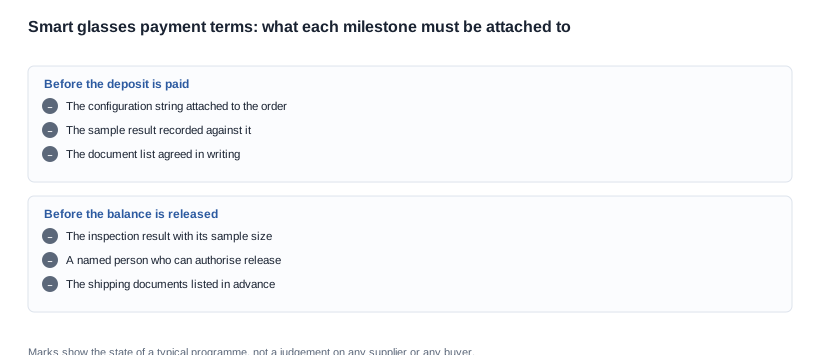
What each milestone has to be attached to
A milestone is a date with a name on it. A release condition is what makes it worth something. The gap between the two is where buyers lose money.
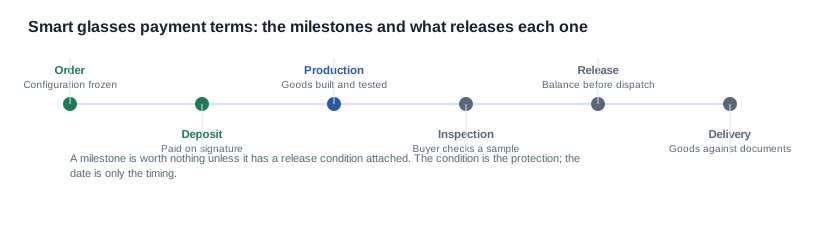
Each milestone in a sensible structure carries a condition that has been met. The deposit milestone is released against a frozen configuration, a recorded sample result and an agreed document list. The production milestone is evidence that the units were built and tested against that configuration. The inspection milestone is a result with a sample size attached, not an assurance. The release milestone is a named person's decision, recorded.
The distinction is easy to state and easy to lose in practice, because a date arrives in a quotation and a condition has to be constructed. A buyer who accepts the dates without constructing the conditions has accepted a structure that pays out on time rather than on evidence.
The two clauses that make a deposit smaller than it looks
Two clauses do most of the work of making an exposed payment structure defensible.
The first is the configuration attachment: the approved sample and the configuration string are referenced by revision inside the order, and the milestone cannot be released until the configuration is frozen. This costs the supplier nothing and it converts a percentage of an undefined product into a percentage of a defined one.
The second is the release-on-evidence clause, which states what has to exist before the balance is due, who checks it, and how long the check takes. This is the clause that makes the difference between an inspection window and a payment date, and it is the clause most often left implicit because it is the one that requires the buyer to commit to a turnaround.
Two more clauses are worth naming even when they are declined. The first is the change notification clause, so that a substitution made mid-build does not trigger a release. The second is the claim route with a period, so that the inspection window and the claim window are the same window and not two different ones. A structure with an inspection window of five days and a claim period of ninety days is a structure that has been negotiated from one side only.

The published rows and what they let you milestone against
Configuration, inspection and the release point
The published catalogue data is what a milestone can be written against, and there is more of it than most buyers expect. The catalogue covers 28 models and publishes cell capacity, charge time and run time for every one of them, so the electrical specification against which a sample is judged is fully available. A charging interface is published for 24 of the 28 — 17 on magnetic charging and 7 on Type C — with the L1 Pro and the CY05, and the CY03 and the MT6 publishing none, although all four do publish a charging-case capacity. A camera resolution class is published for all 11 camera models, splitting into 8 MP for eight of them and 13 MP for three, the L1 Pro and the S7, and the L2 Utral.
Two of those published rows need care in a milestone. Charge time is published for all 28 models, 26 of them written as a ceiling of two hours or less and the D17 and the ZH12 written as about one hour; a ceiling is an upper bound, so a specification sheet that says "under two hours" has changed the meaning of the published row. And cell capacity is published as cell values with a cell count, 55 mAh twice, 90 mAh twice, 70 mAh twice and 100 mAh as a single cell, so a combined total in an inspection sheet is a derived figure and has to be labelled as one.
Where the catalogue is silent, and what that means for a milestone
The rows that are absent are the rows a milestone cannot be written against, and there are four groups of them.
The commercial rows. No unit price, price tier, minimum order quantity, production capacity, lead time or yield is published for any model, so a milestone cannot reference a price-tier threshold and a schedule cannot reference a capacity number.
The physical rows. A body weight is published for one model only, the MT6 at 158 g for the glasses body including the 265 mAh cell and the camera and excluding the folding charging case, whose own weight is not published. Every other model in the range has no published weight, so a shipping-weight milestone has to rest on a figure that does not yet exist in the file.
The camera behaviour rows. No camera model publishes a field of view, a frame rate, a video format, a storage path or a low-light figure, and no camera model publishes a Bluetooth version either. The catalogue text carries no touch row for any model, on the K01 or on anything else, so a touch behaviour has to be established on a sample rather than read off a table. These are exactly the rows a camera sample test exists to establish, which is why a camera programme needs a sample before the balance milestone rather than after it.
The conformity rows. There is no per-model certification row in the catalogue, and its text contains no CE, FCC or RoHS reference for any model, so a documentary milestone cannot be written against published evidence. It has to be written against a document list, and the list is the buyer's, not the catalogue's. Where the destination is in the European Union, the instrument has to be named correctly: the Radio Equipment Directive is (EU) 2014/53/EU, the electromagnetic compatibility directive is the separate (EU) 2014/32/EU, and the EN 301 489 series is a harmonised standard cited inside a conformity assessment. The general product safety regime, Regulation (EU) 2023/988, applicable since 13 December 2024, and the lithium battery transport regime both add documentary stages that have to appear in the milestone plan rather than in a folder.
A worked illustration: the same supplier at order one and order six
What follows is a hypothetical walk-through. No account is described, no supplier is identified, and the numbers exist only to make the comparison legible.
A brand-side buyer orders a camera model in the 8 MP class from a supplier it has never worked with. The quoted structure is a 30 per cent deposit on order and the balance on dispatch, with a seven-day window between the goods being ready and the payment falling due. The buyer has no history with this supplier, and it has no idea whether the supplier has built this configuration before.
At order one, the exposure is the deposit and the window. The buyer is paying 30 per cent of the order value for goods it has never seen, and it has seven days to inspect them after the balance is contractually due. The questions to ask are therefore narrow and specific. Is the balance due on dispatch, or after the inspection window? Is the configuration frozen before the deposit is released? Is there a per-unit test record for the configuration? Is the document list attached to the order? The answer to the last of these matters more than the answer to the first, because the documentary evidence is what the sample and the inspection are being compared against.
At order six, the exposure has changed shape. Three deliveries have been received on time, inspected against the same written list, accepted and paid. The supplier now has a reference customer, and the buyer has a consistency record. The structure can therefore change in three specific ways, and the buyer should push for all three: the inspection window can be extended, because the supplier now carries less risk on inspection; the balance can be released after the inspection rather than before it, because the risk of a mismatch is demonstrably low; and the payment can be netted against a forecast, because the re-order pattern is now predictable enough to be worth financing.
What did not change is the catalogue. The same rows are published and the same rows are absent, and the same four camera models still publish no interface row while publishing a case capacity. The published data is a constant across the relationship, and the variable is the evidence the buyer has accumulated about the party on the other side of the transaction.
The pricing checklist is the companion document when the structure is being set against the price tier, and the MOQ practical advice article covers the case where the deposit percentage is being negotiated against a volume that is still moving. The wider framework is under payment terms and milestones.
Where our own position stops
It is worth being precise: payment terms in this category are a conversation between two parties who know different things, and the useful contribution from a factory is an accurate description of the configuration and a reliable delivery record. We publish the electrical rows for 28 models, a charging interface for 24 of them, a camera class for all 11 camera models, a charging-case capacity for five of those camera models, an ingress marking on two rows and a body weight for one.
What we do not publish, and cannot publish, is anything that would set a payment structure: no unit price, no minimum order quantity, no capacity, no lead time, no yield, and no per-model conformity evidence. Those are the terms of a relationship, and a term that is published is a term that is fixed before the relationship exists.
What we can do is tell you, for a named model and configuration, which published rows a milestone can be written against and which ones have to be created before the first milestone, and what to attach to each so that it releases on evidence rather than on a date. Send us the models, the quantities, the destination and the payment structure you have been quoted, and we will tell you which parts of it rest on something verifiable and which parts rest on a promise.


