

Smart glasses sourcing risk is not owned by the person who finds out about it. It is owned by the seat in the buying organisation that holds the cheapest instrument able to close the gap, and in most buying teams those two people are not the same person. A sourcing manager who discovers that a camera model publishes no charging interface cannot close that gap with a purchase order, and a quality engineer who receives the unit without a written acceptance list cannot close it either. The gap survives until it reaches the one role with the authority to act, and that role is rarely the role that noticed.
This article answers the question by seat rather than by kind of buyer. Each gap in the published specification is assigned to the role that can close it with the least expensive instrument available, and the roles that cannot close it are named as clearly as the ones that can.
Smart glasses sourcing risk: the seat that can actually close the gap
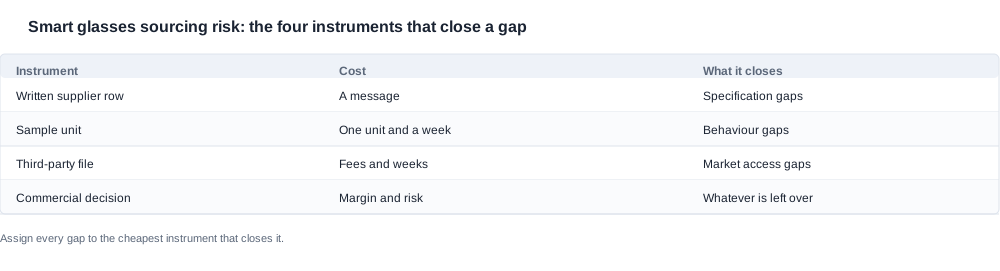
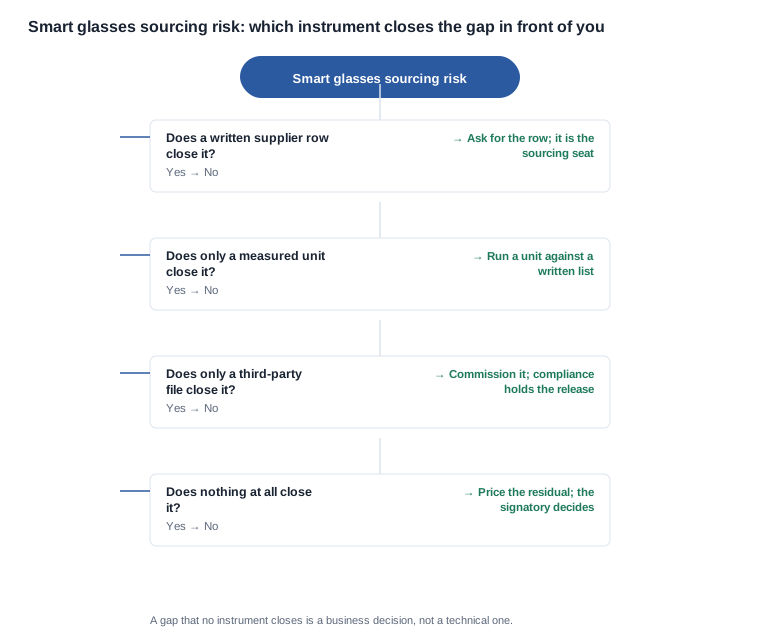
The four instruments, and the rule that assigns each gap
Every open item in a smart glasses sourcing risk review is closed by one of four instruments, and they differ enormously in cost and in elapsed time.
- A written row from the supplier. A price, a minimum order quantity, a lead time, a weight per configuration, a charging interface per model, a cell capacity per model. Costs a message, closes in days, and is binding only if it is in the agreement.
- A sample unit. One physical device in the correct configuration, run against a written acceptance list. Costs a unit and a week, and it is the only instrument that produces evidence about behaviour rather than about specification.
- A third-party document or a test. A conformity file for a destination market, a battery transport file for a configuration, an ingress test report behind an ingress marking. Costs money and weeks, and it is the only instrument that produces evidence a customer or a border will accept.
- A commercial decision. Accept the exposure, price it into the margin, cap it with a contract term, or walk away. This is the only instrument available for a gap that none of the first three can close.
The rule that follows from this is short: assign every gap to the cheapest instrument that closes it, and where no instrument closes it, the gap is not a technical question at all — it is a business decision, and it belongs to whoever signs.
Why the role that finds the gap is rarely the role that owns it
Three structural reasons cause the mismatch, and they are worth naming because they determine where a review should be routed.
The gap is discovered by whoever reads the catalogue row, and the catalogue is not part of the role description. A sourcing manager comparing two quotations for the same model discovers that one supplier's document names a charging interface and the other does not. That discovery belongs to the comparison task, and the closure belongs to a written row request that nobody owns by default.
The role that can close a gap usually cannot see it. A compliance lead who could close a destination-market file will not notice that the file is missing, because missing documents are invisible from the seat that would supply them. They are visible from the seat that has to declare the product.
The cost of the gap falls on the seat that did not create it. A specification gap discovered during clearance is paid for by the launch schedule, and the launch schedule belongs to somebody who had no part in the sourcing decision. That asymmetry is why gaps survive: nobody who could close them is charged for leaving them open.
What "worrying about sourcing risk" means at each seat
At each seat the risk is different, and so is what counts as adequate attention.
- At the sourcing seat, the risk is substitution and commercial drift. The attention that is enough is a written confirmation of the rows for the configuration ordered, and a change-notification commitment attached to the agreement.
- At the quality seat, the risk is a specification that cannot be reproduced. The attention that is enough is a written acceptance list, a golden unit, and a rule for what happens when a production unit does not match it.
- At the compliance seat, the risk is a claim without a file behind it. The attention that is enough is a per-model, per-destination position in writing, and a rule that no listing claim exceeds it.
- At the product and channel seat, the risk is a promise made to a customer that the organisation cannot evidence. The attention that is enough is a claim-to-evidence map, updated whenever the specification changes.
- At the signatory's seat, the risk is the residual after the first four have done their work. The attention that is enough is a memo that names the residual exposure and its worst case in money.
The gaps in this catalogue, and who closes each one
The published specification set in this category is narrower than most buyers expect, and the way to handle it is not to worry harder — it is to route each gap to the seat that owns it.
The charging interface. Twenty-four of the twenty-eight catalogue models publish a charging interface: seventeen on a magnetic contact and seven on a Type-C port. Four camera models publish no interface row at all — the CY03 and the CY05, and the MT6 and the L1 Pro — and all four publish a charging-case capacity, 1400 milliamp-hours on the first three and 1200 milliamp-hours in the folding case on the MT6. A written row closes this gap in a day, and it belongs to the sourcing seat, because the answer changes what you order and how your channel charges the unit.
The unit weight. The catalogue publishes exactly one weight, and its scope is specific: 158 grams for the MT6 eyewear body, including the battery and the camera and excluding the folding charging case, whose capacity is listed separately. Nothing else in the twenty-eight models publishes a weight, and no bare frame weight appears anywhere. The gap closes with a written weight per configuration, which is a sourcing request, and the freight and insurance consequences are what makes it urgent.
The runtime test condition. All eleven camera models publish a rated runtime — five to eight hours on the V03 Pro and the S7, and the V06 and the V03, six to eight hours on the KY06 and the MT5, and about seven hours on the MT6 and the CY03, and the L1 Pro and the CY05, and the L2 Utral — and not one of those rows publishes the workload that produced the figure. This gap cannot be closed by a row. It closes with a measured unit against a stated workload, which puts it in the quality seat.
The per-model conformity position. The catalogue carries one company-level export-certification page, no per-model certification row for any of the twenty-eight models, and no CE, FCC or RoHS wording anywhere in the document. That includes the three children's entries, the A05, the A06 and the A07. This gap closes only with a third-party document per destination market, which is the compliance seat, and it is the slowest of the four instruments to produce.
The case configuration. Five camera models publish a case capacity, two ship with a case whose capacity is not published, and four publish no case row at all — the V06, the S7 and the V03, and the V03 Pro. The consequence is that the contents of a carton cannot be enumerated from published rows, which makes this a sourcing and logistics question rather than a specification question.
The camera series radio version. The audio and sport models publish V5.3 or V5.4; the eleven camera models publish no Bluetooth version. The gap closes with a pairing test against the actual phone fleet of your channel, which puts it in the quality seat with the product seat as the beneficiary.
The ingress marking. IP54 appears on the V06 and the S7 and on no other model, and no test report is published behind it. Only a test report closes this, and it is a compliance item before it is a marketing one.
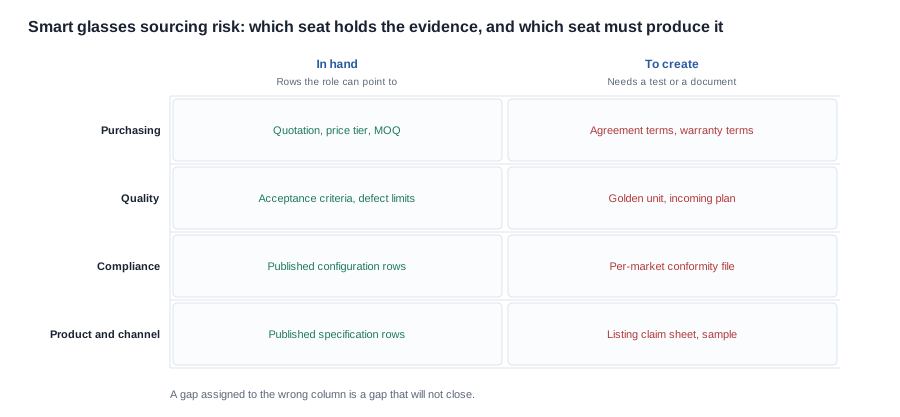
The matrix above is the routing table in one picture. The left column is what each role already has in hand, and the right column is what each role has to go and create. A review that assigns a gap to the wrong column is a review that will not close, which is the most common reason a sourcing risk review ends in a launch date rather than in an answer.
The gaps compound, and the combination is what disqualifies a model
Individually, every gap above has a cheap closing instrument, and a buyer who closes all of them has a defensible order. The difficulty is that the gaps do not stay in their lanes, and it is the combinations that disqualify a model from a particular channel.
Take a camera model that publishes no charging interface, no weight and no per-model conformity row. The interface is a channel question, because the customer has to charge the unit and the channel has to publish what is needed to do it. The weight is a freight and an insurance question. The conformity row is a market-access question, and it is the one that decides whether the model can be sold into the destination at all. Three gaps, three different seats, one model, and a launch date that depends on all three being closed in parallel rather than one after the other. A buyer who closes them in sequence has spent three lead times on one model.
The practical consequence is that the review should be run per model and per destination rather than per order and per supplier. An order containing four camera models with four different case configurations and three destination markets is not one review — it is a small programme, and it has to be scheduled as one. That is the point at which a sourcing review becomes a sourcing programme, and it is much cheaper to reach that point deliberately than to discover it on a launch date.
What each role on the buying side is able to settle
| Role | Can settle | Cannot settle | Instrument |
|---|---|---|---|
| Product or channel lead | The claim set, the target market, the price band | Conformity, acceptance criteria | A claim-to-evidence map |
| Sourcing or procurement manager | Price tier, MOQ, lead time, payment terms | What is claimed, test outcomes | The quotation and the agreement |
| Quality engineer | Acceptance criteria, incoming inspection, defect limits | Commercial terms, market access | The sample and the golden unit |
| Compliance or regulatory lead | The conformity position per model and destination | Unit price, schedule, listing copy | The conformity file per destination |
| Marketplace or channel lead | What the customer is told, the returns path | Whether the unit meets the claim | The published-rows cross-check |
| Finance approver or signatory | The deposit, the credit, the residual exposure | Whether a claim is defensible | A risk memo with the worst case priced |
The product or channel lead owns the claim, and the claim is where an unpublished figure becomes a dispute. A published figure that a competitor cannot reproduce is an advantage; an unevidenced figure on a listing is a return, a review and a correspondence thread. This role's instrument is a short map from every claim on the listing to the published row or the document that supports it, and the map has to be revisited whenever the specification changes rather than only at launch.
The sourcing or procurement manager owns the commercial terms and the written rows. Price tier, minimum order quantity, lead time, payment terms, warranty period, the change-notification commitment and the per-model confirmation of the rows being ordered all sit at this seat. What this seat cannot do is decide what goes on a listing or accept a defect threshold, and it is worth being explicit about that because a sourcing manager asked to close a specification gap will tend to answer it with a commercial concession, which is a different thing entirely.
The quality engineer owns reproducibility. The written acceptance list, the golden unit, the incoming inspection plan and the defect threshold are all at this seat, and all of them are cheap relative to the alternative. The one discipline that matters is that acceptance criteria are agreed before the sample ships rather than reconstructed afterwards, because criteria written after the fact are a description of what arrived rather than a standard.
The compliance or regulatory lead owns the files and holds the release. The per-model, per-destination conformity position, the battery transport documentation for each configuration with a case, and the test report behind any ingress marking are all at this seat. This role is the only one that can stop an order, and the buyer should know that stopping an order is cheaper than clearing one.
The marketplace or channel lead owns what the customer is told and the cost of the return. The returns policy, the listing copy and the channel credit are at this seat, and the exposure here is priced in the margin rather than in the schedule.
The signatory owns the residual. By the time the memo arrives, the other five seats have either closed their gaps or failed to. The signatory's decision is whether to price the residual, cap it with a contract term, or walk away — and the memo that supports that decision has to name the residual in money rather than in adjectives.

How to evaluate a supplier at the point where the risk becomes yours
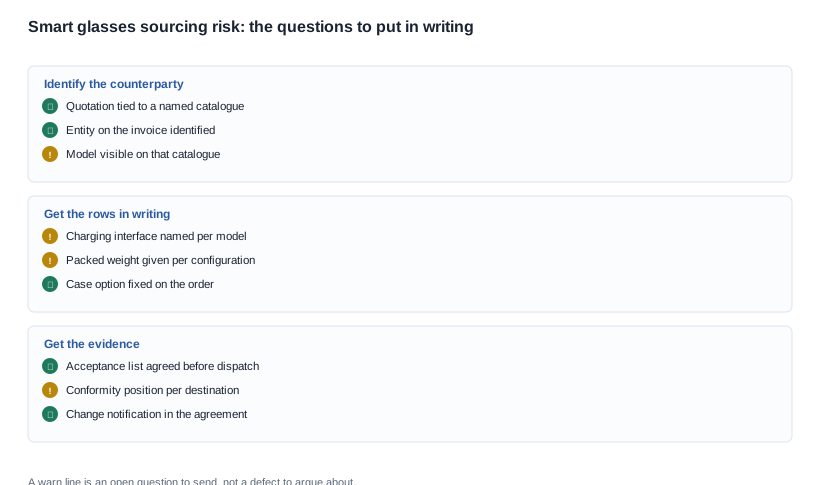
- Establish which catalogue the quotation is based on, by name and by the entity on the invoice. The red flags when a supplier is a trading company article is the field version of this check, and the question is short: who is behind the invoice, and can you see the model on the catalogue the quotation came from.
- Request the per-model, per-destination conformity position in writing, with the model coverage and the issuing body named. A general statement about a company's capability is not a position for a model, and this is where the buyer checklist earns its place.
- Request the configuration rows in writing for the models ordered, covering the charging interface, the cell capacity, the case option and the packed weight. Where the catalogue publishes no row, that request becomes the written row.
- Ask for one production unit and a written acceptance list, and agree the list before the unit ships. This is the only step that produces evidence about behaviour, and it is the step most often replaced by a photograph.
- Ask for the change-notification commitment in the agreement, naming who notifies whom, within what period, and with what documentation.
- Price the residual in the total cost, not in the margin percentage. The question to ask is what the unclosed gap costs if it turns out badly across the whole first order, and that number belongs in the commercial comparison rather than in a separate risk register.
The shortlist criterion that falls out of this is a single question: which supplier converts the most of your open gaps into written answers before the purchase order, and how many of the remainder are the supplier's to close. Two suppliers can quote the same unit price and sit at opposite ends of that scale, and the difference between them is worth more than the difference in price.

How sourcing risk in this category turns into a commercial loss
The claim dispute on a listing. The symptom is a return attributed to a specification the organisation believed was published. The root cause is that a figure was carried from a sample demonstration into a listing without a published row behind it. The prevention is the claim-to-evidence map, held by the product seat and reviewed at every specification change.
The quiet substitution. The symptom is a production unit that behaves differently from the approved one, with no fabrication involved. The root cause is that a component or a cell was changed without a notification, because no one had the authority to require one. The prevention is the change-notification clause, and it is worthless unless the agreement names the notice period and the recipient.
The clearance delay. The symptom is a launch date slipping while the goods sit finished. The root cause is that the conformity file for a destination market was requested after the order was placed. The prevention is a documents calendar owned by the compliance seat, not a reminder in an inbox.
The returns wave. The symptom is a cluster of returns in a single period with no obvious pattern. The root cause is usually a change in the shipped configuration that the receiving team cannot distinguish from the approved one. The prevention is a golden unit held by the quality seat and a receiving check that compares against it.
The second-source illusion. The symptom is an organisation that believes it has reduced concentration risk and has not. The root cause is that the alternative source has never been evaluated against the same acceptance list, so it is a name rather than a source. The prevention is to run the second source through the same seven steps above before counting it.
Every one of these losses is decided before the purchase order is signed, and that is the practical answer to who needs to worry: the seats that still have decisions available after the signature are the ones that will not get a second chance.
The boundary of what we will put in writing
The short answer: we publish the figures the catalogue holds and mark the rest as not published, and we will not give a buyer a number to print that we cannot evidence. We will also tell you when our own position is weaker than we would like. No model in our catalogue carries a per-model certification row, and that includes the three children's entries. The bone-conduction entry publishes a 35 decibel gain figure, which raises a boundary question a buyer must settle before that figure appears in any listing. The AR entry in the catalogue publishes no augmented-reality functionality in its description. The camera series publishes no Bluetooth version, and the catalogue carries exactly one weight, scoped to the MT6 eyewear body alone.
The mechanism is the useful part. Send us the model, the configuration, the destination markets and the launch window, and we will tell you which documentation gaps apply to your order, which of them we can close from our own material, which need a test or a third party, and which are the signatory's decision. The risk section covers the commercial terms, and the camera and audio range is where the published baseline sits.


