

IP rating: the claim with a report behind it
Why an ingress marking is a claim with a report behind it
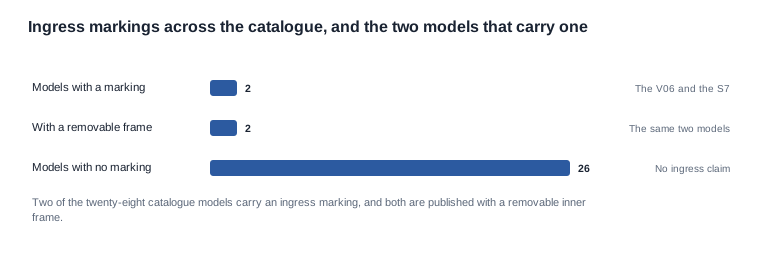
An ingress rating is not a product feature. It is a claim, and like every claim it is only as good as the document behind it and the scope of what that document covers. In our catalogue of twenty-eight models, exactly two carry an ingress marking: the V06 and the S7, both at IP54. The other twenty-six carry no marking at all, which means a buyer cannot treat this as a feature that can be switched on across a range. The commercial question is therefore not whether ingress protection matters, because for a sports or outdoor channel it plainly does, and not whether the number is impressive, because IP54 is a modest number. The question is what IP54 covers on these two specific products, and the answer is more interesting than it first appears: both of them are published with a removable inner frame, and a removable frame is a sealing discontinuity that a test report may or may not have covered. Get the scope of the marking in writing before the artwork says anything, and get the wording right, because the gap between an IP54 marking and the word "waterproof" is where returns and compliance disputes live.
The three situations that make an ingress rating the deciding question
The reader is a brand-side product owner, a channel buyer assembling a sports or outdoor range, or a category manager who has been asked why one of the products can be sold in the rain and another cannot. The situations that bring this question up are few and specific.
The first is a range decision. A channel that sells into cycling, running, fishing or outdoor work needs a product that survives rain and sweat, and a buyer comparing two suppliers' sport platforms finds that one carries a marking and one does not. The second is a listing review. Somebody has drafted copy that says the product is waterproof, and a compliance or marketplace reviewer has asked which document supports it. The third is a returns analysis. A cluster of water-related failures has appeared, and somebody needs to determine whether the product was sold with a protection claim that the test report does not support, or whether the product failed in a condition the rating never covered.
What the buyer is afraid of is specific and it is not the unit price. It is a channel that finds, after a season of returns, that the protection claim was broader than the evidence. It is a competitor or a marketplace that points at the difference between an IP54 marking and a waterproof claim. It is a warranty position that nobody can state, because nobody ever asked what happens to a unit that was submerged when the marking only covers splashing.
Your position in that chain is what decides the levers you hold. A brand owner controls the artwork, the copy and the claim register, and therefore controls most of the risk in this category. A channel buyer controls only the purchase order, so the scope of the marking has to be written into the order as an acceptance criterion. A distributor carrying the same brand in several territories has to be sure the marking is presented identically in each one, because a product described inconsistently across markets is a product that will eventually be described in the wrong one.

The two models that carry a marking, and what the marking does not settle
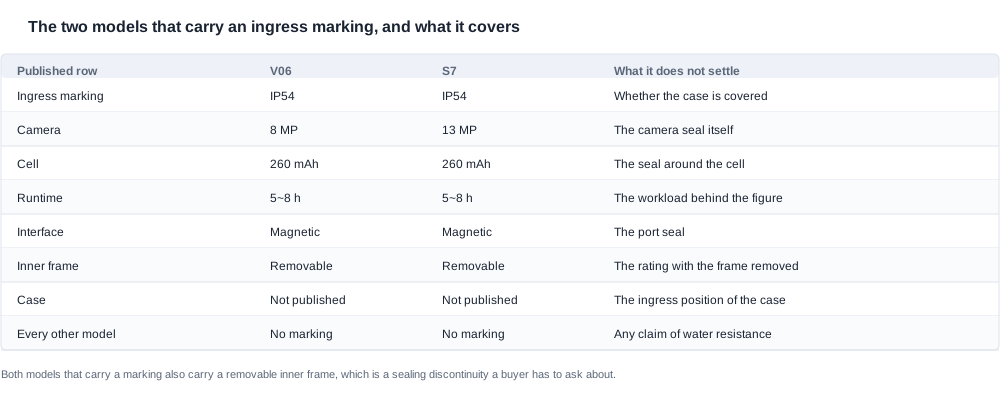
The published data is narrow, and the narrowness is the point. Two of the twenty-eight catalogue entries carry an ingress marking and the other twenty-six do not. The V06 and the S7 are the sport platforms, and both are listed at IP54.
The published rows for those two models are otherwise ordinary. The V06 is an 8 MP camera model with a 260 mAh cell, a runtime quoted at five to eight hours, a magnetic charging interface and a charge time of two hours or less. The S7 is the 13 MP version of the same platform family, with the same cell, the same runtime range and the same magnetic interface. Both are published with an ergonomic design, both are published with a removable inner frame, and the V06 is published with a feature described as extra-long battery life and with four colour options, while the S7 is published with a 13 MP figure described as high-definition.
Two observations follow from that, and they are the reason an ingress rating matters to a buyer rather than being a line on a spec sheet.
The marking and the removable inner frame sit on the same product. Both IP54 models are published with a removable inner frame. A removable part is a place where the enclosure is opened by the user, and an ingress rating is a statement about the enclosure. The commercial question is therefore not whether the product has a rating, it is whether the rating was established with the inner frame in place, and what the condition is if it is removed. A buyer who does not ask this will discover it from a return log, and a buyer who does ask it will find that the answer is specific and testable. The removable frame is exactly the kind of detail that separates a defensible claim from a borrowed one.
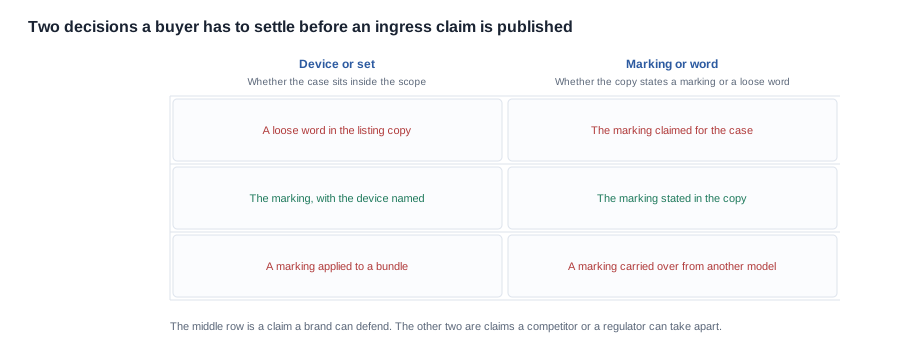
The catalogue's own label is a shorthand. Both models are described with a waterproof label alongside the IP54 marking. The marking is the precise statement; the word is a marketing convenience that sits above it. IP54 is a dust-protected rating with protection against splashing water from any direction. It is not a submersion rating, and it does not cover a unit left in a sink, dropped in a puddle or held under a tap. A buyer who copies the word instead of the marking inherits a claim that is wider than the evidence, and the difference between those two states of the same product is where a returns reserve lives.
The rows that are not published for these two models are just as important. The ingress position of any charging case is not published. The V06 and the S7 are published without a case in their rows, so a buyer who puts one in the box is adding a second object with its own, unpublished, ingress position, and the set is only as protected as the weakest part of it. The sealing of the camera, the cell bay, the charging contacts, the buttons and the microphone openings is not published as a set of details. The number of samples tested, the test date and the standard used are not published; they live in the test report, which is a document the buyer can request.
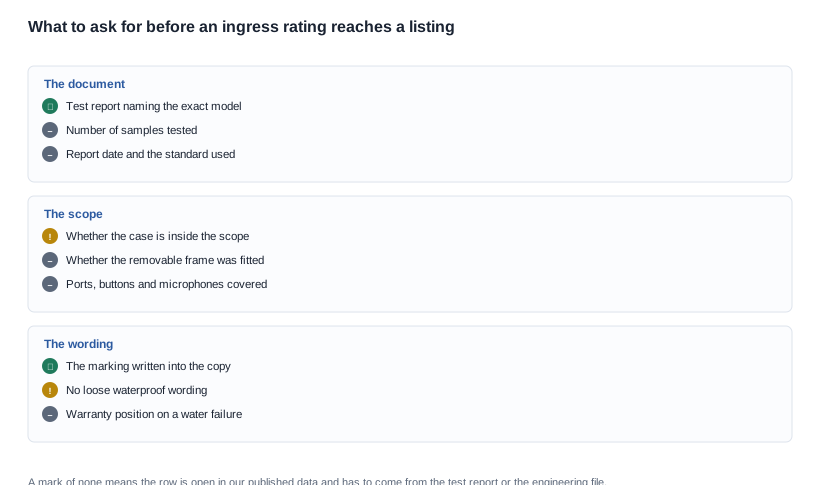
One warning applies to any comparison a buyer makes across suppliers. Ingress figures are not directly comparable between products, and the reason is usually the test configuration rather than the quality of the seal. A rating established on a sample in a laboratory, on a specific build, with a specific number of units, in a specific orientation, is a statement about that build under that procedure. A rating established after a production change, on a different number of units, or with a different accessory fitted, is a different statement. The threshold to hold is a report that names the model, states the standard and the procedure, and gives a date, so that the buyer can tell whether it still describes the units in the current order.

Eight questions that settle what a marking actually covers
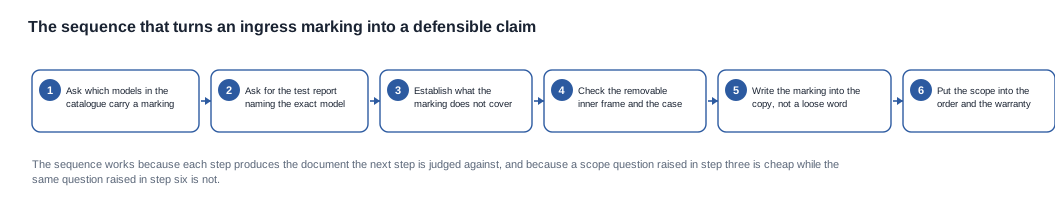
The order matters, because the first three questions decide whether there is a claim to make at all, and the last three decide how the claim is written and defended.
Before you order, the ingress checklist is short: the report, the model designation it names, the configuration it covered, the removable frame condition, the case position, the permitted wording and the warranty scope. How to compare two quotations that both carry a marking is to lay those rows out in the same order before any number is compared, because the trade-off between a lower unit price and a narrower documented scope is invisible until the rows sit side by side. The red flags worth naming are a marking with no report behind it, a report with no model on it, and a listing that uses a word the scope does not support. Those three are the usual pitfalls in an ingress programme, and all of them are cheap to close at quotation stage and expensive to close after the packaging is printed. Which model a brand ends up listing is decided by which of the three it refused to accept.
- Which models in the range carry an ingress marking, and what is the marking for each of them?
- Can you provide the test report, with the model designation it names, the standard used, the date and the number of samples tested?
- Was the unit tested in the configuration it ships in, including the inner frame, the accessories and the packaging?
- Which parts of the enclosure were sealed for the test, and which were not part of it?
- Does the marking hold if the removable inner frame is taken out and put back in, and what is the stated condition?
- What is the ingress position of any charging case or accessory supplied in the box?
- Which words may the listing use, and which may it not use, given the scope of the report?
- What is the warranty position on a unit that fails after immersion, and who pays for the assessment?
Verifying an ingress claim comes down to asking for the report, reading the model designation on it, and comparing that string with the model on the order. That single comparison is the check that catches a rating inherited by a variant, and it takes a minute.
Question two is the one that separates a rating from a rumour. A number without a report is a marketing claim that a buyer will have to defend alone, and a buyer who has to defend it alone will end up narrowing the claim, usually after the artwork is approved and the packaging is printed, which is the most expensive time to do it.
Question three is the one most often skipped, and it is the one that determines whether the report describes the product. A test performed on an early sample with a different accessory, a different inner frame or a different production configuration describes that configuration. The gap between the tested build and the shipped build is where a compliance dispute is found, and it is cheap to close while the report is still being requested.
Question five is the question specific to these two models, and the answer is worth more than a general sealing statement, because it covers the discontinuity the catalogue itself publishes.
Question seven is a commercial question disguised as a legal one, and the practical answer is to write the permitted wording into the claim register before the artwork is released. A brand that has a claim register can answer a marketplace review in an afternoon. A brand that does not has to reconstruct the position from an inbox.
Question eight is the warranty question, and it should be settled before the first unit rather than at the first claim. A unit that was submerged and failed is a different object from a unit that was rained on and failed, and if the marking only covers the second, the warranty position has to say so.

Where ingress claims fail in the channel
The copy that outran the marking. The symptom is a marketplace review, a competitor's comparison or a corporate procurement questionnaire that points at the word in the listing and asks for the supporting document. The root cause is that the word was written from the catalogue shorthand rather than from the marking. The control is to write the marking into the copy and to keep the claim register current.
The accessory that was not in the scope. The symptom is a returns cluster from customers who used the product with the case in the box and then treated the set as a single protected object. The root cause is that the case's ingress position was never asked for and never published. The control is to request the case position and, where it is not published, to state the limitation rather than to imply a set rating.
The removable frame that was not in the test. The symptom is water-related failures concentrated in a group of users who removed the inner frame, which is a subset of the user base that is hard to spot in a returns log because the failures are distributed. The root cause is that the sealing discontinuity was never raised as a question. The control is to ask question five, and to put the answer in the packaging and the product page if the answer is conditional.
The rating that was inherited by a variant. The symptom is a product in a different colour or with a different accessory that carries the same marking without a report behind it. The root cause is that a family-level document was treated as coverage for a specific configuration. The control is to make the exact model designation a condition of the purchase order and to check the string on the units on receipt.
The channel that sold a product with no marking at all. The symptom is a return pattern that nobody could explain, because the listing had implied a level of protection the product never had. The root cause is that the range was assembled for the general category rather than for the marked models, and the unmarked models inherited the wording. The control is to build the range around the two models that carry a marking and to let the rest of the range speak for itself.
The failure that was never a water failure. The symptom is a unit returned as damaged by water when the actual cause was a seal unrelated to ingress, or a condensation effect inside the enclosure. The root cause is that a single warranty description covered several different physical causes. The control is to separate the failure descriptions in the returns process, because the ingress data is only usable if the failure data is honest.
An ingress rating is an ordinary line in a specification, and none of these considerations is grounds for changing supplier. They are reasons to write the scope of the marking into the copy, the order and the warranty, and those three documents are the whole defence.
What is fixed about an ingress rating, and what is still open
The total cost of an ingress programme is the test plus the claims discipline plus the artwork plus the packaging plus the returns reserve, and only the first of those appears anywhere in a quotation. A due diligence question asked of a supplier is therefore worth more than a small unit price concession, because the answer determines how wide the claim can be, and how wide the claim can be determines how much of the returns reserve the programme actually needs. The test is a one-off against a specific build, and its cost sits inside the engineering budget. The cost sits in the claims discipline, the artwork, the packaging, the returns reserve and the review handling, and all five are decisions the brand makes.
The parts of this decision that genuinely move are worth naming. The market list is negotiable, because a channel that sells only into markets where the existing conformity scope already covers the product is a cheaper programme than one that requires new testing. The wording of the claim is negotiable in the sense that a narrower claim is available: IP54 in the copy instead of a waterproof word is not a cost reduction, it is a risk reduction, and it is worth more than a small price concession. The artwork round count is negotiable and each round is a week, so one extra round at the start for the compliance wording is cheaper than a reprint. The returns reserve is negotiable, because the reserve is priced off the failure mix and the failure mix is a consequence of the claim. The number of configurations that carry the marking is negotiable in the sense that a programme can be scoped to the two models that have one.
The parts that do not move are equally worth naming. The test result for a given build is a fact, and pressing on it produces a longer schedule rather than a shorter one. The sealing design of the enclosure is an engineering decision, and a change to it is a new build with a new test. The removable inner frame is a product feature with a commercial purpose, and it is not a variable to be dropped to make a rating cleaner. And the wording of a claim is not negotiable with a test laboratory, only with a compliance review.
The documents worth collecting before the deposit are: the test report with the model designation it names, the standard and the procedure, the date and the number of samples tested, the configuration tested, the list of parts inside the tested scope, the stated condition for the removable inner frame, the ingress position of any supplied case or accessory, the approved claim wording, and the warranty position on a water-related failure.
The clauses worth writing into the purchase order are: the model designation that carries the marking as a named configuration field, the marking itself with the scope it applies to, a clause requiring notice before any change of the enclosure, the inner frame, the accessory set or the sealing method because each of those invalidates the report, a clause requiring the documentation pack to be reissued for such a change, the approved claim wording attached to the order, and a warranty scope that distinguishes a failure within the rated condition from a failure outside it.
On our own side, the boundary is this. We publish the ingress marking for the V06 and the S7 because it is in our documentation, and we publish the cell, the runtime, the camera figure, the interface and the removable inner frame for both. We do not publish the test report, the test date, the number of samples, the list of sealed parts, the condition for the inner frame, the ingress position of any case, or any marking for the other twenty-six models in the range. We will not infer a marking for a model that does not have one, and we will not turn a marking into a waterproof claim, because the marking is the precise statement and the word is not. A buyer who asks for the report gets it; a buyer who accepts a catalogue label gets a label.
Send the models, the quantities, the target markets and the claims you intend to make, and we will tell you which configurations carry a marking, which of the scope questions above are answered by our published rows, and which have to come from the test report. If the claim you want to make is wider than the marking supports, we will say so before the artwork rather than after the first season in the field. The IP ratings and durability page covers what the digits permit, and the IP rating myths article sets out the claims a marking does not support, which is the shorter list than most buyers expect.
Related reading


