
Kids eye protection glasses technology: the word is a claim, not a specification
Why the word protection is a claim rather than a specification
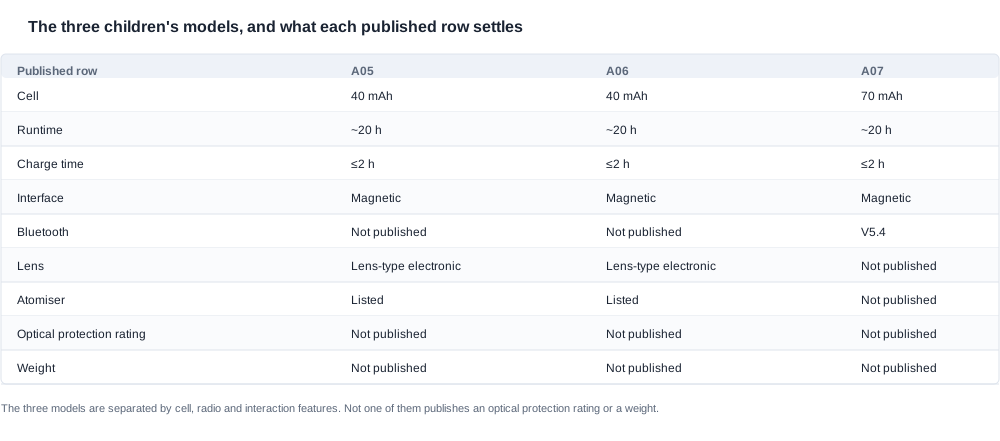
The three children's models in our catalogue are separated by their cell, their radio and their interaction features. None of them is separated by an optical specification, because none of them publishes one. There is no published lens material, no light-transmission figure, no ultraviolet figure, no protection class and no weight for the A05, the A06 or the A07, even though the product name itself carries a word that a buyer cannot source, test or defend from the published data. That makes this category different in a way that has nothing to do with engineering. In an adult smart-glasses programme the hard part is getting the specification right; in a children's programme the hard part is keeping a claim inside what the evidence supports, and doing it before the artwork, because the two boundaries in this category are the claim about what the product does for a child's eyes and the per-market conformity route for a product intended for children. We publish the electrical rows. We will not publish an eyesight benefit we cannot evidence, and a buyer who plans a children's line should plan on the same basis.
The three requests that bring a children's line to a buyer
The reader is a brand-side product owner, a channel buyer building a children's range, or a category manager who has been asked why this category is treated differently. The situations that produce the question are recognisable.
The first is a retail buyer who has been asked for a children's line by a partner or by a channel, and who is now trying to work out whether the regulatory surface is worth it. The second is a listing review. A product page has been drafted using the wording from the product name, and a reviewer has asked what the product actually does. The third is a corporate or institutional buyer with a procurement questionnaire, where a school, an employer or a healthcare-adjacent organisation is asking for a product for a specific age band and wants a written answer about what the product does and how it is tested. The fourth is a returns log in which the reason given is that nothing happened, which is the sound of an expectation that was set by the name rather than by the description.
The fear underneath all of these is specific. It is a claim about children's eyesight that a regulator, a marketplace or a journalist later treats as a medical claim, and a product that is withdrawn from a channel it was never meant to be in. It is also a conformity failure in one market that stops a multi-market shipment, because children's products are tested per model and per market rather than per family, and a company-level capability is not a certificate for a particular product. And it is a reputational cost that has nothing to do with the unit price: this category is the one where a careless sentence travels furthest.
It is your place in the chain that decides what you can move. A brand owner controls the claim, the artwork, the market list and the age band, which is most of the risk. A channel buyer controls only the purchase order, so the claim and the conformity route have to be written into the order as conditions. A distributor carrying the same brand across territories has to be certain the product is presented identically in each one, because a children's product described inconsistently is a children's product that will eventually be described in the wrong way.

The three children's models, and what their published rows actually settle
The published data for the children's models is short, and it is worth reading closely because what it does not say is the programme.
The A05 and the A06 publish identical rows. Both are listed with a 40 mAh cell, a runtime quoted at around twenty hours, a charge time of two hours or less, a magnetic charging interface, a lens-type electronic component and an atomiser, together with the paired labels for correct and incorrect posture and distance and for a clear and an atomised lens. The A07 is listed with a 70 mAh cell, the same runtime of around twenty hours, the same charge time, the same magnetic interface, and a published Bluetooth version of V5.4. No Bluetooth version is published for the A05 or the A06.
The first thing a buyer should take from that table is what it does not contain. There is no optical protection rating for any of the three, no lens material, no light-transmission figure, no ultraviolet figure, no protection class and no weight. The catalogue's export certification page carries images rather than text and states no certification position in words, and it is not a per-model certification row, so no buyer can infer a certification status for the A05, the A06 or the A07 from it — and the catalogue text names no CE, FCC or RoHS against the adult products either, so there is nothing on the page a buyer could infer from in the first place.
The second observation is about the power figures, and it explains the shape of the range. A 40 mAh cell with a quoted runtime of around twenty hours is a duty-cycle number, and it only makes sense for a product that is active for minutes at a time rather than for hours. That is consistent with the published feature set, which describes a reminder and an interaction rather than continuous audio or imaging, and it is consistent with the absence of a radio on the A05 and the A06. The A07, with a 70 mAh cell and a published Bluetooth version, is the configuration where the child is expected to be connected. For a buyer, the practical consequence is that the three models are three different products with three different bill-of-materials and three different conformity scopes, and a range that presents them as colour variants of one product is presenting them wrongly.
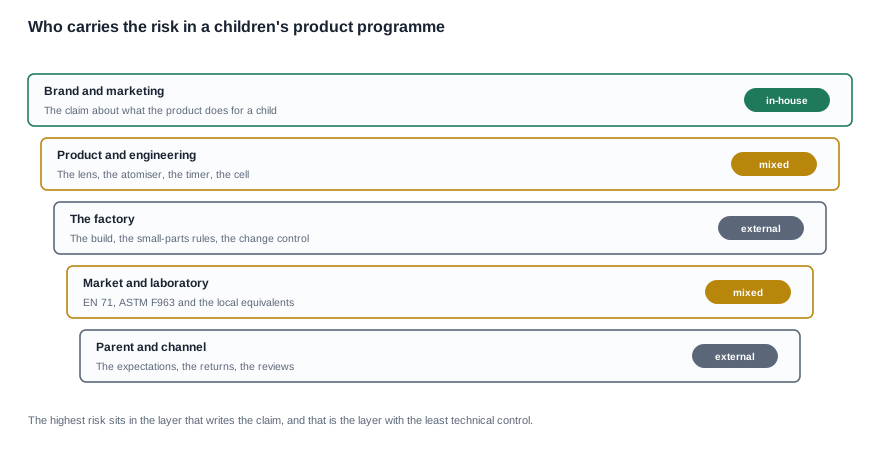
The third observation is the one most buyers find uncomfortable. The published data does not distinguish the A05 from the A06 at all. The two model designations publish the same cell, the same runtime, the same interface and the same feature labels. If the two models exist for a reason, that reason is not in the published data, and a buyer who has ordered both needs to ask what the difference is, because the answer affects the certification scope, the artwork, the packaging and the minimum order quantity for each.
One warning applies to the whole category. Published rows from different suppliers are not directly comparable, and the reason here is the same as everywhere else: the measurement and the scope, not the product. A runtime quoted without a duty cycle, a charge time quoted without a starting state, or a protection figure quoted without a method and a test configuration is a number from a different test than the one the buyer is planning. And the published rows in this category are not directly comparable across markets either, because a children's product is tested against the rules of the market it is sold into.

Nine questions a children's programme has to answer before the artwork
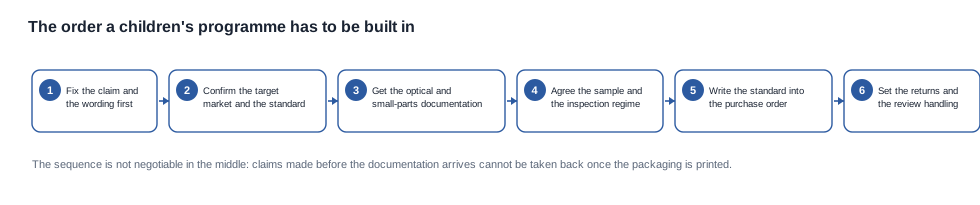
The order is deliberate. The first two decide whether the product can be described in the way the channel is expecting, and everything after them is engineering and logistics.
- In one sentence a customer could read, what does the product actually do?
- What is the optical specification, meaning the lens material, the light transmission and any ultraviolet figure, and is that published or measured?
- Which market is the first one, and which children's product standard applies there?
- Is the conformity documentation per model, and does it name the model designation on the document?
- What are the weight and the dimensions, including the smallest part that could come loose, and what are the rules for that market?
- What is the cell arrangement, the charging arrangement and the magnet content, and does the arrangement comply with the rules for that market?
- What small-parts and magnet documentation exists for each destination market?
- What will the listing say, and what will it explicitly not say?
- Who owns the technical file, and what happens to it if the brand and the factory part company?
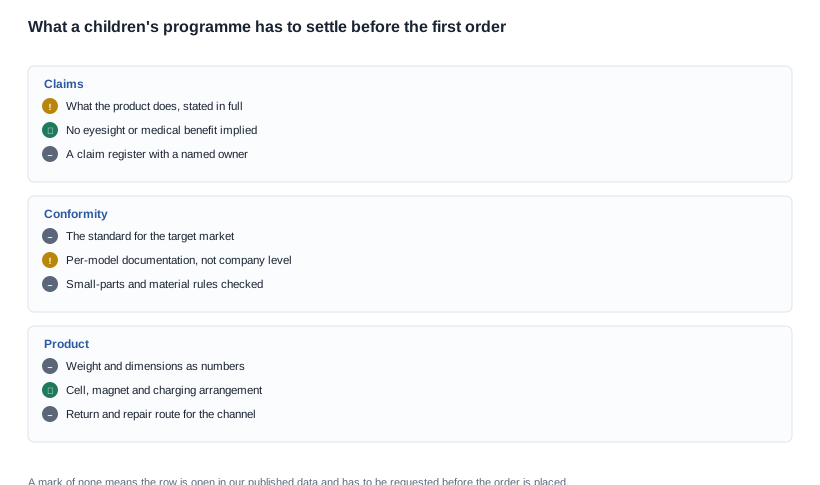
Before you order, the children's checklist is short: the one-sentence description, the optical specification or a written statement that it is not published, the target market and its standard, the per-model documentation, the weight and the small-parts dimensions, the magnet and cell documentation, the permitted wording, and the technical file ownership. How to compare two quotations in this category is to lay those rows out in the same order before any number is compared at all, because the trade-off between a lower unit price and a wider conformity scope per market is invisible until the rows sit side by side. The red flags worth naming are a claim with no document behind it, a company-level certification treated as a product certificate, and a product page that borrows a phrase from the product name. Those three are the usual pitfalls, and a buyer who has closed them at quotation stage has already saved the cost of a reprint.
Question one is the one that decides the programme, and the discipline it demands is simple: the sentence has to be true of the product and supported by a document. A claim about what the product does for a child's eyesight is not available, because our published data contains no optical protection figure for any of these models, and because a claim that cannot be evidenced is a claim that cannot be defended. The rule that applies is a general one and it is not negotiable in this category: no statement about preventing, reducing or correcting a condition of the eye, and no statement that could be read as a medical effect. In the United States the device framework in 21 CFR 800.30 turns on intended use, which is exactly why a phrase in a product name can put a product into a regulatory category that the engineering never intended.
Question three is the one that determines the cost of the programme, and it should be answered before the quotation is compared rather than after. The children's product requirements are not the same in every market. In the European Union the relevant framework is EN 71, and in the United States it is ASTM F963 together with the Consumer Product Safety Commission rules. Neither is a formality, and neither is covered by a certificate that belongs to a different model.
Question five and question six are the two that most often turn into a surprise in this category. The small-parts and magnet rules are specific to the destination market, and they apply to the product as shipped rather than to the model as designed. The A05, the A06 and the A07 all use a magnetic charging interface, and a magnetic arrangement in a product intended for children is a documentation question in every market that regulates it.
Question eight is the one that protects the brand, and the mechanism for it is a claim register: a single document in which every phrase about the product in every listing, every package and every sales script is recorded with the evidence behind it and a named owner. A brand with a claim register can answer a review in an afternoon. A brand without one reconstructs the position from an inbox while a marketplace listing is down.

Where children's programmes fail in the channel
The listing that implied an eyesight benefit. The symptom is a review, a complaint or a correspondence that quotes the product page back at the brand. The root cause is that the product name was copied into the copy and the name carries a word the evidence does not support. The control is the claim register, written before the artwork, with the wording reviewed by somebody whose job is to be difficult about it.
The company-level capability that was treated as a per-model certificate. The symptom is a shipment stopped in one market, or a marketplace asking for a document that names a model the document does not cover. The root cause is that an export certification page was read as a product certification. The control is to request the documentation for the exact model, and to treat the absence of it as an open row rather than an assumption.
The two models that were presented as one. The symptom is a channel that stocks one of the A05 or the A06 and discovers, at the artwork stage, that the other model has a different conformity route. The root cause is that the published data does not distinguish them, so nobody asked. The control is to ask question one from the previous list about the difference, in writing, before both are added to the range.
The product sold for a use it was not designed for. The symptom is a returns cluster with a reason of "it did not do anything". The root cause is an expectation set by the category rather than by the description, usually in a listing that borrowed a phrase from an adult product. The control is to write the expectation into the product page, the packaging and the support script at the same time, and to make the return reason in the channel specific enough to be measurable.
The market that required a standard the programme did not cover. The symptom is a launch in one territory that slips while the units for another territory are ready. The root cause is that the market list was decided at the commercial level and the conformity scope was checked afterwards. The control is a market list in the agreement, with the conformity status for each market recorded against it.
The technical file that belonged to the wrong party. The symptom is a product that cannot be re-certified when the brand changes supplier, or cannot be supported when a question arrives. The root cause is that ownership was never written down. The control is to establish ownership and transfer terms before the first order, which is far easier to agree before anyone depends on it.
Nothing in this list is unusual in children's eyewear, and none of these points is a reason to change supplier. Each one is a document or a clause, and every one of them is cheaper to put in place before the first order than to correct after a listing is withdrawn.
What we publish for the children's models, and what we will not say
The total cost of a children's line is the tooling plus the per-model testing plus the artwork plus the returns reserve plus the review handling, and only the first and the last of those appear in a quotation. A due diligence question asked of a supplier before the order is therefore worth more than a unit price concession, because the answer determines how many markets the programme can enter and how much of the returns reserve it needs.
The commercial terms of this category are unusual in one respect, and it is worth separating the parts that move from the parts that do not.
What moves in a negotiation is the market list, the number of models in the range, the artwork round count, the sample and inspection regime, the returns and repair route, and the ownership terms for the technical file. The market list is the largest of these by a wide margin, because every additional destination market potentially adds a per-model testing obligation. The number of models in the range matters more here than in an adult programme, because each model is a separate conformity scope rather than a variant under one scope. The artwork round count is worth protecting, because the claim wording is exactly the kind of content that needs a compliance read, and a read after the print run is a reprint.
What does not move is the standard that applies in a given market, the small-parts and magnet rules, and the cost and time of the testing itself. Those are fixed per model and per market, they sit in a queue at the test laboratory, and pressing on them produces a longer schedule rather than a shorter one. The optical specification is also not a commercial variable: either the product has a published or measured figure or it does not, and in our range it does not, for any of the three children's models.
The documents worth collecting before the deposit are: the per-model conformity documentation naming the model designation, the optical specification or a written statement that it is not published, the weight and the dimensions as numbers, the small-parts assessment for each destination market, the magnet and cell documentation, the approved claim wording for each market, and the technical file ownership terms.
The clauses worth writing into the purchase order are: the claim wording as a named condition of the order, an explicit statement that no eyesight benefit is represented, the model designation on the order so the documentation follows the product, the market list with a conformity status against each entry, the technical file ownership and transfer terms, a clause requiring notice before any change to the cell, the charging arrangement or the enclosure because each of those invalidates the documentation, and a returns and repair route the channel can be given.
On our own side, the boundary is deliberate and we will state it plainly. We publish the cell capacity, the runtime, the charge time, the charging interface and the Bluetooth version for the A05, the A06 and the A07, and we publish the feature labels exactly as our documentation states them. We do not publish a per-model certification status for any of the three, and we will not infer one from the export certification page on the company's own material, because that page carries images rather than text and states no certification position for any product. We do not publish a weight, a dimension, a lens material or an optical protection rating for any of the three. And we will not make a claim about what the product does for a child's eyesight, because we hold no figure that would support one, and because the claim would put the product into a category that neither the brand nor the factory intended.
That is the honest version of why this category is different. The engineering in the three children's models is straightforward, the published rows are straightforward, and the programme risk sits in two places that have nothing to do with the cell or the radio: the claim about the product, and the conformity route for each market. Send us the markets, the age band, the claims you intend to make and the quantities, and we will tell you which configurations exist, which of those two questions our published rows already settle, and which of them have to be answered before the first order rather than after the first listing. The published parameter set sits in the technology pillar, and the certification requirements by market article sets out what each market's framework actually asks for.
Related reading


