

Will they fall off while running faq has an answer with three parts, and the honest version of it is more useful than the reassuring version. A frame that stays on during a run is held on by geometry, friction and the way its mass is distributed — never by anything electronic. Any product in this category can be made to stay on through a normal run by that mechanism alone. What the mechanism does not do is survive a head that is a different size, a temple that has been bent, a sweat-soaked strap, or a lens that has been swapped for a pair with a different curve. Those four conditions are where the answer changes, and they are conditions you can specify before the order rather than discover afterwards.
Our own published material settles part of this and leaves the rest open. We publish an ergonomic-design row on two camera models, a detachable-inner-frame row on the same two, a flexible-temple row on one, an ultra-slim detachable-temple row on one audio model, and a single weight figure in the entire range. We publish no retention force, no temple adjustment range, no head-size band, no material specification and no drop-test result for any model. That is the boundary of the answer, and the rest of this page sets out how to work around it with a specification and a test rather than with reassurance.
Will they fall off while running: the buying task and what the range publishes
Who is asking, and what they are defending
A brand owner scoping a running or fitness channel is not asking about a physical outcome; they are asking whether the product creates a returns problem and a review problem. A unit that comes loose mid-run generates a review that names the product, and that review sits in the channel permanently. The buyer therefore needs a defensible statement about retention before the first listing goes live.
A procurement manager is holding quotations from two or three suppliers and needs to compare them on the same basis. Retention is rarely quoted as a number, which means the comparison has to be built out of configuration questions — what is published about the temple, about adjustability, about weight — and those questions have to be identical for every candidate.
A channel buyer writing the product copy needs to know which sentence survives a customer who has actually run in the product. "Designed for sport" is a category description. "Stays on through a run" is a performance claim that has to be earned on a specific configuration, and the buyer needs to know the boundary before the copy is written rather than after it is published.
All three are asking the same underlying question in different registers: what is published, what is not, and what do I have to obtain in writing.
The two families a buyer will be comparing are not the same purchase. Our audio range and our sport range carry different published rows, so the shortlist has to be built with separate criteria for each rather than with one comparison table. The running channel note sets out how the sport group is used in practice, and the range note on frame geometry and clearance covers the temple and sizing questions that sit underneath the retention question. A procurement manager who compares the two families on one axis is evaluating the wrong axis, and a supplier who quotes only one of them is quoting half the file.
The published rows that bear on retention
Four rows in the catalogue touch on how a frame sits on a head. They are worth quoting precisely, because they are the whole of the published position.
An ergonomic-design row appears on two camera models. The V06 and the S7 both publish an ergonomic-design row, and both publish a detachable-inner-frame row. Neither of the two is an audio model. They are sport camera models, and the rows are the closest the catalogue comes to a statement about how a frame is shaped to sit.
A flexible-temple row appears on one model. The V03 Pro publishes a flexible-temple row alongside a colour-change lens row and a Type-C charging-port row. A flexible temple is a published feature of that configuration; it is not a published retention figure, and the catalogue does not say how far it flexes or what happens after it has been flexed many times.
Two audio models publish a temple-geometry row. The G07 publishes an ultra-slim, detachable-temple row and the YK12 publishes a slim-temple row. Slimness is a published fact on both, and slimness is genuinely relevant to retention, because a temple that is too wide or too thick for the side of the head simply cannot sit where the design intends.
One weight figure exists in the whole range. The MT6 publishes 158 g, and that figure covers the glasses body — the frame with its 265 mAh cell and its camera — and not the folding charging case, which is a separate 1200 mAh item with its own unstated weight. This is the only published weight for any product in the catalogue. No bare frame weight is published for anything, and no other model carries a weight at all, which means the mass comparison a buyer would want to make cannot be completed from the published rows.
Two models carry an ingress-protection row, and neither is an audio model. The IP54 marking appears on the V06 and the S7 only. The sport audio group — the D17, the ZH12 and the YKC02 — carries no ingress row, no material row and no sweat or corrosion row of any kind.
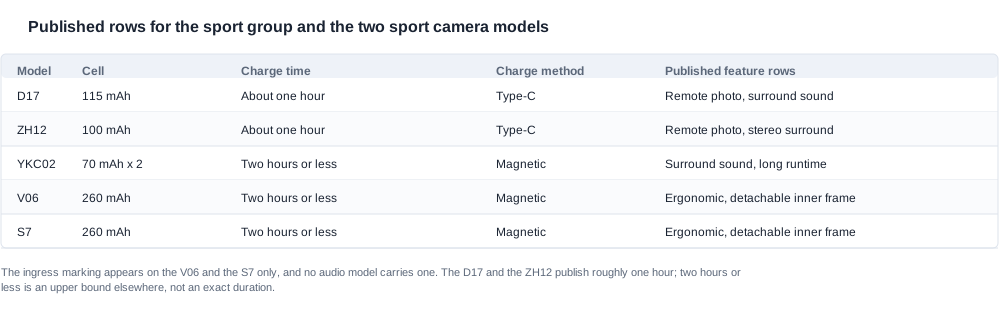
What is published about charging and runtime in the sport group
The sport group has a genuinely distinctive published profile. The D17 publishes a 115 mAh cell, a charge time of roughly one hour, a rated runtime of about seven hours, Type-C charging, and feature rows for remote-control photo capture and surround sound. The ZH12 publishes a 100 mAh cell, a charge time of roughly one hour, a rated runtime of about eight hours, Type-C charging, and feature rows for remote photo capture and a stereo surround-sound line. The YKC02 publishes two a charge time of two hours or less, 70 mAh cells, a rated runtime of about eight hours, magnetic charging, and surround-sound and long-runtime feature rows.
Two of the three publish roughly one hour for charge time; every other model in the range publishes two hours or less, which is an upper bound rather than an exact duration. For a channel where units are issued, used and returned within the same day, that difference is not a specification detail. It is the difference between a unit being available again in a lunch break and a unit being unavailable for the rest of a shift.
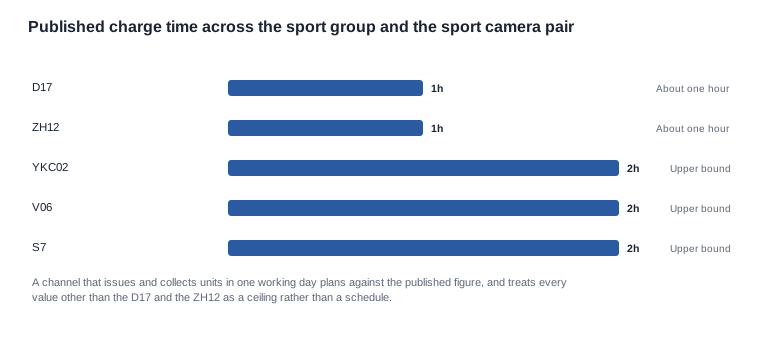
Retention force, temple range, and the mass of every other model
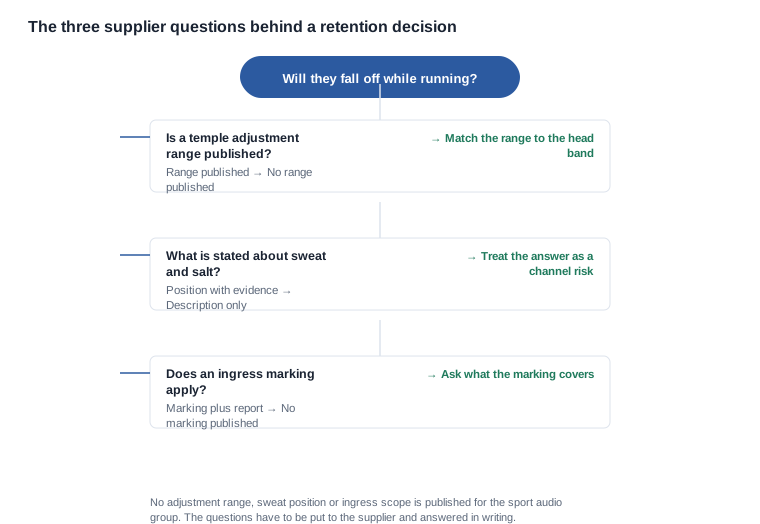
Here is the complete list of what a retention decision would want and the range does not contain: retention force at the temple; the temple adjustment range; the head-size band the product is designed for; the temple material and any grip element; the mass of every model except the MT6 glasses body; drop-test results; sweat, salt-water or corrosion behaviour for any model; whether the ingress marking on the V06 and the S7 covers the assembled product or a part of it; and any statement that a specific model is intended for running.
There is also a control-surface gap that belongs in this file. No model in the range publishes a capacitive touch row. The only control row anywhere is a button-control row on the AR entry, paired with an indicator-light row. So the mechanism a buyer would normally expect to find on a sport product — a physical or touch control reachable without taking a hand off the temple — has no published basis in the catalogue.
The three-part answer, stated plainly
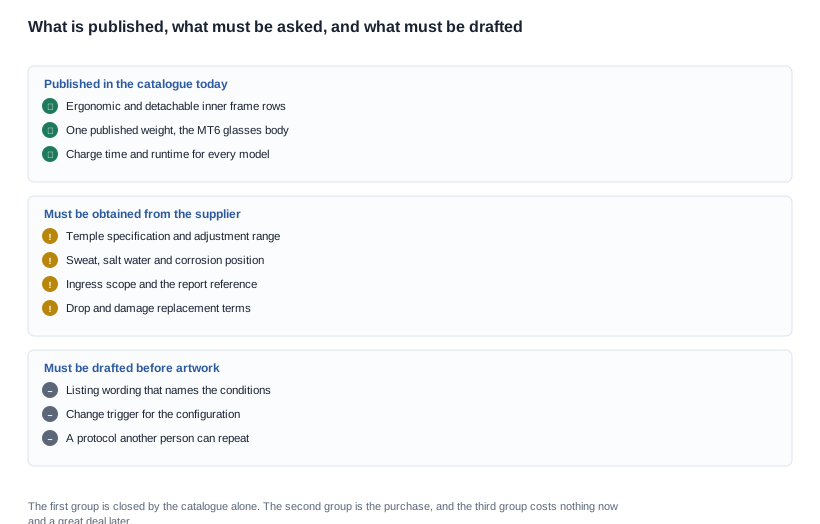
Published. The ergonomic-design and detachable-inner-frame rows on the V06 and the S7; the flexible-temple row on the V03 Pro; the ultra-slim detachable-temple row on the G07; the slim-temple row on the YK12; the 158 g MT6 glasses-body weight; the ingress marking on the V06 and the S7 only; and the complete cell, charge-time, runtime, charge-method and Bluetooth rows for the three sport models.
Not published. Retention force, adjustment range, head-size band, temple material, weight for every other model, drop results, sweat and salt behaviour, and any sport-use designation.
To be asked of the supplier. The temple specification and adjustment range for the exact configuration quoted; the material and any non-slip element; the sweat and salt-water position; the ingress scope of the marking if one is claimed; and the drop and damage terms that will apply to the unit.
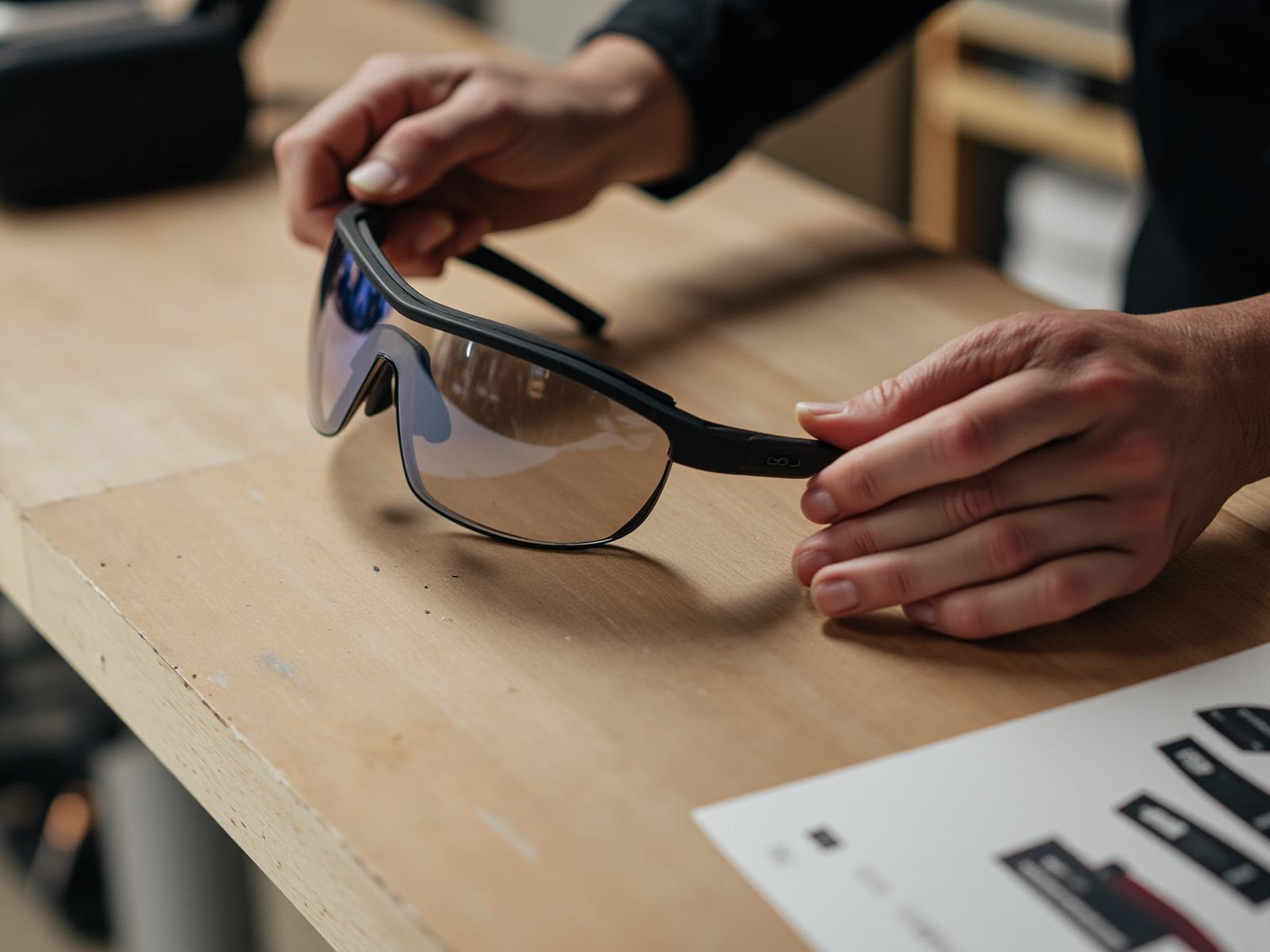
Will they fall off while running: the three mechanisms and the four conditions that break them
Mechanism one, where the mass sits
Retention in this category is mostly a question of mass distribution. A product whose mass sits along the temples and close to the head generates little rotational leverage; a product with a heavy module hanging in front of the face generates a lot of it, and rotational leverage is what lifts a frame during a stride cycle.
The catalogue gives you exactly one published mass figure, and it belongs to a camera model with a 265 mAh cell and a camera built into it — the MT6, at 158 g for the glasses body. That is the heaviest published configuration in the range and it is informative for a different reason: it shows the category's heavy end, and it shows that the range does not treat a front-mounted camera as a reason to make the frame heavy. It also shows the caution, because the folding charging case that goes with that model adds mass in a pocket rather than on the head, and the case weight is not published.
The remaining models publish cell configurations that vary widely — 40 mAh, 55 mAh, 70 mAh, 90 mAh, 100 mAh, 115 mAh, 220 mAh, 290 mAh and multi-cell configurations of 55, 70 and 90 mAh — and cell configuration is the best available proxy for the mass of the powered section. It is a proxy, not a measurement, and a buyer should treat it as one.
Mechanism two, the temple contact
The second mechanism is friction at the temple against the side of the head. Its effectiveness depends on three things at once: the temple width against the head width, the temple profile against the skin, and the presence or absence of any grip feature.
Temple width is the variable a buyer can actually control, and it is also the variable most often left unstated in a quotation. The two published geometry rows — the ultra-slim detachable temple on the G07 and the slim temple on the YK12 — describe slimness without stating a width, so they narrow the question without answering it. If a channel serves a wide range of head sizes, the temple specification is the row that decides whether one product serves the channel or fragments it.
Profile and grip are not published for anything, which is why the supplier question below asks for a material and a grip feature rather than for a comfort description.
Mechanism three, the detachable parts
The third mechanism is the retention of the removable components, and it is the one most likely to be forgotten in a running channel because the failure is rare per unit and frequent across a channel.
The catalogue publishes detachable elements on four models in two different senses. The V06 and the S7 publish a detachable-inner-frame row, which describes an inner frame that can be taken out — and therefore replaced, which is a genuine advantage in a channel where prescription or fit variants exist. The G07 publishes a detachable-temple row. Those are different components with different failure consequences: an inner frame that releases is an inconvenience, and a temple that releases mid-run is an incident.
A buyer who is assembling a running channel should therefore ask separately about each removable element, what retains it, and what the replacement part and lead time look like. None of that is published.
The four conditions that change the answer
A head size at the edge of the adjustment range. The mechanism assumes the temple geometry accommodates the head. At the limit of travel, the contact force that produces friction is lower, and the frame can rotate. This is the single most common reason a product that works for one person fails for another, and it is why an adjustment range matters more than a marketing description of fit.
A temple that has been bent. The G07 publishes a detachable temple and the V03 Pro publishes a flexible temple, and both can be manipulated in ways the catalogue does not characterise. A bent temple changes the contact geometry permanently. Retention claims and temple claims belong to different parts of the file.
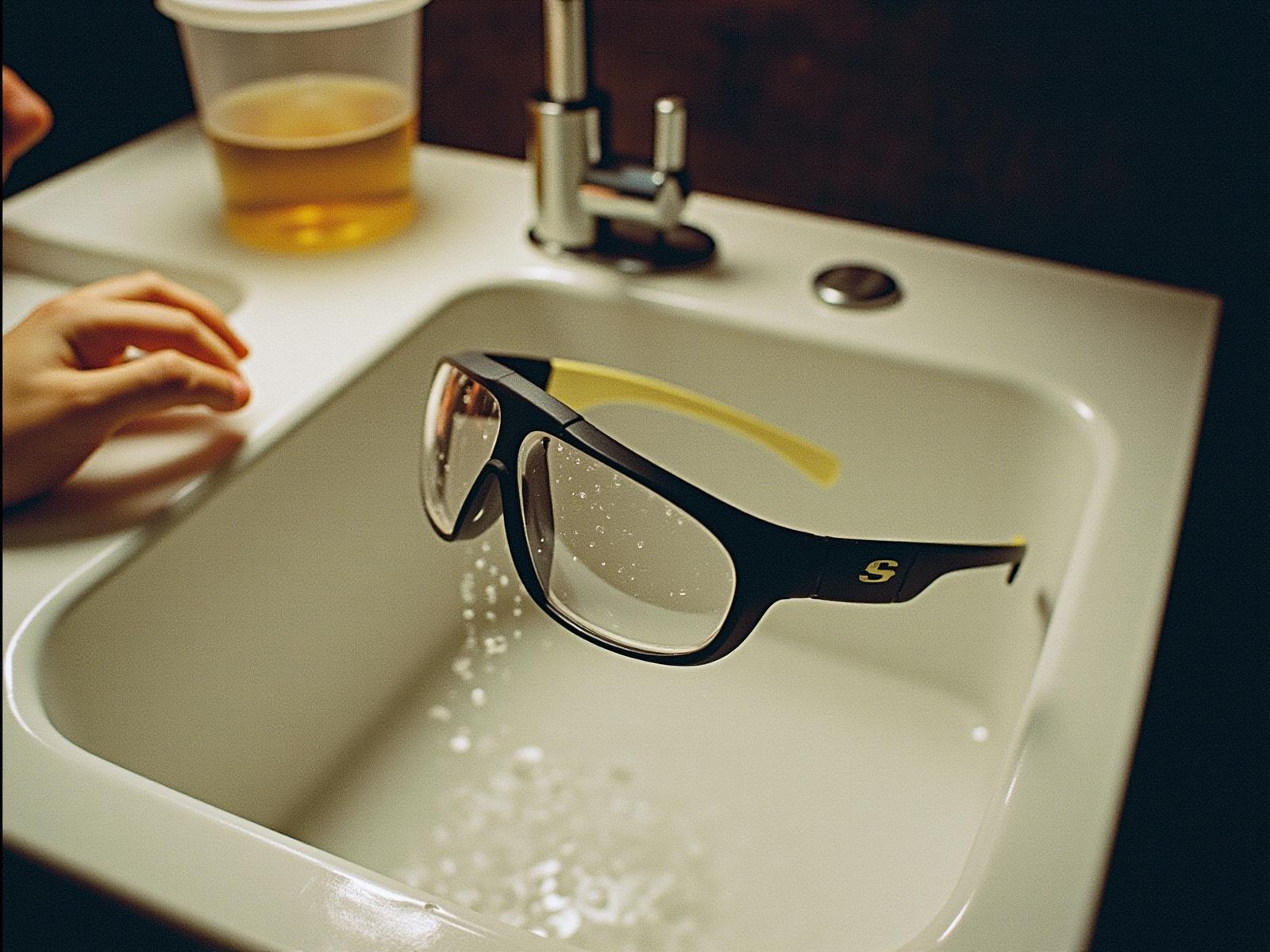
Sweat. Sweating changes friction and, over a period, changes surface condition. There is no sweat row for any model and no salt or corrosion row for any model. The two models that carry an ingress marking are camera models, and the sport audio group carries no protection row at all. A channel that operates outdoors in summer and recharges units overnight will generate returns that correlate with humidity, and nothing in the published material will explain them.
A lens or inner-frame change. Where a detachable inner frame exists, swapping it changes the geometry of the front of the frame and can change how the unit sits. A channel offering fit variants needs to know whether the retention figures — if any are ever obtained — survive the swap.
Will they fall off while running: a test you can run on samples
Retention is one of the few properties in this category that a buyer can test directly and cheaply, and it is a shame that so many programmes skip it. A test does not replace the published rows; it fills the gap those rows leave.
Building the test around the failure you are worried about
The first decision is what you are actually trying to find out, because a "does it fall off" test and a "does it stay comfortable over an hour" test are different experiments with different pass criteria. If the concern is a customer returning the unit because it came loose, the test is about displacement events. If the concern is a review complaining about pressure, the test is about contact force over time.
For the retention question, the displacement test is the relevant one, and it needs three axes of movement rather than the single forward bob that a casual test produces. A run cycle contains vertical oscillation, lateral rotation and fore-aft pitching, and a frame can survive the first while failing on the second.
The protocol
- Fix the configuration. Record the exact model, the unit identifier, the temple fitted and anything else that is not standard to that model. A retention result without the configuration attached cannot be reused.
- Establish the head size band you care about. If the channel serves a range, test at least one size at the narrow end and one at the wide end. A single head proves nothing about a channel.
- Run each movement axis separately for a fixed number of cycles, on a defined surface — treadmill, sprung floor, rubber — and record the number of cycles before any displacement event.
- Repeat with a sweat condition. This is the step most programmes omit and the one that changes the answer, because friction and grip both degrade with moisture.
- Exchange the units and repeat. As with any acoustic comparison, familiarity changes perception, and the second unit in the hand is judged more harshly than the first.
- Log every event in one table: unit, size, condition, axis, cycles survived, and what moved.

Interpreting the result honestly
A pass result from this protocol is a screening result. It says that a specific unit, on a specific head, survived a specific movement pattern a specific number of times, under a specific moisture condition. It does not say the product will not come loose, and it must not be written into a listing as though it did.
A fail result is more informative than a pass. A unit that fails on the lateral axis but survives the vertical axis tells you the geometry is marginal, and a supplier who can act on that feedback — a different temple, a different adjustment — has been given something actionable. Suppliers who receive a structured test result tend to respond better than suppliers who receive a complaint.
What to do with a result you cannot repeat
If your test cannot be repeated by somebody else — because the protocol is written in a notebook rather than in a document — then it is an anecdote with extra steps. The deliverable of the exercise is not the pass or fail; it is a protocol that another person can run and get the same result from, and that is what goes into the file alongside the supplier's own answer.
Will they fall off while running: where a retention answer goes wrong
The categorical claim
"They will not fall off" cannot be substantiated, cannot be reproduced and cannot be defended. It is the most frequently written retention sentence in the category and it is the one most likely to be challenged by the first customer who loses a unit on a bike path.
The replacement is a bounded statement: this configuration, this head-size band, this movement pattern, this moisture condition. It is longer, and it is the only version that remains true when a customer reports otherwise.
Treating an ergonomic-design row as a measurement
The ergonomic-design row on the V06 and the S7 is a descriptive feature label. It does not state a retention force, an adjustment range, a head-size band or a test method. A buyer who reads it as a performance figure is reading a marketing word as an engineering result.
The row is genuinely useful in a different way: it identifies the two models in the range where the supplier considered frame shape worth stating, and a detachable inner frame alongside it. That combination makes those two models worth evaluating first in a fit-sensitive channel — as a starting point for a test, not as a conclusion.
Assuming an ingress marking answers a sweat question
IP54 appears on the V06 and the S7 and nowhere else. It is easy to carry that fact across a range and end up describing a sport audio model as water resistant. The sport audio group — the D17, the ZH12 and the YKC02 — publishes no ingress row at all, and neither does any other model in the range.
Even where the marking exists, the buyer has two separate questions: what the marking covers, and what it does not. A marking on a frame does not necessarily describe a charging port, a microphone aperture or a seam between an inner frame and its housing. Ask for the scope in writing and ask for the report reference.
Comparing a camera model with an audio model as if they were alternatives
The V06 and the S7 carry a camera and carry an ingress marking. The D17, the ZH12 and the YKC02 are audio products with no camera and no ingress marking. A shortlist that mixes them without separating the questions is comparing a specification with a use case.
Separate the two files. The retention question applies to both. The sweat question has a published answer only for the camera pair. The capture question applies only to the camera pair, and it brings its own requirement — the remote-photo rows on the D17 and the ZH12 mean a running channel may need a physical shutter control, which interacts with the control-surface gap described above.
Sampling on one head
The most common methodological failure. One head is one data point, and if it is the head of the person who wrote the specification, it is a data point about the specification rather than about the market. Two sizes, one unit exchanged, one sweat condition — that is the minimum that produces a result worth filing.
Will they fall off while running: what to negotiate and what to write down
The retention position is not published, so it is bought. Four items are worth securing, and the order matters because the first makes the rest cheaper.
A temple specification with an adjustment range
Ask for the temple specification of the configuration quoted, expressed as an adjustment range rather than as a description. A range is a number you can match a channel against; a description is not. The question worth asking in the same breath is how the range is implemented — slides, interchangeable temples, or an elasticated fit — because an interchangeable temple has a replacement part and a lead time attached to it.
This single row also protects against a mismatch between what a customer is sold and what they receive. A channel with a fit promise has to know the band behind the promise, and that band has to exist somewhere other than in the copy.
A sweat and salt position
Ask what the supplier states about sweat, salt water and corrosion, and whether any statement can be supported by a test. Do not accept a general durability description in place of a position. A supplier who answers "we do not publish that, and here is what we can offer" has given you a stable position; a supplier who answers with a material description has given you a different material question.
The ingress scope, where a marking is claimed
Where the configuration carries an ingress marking, ask what part of the product the marking covers, what the test report reference is, and what happens to the marking if the inner frame is replaced or the temple is changed. A marking attached to a part does not automatically extend to an assembly.
The damage terms and the turnaround
Two commercial items attach naturally to a running channel. The first is what happens when a unit is dropped or damaged in use — the replacement terms, the evidence needed, the treatment of a unit returned with the temple deformed. The second is turnaround, and here the published rows give a genuine and usable distinction: the D17 and the ZH12 publish a charge time of roughly one hour, while the rest of the range publishes two hours or less as an upper bound.
For a channel that issues and collects units within a working day, that published difference should be in the quotation as a scheduling input, with the note that it is an upper bound rather than a guaranteed duration. It is one of the few places where the published rows translate directly into an operational number.
Drafting the listing sentence that survives a complaint
Agree the wording with the supplier before the artwork is produced, and keep it inside three categories. Architectural and configuration descriptions are safe. Published specification statements must match the catalogue rows exactly. Performance outcomes need a test behind them, with the conditions attached, or they do not belong in the copy.
A sentence that names the movement pattern and the configuration survives a complaint. A sentence that promises the unit will stay on does not, and it does not survive the first review either.
Will they fall off while running: a worked shortlist and the boundary of this answer
A hypothetical shortlist, run through the sequence
A brand owner is building a running channel and has three candidates on the table: a sport camera model that publishes an ergonomic-design row and a detachable-inner-frame row, a sport audio model that publishes roughly a one-hour charge time and a remote-photo row, and a general audio model with an ultra-slim detachable temple. The exercise illustrates the method; it does not select a product.
Step one, the published rows. The camera candidate is the only one of the three with an ingress marking, and the only one with a published ergonomic row and a detachable inner frame. The sport audio candidate is the one with the shortest published charge time and with a physical capture control. The general audio candidate is the one with a detachable temple and one of the narrower temple profiles published anywhere in the range. On paper the three are not substitutes for one another, and that is already the first finding.
Step two, the supplier questions. The same three questions go to all three suppliers: the temple specification and adjustment range for the quoted configuration; the sweat and salt position; and the ingress scope where a marking is claimed. One supplier answers the temple range with numbers and declines the ingress scope because no marking is claimed for that configuration. One answers the sweat question with a material description. One answers all three with documents.
Step three, the sample test. The three are tested under the same protocol at two head sizes with a sweat condition. The camera candidate survives the movement cycles but the test surfaces a question about the inner frame, which is exactly the kind of finding a sample run exists to produce. The sport audio candidate shows a difference between the dry and the damp condition, which makes the sweat question commercial rather than academic. The general audio candidate's narrow temple profile turns out to fit one of the two head sizes only, which is a catalogue-level fact that no row predicted.
Step four, the file. The shortlist is now separated into three different purchases rather than one, each with its own configuration, its own open question and its own wording decision. That is a usable outcome, and it was produced by the protocol rather than by the descriptor rows.
What this page can settle
What we can state. The published configuration rows for every model — cell, charge time, rated runtime, charge method and interface, and Bluetooth version where the catalogue records one. The ergonomic-design and detachable-inner-frame rows on the V06 and the S7. The flexible-temple row on the V03 Pro. The ultra-slim detachable-temple row on the G07 and the slim-temple row on the YK12. The 158 g MT6 glasses-body weight, which is the only published weight in the range and does not include the folding charging case. The ingress marking on the V06 and the S7. And the charge-time difference inside the sport group, with roughly one hour published for the D17 and the ZH12 against two hours or less elsewhere.
What we will not state. We will not estimate a retention force, a temple dimension, a head-size band or a weight for any model the catalogue does not publish it for. We will not convert the ergonomic-design row into a performance figure, and we will not treat the ingress marking as a general durability statement.
What we will do. For a specific model and a specific channel, we will identify the published rows that bear on retention, say which questions have to be answered in writing before the position can be used, and specify the test that would close the remaining gap on your own units.
The next actions for a buyer who has to answer this
- Write the temple and sweat questions into the request for quotation, so every candidate answers identically.
- Separate the shortlist by configuration type — sport camera, sport audio and general audio are different purchases and should not share a specification sheet.
- Order samples and run the six-step retention protocol at two head sizes, with a sweat condition, exchanging units between runs.
- Obtain the ingress scope in writing wherever a marking is claimed, and confirm whether the marking survives an inner-frame or temple change.
- Agree the listing wording with the supplier before artwork, so the copy describes the configuration rather than promising an outcome.
The short answer to will they fall off while running is that the geometry holds a frame on through a normal run and fails at the edges of its adjustment range, once a temple has been bent, once the frame is wet, and once a removable component changes. Our catalogue publishes one weight, two geometry rows and a pair of ergonomic rows, and none of the four failure conditions. Everything else has to be asked for and tested, and the range note on frame geometry is a reasonable place to begin that conversation with your supplier.


