

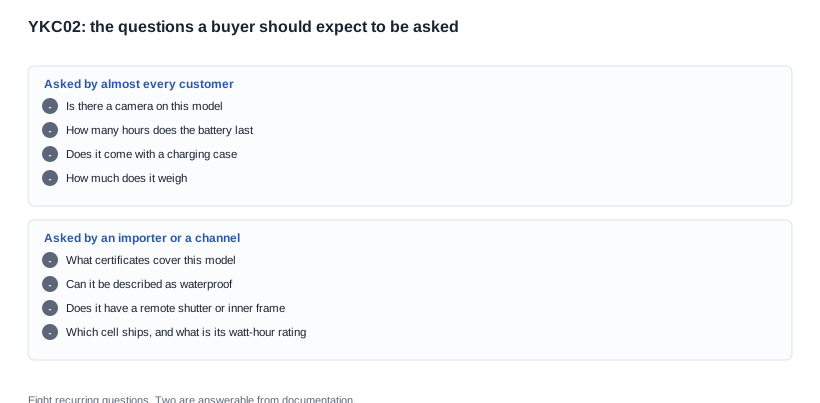
The published row for this model is Bluetooth 5.4, two 70 mAh cells, a charge time of up to two hours, roughly eight hours of rated runtime, magnetic charging and a surround-sound description. Six rows, and the questions that arrive against them are almost all about the rows that are not there.
Which of those we can answer, which we cannot, and what to do with the ones that stay open is what this article is for. Two of the recurring questions are answerable from documentation, four are not, and the four are the expensive ones.
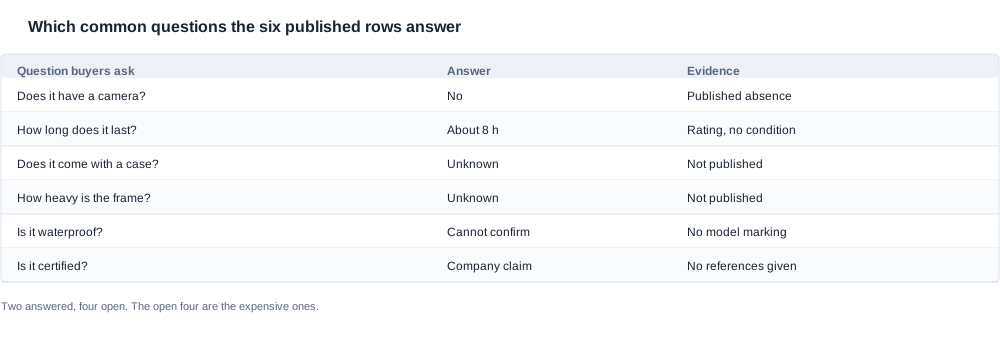
| Question buyers ask | Answer | Evidence |
|---|---|---|
| Does it have a camera? | No | Published absence |
| How long does it last? | About 8 hours | Rating, no condition attached |
| Does it come with a case? | Unknown | Not published |
| How heavy is the frame? | Unknown | Not published in the range |
| Is it waterproof? | Cannot confirm | No marking on this model's row |
| Is it certified? | Company claim | No references published |
Does the YKC02 have a camera?
No camera is published for this model. Two other models in our sport range carry a camera — the V06 at 8 megapixels and the S7 at 13 megapixels — and this one does not, and its published row contains no camera specification at all.
That is a meaningful answer rather than an absence, and it is worth distinguishing from the other kind of unknown on this page. A published absence is a documented position: the specification exists and does not include a camera. It changes what you can write about the product — no recording claims, no video-quality questions, no storage behaviour to worry about, no data question in markets where those attract attention — and it is a line you can state on a listing page with confidence.
The upside for a channel is a cleaner privacy and compliance story in a category where camera-equipped products attract more questions. Confirm the absence in writing before the packaging is printed, so that the box, the product page and the marketplace listing all say the same thing — a feature that exists on one and not the others is the kind of inconsistency that reaches a listing and stays there.
The commercial value of a documented absence. It is worth being concrete about why this is an asset rather than a gap, because buyers sometimes treat the absence of a camera specification as a missing feature rather than as a documented position. It does three things. It shortens the compliance conversation, because there is no storage, recording or data question to answer. It removes a whole category of returns, because a customer who expected a recording function will return the product rather than troubleshoot it. And it makes the product page defensible, because every statement on it can be traced to a published row — which is a stronger position than a competitor whose page lists features the specification does not support.
The one place this advantage does not apply. If your channel's customers buy on the promise of recording, then a documented absence is simply a disqualification, and no amount of compliance cleanliness compensates. Write the proposition sentence before the model selection, not after, because the sentence determines which specifications are load-bearing, and on this model the load-bearing row is the audio description rather than anything to do with capture.
Three questions the category text does not answer
Is it waterproof? This model's own row does not carry an IP marking. Our sport category description lists an IP54 marking, a detachable inner frame, a remote shutter and a roughly one-hour Type-C fast charge — but those are written at category level, and two models carry them in their own rows while the others do not.
This model publishes a charge time of up to two hours rather than the roughly one hour in the category description, which is itself evidence that the category description does not describe it uniformly. That single discrepancy is the clearest demonstration available that a category-level feature list cannot be attributed to a specific model.
So the answer is: we cannot confirm an ingress rating for this model, and we will not state one. Separately, even where a marking is carried in another model's row, we have not been provided with a third-party test report behind it and we do not hold one. If your channel needs an evidenced rating, that is a document you need from a testing body, and it is not obtainable from this model at any price.
Does it have a remote shutter or a detachable inner frame? Neither appears in this model's published row. Both appear in the category description and in the rows of other models in the range. Confirm for this specific model before you write either onto a page. IP ratings and durability covers how to read a marking before you rely on one.
Why the category-level mistake is worth naming explicitly. It is the most common documentation error in this product category, and it is made by suppliers, distributors and channel buyers in roughly equal measure. A category page describes what the range can do; a model row describes what this product does. When the two disagree, the model row wins, because that is what the customer receives. A feature written onto a listing from a category description is a feature a customer may search for on a product that does not have it, and the resulting complaint lands on the seller rather than on the catalogue.
The three questions to put in writing before any of this goes on a page. Does this model have a detachable inner frame? Does it have a remote shutter? Is there an ingress rating, and if so what is the test report behind it? Ask all three for this specific designation, in one message, and put the answers in the quotation. Two of the three will almost certainly come back negative, and a negative confirmed in writing is a much better position than an ambiguous feature list that nobody has checked — because the confirmed negative tells your customer service team what to say, and tells your compliance contact that the packaging can go to print.
The consequence of getting it wrong, concretely. A detachable inner frame written onto a product page that does not have one produces a return, a refund and a marketplace listing correction. A remote shutter written onto a product page produces the same, plus the awkward discovery that the instruction leaflet in the box contradicts the listing, which is a different and worse customer conversation. An ingress rating attributed without evidence is the most serious of the three, because it is a safety-adjacent claim rather than a convenience claim, and safety-adjacent claims are the ones regulators and platforms treat differently from ordinary product descriptions.
How long does the battery last, really?
Published as roughly eight hours from two 70 mAh cells. That is the longest published runtime in the audio part of this range, delivered on 140 mAh of total nominal capacity, which implies an average draw of about 17.5 mA.
The test condition is not published — volume, codec, distance from the source, whether the surround-sound mode was engaged, sample size, and whether the figure is a mean or a best case. Treat the figure as a ceiling rather than a typical day. The surround mode is a specific question worth asking, because this model publishes a surround description and the mode state is binary: a measurement taken with it disabled does not describe a customer running it enabled.
The practical answer to a customer asking this is a condition, not a number. "About eight hours under stated conditions, and here is what changes it: volume, codec, distance and mode state" is a better answer than either the bare figure or a refusal. It is also the answer that keeps a return from becoming a complaint, because the customer has been told in advance what the figure depends on. YKC02 battery life sets out the arithmetic and the protocol in full.

The case and the weight, both absent
Does it come with a charging case? Magnetic charging is published. Whether a case or dock is included at your quantity, and what capacity it carries, is not published.
That single unknown is worth more than any of the figures above, because it decides whether this product is a dock-based object or a cable-based one. Published case capacities elsewhere in our range run from 900 mAh to 1400 mAh, so the omission spans a wide range of real products rather than a formality. It also decides the packed weight, the freight class and the accessory minimum order quantity, which is why it belongs at the top of the supplier request list.
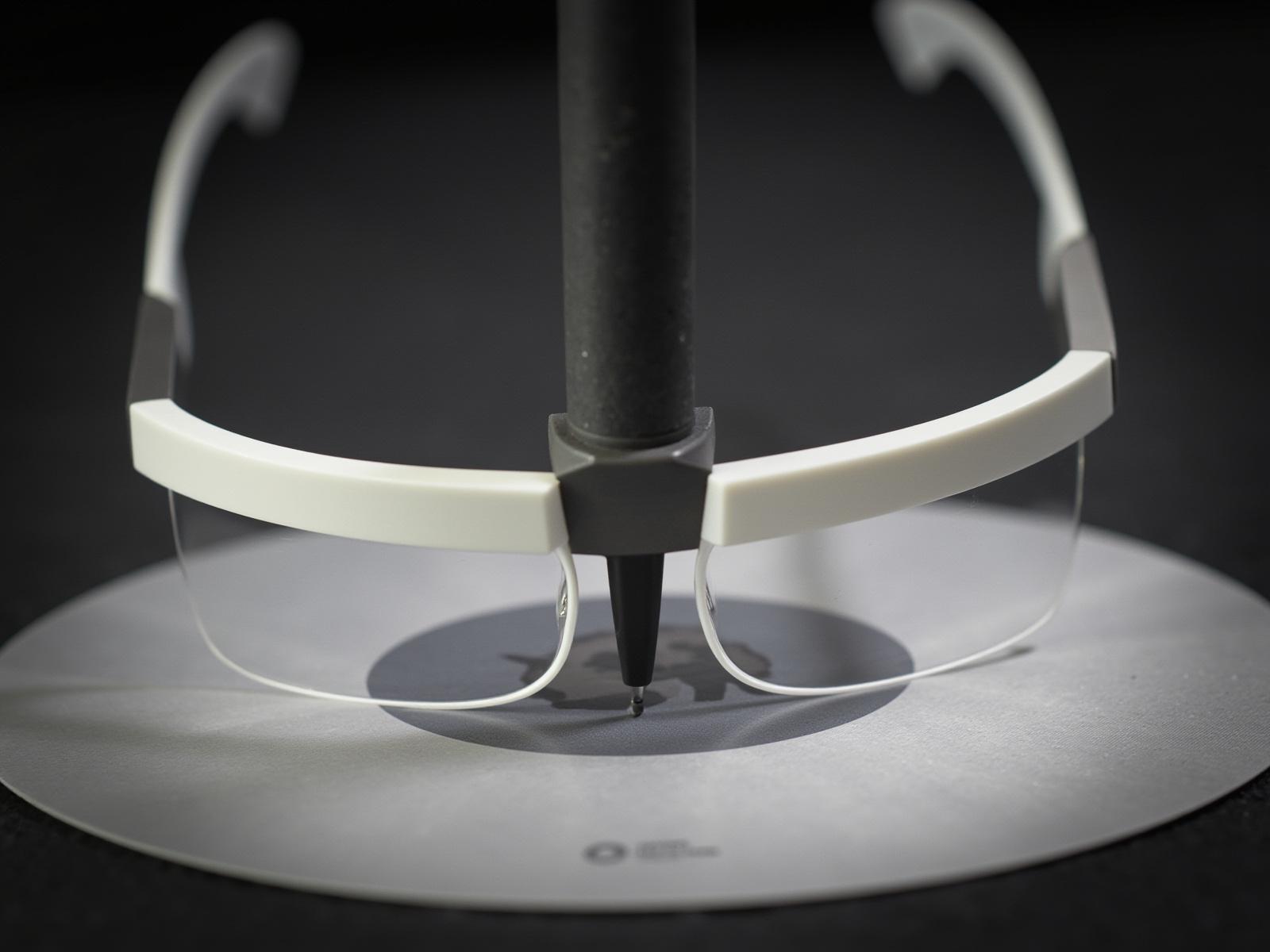
How heavy is it, and will it fit? Frame weight, temple length and lens dimensions are not published for any model in this range. On a product worn in motion for an hour at a time, weight decides whether it stays on the head, and that is the variable that determines perceived endurance more than the cell does. This is the row we would most like to give you, and it is the row nobody in this category has published.
The commercial answer is short: weigh a sample and quote your own figure. Record it with the cells fitted, note the date, and keep the measurement separate from the manufacturer's published rows so that a number you produced is never mistaken for one you were given.
Three measurements that close more rows than they appear to. Weighing a packed unit — frame, cells, dock and packaging — closes the freight class, the forwarder's quotation and the total landed cost on an incoterms basis, all from one number. Recording the temple section with calipers closes the geometry question that no model in this range documents. And running the runtime protocol on three units rather than one closes the spread question, because a single unit tells you what happened to that unit and three tell you what your customer will experience. All three cost an afternoon and require no supplier cooperation at all, which is why they should not sit waiting behind a document request.
How to weight the two unknowns against each other in a total cost. The case inclusion is a purchase-order line: it changes the accessory minimum order quantity, the packaging specification and the freight class, so it must be settled before the order. The frame weight is a specification line: it changes the return-rate assumption and the shipping calculation, so it must be settled before the listing copy is written. Neither is a customer-facing claim, which is why both can be handled internally and neither needs to delay the other. Treat them as two parallel tasks rather than one sequence, and the total cost is buildable once both have a number rather than once both have a document.
Is it certified, and what about market access?
Our catalogue publishes no CE, FCC or RoHS text and no per-model certification row for this model. Certificate numbers, issuing bodies, validity periods and covered model schedules are not published.
For the European market the radio side sits under the radio equipment framework, framework reference 2014/53/EU, and the restricted-substance side is separate work. Request the document and check that its model schedule names this model — a reference covering a family tells you the supplier has run conformity work, not that this designation was in scope when it was.
A model with no camera has a narrower compliance surface than a sport camera product would have, because there is no recording and no associated data question. That is worth something, and it is a legitimate argument for the model in a conservative market. It does not remove the radio obligations, the battery obligations or the general consumer product obligations, and the certification status for this model sets out all seven items and who resolves each one.
What to ask, and what to do with the answer. Request the certificate and grant references naming this model, with issuing body and validity, for each destination market; the Bluetooth listing and declaration identifiers; the cell fitted with its test summary and declared watt-hour rating; and the economic operator and responsible-person details that will appear on the packaging. Then separate the answers into three files: model-level, family-level, and not held. Only the first file supports a claim on a listing. The second supports a statement to a distributor who is doing their own work. The third is a gap to be closed, priced or disclosed before it becomes an obstacle.
Why this matters more here than for a camera model. A model with an imaging function attracts questions about data handling, storage behaviour and retention, and each of those is a conversation with a supplier and sometimes with a regulator. This model removes that entire set, which makes it a genuinely easier product to place on a market — provided the documents naming it actually exist. The narrow compliance surface is an advantage only when the paperwork underneath it is complete, so the request is worth as much as the reduction.
How to handle a question you cannot answer, and the line we hold

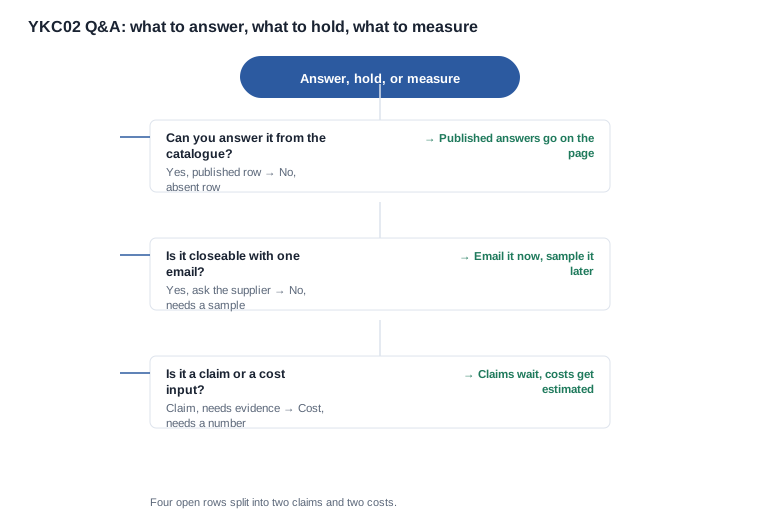
The rule is simple and it is worth stating once. Say plainly that the row is not published — not that the feature does not exist, and not a hedge. Then say whether it is closeable by document, closeable by sample, or not closeable at all. An honest unknown beats a confident estimate that has to be retracted, because a retraction costs a customer relationship and a corrected listing, while an unknown costs nothing but a follow-up question.
Four forms of answer, and they are not equally useful to a buyer. "It is not published, ask the supplier and I will send the request" is the best. "We do not have that figure" is acceptable and honest. "It depends on the configuration" is usually true and usually unhelpful, because it should be followed by the specific configurations. And a confident estimate is the one to avoid, because nothing on this model is difficult enough to require one.
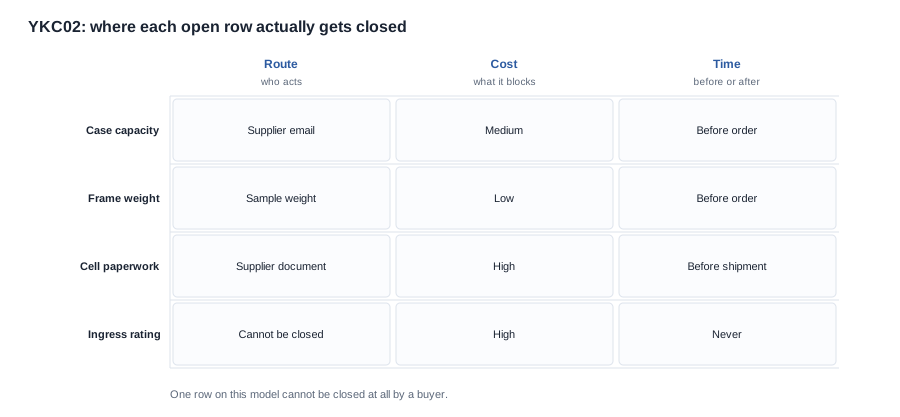
Put the closable ones in the next supplier request and mark the unclosable ones as listing boundaries immediately. The case capacity and the runtime condition are closeable by document. The frame weight is closeable by sample. The ingress rating may be closeable only by commissioning a test, which is a budget decision rather than a question. Recording which is which — in the technical file, with the date — is what stops the same four questions being asked again in six months by a different buyer who has no idea they were asked in March.
The criteria for deciding which questions to pursue first. Rank them by what each one blocks rather than by how often it is asked. The case capacity blocks the accessory order, the packaging decision and the freight class. The runtime condition blocks the listing's headline claim. The frame weight blocks the return-rate assumption and the shipping calculation. The ingress rating blocks a single possible claim and nothing else. That ordering produces a different priority list than asking your customers what they want to know, and it is the right one, because the questions a customer asks are the ones that end a sale while the questions that block a decision are the ones that create a cost.
How to evaluate a supplier's answer to any of them. Four forms, and they are not equally useful: a document that names this model is evidence; a family-level reference is context; a verbal assurance is nothing; and a confident estimate is worse than nothing, because it will be acted on. When you shortlist suppliers, this is the criterion that separates them — not the number of documents offered, which is a measure of their filing system, but whether the document offered is the right one. A supplier who returns a model-level reference in the first exchange has a process behind it, and that is worth more to a buyer than a longer document list.
What to ask, in the order that produces answers fastest. Start with the Bluetooth identifiers, because they are usually returned within days and their arrival establishes that the supplier answers requests rather than deflects them. Then the model-level radio references. Then the cell, because that determines your freight booking rather than your listing. Then the case inclusion, which determines the accessory order. Then the ingress question, which is the one you are most likely to decide you do not need.
What to do with a question that cannot be closed at all. Some rows in this category are not closable by a buyer at any price — an ingress rating without a test report is the clearest example. The correct response is to mark it as permanently unavailable, remove it from every listing, the packaging and the sales script, and tell the channel once so that nobody re-raises it. A row that has been formally closed stops being re-asked, and that saves more time than any amount of additional documentation.
The supplier request, written as a single list. Send us the case inclusion and capacity at our quantity; the measurement protocol behind the eight-hour rating, including whether the surround mode was engaged; the input current and voltage the frame requires; whether this designation has a detachable inner frame, a remote shutter or an ingress rating; the certificate and grant references naming this model for each destination market; and the cell fitted with its test summary and declared watt-hour rating. Ask what does not exist as well as what does, in writing, because a supplier who volunteers a gap is giving you the most useful sentence in the exchange — and because the alternative is discovering the same gap again in six months from a different buyer who did not know it had already been asked.
We can answer the camera question and answer the runtime question partially, and we cannot answer the ingress, case, weight or certificate questions from the documentation. We will not attribute a category-level feature to this model, will not quote a case capacity or a frame weight, and will not describe an ingress marking as a tested result.
What we will do is tell you which questions are closable and at what cost, so that you can budget the evidence rather than discovering its absence. Send us the market, the channel, the quantity and what your customer actually does with the product, and we will tell you which of these answers can go on a page and which ones have to come back as unknown.
The range this model belongs to is on the sport smart glasses page, reading an IP rating before you write it is covered in certification checks, and the runtime and charge claims are covered in smart glasses battery life.
Related reading
- The range behind this model — sport smart glasses
- Reading an IP rating before you write it — certification checks
- Reading the runtime and charge claims — smart glasses battery life
Send the market, the channel, the quantity and what your customer does, and we will tell you which answers hold.


