

Value for money in a smart glasses line is not a single number, and it is not something a catalogue can settle on your behalf. The YKC02 is a sport-category model with two 70 mAh cells, about 8 hours of runtime, a charge cycle of 2 hours or less, magnetic charging, a Bluetooth V5.4 radio, and a published surround sound descriptor. Some of the rows that decide what a unit costs to buy and to land are on the record. Most of them are not. This article separates the two sets, converts every blank row into a specific question a supplier has to answer, and then sets out the quotation caliber that two quotations have to share before their numbers can be set next to each other.
The platform in the title of this piece is the platform a buyer actually buys on — a listing, a range, a channel relationship — and not a shared internal product platform. The catalogue publishes no firmware branch, no accessory family and no application structure for any of the 28 models, so we will not present a matching specification row as an inherited capability. Where the catalogue is silent, this article says so and turns the silence into a question.
This article breaks the value question into three parts you can act on. We will read the published specification properly and mark which rows carry a number and which are blank. We will then work through what the cost is actually made of, line by line, and turn each blank row into a question. We will place the model against the D17 and the ZH12 on published rows only, and close with the quotation caliber that makes two quotations comparable at all.
The YKC02 rows a quotation has to rest on
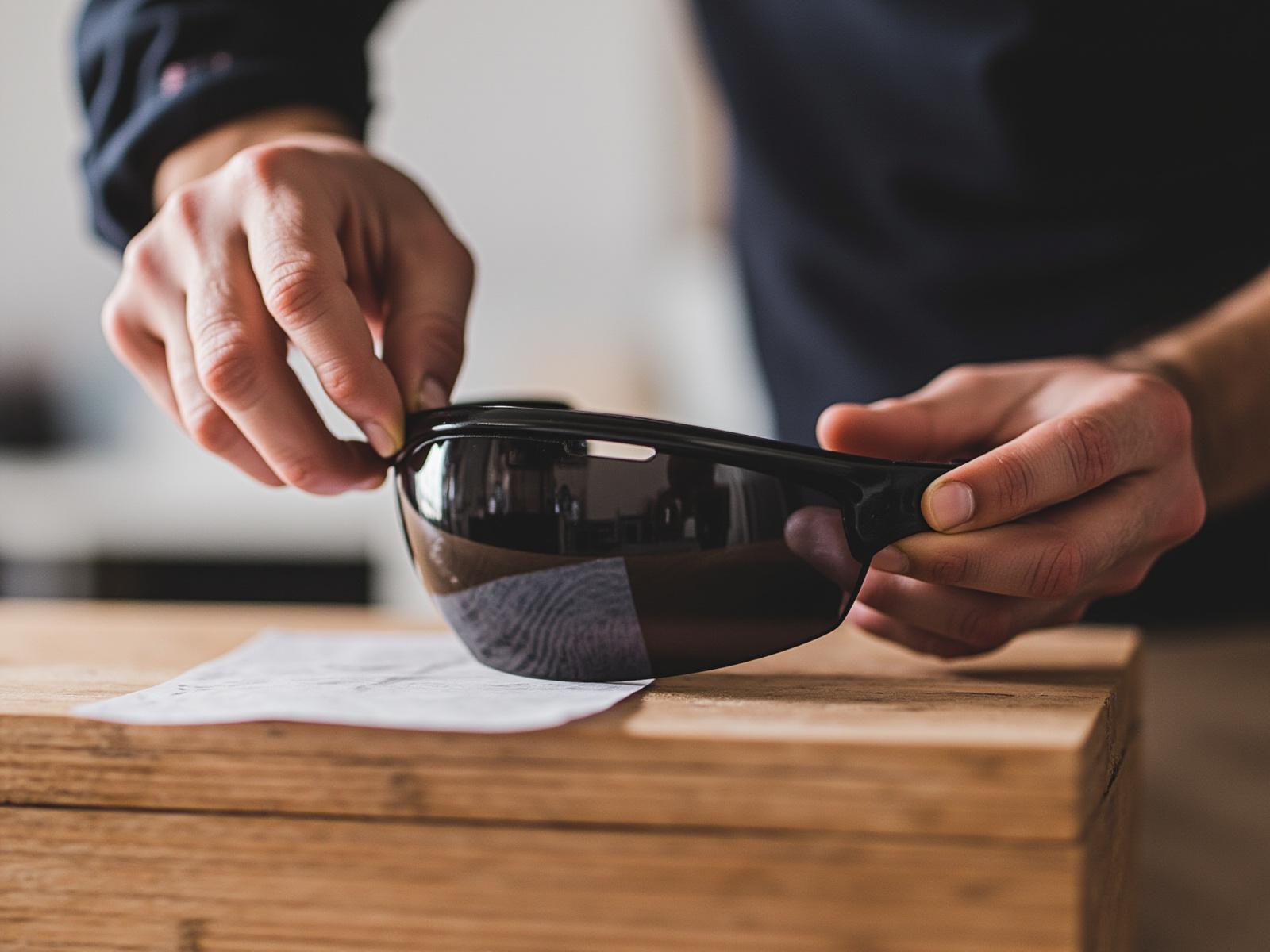
Start with the record, because a value argument built on a misread specification is worthless no matter how good the rest of the analysis is.
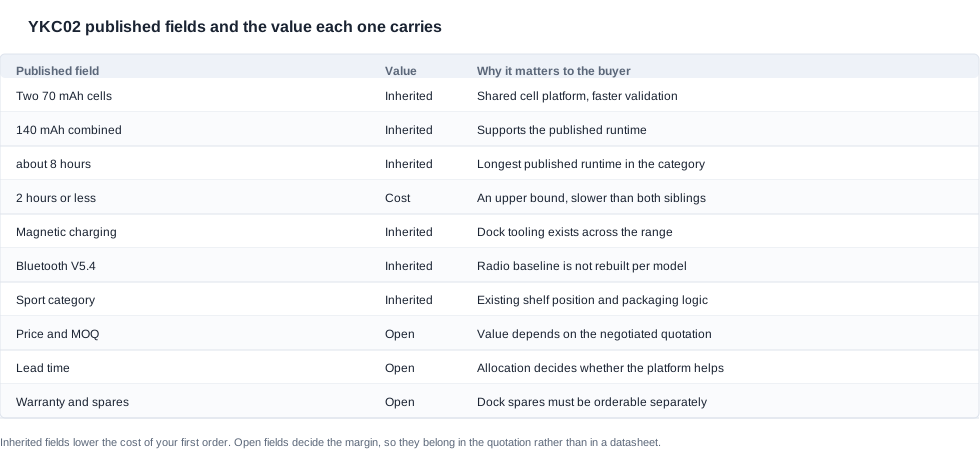
The YKC02 is published in the sport category. Its power source is two 70 mAh cells, which is a combined 140 mAh. Its published runtime is about 8 hours. Its published charge time is 2 hours or less. Its charging method is magnetic. Its radio is Bluetooth V5.4. Those are the six published facts, and each one carries a commercial meaning worth spelling out.
Two cells of 70 mAh is not an unusual number in isolation, but a two-cell configuration inside a pair of glasses is a deliberate architecture rather than a convenient figure. It means the frame carries two energy stores, which means the charging interface must be a physical dock rather than a socket, which means the dock is part of the product and part of the packaging, and part of the merchandising story. The 140 mAh combined capacity, once the supplier confirms the topology, sits behind the about 8 hour runtime, which is the highest figure published in the sport category and is matched by the ZH12. The charge cycle runs in hours rather than minutes, and that is a field your channel partner will read before your listing does.
The 2 hours or less figure is an upper bound. That single phrasing detail is the most consequential thing in this record for a channel buyer, because it is the difference between "charges fully for the weekend" and "charges fully between shift changes". A buyer selling into an active lifestyle or outdoor-retail context has to build the recharge moment into the operating plan rather than hide it, since the customer will discover it on day one anyway. A buyer whose channel turns product over inside a single day can treat the ceiling as a non-issue. The field does not go away either way; it lands on a different line of the plan.
The Bluetooth V5.4 radio is a generational statement about the pairing stack, and it is a published row rather than a market assumption. It tells a buyer that the model sits on a current connectivity baseline, which is exactly what a channel partner will ask about when deciding whether the product belongs in this year's range rather than a clearance range.
What is not published for the YKC02 is as important to the value case as what is: frame weight, dimensions, lens material, colours, ingress protection rating, certification, price, minimum order quantity, lead time, sample policy, warranty, and production capacity. We will treat each of those as a supplier question rather than a spec, and we will not borrow a number from another model to fill the gap. For a value argument, this is not a weakness of the model, it is the definition of the exercise, because the value has to be built from what is published plus what you successfully extract from the supplier.
One more reading note on runtime, because it changes the arithmetic in a margin model. A published runtime figure with no stated test protocol is a claim, not a measurement, and the claim is a ceiling rather than a floor. If your marketing says "up to 8 hours", you are quoting a ceiling, and customers who average their own usage will land lower. Our notes on how runtime claims are written and tested are in the battery life reference, and we will ask the supplier for their test conditions rather than infer them from the number.
What the YKC02 cost lines are made of
Value for money in a smart glasses line is a cost question before it is anything else, so we will build the cost out of the published rows rather than out of an impression of the model. There are two lists, and they do not overlap: the rows the catalogue publishes with a number on them, and the rows it leaves blank. Each published row decides something specific about what a unit costs to buy and to land, and each blank row decides something equally specific about what is still unknown when you are about to commit.
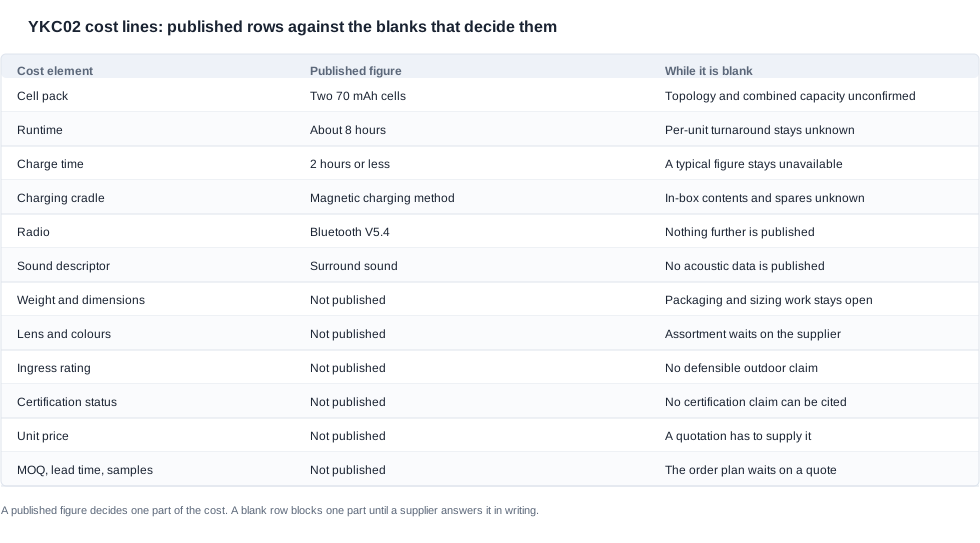
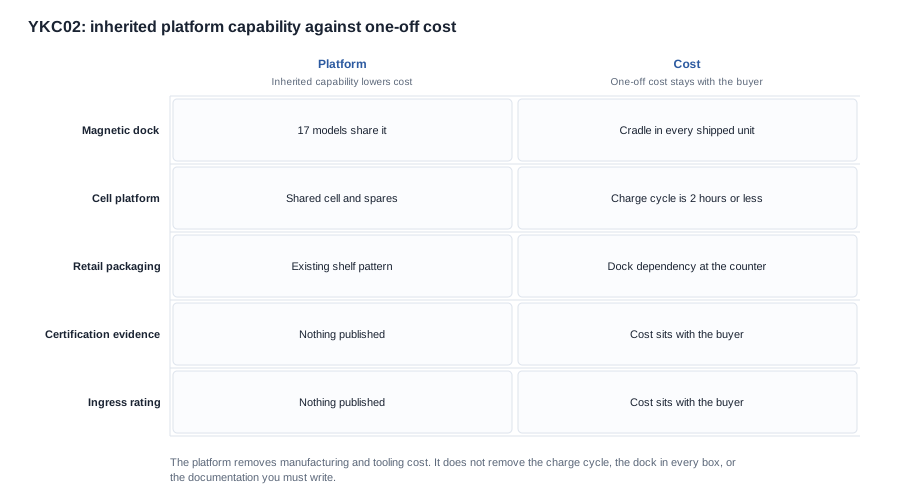
The published list is short, and every item on it is a number you can quote. Cell configuration: two 70 mAh cells, which is a combined 140 mAh once the topology is confirmed. Runtime: about 8 hours. Charge time: 2 hours or less, a ceiling rather than a typical figure. Charging method: magnetic, which decides that the charging cradle is an in-box item and therefore a packing-volume line and a spares line rather than a zero-cost detail. Radio: Bluetooth V5.4. Category: sport, labelled YKC02 Sport Glasses. Sound descriptor: surround sound, listed alongside a long-endurance row and carrying no acoustic data behind it. That is the whole published list, and every row on it tells you something about the unit.
Each of those rows decides a different part of the cost. The cell configuration decides the freight declaration, because two cells change how the pack is described on a shipping document. The runtime figure decides how many units a single charger or a single charging fixture has to serve, which is a capital cost spread across your volume. The charge ceiling decides the turnaround you can promise a channel partner, and a ceiling of two hours or less is the number that has to appear in the operating plan rather than a figure you average down. The magnetic interface decides that a cradle is packed, shipped and eventually lost, so the spare ratio on that cradle is a real line in the cost model. The radio standard decides the compatibility set your channel has to support, and therefore how many support requests the listing generates. None of those decisions needs a price to be made. All of them need to be in the model before the price is negotiated.
The blank list is longer, and it is where a value argument either holds up or collapses. Frame weight, frame and lens dimensions, lens material, colour availability, ingress rating, certification status, price, minimum order quantity, lead time, sample policy, warranty term, and the cell topology behind the 70 mAh x 2 notation: none of these appear in the catalogue for this model. A buyer who fills any of them with an estimate will eventually have that estimate fail against a purchase order, and the failure surfaces as a margin problem rather than as a specification error.
There is one trap worth naming here, because it is the one that quietly manufactures value. Several rows on the YKC02's sheet are identical to rows on the D17 and the ZH12: Bluetooth V5.4, a sport-category label, and a sound descriptor. Identical published rows are not the same thing as a shared platform. The catalogue does not describe our internal firmware, accessory or application structure for any model, and we will not present a matching row as an inherited capability, because a matching row is a coincidence on a datasheet and an inherited capability is a manufacturing fact that has to be confirmed. If you want to know whether a cradle, a cell or a package can be reused across models, that is a question for the supplier, and it is answered in their answer rather than in ours.
Here is the cost model in the only form the published material supports: what is known, what each known row decides, what is blank, and what each blank row blocks.
| Cost element | Published figure | What it decides | While it is blank |
|---|---|---|---|
| Cell pack | Two 70 mAh cells | Freight declaration and spare-cell policy | Topology and combined capacity stay unconfirmed |
| Runtime | About 8 hours | How many units one charger or fixture serves | Per-unit turnaround stays unknown |
| Charge time | 2 hours or less | The turnaround you can promise a channel | A typical figure stays unavailable |
| Charging cradle | Magnetic charging method | Packing volume, spares ratio, loss rate | In-box contents and spare terms stay unknown |
| Radio | Bluetooth V5.4 | The compatibility set your channel supports | Nothing further is published |
| Sound descriptor | Surround sound | The acoustic claim a listing may carry | No acoustic data is published |
| Frame weight and dimensions | Not published | Freight class, fit guidance, return rate | Packaging and sizing work stays open |
| Lens material and colours | Not published | Range planning and listing count | Assortment decisions wait on the supplier |
| Ingress rating | Not published | Whether any water-resistance claim is possible | No defensible outdoor claim can be written |
| Certification status | Not published | Market access and liability exposure | No certification claim can be cited |
| Unit price | Not published | The margin line | A quotation has to supply it |
| MOQ, lead time, samples, warranty | Not published | The whole order plan | The order plan waits on a written quote |
That table is the cost side of the value question, and it is enough to build a margin model once the blank rows are filled. It is not enough on its own, because two quotations are rarely on the same basis, and a comparison between quotations on different bases produces a number that looks like a price difference and is actually a specification difference. Three things have to be fixed before two quotes are set next to each other. The first is the configuration: how many configurations is the supplier quoting, and does each one carry its own stated minimum order quantity? The second is the delivery basis: the incoterm, the packing list, whether the charging cradle is in the carton, and what is charged as an accessory or a spare. The third is the commercial frame: warranty length, sample terms, lead time, and the quotation validity period. Two quotes that differ on any of those three are not comparable, and the difference you would be reading as a price gap is usually sitting in one of them.
The magnetic cradle is worth isolating, because it is the one published row that generates a physical cost a datasheet does not show. The cradle occupies packing volume in every unit, it is a consumable the end customer can lose, and it is an item a channel buyer may want to reorder separately. That makes the spare ratio on the cradle a line in the cost model and a question for the supplier, and it makes the in-box contents a negotiation item rather than an afterthought. We will not attach a price to any of it, because none is published. We will say that it exists, and that it has to be costed before the margin model is signed.
The narrow published record carries a third cost that is easy to miss because it never appears on a quotation. Every field the catalogue leaves blank is a field you have to source, and sourcing it costs time and attention whether or not it eventually produces a number. A model with a wide published record supplies most of its own documentation; this one supplies its position in the category and leaves the rest of the file to be requested. That is an argument for getting the answers in the first exchange rather than across five, not an argument about the product.
What the published material supports is a specific and defensible claim. The YKC02's cost lines that you can model today are its cell configuration, its runtime, its charge ceiling, its charging interface, its radio, and its sound descriptor. The lines that decide whether the order works are its weight, its dimensions, its ingress status, its certification evidence, and its commercial terms. If a quotation answers the second set, the value question for this model becomes answerable in the way a buyer needs. If it does not, the first set is still useful for what it is: a category position, and a specification you can put in front of a channel partner without having to guess.
Where the YKC02 sits against the D17 and the ZH12
The sport category contains exactly three models, and comparing the YKC02 against the other two is the fastest way to make sure a buyer is buying the right one. It is also the fastest way to lose a channel partner, so we will be exact about the differences rather than about which model is better.
On power and runtime, the YKC02 uses two 70 mAh cells for 140 mAh combined and publishes about 8 hours. The D17 uses a single 115 mAh cell and publishes about 7 hours with an approximately one-hour charge time. The ZH12 uses a single 100 mAh cell and publishes about 8 hours with an approximately one-hour charge time. The honest reading is that the YKC02 and the ZH12 publish the same runtime and the D17 publishes slightly less, while both siblings publish a materially faster charge and both do it over a wired USB-C interface.
On features, the D17 and the ZH12 publish a remote control shutter, and the ZH12 publishes stereo surround sound. The YKC02 publishes a surround sound descriptor of its own, listed next to its long-endurance row, and no remote control shutter. Only two models in the entire catalogue have a remote control shutter, and both are in this comparison set, so that gap is structural rather than incidental.
Where the YKC02 stands alone is the two-cell architecture and the magnetic interface. It is the only model in the category on that combination, which means it is the only one whose charging story is a cradle story, and the only one whose runtime comes from a split cell budget rather than a single cell. That difference stays visible in a comparison chart only if the chart keeps the cell column in its original form, because a chart built from the fields published for every model will flatten it out.
So the decision splits three ways, and it is worth making explicit before you approach a supplier. If the workflow needs a remote shutter alongside the fastest published recharge, the two models that publish both are the D17 and the ZH12, and the differentiators between them are the published sound descriptor and the cell configuration. If the workflow needs the published runtime that the YKC02 and the ZH12 share, together with a cradle-based charging story and no shutter, the YKC02 carries those rows. If the workflow needs a shutter and that runtime in the same model, this catalogue publishes no single model that carries all of them, and a buyer who assumes one exists will discover it during the quotation round rather than before it.
The same three-way logic appears on the buyer side of the range, and the guide to who needs the YKC02 walks through the user profiles that suit this model and the ones that do not. We will use that fit test as a filter on your own pipeline before you build a business case, because a model that fits half your prospects well is worth more than one that fits all of them poorly, and the YKC02's published record supports a narrower positioning rather than a broad one.
We will also note the trap of the audio tier, because it is the most common placement error we see. The audio tier of this catalogue is exactly eight models, and the YKC02 is not one of them. Buyers routinely group it with the D17 and the ZH12 as a sport-audio trio and then write copy about immersive audio for a model whose catalogue page carries one sound descriptor and no acoustic data behind it. The name is publishable; a performance claim built on that name is not, because no measurement accompanies it for this model or for any other in the range. If you want to see how that category is structured from a buyer perspective, the sport smart glasses common questions page covers the decision points that channel buyers raise most often, including how to describe a model that sits outside the audio tier.
One more comparison a buyer should run is against the kids category. The catalogue carries 3 kids models, and some of the enquiries that reach us about the YKC02 are actually requests for a simpler, lower-commitment product for a younger buyer or a first-time smart glasses user. That is a different product decision, and the kids smart glasses category is the right place to test it. This article stays inside the sport category, but a buyer who never looks at the adjacent category risks pricing the YKC02 against a use case it was never aimed at.
Finally, there is a value question that the comparison charts never answer, which is how the three models differ in the things a buyer actually pays for: the fixture, the packaging volume, the accessory spares, and the documentation effort per launch. The YKC02 asks for a cradle in every unit, the D17 and the ZH12 ask for a cable. The YKC02 asks for a documentation sprint before the first order, because its published record is narrow. The siblings ask for a comparison-chart revision, because their records overlap. Neither cost is visible in a spec table, and both of them are real. We will build them into the margin model before we negotiate a quotation, because a channel buyer who discovers them afterwards discovers them as a margin problem rather than as a procurement question.

YKC02 questions before the margin model is signed
A value argument is only worth as much as the terms that support it, and the terms for the YKC02 are not published. We will ask the following, and we will expect the answers in the quotation itself rather than in a conversation.
- Confirm the cell configuration behind the published runtime, including the cycle life of each cell and whether the two cells are a standard catalogue part or a build specific to this model.
- Provide the measured charge time for a full cycle from empty, together with the test conditions behind the published upper bound.
- State whether the magnetic charging dock is available as a separately orderable spare, at what quantities, and at what unit price.
- Explain the cell layout inside the frame, including the position of the dock contacts and the effect on temple balance.
- Supply the frame weight, the overall dimensions, the lens material, and the available colourways on one sheet.
- Confirm whether an ingress protection rating applies to this model, supplying a report if one exists.
- Outline the certification evidence available for this model, stating which standards each document covers.
- Give the minimum order quantity for a pilot order and for a repeat order, and whether the two differ.
- State the lead time from purchase order to shipment, the incoterms offered, and the current production capacity and allocation.
- Quote the packaging specification, including the cradle, the insert, and the carton dimensions.
- Set out the warranty term, the spares ratio, and the return process for a defective unit.
- Explain any tooling, moulding, or customisation charges and how they are amortised across repeat orders.
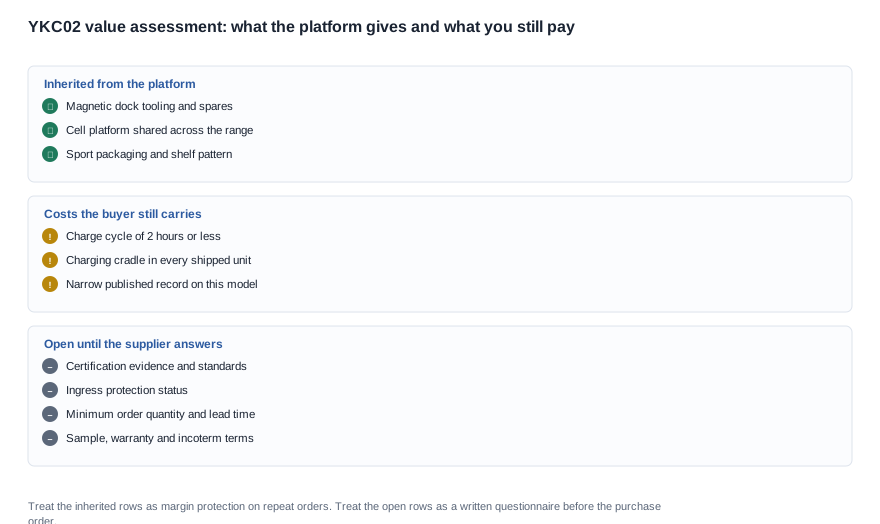
We will also press on three commercial questions that decide whether the cost model we have built holds up. First, we will ask whether the magnetic charging cradle is available as a separately orderable spare, at what quantities and on what terms, because a cradle that cannot be reordered becomes a warranty cost and a customer service cost rather than a consumable. Second, we will ask how many configurations the supplier is quoting and what minimum order quantity applies to each, because a single-configuration quotation cannot be set against a multi-configuration one. Third, we will ask what the production capacity is and what the current allocation looks like, because a quoted lead time that depends on an allocated line is a schedule risk rather than a committed date. These three answers determine whether the value story survives contact with the order book.
On certification, our position is unchanged and we will hold it in writing. No certification status is published for the YKC02, so we will not claim one in any listing, packaging, or sales material, and we will request the evidence pack and summarise only what it supports. On ingress protection, the model has no published rating, so we will ask for either a report or a written confirmation that none applies, and we will adjust the outdoor positioning accordingly rather than implying a ruggedness the record does not carry. The ingress protection reference is where we keep the detail on what a rating does and does not license you to claim.
On the commercial side, we will negotiate the minimum order quantity against a pilot order, ask for the lead time in writing, and confirm the incoterms before any purchase order is raised. We will ask what sample cost applies and whether it is credited, because the sample is the cheapest way to test the charge cycle and the weight in the hands of a real customer. We will price the packaging and the dock into the landed cost rather than treating them as free accessories, and we will ask for the spares ratio so that a broken or lost dock does not quietly consume the margin. The warranty term we will negotiate against the channel commitment we have with our own customer, which for a sport model sold on runtime claims is usually shorter than the supplier would prefer to offer.
Finally, the sequencing matters more than the order of the list. Samples first, because they answer the weight, the fit, the dock, and the runtime questions that no document answers. Then a pilot order, because it answers the repeatability question and it is where tooling, packaging, and quality control get proven. Then the purchase order for the main volume, with the negotiated terms attached. A buyer who skips straight to the main volume on this model is betting on assumptions about every field the catalogue leaves unpublished, and the platform value only pays out if the volume is planned rather than hoped for.
That is the shape of the YKC02 value question, stated plainly. It is a sport-category model whose published record covers power, runtime, charging method, radio and a sound descriptor, and whose unpublished record covers weight, dimensions, lens, colours, ingress, certification and every commercial term. It publishes a two-hour-or-less charge ceiling where its two sport siblings publish about one hour, and it publishes no remote control shutter where they publish one, so the listing copy has to live inside that record. The published rows are enough to place the model in its category and to build the first version of a cost model. The blank rows are what a supplier has to fill, and until they are filled in writing, the value of this model is a hypothesis rather than a number.


