

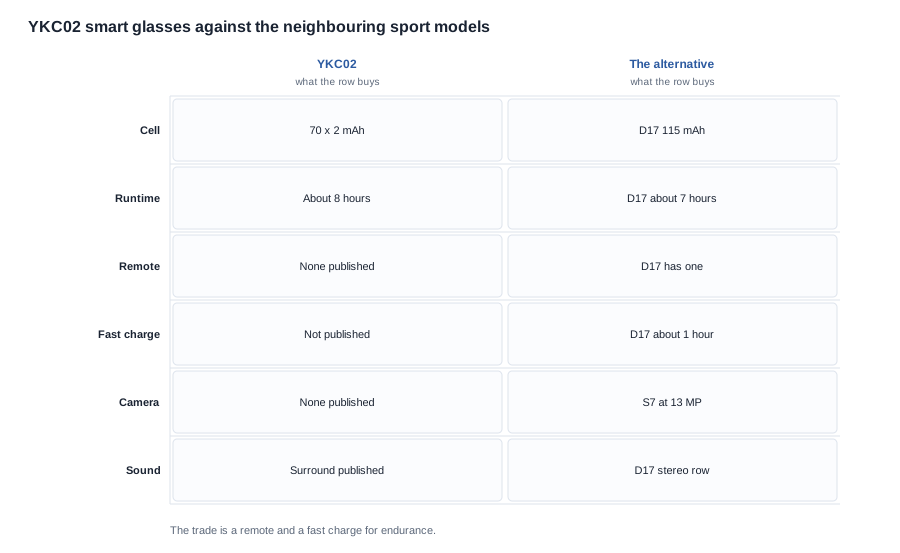
The YKC02 is a sport frame with a 70 mAh × 2 cell, a rated runtime of around eight hours, magnetic charging and a published surround sound row, and it is published with no ingress rating and no detachable inner frame, where the two sport camera models carry both. It has no camera, no remote control and no one-hour fast charge.
Those three absences define the buyer, and they are not accidents. They are what makes this the longest-running frame in a category built around endurance. YKC02 smart glasses suit a brand whose customer is out for hours, whose category is sport rather than gadgets, and whose product needs to make sound rather than make images. For that buyer it is a good fit, and the published runtime supports it. For every other buyer the absences are the answer, given early.
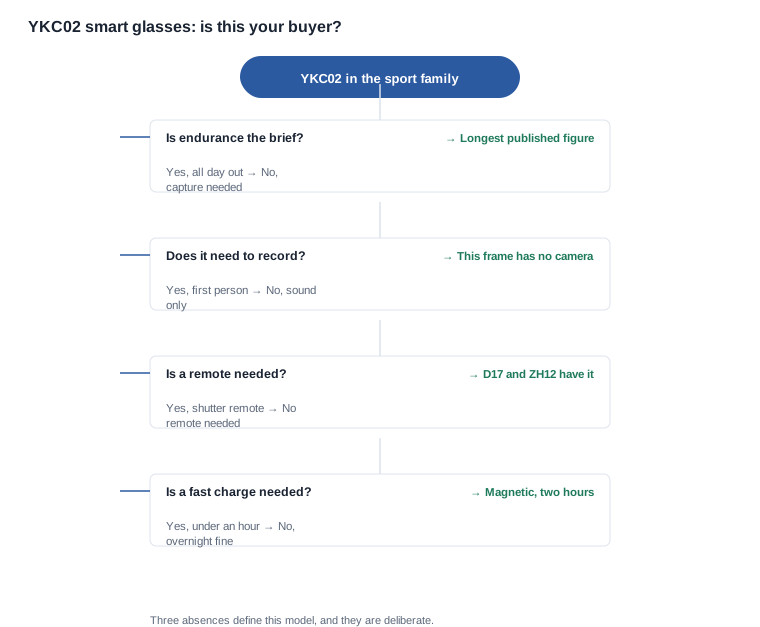
YKC02 smart glasses and the four rows that carry the proposition
A 70 mAh × 2 cell configuration that exists nowhere else in the range. The audio range uses 90 mAh × 2 on the K01 and the K02, 55 mAh × 2 on the G07, the YK12 and the LC-105 pair, and a single 100 mAh on the D11 and the D12. This model runs a 70 mAh × 2 arrangement, which makes it a platform of its own rather than a variant of another. For a brand building a range, that is a mixed blessing: it buys a genuine endurance position and costs a second accessory family if the accessory is cell-dependent.
What a unique cell configuration actually costs in a procurement file. Three lines, and only the first is obvious. The cell itself is a bill-of-materials line that sits inside a quotation rather than beside it, so it is rarely negotiated directly but it sets the freight class. The charging accessory is the line buyers forget: if the dock is specific to this cell arrangement, the brand needs a separate accessory SKU with its own minimum order quantity, its own packaging specification and its own reorder lead time, and a channel that runs out of docks mid-season has a product it cannot serve. The third line is the spare-parts path, which on this family means inner frames rather than docks, and which needs the same treatment. A brand choosing a second cell configuration should budget for the accessory ecosystem, not only for the cell.
The alternative worth testing before committing to either. A brand that is genuinely unsure whether the endurance position is worth a second accessory family could hold samples of this model and of one of the larger-cell frames on the 90 mAh × 2 platform, and measure both against the duty cycle its own customers actually keep. That comparison costs one afternoon and it produces a decision rather than an opinion, because the duty cycle is a fact about the customer that nobody has to guess at. The measured answer frequently moves buyers toward a shared platform, and it does so on evidence rather than on caution.
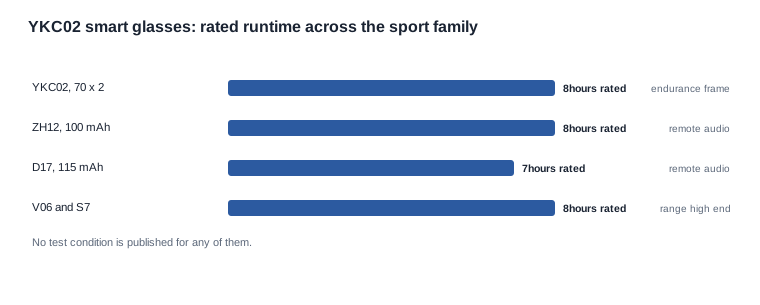
A rated runtime of around eight hours, with no case in the box. No model in the sport family publishes a charging case, so the eight hours is what the customer actually gets without buying anything else. That is a cleaner commercial position than it sounds: the customer's daily routine is defined by a single product rather than by a product plus an accessory, and the returned-unit conversation does not involve explaining a case.
Magnetic charging at up to two hours. Not the one-hour Type-C fast charge that belongs to other models in this family. On an endurance-led product a two-hour overnight charge is the correct trade, because the customer is not taking the product out twice a day and topping it up between sittings.
A published surround sound row on a frame with no camera. This is the row that makes it an audio product rather than a stripped-down camera product, and it is published alongside the D11 and the YK12. What is not published is any acoustic figure — no leakage measurement, no driver size, no frequency response, no microphone count and no pickup distance — so the claim can be stated but not quantified.
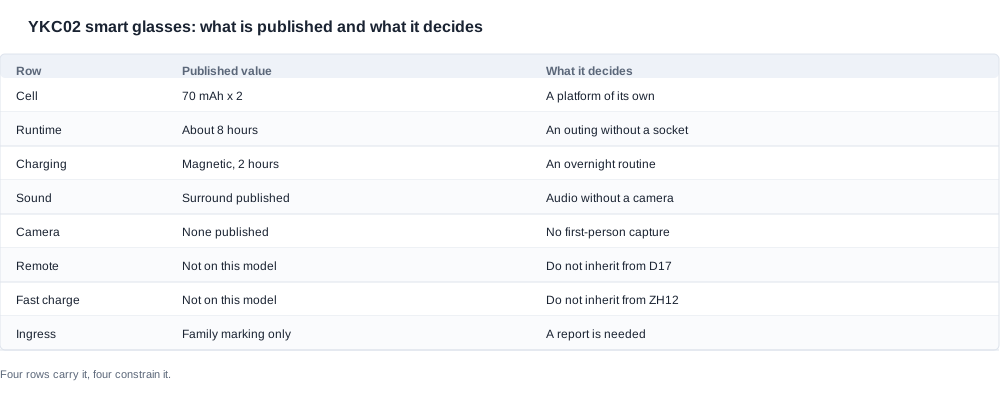
The four rows that constrain it, and the family-versus-model line
No camera. There is no first-person capture, and the models that do it are the V06 at 8 MP and the S7 at 13 MP in the same sport family. A buyer whose brief is capture should not spend negotiation time on this model; that time is better spent closing the camera specification on a model that has one.
No remote shutter, and no one-hour fast charge. Our documentation attributes the remote shutter — and the stereo surround sound and the one-hour Type-C fast charge that go with it — specifically to the D17 and the ZH12. This is the single most common error we see in sport-range comparison charts: a feature carried across from a neighbouring model in the same family. It produces a listing that describes a product the customer does not have, and it is worth naming in any channel briefing that covers more than one model in this group.
The family-versus-model line, which is the one that needs a written answer. The family documentation includes an IP54 marking, an ergonomic frame description and a detachable inner frame. Whether those rows are model-level or family-level for the configuration you are ordering is not something to infer. A listing that promises a detachable inner frame on a configuration that does not have one is a support contact on day one, and the way to avoid it is to ask for the configuration-level confirmation in the same written request as everything else.
The ingress evidence. The IP54 marking in this family carries no published third-party test report number, standard reference or covered sample batch. If your channel plans a weather claim, the report is a lead-time item and belongs in the first request. Our IP rating guidance covers what a marking establishes and what it does not, and sport water resistance analysis covers what the marking means where it does apply.
The buyer profile, and the three that should not take it
A brand whose customer is out for hours. Cycling, walking, field work, site visits, anything where the customer's day is long and the product has to last it without a socket. This is the core profile and the published runtime supports it directly.
A channel that sells eyewear and outdoor gear rather than gadgets. The feature vocabulary this model uses — an ergonomic frame, an inner frame, a protection marking, an endurance figure — is the vocabulary that channel already speaks. A brand entering this category from consumer electronics will find the whole product page harder to write than the product is to source.
A brand minimising landed cost per unit. No camera module, no case, no second parcel item, no ingress claim to defend and no camera specification to close. At volume that is worth more than the specification difference between models in this family, and it is invisible on a product page.
The freight version of that same argument, in numbers a buyer can work with. An audio frame with no camera module carries no optical assembly, no storage arrangement and no video firmware branch, and every one of those is a line in the bill of materials that a camera model carries and this one does not. Add the absence of a second lithium cell in the parcel — no accessory battery, no battery transport document for it, no additional customs line — and the saving compounds. None of these figures is published, which is exactly why they belong in a quotation request rather than in a comparison: a buyer who asks for the packed unit weight and the carton dimensions on this model and on a camera model in the same family will find a difference that no specification table shows, and that difference is the whole landed-cost argument.
And the trade-off against that saving. A cheap-to-ship product is also a cheap-to-copy product. This model's defensibility rests on the cell configuration and the published endurance, both of which a competitor can specify without having to match anything hard, because there is no camera to reproduce and no certification to cross. Buyers who are relying on the freight saving as the primary commercial case should also have an answer for what makes the second order go to them.
The buyer that should not take it: a capture brief. There is no camera. That is the whole reason, and there is no partial answer to it.
The buyer that should not take it: a channel whose proposition is the remote shutter or the one-hour recharge. Both belong to other models in this family. Choosing this model for either is choosing a specification that does not exist on it.
The buyer that should not take it: a channel that cannot stock an inner-frame size range. If the detachable inner frame is confirmed for this configuration, the feature requires inventory and a size guide. A channel that cannot execute it should establish that before the copy promises it.
Verification steps and the criteria before it enters the range
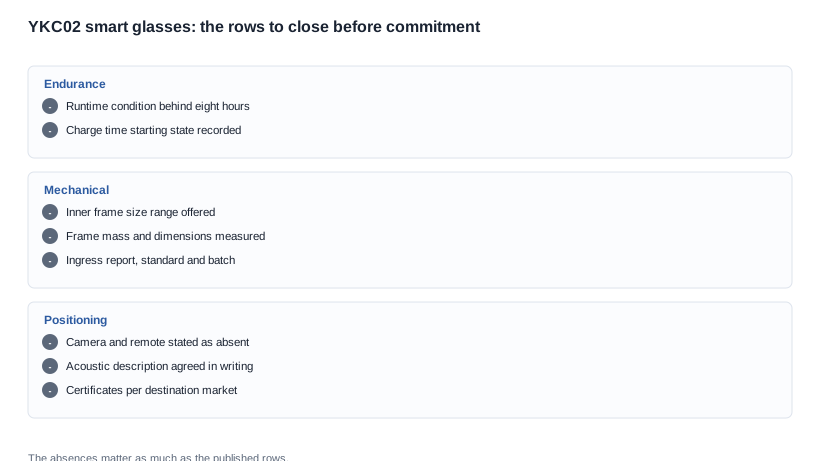
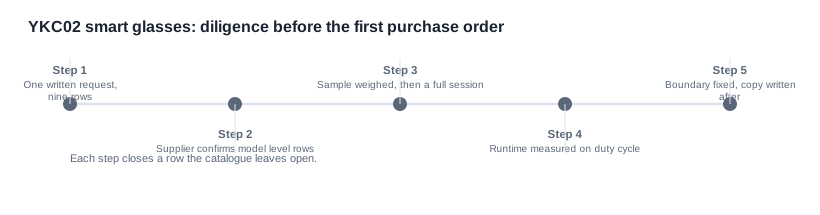
Send the open rows in one request, with the family-versus-model question stated explicitly. The runtime condition. The frame weight and the inner frame size range. The ingress evidence, or the explicit position that none exists. The acoustic description in words. The certification position per market. And, separately, which of the family-level rows — the IP54 marking, the ergonomic frame, the detachable inner frame — are confirmed for the configuration being ordered. Asking that last question as its own item is what prevents the most expensive inheritance error in this category.
Hold a sample, weigh it, and wear it through a full active session. On an endurance-led model the feel curve falls in the second half of a session, and on this model that second half is the entire proposition. A ten-minute shop trial tells a buyer almost nothing about this specific model, which is worth stating plainly because ten-minute try-ons are the normal sample practice.
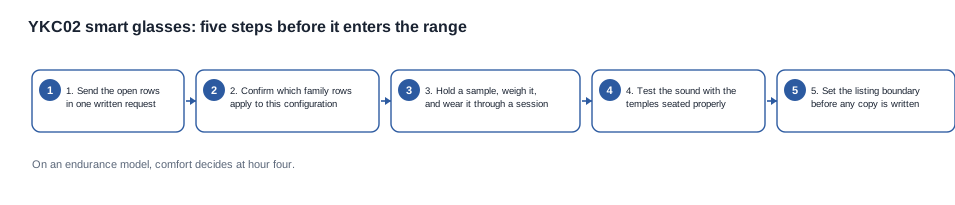
Test the sound with the frame seated properly. The family description includes directional audio, and the sound depends on where the temple sits relative to the ear. Our open-ear audio guidance covers the format and the trade-offs that the unpublished acoustic figures would have covered.
Check the endurance against the real duty cycle. Eight hours is a rating, and on an endurance-led model the rating is the proposition. Measuring it on a sample, in the condition the customer will experience, produces the only figure that can go on a product page with a condition attached to it.
Set the listing boundary before the copy exists. Published rows you may print: the cell configuration, the runtime figure as a rating, the charging method, the charge time and the surround sound row. Open rows you may not: the weight, the dimensions, the inner frame sizes, the acoustic figures, the ingress evidence and the certificate coverage. And explicitly unavailable on this model: any camera, any remote shutter, any one-hour fast charge.

Six ways this model gets listed wrongly
A remote shutter is added from a neighbouring model. Symptom: a listing promises a trigger the product does not have. Root cause: a family-level inference. Prevention: check the specific model's row, in writing, before the copy is written.
The fast charge is inherited from the D17 or the ZH12. Symptom: a retailer promises a full charge between customers in under an hour. Root cause: a platform feature carried across. Prevention: the published figure on this model is magnetic charging at up to two hours.
The IP54 marking is printed as a tested rating. Symptom: a customer expects rain tolerance and the product is splash-rated at best. Root cause: a catalogue entry treated as a result. Prevention: obtain the report, or describe the product as sport-positioned.
The eight hours is published as a working day. Symptom: a customer in a heavy use pattern is disappointed. Root cause: the test condition was never requested. Prevention: quote it as a rating with its condition, or publish your own measurement instead.
The family feature set is treated as a model-level specification. Symptom: a listing promises a detachable inner frame that the ordered configuration does not have. Root cause: family rows read as model rows. Prevention: obtain per-configuration confirmation in writing.
The weight is inferred from the cell configuration. Symptom: returns on an endurance-led product, in the second half of a session. Root cause: a cell size read as a frame measurement. Prevention: weigh a sample and quote your own figure. Our materials and ergonomics guidance covers what to measure on a sample.
Terms, and where this model sits in the range
What this model's position is worth commercially. It is the cheapest model in the sport family to ship: no camera module, no case, no second lithium cell in the parcel, no ingress claim to defend and no camera specification to close. At volume that is worth more than the specification difference between the models in this family, and it is entirely invisible on a product page — which is why a range built around it has to be sold on positioning rather than on parameters.
Open to negotiation, and worth the time. Unit price and volume tiers across a bulk order; the accessory set with its minimum order quantities; the inner frames and their minimum order quantity, which is the line that decides whether the fit feature can be executed; packaging specification; delivery splitting so a first tranche can be validated; payment terms with nodes against inspection rather than against shipment; the warranty period with a stated response time; return terms; and the terms of a pilot order. The trade-off between an endurance-led SKU and a capture-led one is worth pricing rather than assuming.
Certification cost is the one line nobody should try to move. It follows the procedure and the testing body. Tooling is the line to interrogate: it is frequently amortised across a first order, while certification cost is charged per product family, so a quotation that bundles the two into one line is hiding an amortisation difference that matters at exactly the point a second order is placed.
Clauses for the agreement. The published rows for the configuration ordered; the endurance condition; the inner frame size range and the spares route; the ingress evidence or the position that none exists; the frame weight and dimensions as measured; the certification position per market; and the warranty period with a stated response. Clauses to leave out entirely: any remote feature, any fast-charge claim, any weather claim without a report, any weight not measured, and any acoustic figure that is not published.
Where this model sits. Against the D17 and the ZH12, which are the same audio-first idea with a remote, a one-hour Type-C fast charge and a stereo surround sound row, this model trades that fast charge and the remote for a longer published runtime and a larger total cell capacity. Against the YK12, its nominal sibling in the audio range, it is the endurance version of the same idea — bigger cell, longer figure, sport-family mechanical features. Against the V06 and the S7, it is the endurance answer while they are the capture answer.
Where we stand. Our position is that this is a focused product for a focused buyer. We will not dress the family's feature set up as a model-level specification, we will not present the IP54 catalogue marking as a tested result, and we will not put a remote shutter on it. A brand that needs the camera and the endurance in one SKU is asking for something this family does not contain, and the honest answer is two models rather than one.
What a first order should look like when the brief is right. A sample order across the configurations intended for the range rather than one unit of the headline colour, because an endurance model with a detachable inner frame has to be checked in every inner size the channel will stock. A pre-shipment inspection with pass lines written before production — packed unit weight, carton dimensions, colour against the order, and the accessory set against the packing list — because those four lines are where a mistake is cheapest to catch and most expensive to discover later. Payment terms with a node tied to that inspection rather than to shipment. And a warranty period with a stated response time, because on a product whose proposition is a long session, the returns conversation is the customer service conversation and a stated response time is worth more than a longer warranty period on paper.
If you tell us the sport, the channel, the volume and the target market, we will come back with which model in this family fits and which ones we would rule out, and we will say so plainly. The family is on the sport smart glasses range page, the model-level detail is in YKC02 compared, and the sizing question is covered in sport sizing analysis.
Related reading
- Where this model sits in the range — YKC02 compared
- The sport range this model belongs to — sport smart glasses
- The sizing question in depth — sport smart glasses fit and sizing
We need the target market, the quantity and the required configuration, and we will come back with what is available and what is not.


