

Two models with the word sport in their product description, sitting close together in a supplier's line-up, and a buyer asks whether they are alternatives. The honest answer is that they are not, and the reason sits in the physical object rather than in the specification table. The YKC02 is a sport-category model with no camera row published at all: it is an audio-style frame whose entire payload is speakers, a battery and a radio. The S7 is published as an AI sport photo glasses product: it carries a 13 MP camera, an IP54 ingress marking and a 260 mAh cell, and it publishes a removable inner frame. One of these products is built to disappear into a session and run all day. The other is built to capture a session and survive the weather while doing it.
That mismatch is why a straight comparison is misleading, and we will treat it as a mismatch rather than a scorecard. Below we set out what form factor actually means once you are holding the product, which rows the catalogue actually publishes for each side, which rows neither side publishes, and what to make a supplier put in writing before anyone treats the two as substitutable on a shelf or in a buy sheet.
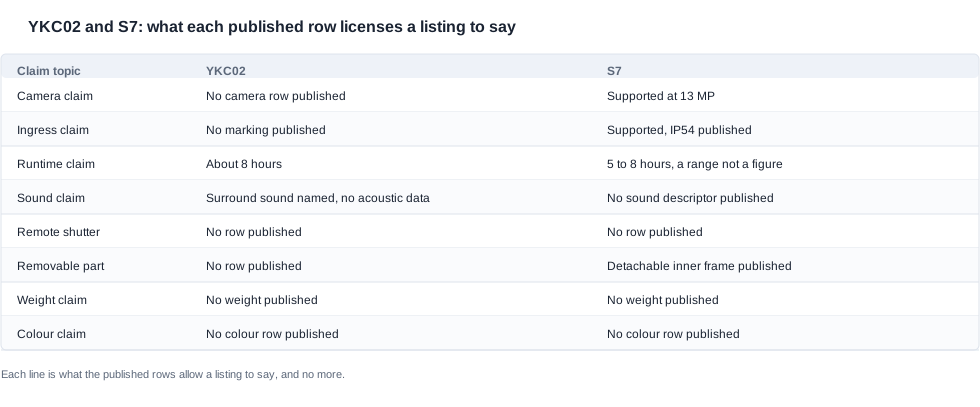
What YKC02 form factor means for a buyer
Form factor is not a styling preference. In a procurement meeting it means the physical answers to six questions: what the frame looks like and what it is made of, what the temple carries, which parts can be separated from the main body, where and how the charging interface sits, what the frame is forced to carry in terms of cell, electronics and sealing, and whether the physical envelope survives the way your customers actually use it.
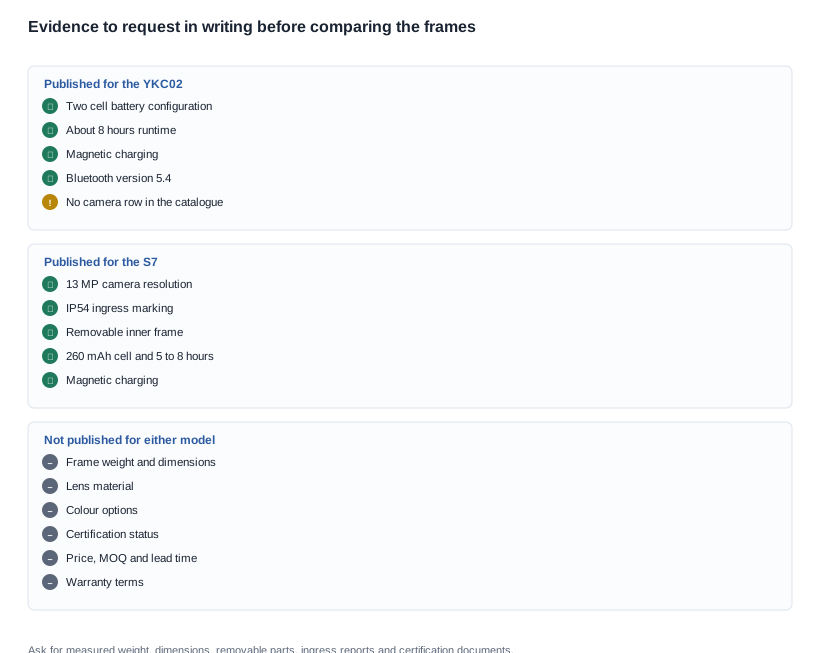
For the first three, the catalogue is uneven. Lens material, frame dimensions and colour options are not published for the YKC02, and frame weight is not published for either of the two models in this comparison. The only public weight anywhere in the entire catalogue belongs to a different model entirely, at 158 grams for the glasses body excluding its folding case. That means any statement of the form "the S7 weighs more because it carries a camera" is an inference about physics rather than a published figure, and it must be presented that way in any buy sheet that goes to a customer.
For the fourth, the charging interface, the two models share a published row, and that is the strongest form-factor point in their favour. Both the YKC02 and the S7 use magnetic charging. Whether one cradle serves both models is a question the catalogue does not answer: magnetic charging is a method, not a published dock standard, and no accessory family is described for any model. A channel partner running both SKUs should therefore ask the supplier directly whether the same cradle charges both, and build the accessory programme on the answer rather than on the shared method. The published rows tell you the method is the same; they do not tell you that the hardware is the same.
For the fifth and sixth, the divergence is structural. The S7's frame is published with an IP54 ingress marking, a 13 MP camera and a 260 mAh cell, and the S7 is one of only two models in the whole range that publish a removable inner frame. The YKC02's published payload is two 70 mAh cells and no camera row. We will say the consequence plainly: the S7 frame is engineered to enclose a lens, a sensor and a sealed enclosure, while the YKC02 frame is engineered to enclose speakers, cells and a radio. Those are different envelopes, and no packaging, bundling or feature-table trick makes them the same product.
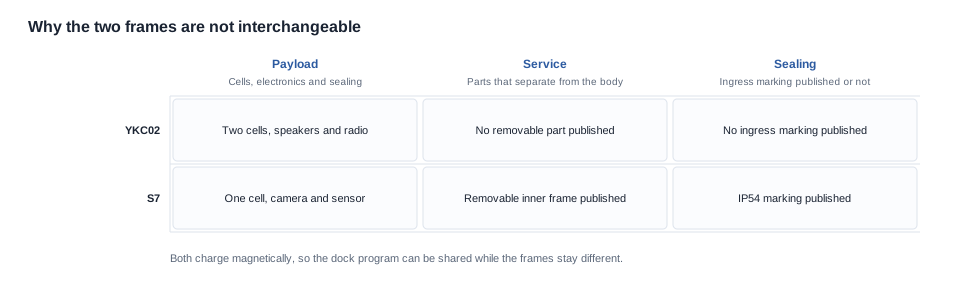
One more form-factor consequence belongs at this stage rather than at the end. If your customer promise is "capture the run, watch it back later", the S7 is the only one of the two that can keep that promise, and the camera row is what makes it keepable. If your customer promise is "wear it through a long session and keep the music going", the YKC02's published runtime of about 8 hours is the relevant number, and the S7's published runtime is a range of 5 to 8 hours rather than a fixed figure. A range on a spec sheet is not a smaller number; it is an acknowledgement that runtime moves with content and settings. The S7 also publishes a charge ceiling of 2 hours or less, matching the YKC02, which means both land in the same accessory and logistics pattern even though their bodies are built differently.
The temple question deserves its own emphasis, because temple geometry is where a buyer actually touches the product. Both models are frames with electronics running through the arms, and both publish magnetic charging, which implies power routing to the frame body. What neither model publishes is the temple's structural detail: no published material statement, no published hinge or detachable-temple row for the YKC02, and no published weight to indicate how the mass distributes front to back. The one detachable-temple fact published in this catalogue belongs to a different model, the G07. That means a buyer who needs to know whether the S7's temple can be swapped for a different size, or whether the YKC02's arms can be replaced in the field, has to ask and wait for a drawing rather than read it off a page. So we will make no assumption in either direction.
The published rows that separate the YKC02 and the S7
Setting aside everything not published, the rows that are published for these two models are enough to place them in clearly different commercial slots. The table below is the whole published set.
- Category and product type. The YKC02 is a sport-category model with no camera row. The S7 is published as an AI sport photo glasses product with a camera row. The catalogue's sport category contains exactly three models — the YKC02, the D17 and the ZH12 — and all three of them name a sound descriptor; the S7 belongs to the camera-carrying group of eleven models.
- Camera. The YKC02 publishes no camera row and must never be described as a camera model. The S7 publishes 13 MP, one of only three models in the range at that resolution, alongside the L1 Pro and the L2 Utral.
- Ingress. The S7 publishes IP54. Across the whole catalogue, only two models publish an ingress marking at all, the S7 and the V06. The YKC02 publishes no ingress rating.
- Cell and runtime. The YKC02 publishes 70 mAh x 2 and about 8 hours of runtime. The S7 publishes 260 mAh and a runtime range of 5 to 8 hours.
- Charge time and method. Both publish a charge ceiling of 2 hours or less, and both charge magnetically. Only two models in the range publish the shorter about-one-hour charge figure, the D17 and the ZH12, and neither of them is in this comparison.
- Removable parts. The S7 publishes a removable inner frame, and it shares that trait with the V06. The YKC02 publishes no removable-part row.
- Connectivity. The YKC02 publishes Bluetooth version 5.4. The S7 publishes no Bluetooth version row, because the catalogue does not publish a Bluetooth version for its camera group.
- Sound descriptor. The YKC02 publishes surround sound next to a long-endurance row. The S7's catalogue page carries no sound descriptor at all.
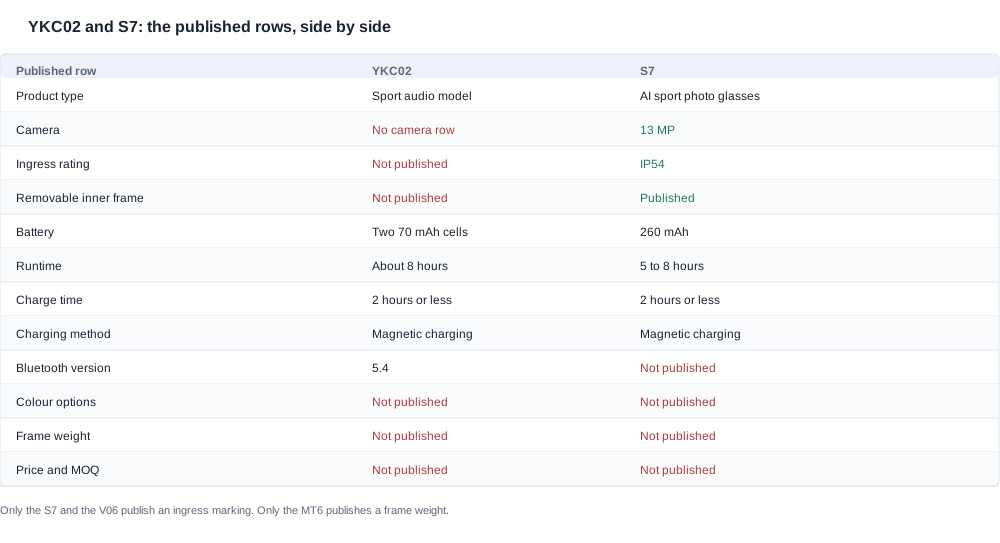
Three observations follow directly from that table, and they are the ones to put in a buy sheet.
First, the 13 MP camera on the S7 is a minority position within the camera group, not a majority one. Eight models in the range publish 8 MP, three publish 13 MP, and the remainder publish no resolution at all. A channel partner positioning the S7 should know it is buying into the higher-resolution minority of the camera line, which is a narrower shelf position and a different sourcing conversation from the 8 MP majority. The companion comparison S7 vs V06 spec comparison is worth reading before you brief a merchandiser, because the V06 shares the sport-photo positioning, the IP54 marking and the removable inner frame but publishes 8 MP instead of 13 MP, and publishes four colour options that the S7 does not.
Second, the IP54 marking is a form-factor claim that carries an obligation. The S7 can be sold as dust and splash resistant, subject to whatever evidence the supplier provides, because the marking is published. The YKC02 cannot be sold that way, because no ingress rating is published for it. This is why we will stress that IP54 is a standard marking, not a marketing free-for-all, and that the underlying test evidence for the specific model is what a serious channel partner should request. Our IP ratings guide sets out what the marking actually covers, and it is worth reading before the claim reaches a product page.
Third, the removable inner frame is a serviceability and fit decision, not a gimmick. A removable inner frame means the sizing layer can be changed or replaced independently of the electronics body, which affects how you stock sizes, how you handle returns, and how many spare frames you carry. It also has a tooling and assembly consequence the buyer should price into a pilot order. If you are evaluating the S7 alongside its sibling, our notes on V06 smart glasses limitations cover the kind of practical friction that emerges once a removable-parts design reaches real customers.
The YKC02's side of the ledger is simpler and more conventional: two cells, about 8 hours, magnetic charging, a 2-hour charge ceiling, and Bluetooth 5.4 published, with no camera row and no removable-part row. That is a coherent audio-first package. It simply is not the same object as the S7.
The position within the wider range reinforces the read. Across the catalogue of 28 models — eight audio, three sport, eleven camera, three kids and three with no model number — magnetic charging is the dominant method, published on seventeen models, and both the YKC02 and the S7 sit inside that majority rather than in the small USB-C group of seven. Charge time is published as a ceiling of 2 hours or less on 26 models, with only the D17 and the ZH12 carrying the shorter about-one-hour figure, so neither model in this comparison is a fast-charge outlier and neither is competing on that axis. Neither sits in the four-model group whose charging method is not published at all. The YKC02 sits in the group with a published Bluetooth version; the S7 sits in the camera group where no Bluetooth version is published, which is a category-level gap rather than a judgement on the product.
One point of catalogue housekeeping is worth stating plainly, because it changes how a buy sheet should be headed. The sport-category models in this range are the YKC02, the D17 and the ZH12. The S7 carries a sport photography descriptor in its product name, but it is published with a camera row and belongs with the eleven camera models. If a buyer files the two under a single heading, that heading should describe a use case, such as sport and outdoor wearables, and never a product category, because the category assignment puts the S7 and the YKC02 in different rooms.

What neither the YKC02 nor the S7 publishes
This section exists because the gaps are where sourcing projects break, and we will keep the list exact rather than rounding it up into something reassuring.
Not published for the YKC02:
- Camera resolution. There is no camera row, so any comparison column for image quality must stay absent rather than showing a blank or a zero.
- Frame weight, and therefore any comfort or all-day-wear claim backed by a number.
- Frame dimensions, lens material and lens specification.
- Colour options. The YKC02 publishes no colour list.
- Ingress or IP rating. No weather-resistance claim is available.
- Certification status. The catalogue body contains no certification entries at all, so nothing about regulatory compliance can be asserted from published material.
- Price, MOQ, tier, lead time, sample policy, warranty term and any stated capacity beyond the two 70 mAh cells.
- Any capacitive-touch row and any translation row. Neither feature appears anywhere in the catalogue, so no touch-control or live-translation claim is available on either model.
Not published for the S7:
- Frame weight and dimensions. The only public weight in the catalogue is the 158 grams published for a different model, and that figure excludes its folding case, so it cannot be transferred.
- Lens material, and any aperture or field-of-view detail.
- Colour options. Four colour options are published for the V06, but the S7 publishes no colour list.
- Bluetooth version.
- Certification status, price, MOQ, tier, lead time, sample policy and warranty term.
Shared by both, and worth stating as a category-level caveat rather than a model-level one: certification status is not published anywhere in this catalogue, and there is no capacitive-touch row and no translation row anywhere in it either. If your marketing team has drafted claims about touch controls on the temple, live translation, or regulatory compliance for either model, those drafts are currently unsupported by published specification and should be treated as unverified until documentation arrives.
We will also flag the honest limit of the weight question, because it comes up in almost every channel conversation. You cannot compare the two on weight because neither publishes one. You can reason that a frame carrying a lens, a sensor and a sealed ingress boundary will differ in mass from a frame carrying speakers and two cells, and you can ask a supplier for the measured figure including or excluding the removable inner frame. What you cannot do is publish a number that no source provides, because the first customer who weighs the product will find the discrepancy.
The discipline that closes this section is simple, and we will state it without hedging: a form-factor claim is only as strong as the row behind it. The S7 may be described as camera-equipped, IP54 marked, and fitted with a removable inner frame, because all three are published. The YKC02 may be described as an audio-style sport model with two cells, about 8 hours of runtime and magnetic charging, because all four are published. Neither may be described with a weight, a colour list, a lens material, a certification mark or a weather-resistance claim on the strength of the other model's row. When a channel brief needs those numbers, they are purchase-order conversations, not product-page copy, and the correct move is to keep the claim off the page until the paperwork arrives rather than to soften the wording and hope nobody measures.
YKC02 and S7 questions before comparing them
Whether the two models belong on the same shelf, the same landing page or the same buy sheet is a decision, and the decision needs documentation before it is made. Here is the request we would send, structured so that the answers arrive in a form you can paste straight into a comparison sheet. We will keep each item to a single question so that nothing is answered in the abstract.
- Measured weight, with conditions. Ask for the weight of each model in grams, stated with or without the removable inner frame, and for the tolerance or measurement method. Follow up on the YKC02 with the same request including both cells and the charging contacts installed.
- Frame dimensions and lens material. Ask for the temple length, lens height and lens width for each model, the lens material, and whether the lens is removable or bonded. Without these you cannot write a fit guide or compare against a competitor's frame.
- Removable parts. Ask which components of the S7 are removable in the field, whether the removable inner frame is offered in more than one size, how it is replaced, and whether spare inner frames are supplied as spares. Ask the same question for the YKC02 and accept that the answer may be that nothing is removable.
- Ingress evidence. Ask for the IP54 test report for the S7, naming the standard, the test laboratory and the report date. For the YKC02, ask whether any ingress testing has been carried out at all. If no testing exists, the correct commercial action is to remove the weather-resistance claim from the channel brief.
- Charging and accessory program. Ask for the magnetic dock specification for both models, whether one dock serves both, the cable and dock contents of the retail box, and the recommended spare-parts ratio for docks.
- Runtime conditions. Ask what content and settings produce the S7's 5 to 8 hour range and what produces the YKC02's about 8 hours, and ask for a test method. A runtime figure without conditions is not comparable across models, and our battery life reference explains why.
- Camera data handling and storage. Ask how the S7 stores and transfers footage, whether storage is internal or removable, the format, and whether there is a companion application. For a camera-carrying product this is a form-factor question in disguise, because it determines whether the customer handles a file or a cable.
- Materials and ergonomics. Ask for the frame and temple material, the temple tip material, the nose pad treatment, and the adjustment range. Our materials and ergonomics reference gives the vocabulary to frame those questions precisely.
- Commercial terms on one basis. Ask for a quotation for both models with the same currency, the same incoterms, the same packaging configuration and the same warranty scope, plus the MOQ and lead time for each, and the sample policy for both. Do not accept two separately framed quotations.
- Certification evidence and pilot order. Ask for the actual certification documents and test reports per model with validity dates, then ask for a pilot order quantity and a purchase order schedule for each SKU. Where you need to place both in the same range page, confirm both are in the same sport smart glasses range and that neither model is superseded in the current line-up.
On point nine, one specific instruction matters more than the others: fix the incoterm before you ask for numbers, then ask the supplier to state what the quoted figure includes — tooling, packaging, certificates, freight, duty. A unit price quoted under two different delivery terms is not a price difference, it is two different contracts, and comparing them produces a false result.
The commercial mechanics follow the form factor, and a buyer who skips them ends up negotiating the wrong number. Samples are the fastest way to settle the physical questions in this article: ask for a production-equivalent unit of each model, ask whether the sample cost is credited against a first purchase order, and ask for the sample lead time separately from the production lead time, because a sample that takes as long as production defeats the purpose of sampling. Tooling follows the removable-parts question, because the S7 publishes a removable inner frame and a removable-parts design carries its own tooling and assembly implications; for the YKC02, ask whether any tooling applies at all to a colour variant or a logo treatment on either model, and whether a pilot order can absorb part of the first production volume. Packaging follows the accessory program: because both models charge magnetically, one dock design can serve both, so ask whether the packaging configuration is shared or per-model and what the retail box contains in each case. Spares follow the same logic — ask for a recommended spare-parts ratio for magnetic docks, for the removable inner frames, and for any remote control accessory, and ask whether spares can be ordered separately from finished goods.
Two trade-offs deserve to be priced rather than assumed. The first is the trade-off between a small MOQ that keeps your inventory light and a larger MOQ that improves the unit economics, and because the two models have different cell architectures and different bill-of-materials complexity, the negotiation on each can move in opposite directions. The second is the trade-off between a short lead time and a lower quoted price, and with two models on one purchase order you can often improve one side by consolidating the other into a single production window. Fix the incoterm before the numbers move, because otherwise the trade-off you appear to win is only a change of delivery terms. We will treat any figure that arrives without a named incoterm, a stated MOQ, a stated lead time and a stated warranty scope as incomplete, and we will not build the comparison sheet on it.
So we will close by naming the outcome we are steering toward. The two models are complementary, not substitutable. The YKC02 is the audio-first, long-runtime, entry-level wearable for a channel that wants a simple battery story and a single magnetic accessory ecosystem. The S7 is the camera-carrying, weather-marked, removable-frame product for a channel that wants capture as the core promise and can justify a 13 MP minority position. Sell them side by side, share the dock program, and let each product carry the claim its published rows actually support. Confirm availability and the current line-up on the sport smart glasses range page, then take the ten questions above to the supplier and build the comparison sheet only from what comes back in writing.


