

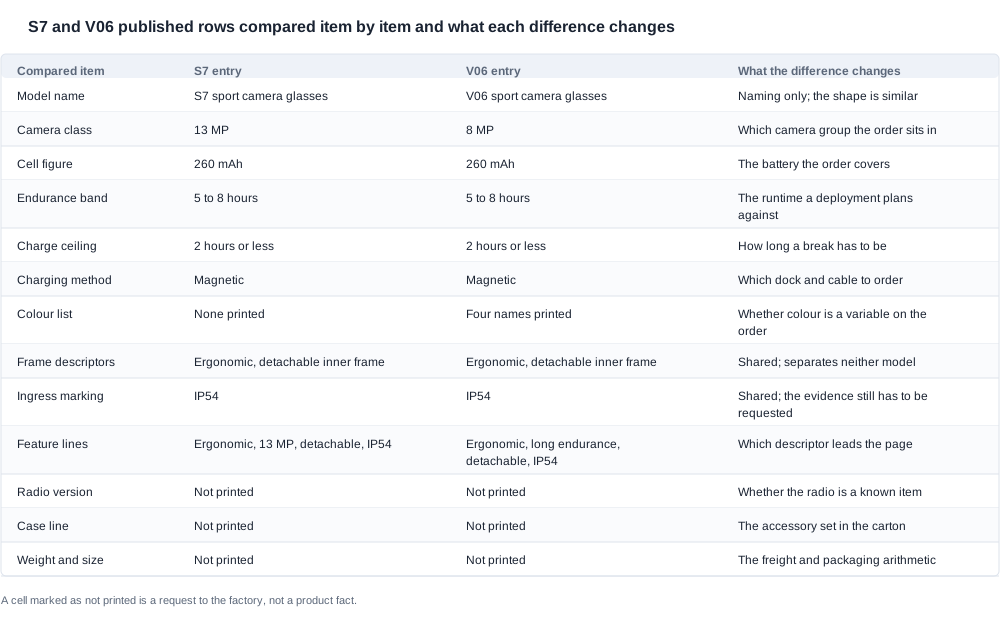
A row-by-row reading of the S7 smart glasses and the V06 is one of the more useful exercises available to a buyer, because the two catalogue pages are almost identical and the differences sit in specific, checkable places. Both models print the same cell figure, the same endurance band, the same charge ceiling and the same charging method, and both carry an ergonomic frame descriptor, a detachable inner frame and an ingress marking. They separate on the camera class, where the S7 prints thirteen megapixel and the V06 prints eight, and on the colour list, where the V06 names four colours and the S7 names none. A comparison sheet that says these two models differ in one row is wrong twice over, and a sheet that says they are the same product is wrong once. This page is written for the buyer who needs the separation located precisely, because a two-line difference between two otherwise identical pages is a decision, not a detail.
S7 and V06 side by side: the published rows
The table below lists every row printed on either page, arranged so that a buyer can see at a glance which entries move a decision and which are shared. The last column is deliberately written in terms of consequence rather than in terms of superiority, because the two models are being compared for a sourcing decision and the consequence of a difference is what a procurement team can actually act on.
A row-by-row comparison is quicker if it runs as a fixed set of checks rather than as a reading. The sequence that works for these two pages is:
- Take the specification block of each page and list the rows in the same order.
- Mark each row as shared, different or absent.
- Record the label used for each shared row, because the label is what a quotation has to copy.
- Move to the feature lines and note the leading descriptor on each page.
- List the rows absent from both pages and carry them onto the request annex.
- Re-read the two pages against the requirement, not against each other.
Step six is the one that prevents a false conclusion, because a comparison read against another model tends to find differences and a comparison read against a requirement tends to find work.
One structural note belongs here too, because it changes how a sheet should be built. The S7 and the V06 are the only two models in the catalogue that print a detachable inner frame, and they are the only two that carry an ingress marking. That means these two pages share two rows that are unique to them, and it also means that a comparison sheet built from them can say something that no other pair of models in the library can say. The reverse is equally true: the radio version is printed on every one of the eight audio models and on none of the eleven camera models, so an empty radio cell on both of these pages is the normal state of the camera group rather than a gap peculiar to these two products.
Read the table as a whole and the shape of the relationship is clear. The two models are near-substitutes on paper, which is exactly why the two differences that do exist carry so much weight, and exactly why a buyer should be careful about which one carries more weight for the requirement in front of them. The camera class is a hardware difference. The colour list is a merchandising difference, and it is the one that touches artwork, stock planning and the range story a brand owner has to tell.
Resolution, cell and runtime
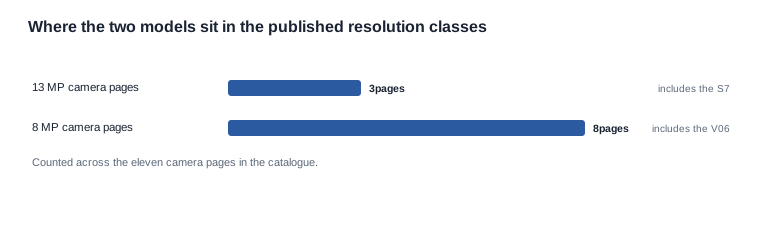
The camera class is the cleanest of the differences. The S7 prints thirteen megapixel; the V06 prints eight. Across the eleven camera pages, three print thirteen and eight print eight, and the S7 is one of the three while the V06 is one of the eight. That is a published class on each side, which makes it usable in a specification annex in a way that most camera claims are not.
What the class does not carry is the part that matters commercially, and it does not carry it on either page. Neither page identifies a field of view, a frame rate, a video format, a sensor model, a lens or a stabilisation system, and the S7 and the V06 are published on the same footing in that respect. A class figure tells a buyer that the S7 sits in the smaller of the two camera groups and that the storage, transfer and file-handling arrangements for this product are a real part of the specification. It does not tell a buyer how the images come out, and the catalogue does not attempt to.
There is a second thing a class does not do, which is settle the question a buyer actually asks about an image row: whether the figure describes a result or a component. A resolution class is a component figure. It says what the camera is specified to capture at, and the catalogue attaches nothing to it about how the resulting files behave — no frame rate, no file format, no storage capacity, no stabilisation, no behaviour in low light. On both of these pages the same is true, which means a buyer comparing them on image outcomes has no published material to compare. The honest position is that the two classes can be written into a specification and that the imaging behaviour of either one has to be established with a sample.
The S7's own feature line repeats the thirteen megapixel figure as a descriptor, and the V06's leading descriptor is a long-endurance line instead — which is an interesting asymmetry, because both models print the identical five to eight hour band in their runtime row. In other words, the V06's page leads with a claim about endurance while publishing exactly the same endurance figures as the S7, and a buyer who reads descriptors as evidence will read a difference into a page that does not have one. The same test applies in reverse: the S7's descriptor adds nothing to its specification block, so a buyer who reads descriptors as information will read information into a page that does not have any.
The cell and the runtime rows are shared, and shared rows have their own specific danger on a comparison sheet. The identical 260 mAh figure and the identical five to eight hour band are printed under the same label on both pages — the electromagnetic capacity label and the usage duration label, both of which are the camera-page wording — so neither model can be described as having a larger battery or a longer run. What the shared rows do establish is that the two models are the same electrical class, and therefore that a buyer choosing between them is choosing on camera class, colour and the unprinted rows, and not on power. That is a useful narrowing, because it removes the two comparisons a spreadsheet is most likely to get wrong.
There is one further consequence of the class difference that belongs in a stock plan rather than in a spec sheet: the two models sit in groups of different sizes. Three camera pages carry the thirteen megapixel class and eight carry the eight megapixel class, so a range holding both classes has a product mix weighted towards the lower class by a factor of more than two to one. A buyer planning how many of each to hold is therefore making a range decision as much as a product decision, and the published class counts are the only figures that inform it without a price list.

What separates the S7 from the V06 beyond the sensor
Beyond the resolution class, the two pages differ in two further places, and one of them is easy to miss because it is expressed as an absence rather than as a value.
The colour list is the clearest. The V06 prints four colour names on its page, and the S7 prints no colour row at all. Across the entire catalogue only two models print colours. For a brand owner planning shelf stock this is a real difference: on the V06, colour is a variable that has to be ordered, forecast and photographed; on the S7, whether colour is even a variable is not published, so a request is needed before artwork or stock planning can begin. It is also a difference in the direction of risk. A colour list that exists creates a forecasting obligation, while a colour list that is absent creates an open question. Neither is better than the other, but they are not the same, and a comparison sheet that shows both cells as "not published" would be wrong about the V06.
The feature lines are the second difference, and they are a matter of which descriptor leads. Both pages carry the ergonomic design line and the detachable inner frame line and the ingress line. The S7's third line is the thirteen megapixel descriptor, which restates the resolution row it also prints in the specification block, while the V06's third line is the long-endurance descriptor, which restates nothing in its own specification block because its runtime row is the same band as the S7's. The S7 therefore repeats a figure it has already published and the V06 asserts a quality it has not quantified. A buyer who wants to treat descriptor lines as marketing and ignore them will get a different answer from a buyer who treats them as claims to be evidenced, and the second reading is the one that survives a question from a customer.
There is a third difference that sits outside the specification entirely and that a documentation-conscious buyer will want to know about. Both of these catalogue pages carry a page-number annotation that does not match the sequence in the table of contents: the footer on the page shows a different number from the one the contents list assigns to the model. The same annotation issue appears on the MT5. It is a documentation question to raise with the supplier, and it matters in a narrow but real way — a technical file that cites the wrong page for a specification is a file that has to be corrected, and a compliance file is the worst place to find a citation error.
There is also a naming point that is easy to misread in a range presentation. Both models carry a sport name in their catalogue titles, and both are camera models in the group structure — eleven of them — rather than members of the three-model sport group. The sport wording describes the shape of the product, not the shelf it belongs to, and a range slide that groups the S7 and the V06 with the D17 or the ZH12 on the strength of their names will produce a comparison that does not hold up. The same slide should also carry the group counts, because the counts are the published structure: eight audio models, three sport models, eleven camera models.

The rows neither model publishes
The rows that neither page carries are not a minor gap; they are the larger half of what a buyer needs. Both models are silent on unit weight, on frame dimensions, on temple length, on the radio version, on the charging case, on every camera detail behind the resolution class, and on every commercial term including price, order floor, production timetable and warranty period. A single unit weight appears anywhere in the catalogue, and it sits on a different model's page: the MT6 eyewear body, listed at 158 g, and measured without the folding case that the same page lists. Nothing about mass, size or packaging is published for either the S7 or the V06, so the freight arithmetic, the carton plan and the warehouse slotting all start from an empty sheet.
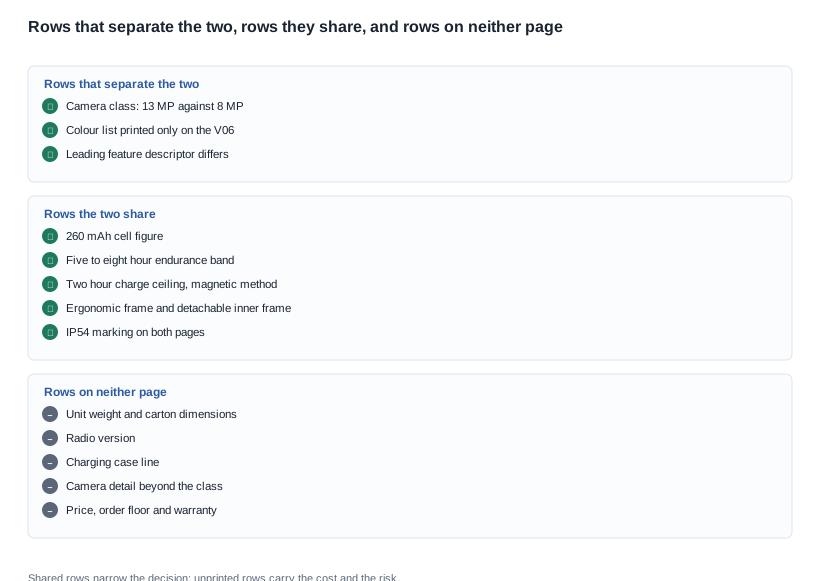
Two of those unprinted rows deserve particular attention because they are easy to assume rather than to read. The first is the charging case. Neither page carries a case line, and the two models sit together in the group of camera pages where the case question is simply not answered — a printed capacity on five pages, a named case with no figure on two, and no line at all on the rest. That means a buyer cannot know from the pages whether a case is in the carton, whether a case has to be added to the bill of materials, or whether the packaging artwork should be drawn around one. The second is the radio version, and the treatment is different: because no camera page prints a radio version, a buyer who needs to know it is making a general request about the camera group rather than a specific question about the S7 or the V06. Both rows are request lines, and a request line that has been written as an assumption is a line that will eventually contradict a carton.
The certification position is the third of the unprinted rows and the one with the most paper attached to it. No certification row appears against any model, and the words CE, FCC and RoHS do not occur in the catalogue text at all; what the export certification page carries is a set of patent images — eight of them appearance-design patents, two of them utility-model patents — so it says something about the company and nothing about this model. What a finished unit would need is the conformity documentation under the EMC Directive 2014/32/EU together with the Radio Equipment Directive (EU) 2014/53/EU on the radio side, with the certificate numbers and the model schedule the certificates cover, which means it has to be requested rather than read. The certification checklist for buyers sets out the document set to ask for, and how the S7 certification position is written up covers the same ground for this model.
Everything in that last group is a request rather than a defect, and there is a practical reason to treat it that way. A factory has answers to all of it: the carton list exists somewhere, the weights were measured before the packaging was signed off, the radio was qualified against a particular standard, and the conformity file was assembled for shipment into whichever markets the model is sold into. None of it is refused and none of it is unusual. What is missing is a published place to read it, which is a different problem from an unavailable answer, and it is solved by a written request with a named document attached to the reply. A buyer who treats the absent rows as blockers will wait; a buyer who treats them as a request list will have a working specification inside a week.
Choosing between the S7 and the V06
Because the published difference is so narrow, the criteria that decide between these two models are short, and a buyer can write them down before the first quotation rather than after it. The first criterion is whether the requirement involves capture. If it does, the camera class is the published separator, and it is the only published separator that touches the requirement directly. If it does not, the two models look alike on paper and the decision moves to the second criterion, which is the colour list and the merchandising work it generates. The third criterion is the request list, and it is where the two models stop looking alike in practice: a buyer who has a written request annex for one of them has a head start on the other, because the same annex covers the shared rows and only the differences need to be re-asked.
The practical sequence that follows from that is straightforward. Build one request annex covering the shared unprinted rows — the carton contents, the case position, the weight as shipped, the radio version, the camera detail behind the class, and the commercial terms. Run it against whichever model the requirement points to, and note the two model-specific lines it produces: the resolution class and the colour list. Then score the returned answers against the criteria above rather than against a preferred outcome. If a buyer instead scores the two models on the published rows alone, the result will be decided by the camera class, which is a legitimate input but a narrow one, and the unprinted rows will sit outside the decision where they belong to the cost and the risk.
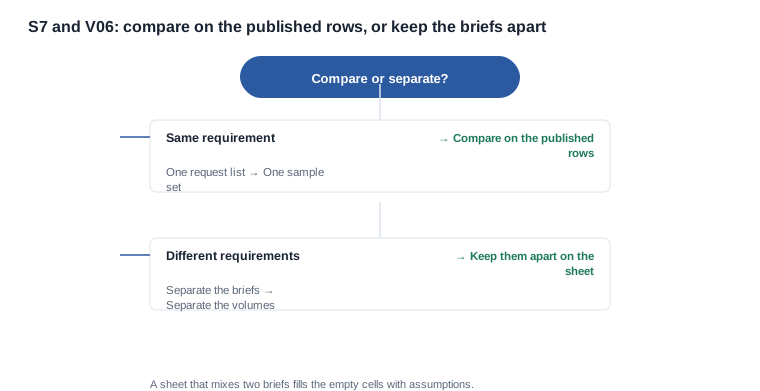
The V06 and the S7 pages look alike because most of what a buyer wants to compare is simply not printed on either of them. We print what we can stand behind and leave the rest of the page blank rather than pad it with numbers chosen for convenience, which is why these two pages look so alike and why the two real differences stand out so clearly. We will not present a resolution class as an imaging specification, a descriptor line as evidence, or an absent row as a negative statement, and we will not rank the two models against each other on a claim that neither page carries. What we can do is give a buyer the two pages as they are, the three groups of rows, and the request list that closes the gaps.
There is a second reason to keep the criteria in writing. These two models are close enough on paper that a conversation with a channel partner can slide into a discussion of which one is "the better camera" without any document behind it. Naming the camera class as the separator keeps the conversation honest: the S7 publishes a higher class, the V06 publishes a colour list, and neither page publishes evidence about the images or the options. If you need the published rows for the S7 gathered in one place before you write the request annex, the S7 specification breakdown is the reference; the request annex that follows from it is set out in the S7 buyer review checklist. The two pages are close enough to be worth comparing properly, which is the whole argument for doing it row by row.


