

The short answer is this: the ZH12 occupies a narrow, well-defined position in the CYNRIN catalogue, and it is a position defined by what it publishes rather than by what it lacks. It is one of three sport-category models, it is one of two models in the entire 28 model range that publish an approximately one hour charge time, it is one of two models that publish a remote control shutter, and it publishes no camera row and no ingress rating at all. A buyer who understands those four facts already has most of the positioning work done.
This article walks the whole range group by group, places the ZH12 against its two sibling sport models row by row, and then builds the sheet you should use when you sit down to compare any model against any other. The point of the sheet is not elegance. It is that it keeps a published specification separate from a specification you still need to request, so that a quotation request and a product page end up saying the same thing.
Which catalogue group the ZH12 belongs to
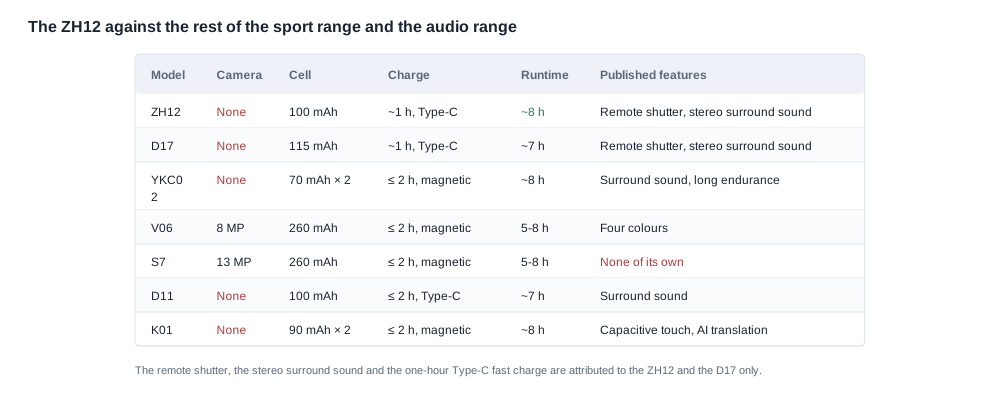
The catalogue contains 28 models, and they fall into a small number of recognisable groups.
- Audio group, 8 models. The G07 and the K01, the LC-105-1 and the D12, the K02 and the D11, and the LC-105-2 and the YK12.
- Sport group, 3 models. The YKC02, the D17 and the ZH12.
- Camera group, 11 models. The CY03 and the L2 Utral, the V03 Pro and the KY06, the S7 and the MT6, the V06 and the CY05, the MT5 and the L1 Pro, and the V03.
- Kids group, 3 models.
- No model number, 3 entries. The AR glasses entry, the electrochromic entry and the bone conduction entry.
The ZH12 belongs in the sport group, and the sport group is small enough to know in full. There are exactly three models in it. That is worth stating clearly because the category boundaries in this catalogue are not always obvious from a product page, and the ZH12 in particular sits next to models in other groups that publish rows it does not.
The ZH12 is not an audio-tier model. The audio group has its own eight models with their own row sets, and the ZH12 is not one of them. It publishes a surround sound row, which is a feature rather than a category, and the audio group publishes surround sound only on the D11.
The ZH12 is not a camera-tier model. The camera group has 11 models and the ZH12 is not among them. Its feature row contains no camera entry at all, which is a stronger statement than saying the camera specification is unpublished. A model that carries a camera row with a missing value still has a camera. The ZH12 simply does not carry a camera row, and we will not describe it as a camera model, attach a resolution to it, or place it inside the camera group when we build a range comparison for a customer.
That last point is the one that generates the most avoidable errors. A buyer comparing across the range will naturally ask the ZH12 for a resolution because every camera model in the catalogue answers that question. The correct handling is to record the cell as "not applicable, no camera row published" rather than as "not published", because those two entries mean different things on a positioning sheet. The first says the model is not in that category. The second says the category applies but the value is missing. Conflating them puts the ZH12 into the camera group in your own internal documents, and from there it leaks into product copy.
For contrast, the camera group publishes a camera resolution on every model that carries one — 8 MP on eight models and 13 MP on three, which are the S7 and the L2 Utral, and the L1 Pro. The V06 and the S7 also publish IP54, and those are the only two models in the entire 28 model range with any published ingress rating. So the contrast for a buyer is clear. A brand stocking the ZH12 next to a camera model such as the S7 or the V06 is giving the customer a shutter-driven, sound-led sport product and an image-capture product as genuinely different propositions, not as spec-sheet increments of each other. That is a healthier range architecture than three near-identical audio models, and the sport category is the reason it is possible.

The published rows that place it
Here is the complete published row for the ZH12, with nothing added and nothing inferred.
- Cell. A single 100 mAh cell.
- Runtime. Approximately 8 hours.
- Charge time. Approximately one hour.
- Charging method. USB-C.
- Bluetooth version. V5.4.
- Feature row, entry one. Remote control photo.
- Feature row, entry two. Stereo surround sound.
That is the whole published specification. Seven rows, one of which is a two-entry feature row. The catalogue publishes no camera resolution, no frame weight, no dimensions, no lens material, no colour options, no ingress rating, no certification status, no price, no MOQ, no lead time, no sample policy, no warranty terms and no capacity for the ZH12.
Each of those published rows carries comparison weight, and the weight is different in each case.
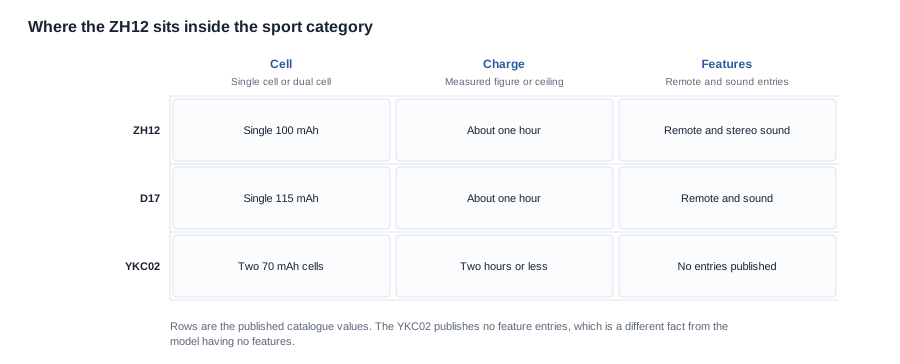
The cell places the ZH12 against the YKC02, which uses two 70 mAh cells. Single cell versus dual cell is the structural difference that explains the rest of the sport group's internal trade-offs.
The runtime places it level with the YKC02 on published hours. The D17 publishes approximately 7 hours from a slightly larger single cell. So within the sport group, the published runtimes sit at approximately 8 hours for the ZH12, approximately 8 hours for the YKC02 and approximately 7 hours for the D17.
The charge time is the strongest single differentiator in the catalogue. The ZH12 publishes approximately one hour. The D17 publishes approximately one hour. Every other model in the 28 model range publishes two hours or less. That distinction matters methodologically as well as commercially. The two hours or less figure is an upper bound, a ceiling, not a measured value. When you compare an approximately one hour measurement against a two hours or less ceiling, you can say the ZH12 is one of two models with a published charge time of about one hour, and that it is the fastest published figure in the range. You cannot rank it against models whose true charge time is unknown but is somewhere under the ceiling. Our battery life technical section covers how this class of product is normally measured and why the difference between a ceiling and a measurement is worth understanding before you put a claim on a carton.
The charging method places the ZH12 with the USB-C group. Across the catalogue, magnetic charging is published on 17 models, USB-C on 7, and the charging method is not published on 4, which are the CY03 and the CY05, and the L1 Pro and the MT6. The YKC02 is a magnetic model. That single row separates the ZH12 and the D17 from the YKC02 cleanly.
The Bluetooth version places the ZH12 at V5.4, alongside the D17 and the YKC02. Across the whole catalogue, the Bluetooth version is published for 14 models. It is not published for the 11 camera models, nor for the A05, nor for the A06, nor for the bone conduction entry. So for a buyer building a range sheet, the ZH12 sits on the well-documented side of the catalogue, where the radio version is a stated fact rather than a blank.
The feature row is what makes the ZH12 the ZH12. The remote control is published on exactly two models in the range, the D17 and the ZH12, which means it is a genuine category differentiator for a sport model rather than a common feature. Surround sound is published on the D11 and on the ZH12, and the D11 is the only model in the audio group carrying it. That is three models in 28 with a surround sound row.
The reason these last three rows carry more weight than the others is that they are the rows a customer can actually feel. Cell capacity, runtime and charge time are engineering inputs that a buyer internalises and a customer only sees the consequence of. The remote control and the surround sound are visible on the shelf, demonstrable in a store, and photographable for a product page. That is why the sport category exists as a separate group with three models rather than as a colourway option on an audio model, and it is why a range sheet should treat a two-entry feature row as a positioning statement in its own right. The ZH12 publishes exactly two entries, and both of them are category-level differentiators. That is an unusually clean position to defend.
For a buyer assembling a range, there is a practical consequence to the well-documented rows and it cuts in your favour. Because the cell capacity, the runtime, the charge time, the charging method, the radio version and the feature row are all published for the ZH12, you can write a specification table for it, quote it, and negotiate a price against it without a single additional request. Every model where you have to ask first is a model where your launch date depends on someone else's answer. The ZH12 does not carry that risk on the rows that matter most for a product page, and we will always write it up in that form because the published record supports it.
Two things you will not find anywhere in the catalogue are worth noting explicitly, because they are the claims buyers most often want to make about a sport model and least often can. There is no capacitive-touch row on any model, and there is no translation row on any model. If a buyer asks whether the ZH12 has touch control or live translation, the answer is that no model in the range publishes either, so the ZH12 cannot be presented as holding an advantage on a feature no one has.
How it differs from the D17 and the YKC02
Row by row, against the only two models it can be compared to inside its own category.
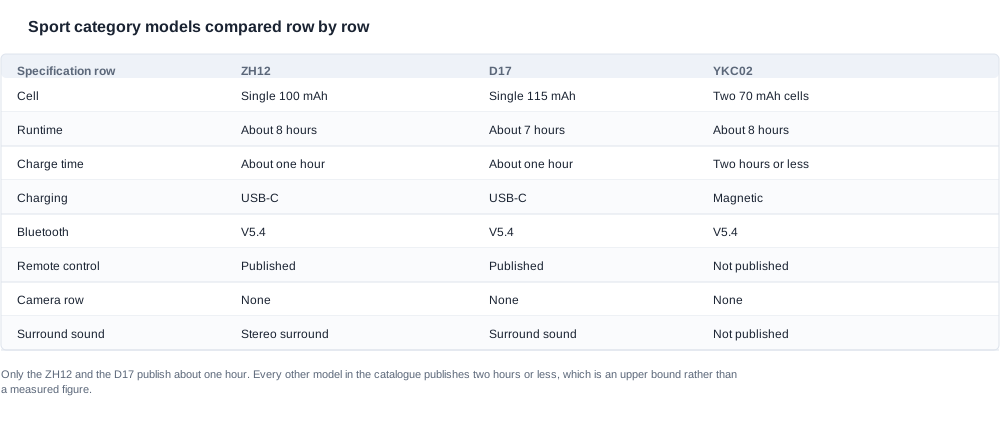
| Row | ZH12 | D17 | YKC02 |
|---|---|---|---|
| Cell | Single 100 mAh | Single 115 mAh | Two 70 mAh cells |
| Runtime | Approximately 8 hours | Approximately 7 hours | Approximately 8 hours |
| Charge time | Approximately one hour | Approximately one hour | Two hours or less |
| Charging | USB-C | USB-C | Magnetic |
| Bluetooth | V5.4 | V5.4 | V5.4 |
| Remote control | Published | Published | Not published |
| Camera row | None | None | None |
| Surround sound | Stereo surround sound | Surround sound | Not published |
Against the D17, the two share an architecture and differ on the numbers. Same single cell design, same USB-C charging, same V5.4 radio, same approximately one hour charge time, and the same remote control photo feature. They diverge on cell capacity, 100 mAh against 115 mAh, on runtime, approximately 8 hours against approximately 7 hours, and on the wording of the sound row, stereo surround sound against surround sound. The most useful reading of that combination is that these are two distinct products with a shared design language rather than one product under two names. A slightly smaller cell producing a slightly longer published runtime is exactly the sort of detail that only occurs when two genuinely different units are involved. If you are asked whether the D17 and the ZH12 are interchangeable for sourcing, the published rows answer that they are not.
Against the YKC02, the two sit at the same published runtime by completely different means. The YKC02 carries two 70 mAh cells, which is a greater total capacity than the ZH12's single 100 mAh cell, spread across two packs. It charges magnetically and is published at two hours or less, where the ZH12 charges over USB-C in approximately one hour. The YKC02 publishes no remote control row, no camera row and no surround sound row, so its feature row is effectively empty in the published record. The trade-off is clean and it is the central commercial decision inside the sport category. If remote control and stereo surround sound are your proposition, the ZH12 is the only model in the category that carries both, and the price of that proposition is a single cell design with a one hour charge rather than a two cell design with a two hour ceiling. If you want the maximum published cell capacity and a magnetically charged pack and no additional claims to defend, the YKC02 is the model for you.
One point of care on the feature rows. The D17 publishes "remote control photo" and "surround sound". The ZH12 publishes "remote control photo" and "stereo surround sound". We reproduce those labels exactly as published and we will not upgrade the D17 to stereo in your copy, because that would be a claim the catalogue does not support for that model. Conversely, if your customer-facing comparison table places the two side by side, keep the published wording in both cells so the table survives scrutiny.
And a point of care on the YKC02. Its feature row being empty in the published record does not mean the YKC02 has no features. It means no features are published for it. That is a meaningful difference for anyone building a range sheet, and it is the difference between a cell that reads "not applicable" and a cell that reads "not published".

Building a range positioning sheet
A range sheet that works is not a summary of the catalogue. It is a working document that a buyer can use to write copy, raise a quotation request and negotiate with confidence. Here is the structure we recommend, and the order in which to fill it.
- Assign the group first. Group membership is not a matter of judgement, so settle it before anything else. For the ZH12 that means sport group, and it means explicitly not audio group and not camera group. A model sits in one group and, for the ZH12, the absence of a camera row is part of the group assignment rather than a gap within it.
- Transcribe the published rows verbatim. Copy them as published, including the qualifiers. Approximately one hour stays approximately one hour. Two hours or less stays two hours or less and gets marked as a ceiling. Do not let the copy step smooth over the difference between a measurement and a bound.
- Mark every row that is not published as not published. Use one consistent marker for the entire sheet. Do not leave blanks, because a blank reads as a value of zero or as something nobody has checked yet. Do not write "no" in a published field either, because no and not published are different facts.
- Mark every row that is not applicable as not applicable. This is the category boundary, and it applies to the ZH12 on camera resolution, ingress rating and the audio feature set. These are the entries that must not be turned into questions, because there is nothing to ask.
- Convert the remaining gaps into a written question list. Weight and dimensions, colour options, lens material, ingress, certification evidence, price, MOQ, lead time, samples, warranty, spares, packaging and incoterms all go onto the list with an owner and a date against each one.
- Record the commercial answers separately from the technical answers. Keep the quotation request and the purchase order conditions in one place, and the technical gaps in another, so that a slow technical answer does not hold up a price negotiation or a lead time commitment.
- Re-check before the purchase order is issued. Every published row still matches the catalogue, every confirmed row is now written down, and nothing has been upgraded from a ceiling into a measurement along the way.
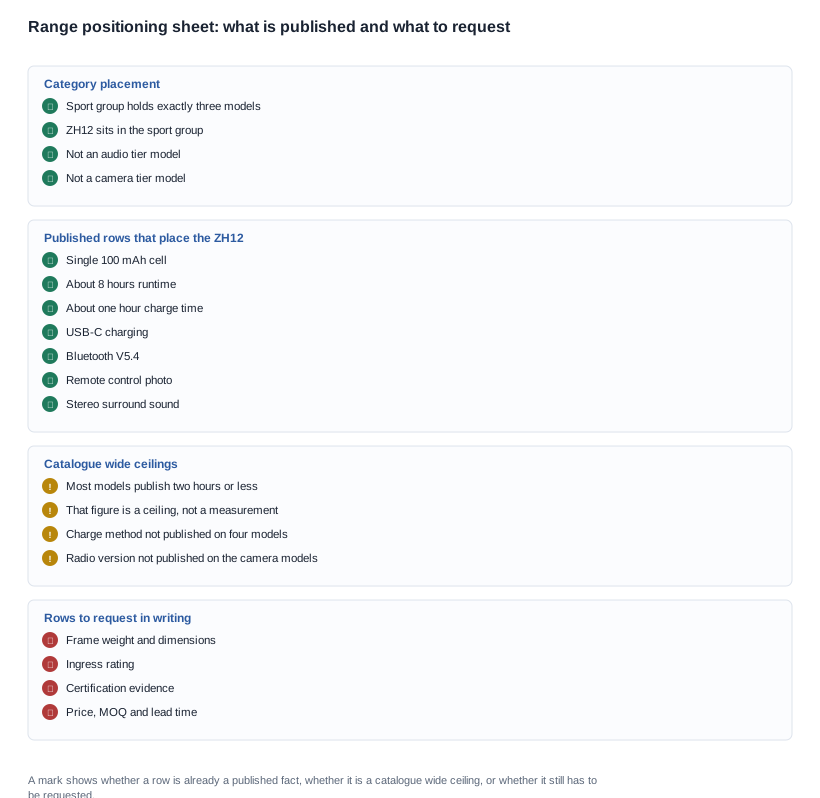
That last point catches the most common failure in this category. Somewhere between the catalogue page and the finished product page, a "two hours or less" becomes "two hours", and then "fast charging" appears without a comparison, and then a buyer asks why the fast-charging model charges in one hour and the manual says two. Marking the ceiling explicitly at the start prevents that, because the difference between the ZH12 and the D17 is the only place in the catalogue where a fast-charge claim can be made with a number attached.
The second discipline on the sheet is about the rows the catalogue publishes for only a few models. The single public weight in the entire catalogue is the MT6 at 158 grams, which is the glasses body and excludes the 1200 mAh folding case. The only published ingress ratings are IP54 on the V06 and the S7. The only models publishing a camera resolution are the 11 camera models. A sheet that carries these as if they were the range average would misrepresent every model that does not publish them, including the ZH12. The correct use of a single data point is as a reference, not as a benchmark.
A third discipline, and this one is about how the sheet is maintained rather than how it is built, is to version it. A range sheet that sits in a shared folder and gets edited by four people over two quarters is no longer a working document; it is a document people are afraid to trust. We will keep the catalogue transcription static and dated, so that anyone reading the sheet can see which version of the catalogue it was built against, and we will keep the confirmation log separate so that a new answer does not silently rewrite the published rows. This costs almost nothing and it is the difference between a sheet you hand to a new colleague and one you have to re-explain.
The sport smart glasses common questions article covers the question-by-question view from the buyer's side, and the sport smart glasses remote control options article covers the remote in detail, which is the feature that most sharply separates the ZH12 from everything except the D17. Our AI camera glasses category page covers the 11 camera models as a group if you are weighing the sport and camera propositions together.
We will keep to the same rule across every sheet we build for a customer: published rows are reproduced exactly as the catalogue states them, unpublished rows are marked as unpublished and turned into written questions, and category boundaries are respected rather than smoothed over. That is what makes a positioning sheet usable long after the person who built it has moved on to something else, and it is what stops a range plan from quietly turning into a set of claims the factory never agreed to.
There is a commercial reason to keep the sheet disciplined as well as a documentation reason. A range plan built on unconfirmed values will fail in the two places that cost the most: the product page, where an unsupported claim becomes a customer complaint, and the purchase order, where an assumed figure becomes a dispute over what was actually agreed. Neither failure is recoverable by apologising later. Both are recoverable by spending a week asking the right questions in writing before the packaging artwork is locked, and the sheet is simply the instrument that makes that week efficient.
Before you commit to a range position, the last step is not a document at all. It is a sample in your hand and a measurement on your bench. Samples settle the remote control question, the runtime question and the build quality question faster than any exchange of emails, and a pilot order then tests the packaging, the documentation and the after-sales process at a scale where a mistake is still cheap. Once you have the sample, the published rows become checkable facts rather than something you are taking on trust, and the sheet above becomes a record of what you verified rather than a list of what you were told.


