

Value judgements in smart glasses are usually built on three numbers: the unit price, the minimum order quantity and the charge time. For this model the first two are not published anywhere in the catalogue, which leaves a single published pair doing most of the work — and a buyer-facing question that most product pages never answer. Whether that is enough depends on what your channel sells and how the product gets used, so this piece works through the figures that exist, the claims they can carry, and the terms you still need before the zh12 can be compared on price with anything else.
zh12 value: what the published rows can actually carry
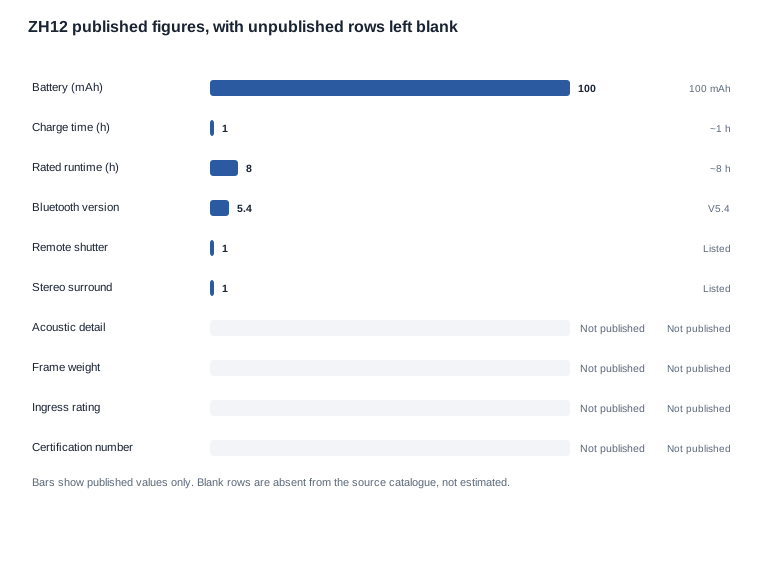
Value in a hardware channel is not the same thing as price. Price is the number a buyer argues down in a negotiation; value is what a unit has to earn in your channel after everything that is not on the invoice has been counted. For this model the catalogue publishes seven rows, and two of them do most of the value work: a charge time of about one hour and a rated runtime of about 8 hours, carried by a 100 mAh cell over a Type-C interface.
The pairing is unusual for a reason worth stating plainly. Twenty-six models publish a charge time of two hours or less — a ceiling that filters out products nobody would want to own — and only two publish about one hour: this one and the D17. On runtime, about eight hours sits at the top of the published audio range, level with the K01 and the LC-105 series, above the D11 and the D12 at about seven hours and the G07 at about six. The file therefore combines the shortest stated charge time in the range with a top-of-range runtime, in a single 100 mAh cell rather than a paired configuration.
What that combination does for a channel is concrete even without a price. A one-hour charge changes the rhythm of ownership. A customer who wears the product through the working day can put it on charge over a lunch break and take it off charge again before an evening session, which removes the small daily interruption that generates returns and support tickets in this category. The eight-hour rating changes the same rhythm from the other end: fewer occasions on which a customer looks at the product and wonders whether it will last. Neither figure guarantees that experience, because neither carries a test condition, and smart glasses battery life explains precisely why these published numbers cannot be compared across models without their method.
The third value row is the interface. Type-C charging means the product reuses a cable the customer already owns, which removes the accessory objection at the point of sale and one line from the packing list. In a portfolio where seventeen models charge magnetically, seven charge over Type-C and four publish no charging method, the interface also determines how your warehouse, spare-parts plan and retail merchandising work. A model that fits your existing cable habit is worth more than the same model with an adapter, and that difference never appears in a price comparison.
What these rows cannot do is carry a superlative. No test condition is published for any model in this catalogue, so a claim that this model lasts longer than a competitor cannot be evidenced, and a claim that it charges faster than a competitor cannot be evidenced either unless both protocols are supplied. The honest commercial use of the published rows is narrower and more durable: this model publishes the shortest stated charge time in the range, and it publishes a runtime at the top of the audio range. Everything the channel wants to say beyond that has to be built on something else.
The published rows also shape the reviews a product collects, and reviews are part of a channel's unit economics. Where customers can compare charge times on a page, the fastest published figure tends to produce the strongest first impression and the weakest first-day reality, because the customer measures from a different state than the catalogue did. A one-hour figure with no protocol invites exactly that mismatch: the customer times a full charge on a cold cell with a slow adapter, lands closer to ninety minutes, and leaves a one-star review for a difference that is documented rather than defective. That is an argument for the supplier's method rather than against the model, and for the quotation to carry the condition, so a support team can answer the first review with a document instead of a guess.
The rest of the audio range matters here, because the same channel will usually carry one of those models too. Eight models make up the audio category — the K01, the K02, the D11, the D12, the LC-105 series in two configurations, the G07 and the YK12 — and they sit on longer charge times and shorter or comparable runtimes. A channel stocking two or three audio products usually ends up with one as the everyday item and one as the sport or endurance item, and this model is built for the second role. That is a channel-structure point rather than a technical one, and it decides where the unit sits in the price ladder once the terms are known.

What a zh12 price comparison cannot show you
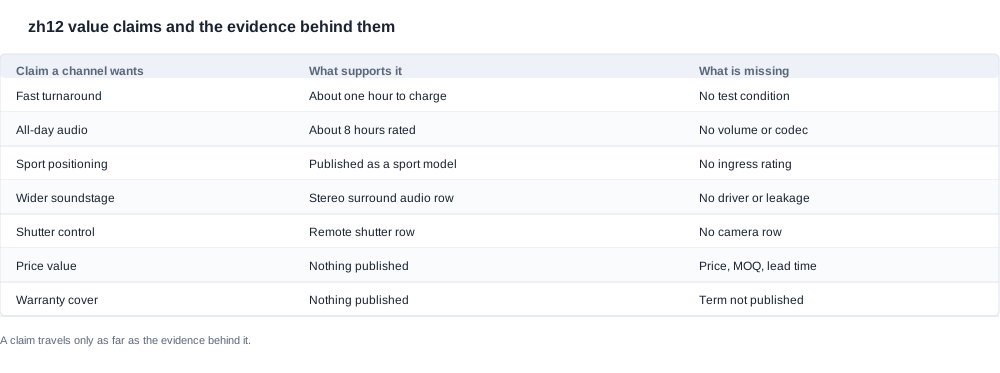
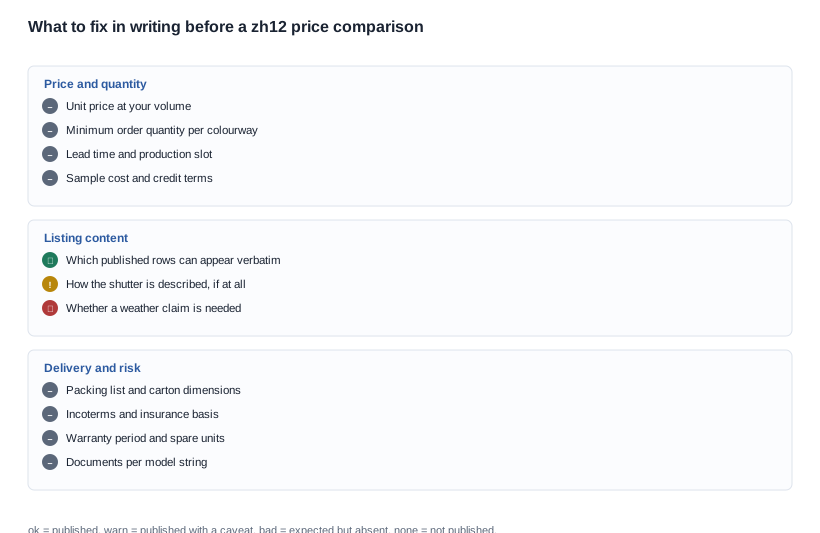
No unit price, production lead time, minimum order quantity, sample cost or warranty period is published for this model, and none is published for any other model in this range. That is not an omission in the page; it is how the catalogue is built. It does mean that any comparison you make before those five figures are fixed is arithmetic on numbers you have not yet seen, and the comparison will change shape the moment the real ones arrive.
The reason is that effective unit cost is not a price. It is the landed cost of one sellable unit at your volume, with your configuration, in your market, under your terms. Five things move it, and a supplier quote that blends them into one number cannot be negotiated, because any movement on one element moves all the others invisibly:
- Unit price — the price at your volume band, stated against a quantity, with the currency and the validity period on the same page.
- Quantity bands — the minimum order quantity per colourway and per configuration, and what the price becomes at the next band above it.
- Packaging and accessories — the cost of your carton, artwork, printed insert and any Type-C cable or adapter you decide to include.
- Certification scope — what a document set for your market and your configuration actually costs, and which model string it attaches to.
- Freight and terms — the incoterms the price is based on, because a quoted figure on one basis and a quoted figure on another will make the cheaper offer the more expensive one once it lands.
The minimum order quantity deserves particular attention, because in this category it drives effective unit cost more often than the list price does. A channel that wants four colourways and a logo carries four separate commitments, and the headline minimum rarely reflects that. The lead time matters for the same reason: it is not a date, it is a quantity of working capital tied up in a product that cannot be reordered in small increments. Ask how the lead time splits between the sample, a pilot order, the first production order and a reorder, because those are four different answers.
The most expensive mistake at this stage is not choosing the wrong model; it is comparing two models on a basis that flatters one of them. A quote that bundles certification for one market and excludes it for another, or that includes accessories for one product and not the other, produces a result that reverses the moment the terms are normalised. Normalisation is unglamorous work and it is the only way the shortlist criteria mean anything: same volume, same scope, same basis, same currency, same validity. We would rather spend an afternoon on a table than a quarter on a shipment that was never actually compared.
Minimum order quantity is also where a sport range becomes expensive quickly. The sport category publishes no colour list for this model, so a channel that wants three colourways is committing to three minimums, three lead times and three sets of packaging rather than one of each. A buyer who arrives with a single configuration requirement usually finds a materially better effective unit price, and a buyer who arrives with a colour plan usually finds that the plan, not the product, decides the price. Both of those are worth knowing before the shortlist is drawn.
Two further terms decide whether a good price stays good after the shipment. Warranty scope matters more here than the category average, because a product sold on an eight-hour runtime and a one-hour charge generates returns when a cell degrades or a charge port fails, and those returns are invisible in the unit price. And a sample is not a courtesy — it is the cheapest line in the budget, because it is where the published rows meet something you can hold. Smart glasses wholesale covers the structure of a wholesale order and the terms that usually decide the outcome.
The practical method is to compare after the specification is fixed and before the order is placed. Ask for the written terms, put them into a single table, and compare models on the same basis: same volume assumption, colourway count, packaging scope, certification scope, incoterms, warranty period and payment structure. A comparison built that way survives scrutiny from your own finance team, and it is the only kind that tells you which model is the better buy for your channel.
Missing rows, and the zh12 claims they block
A published row is an asset. An unpublished row is a limit, and the limits on this model are concentrated in exactly the places where a channel would want to make its strongest claims. Four of them matter commercially, and a fifth is unusual enough to treat separately.
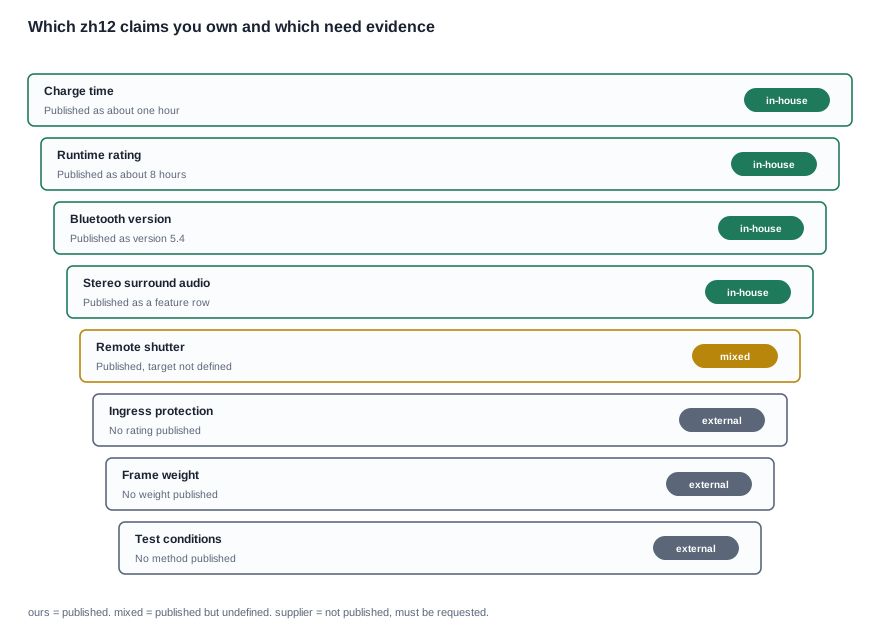
The first is ingress protection, and it is the one a sport-positioned listing needs most. Only the V06 and the S7 publish an IP marking in this catalogue, both at IP54, and both are camera models rather than sport audio models. There is no marking to inherit and no baseline to point at, which means a listing for this model cannot say splash resistant, sweat proof or weather ready, and cannot carry a softened version of any of them either. IP ratings and durability sets out what a marking would establish if one existed and why its absence is not a neutral gap.
The second is weight. Exactly one model in this catalogue publishes a weight — the MT6, at 158 grams for the glasses alone, excluding its 1200 mAh foldable case — and nothing about that figure transfers to a different cell and a different hinge. So a lightness claim cannot be sourced from the catalogue, a comfort comparison against a competitor cannot be made, and fit cannot be pre-screened before a sample arrives. The third is acoustic detail: driver size, frequency response and leakage are published for no model, so the stereo surround row can be named in a listing but never quantified, and a customer comparing two pairs in a shop has nothing on the page to compare. Open-ear audio technology covers why leakage and response matter more than the word surround.
The fourth is certification, and it is the gap most likely to stop a shipment rather than a listing. The catalogue carries no per-model certification row. The export-certification page is a picture page: ten patent certificate images, eight design patents and two utility models. A patent certificate evidences an ownership right over a design or a mechanism; it is not a conformity test report for a finished radio product. No certification scheme or report number is named in the catalogue body for any model. The phrase certified on a product page, a carton or a tender response needs a document behind it, and certification checklist is the format we work from.
The fifth row is the strange one, because it is published and still cannot be used. Remote shutter control appears on this model, and no camera row appears for it at all. The same row appears on the D17, which points to a shared platform rather than a model-specific function. Whether the control triggers a paired phone, works with a separate camera unit in a bundle, or has no defined function on this model is not published, and the three explanations are equally unproven. A page that lists a shutter button on a product with no camera is a page a reviewer can dismantle in one sentence, and the damage is not confined to that line: it teaches the customer to distrust every other number on the same page, including the two that carry the value argument.
Two catalogue-wide absences shape the listing as well. There is no capacitive-touch row anywhere, so no touch control language can be written for this model or any other. There is no translation row anywhere, so a live translation feature cannot be claimed on the strength of a catalogue page.
There is a way to write copy around an absence, and it is worth separating from a workaround. A missing row means the claim does not exist, and the honest treatment is to leave it out and say what is published instead: a Type-C interface and a one-hour charge, a stereo surround mode, a Bluetooth version. A workaround means restating the claim in softer language until it survives review, and that is how a page ends up carrying a sentence the supplier cannot support. The first approach costs a line of copy; the second costs the trust the whole page depends on.
It is also worth being precise about why these rows are missing rather than merely absent. When a catalogue withholds a field on a minority of models, the supplier usually holds the data and has simply not committed to publishing it, which means it can normally be produced on request — a very different position from a field nobody tracks. The way to tell the two apart is to ask for the field against a model string and see what comes back: a number with a method attached, or an honest answer that it was never measured.

What the zh12 offers next to the D17 and the YKC02
The sport category in this catalogue contains exactly three models: the YKC02, the D17 and this one. Two of the three publish about one hour to charge over Type-C — this model and the D17 — and the third, the YKC02, charges magnetically over a paired 2 × 70 mAh configuration and reaches about eight hours of rated runtime. This model is a sport model; the YKC02 is not an audio-range model and should never be listed as one.
The three published stories are not interchangeable. This model leads on the charge-and-runtime pairing, with about one hour to charge and about eight hours of rated runtime on a single 100 mAh cell. The D17 matches the one-hour charge and the Type-C interface but carries a larger 115 mAh cell at about seven hours, and publishes a Surround Sound row where this model publishes stereo surround sound plus the remote shutter. The YKC02 shares the eight-hour runtime rating and the sport positioning but reaches it through two cells and a magnetic dock, which is a different customer experience, a different accessory and a different spare-parts story at the point of sale.
The trade-off runs through that architecture. A single-cell design charges in about an hour and depends on one cell for the whole session; a paired-cell design spreads the load but introduces a dock into the box and a second item to replace. For a channel that sells on endurance and simplicity, the single-cell model is the cleaner story. For a channel whose customers expect a case that arrives with the product, the paired configuration answers a question the single-cell model cannot.
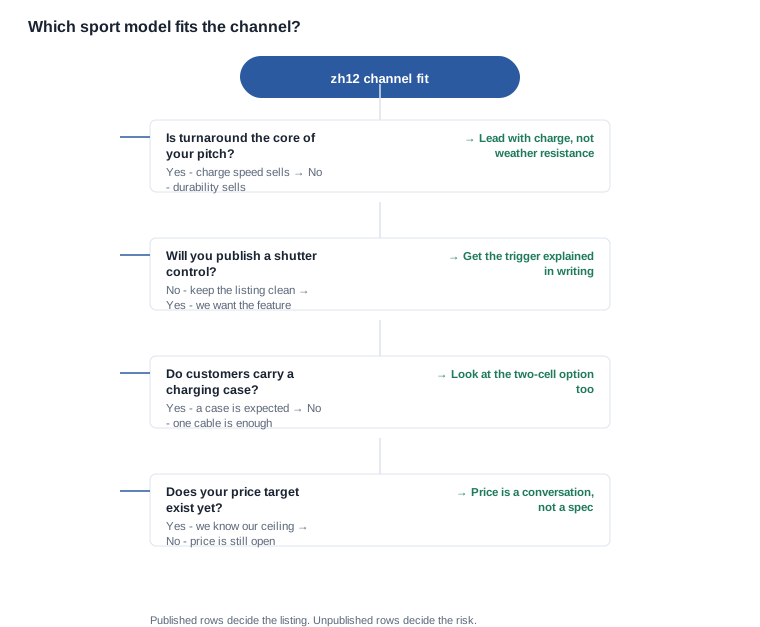
That is where the shortlist criteria for this range really sit, and they are not the rows a product page leads with. Which one of the three you choose depends on whether your customers carry a case, whether your channel is built around charging once a day or twice, and whether you can support a magnetic dock as a spare part. If your channel carries one sport model only, pick against those three questions. If it carries a range, the three are complementary rather than overlapping, and the specification work is a matter of matching each one to a use rather than forcing a single recommendation across all of them.
Selection is easier when it is done against a usage rather than against a feature. A customer who runs before work and wants the lightest thing they can forget about is asking a different question from a warehouse supervisor who needs audio that survives a full shift, and both differ from a retailer who needs a box that sits on a shelf against a price point. If the sport positioning is central to your proposition, the published rows support an endurance story and a fast turnaround story. If it is not central, the same model ends up competing on price against mainstream audio products that carry fewer published advantages, and that is a harder negotiation with a thinner evidence base.
Building a zh12 quotation that survives negotiation
A quotation is where the published rows and the commercial terms meet, and it is the document that either supports the value argument or quietly contradicts it. The version that survives a negotiation is the one where a buyer can see every assumption, because assumptions are what move when a supplier pushes back on a number.
The structure we ask for is short and specific:
- Model string and configuration — the catalogue name, the revision, the colourway and the logo or packaging scope, so that every line below attaches to one product.
- Unit price and quantity — the price at your volume band, the minimum order quantity per colourway, and the currency with the validity period.
- Incoterms and freight basis — the terms the price assumes, so that two quotes can be compared like for like.
- Lead time — the split between sample, pilot, first production order and reorder, and what happens when an order sits at the minimum rather than above it.
- Sample terms — the sample cost, the sample lead time, whether it is credited against the first order, and whether the sample unit is production-representative in firmware and finish.
- Warranty and spares — the warranty period on the cell, the charge port and the electronics, when the period starts, and the spare-unit ratio you would expect to hold.
- Certification scope — which documents exist for this model string in your market, as documents, with the cost shown as its own line.
- Packing list and packaging spec — the master carton quantity, the carton dimensions, the gross and net weight, and the accessory list.
- Tolerance and change control — the tolerance on the published figures and the notice period you would receive if a cell, a driver or a supplier changes.
Most of that is not published anywhere, which means each line is a negotiation. The useful discipline is to know which lines can move. Unit price moves against volume and lead time. Packaging cost moves against the customisation you ask for. Payment terms move against the size of the order. Certification scope is close to immovable once a document set is defined. The specification itself — the cell, the runtime, the charge time, the interface, the feature rows — is the part you should hold, because that is where the value argument lives, and a concession there costs you the argument rather than a margin.
Two practices keep a quotation and a listing aligned. First, keep the two columns: the seven published rows on one side, the confirmed answers on the other, and only build the customer-facing claims from the left. Second, spend the sample budget on due diligence rather than on a display unit — measure the charge time with a stopwatch from a stated state to a stated state, run a controlled runtime session at a stated volume and codec, and test the shutter behaviour against the phones your channel actually sells into. A sample that only confirms what the catalogue already says has not been tested; the value sits in the fields that came back blank.
Two terms usually get left until the second order, which is the worst moment to discover them. The reorder price, the reorder minimum and the reorder lead time are often different from the first order, and a reorder on different terms cannot be reconciled against the original margin. The other is payment: a deposit, a balance against pre-shipment inspection, and a milestone before the consignment leaves are three different risk positions, and which one you accept tells the supplier more about the order than the price does. Both belong in the first quotation, even when the reorder is a year away, because that negotiation is easier once a proven run has settled the specification.
The sport smart glasses range gives you the models to choose from, and this piece gives you the criteria to choose between them. Tell us the target market, the quantity and the configuration you need, and we will tell you what is available, what is published, and which rows we would have to fill in before you carry more.
Related reading
- The sport range this model belongs to — sport smart glasses
- What an absent ingress rating means for sport positioning — IP ratings and durability
- Why runtime figures are not comparable — smart glasses battery life
- How open-ear audio is measured and why it matters — open-ear audio technology
- The document set to request before you commit — certification checklist
- Terms that determine unit price — smart glasses wholesale
Tell us the market, the volume and the configuration you need, and we will come back with what is published for this model, what is available, and which rows still have to be confirmed in writing.


