
The interpretation problem
The best tour guide is the one nobody has to operate
Museums, heritage sites, attractions and destination operators share one goal: deliver interpretation without breaking the visitor’s relationship with the place. Today’s tools all interrupt it. Handsets and audio wands are borrowed, sanitized, clutched and returned; they occupy the hand that wants to point, sketch or hold a child’s. Earbud-based guides seal visitors into a private soundtrack and away from the room, the guide and each other. Phone tours mean looking at a small screen instead of the thing the visitor traveled to see.
Group guiding has its own friction. Raised voices damage quiet galleries and fragile sites; one-language tours exclude everyone else; printed whisper receivers tangle, break and distribute unevenly. Multilingual staffing scales poorly, and accessibility visitors — hard-of-hearing guests, low-vision visitors, guests who need narration rather than text — are too often served by a separate, stigmatizing device.
Gloves? No. Glasses. Ordinary-looking eyewear with open-ear audio is the closest thing yet to an invisible guide: narration arrives while the visitor looks at the actual object, in their language, at their pace, with both hands free and the room still audible. Nobody clutches a device, nobody is sealed off, and the experience belongs to the place rather than the hardware.
Two honest qualifications frame the category. First, CYNRIN supplies the eyewear platform; the narration content, languages, wayfinding logic and ticketing integration belong to the operator or its experience-technology partner. Second, for visitors the default specification should be camera-free audio: it removes the privacy question at a stroke and is almost always the right fleet for public-facing tours.
The visitor experience
Quiet narration, many languages, room to look around
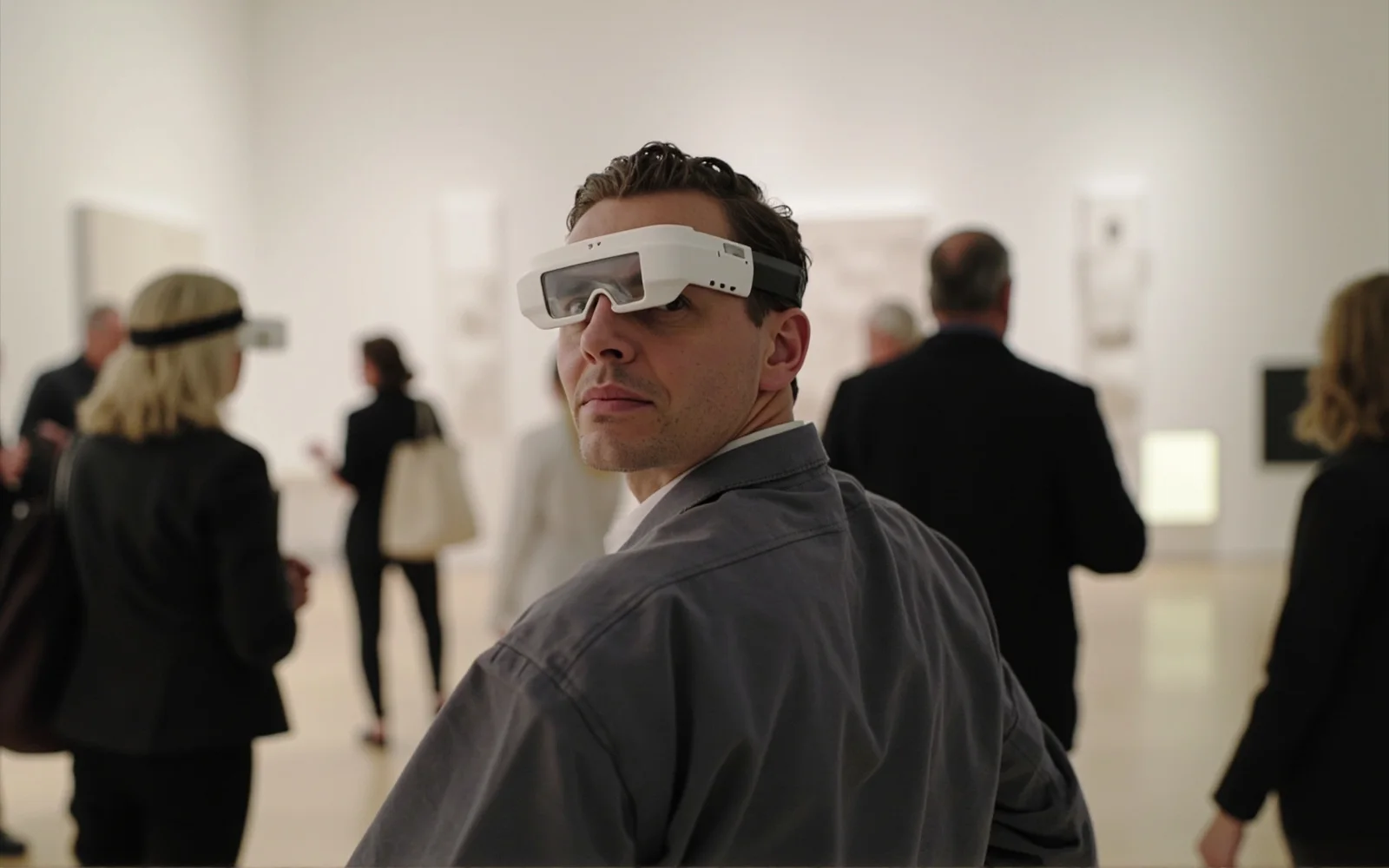
The core experience is deliberately simple: a visitor collects a branded pair at admission, puts them on like ordinary glasses, and hears interpretation begin — either on a schedule tied to a guided group, by position within an exhibition, or started and paused by a simple control. Nothing is held, nothing is read off a screen, and the acoustic delivery is open-ear, so the gallery, the guide and fellow visitors remain present.
- Multilingual at scale. One fleet serves many languages without multiplying devices or guides; the visitor’s language is selected at handout or through the operator’s app.
- Accessibility by default. Clear open-ear narration supports hard-of-hearing and low-vision visitors, neurodiverse guests who prefer audio, and anyone who benefits from description rather than labels — without a special device that marks them out.
- Group and whisper guiding. A docent’s voice reaches the group quietly and evenly through open-ear audio, preserving the hush of galleries and sacred or fragile spaces.
- Hands-free visit. Visitors point, photograph with their own cameras, handle interactives and keep children close while the narration continues.
Audio-led use of this kind shares its acoustic foundation with everyday open-ear listening, explained in the consumer open-ear vs earbuds comparison, and with the narration-led education model in hands-on education & training.
How narration triggers — position, schedule or manual — is defined by the operator’s tour platform and its location technology. The eyewear is a comfortable, fleet-manageable audio endpoint for that system rather than the system itself.
Where it is used
From galleries to outdoor heritage and hospitality
The model generalizes across anywhere interpretation is delivered to a moving visitor.
Museums and galleries
Multilingual exhibition guides, quiet docent groups and descriptive-audio accessibility on a single camera-free fleet, branded to the institution and returned at the exit like any other guide device.
Heritage sites and outdoor attractions
Casts, archaeological parks, botanic gardens and monuments deliver location-aware storytelling across large areas where handheld guides and signage fail in weather and scale. Sport-style frames with sun tints suit bright outdoor sites; power is scoped to the real operating day.
Tourism and hospitality
Walking tours, resort orientation and cruise shore excursions use open-ear group audio that keeps traffic and the guide audible — the same situational-hearing logic developed for hiking & outdoor safety. Hotel concierge programs and premium experiences can offer branded pairs as an amenity.
Marketing and content capture (staff only)
Separately, camera-equipped units issued to staff — never the default visitor fleet — capture first-person heritage and event footage for channels, in the spirit of travel vlogging, with visitor privacy governed by explicit site policy.
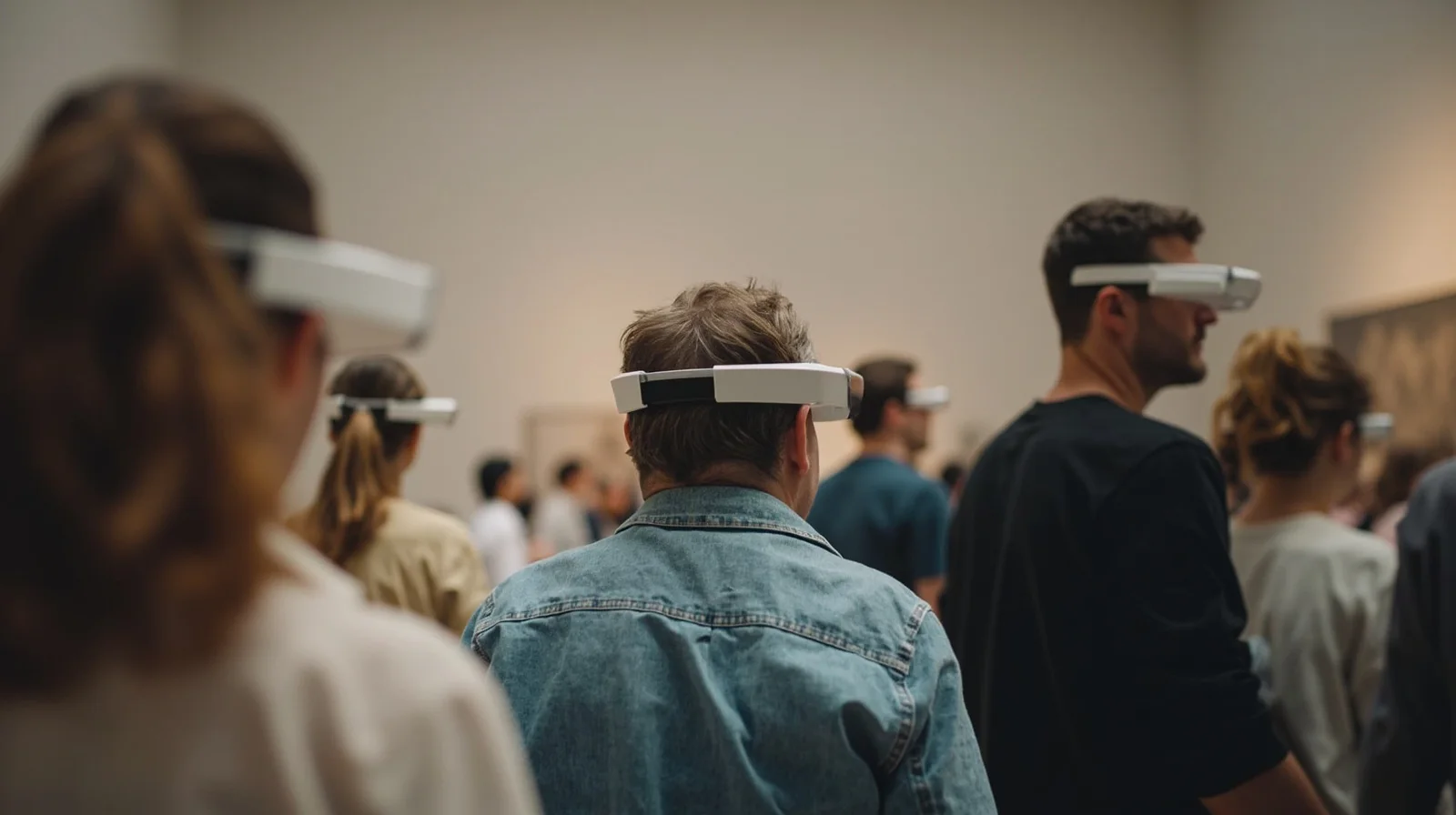
For institutions running learning programs as well as visits, the education fleet model — charging cabinets, reset between users and durable frames — carries over directly from hands-on education.
Visitor privacy
Why the visitor fleet should have no camera at all
Museums and attractions are unusually exposed environments: children, ticketed guests who did not consent to recording, loaned objects and licensed galleries. A camera on every visitor’s face is not a feature in that setting; it is a governance liability. The responsible default is therefore structural rather than procedural.
- Camera-free visitor units. Audio-only frames mean there is nothing to indicate, nothing to govern and nothing for other guests to worry about — the strongest possible privacy posture.
- Capture stays with staff. Where first-person marketing content is genuinely wanted, a small number of camera units are issued to trained staff under the site’s filming policy, with a visible active-state indicator.
- Reset on return. Every borrowed unit clears language selection, session and pairing at the charging rack so one visitor’s session never meets the next.
- Content owned by the operator. Narration scripts, translations, accessibility description and usage data live in the operator’s tour platform; the eyewear stores none of it independently.
This mirrors the privacy-by-design discipline used in healthcare and schools, summarized on the retail & education pillar: obvious capture state where capture exists, and hardware that makes the safer choice the easier choice.
Comfort is the other trust requirement. Visitor fleets are worn by every face shape and age, sometimes for hours, sometimes over prescription glasses. Weight, balance, temple pressure and nose-pad options are reviewed against that variety — a device returned after ten minutes is a failed tour regardless of content quality.
Specifying the fleet
Comfort, charging and a full day of visitors
The hardware brief for attractions is closer to hospitality operations than to consumer electronics: many brief users, one long operating day, and a hard reset every time.
Audio-first platforms. The E13 Bluetooth audio frames and the value-tier K01 are the natural visitor fleet: open-ear narration and group audio, light weight, zero camera. Outdoor sites can specify sun tints and sport-minded geometry. The V03-T5 camera platform is reserved for the separate staff content kit.
Open-ear tuning. Speech must stay intelligible over reverberant galleries, crowded rooms and outdoor wind without being played so loud that it leaks to nearby visitors; tuning is confirmed against representative site conditions. Power and charging. Duty cycles are modeled on a full operating day of intermittent narration plus standby, with rack charging turning the fleet between opening hours — figures confirmed on the program datasheet, not promised generically.
Durability and hygiene. Hinges, finishes and replaceable contact parts are chosen for thousands of handouts and the operator’s cleaning routine, with chemical compatibility confirmed per program. Fleet packaging. Numbered bays, bulk charging trays, quick-start cards and branding surfaces are specified as part of the product. Frame colors, logos, cases and unboxing material carry the institution’s identity through customization; custom geometry — for example a signature frame for a landmark operator — runs through ODM, with documentation aligned through quality control.
Building the program
For institutions, experience vendors and destination brands
Program buyers are typically museums and cultural institutions refreshing guide fleets, experience-technology and audio-guide companies needing better endpoints, destination-management and tour operators, and hospitality brands looking for an amenity with a story. The rollout sequence is short because the honest product is simple.
- Define the visit. Indoor galleries or outdoor site, group or self-guided, triggering model, and the language and accessibility list.
- Default to camera-free. Specify audio-only visitor units; decide separately whether a small staff camera kit serves marketing.
- Scope the day and fleet. Visitor throughput, operating hours, rack-charging layout, cleaning routine and number of spare units.
- Brand and integrate. Institution identity and packaging via OEM/customization, with the tour platform and triggering handled by the operator’s software partner.
- Pilot a season, then commit. Reference samples support a real exhibition or season; MOQ, lead times and destination-market documentation are confirmed per program.
The result is interpretation nobody has to operate — visitors keep their eyes on the collection and their hands free, the institution keeps its privacy position clean, and the operator keeps full ownership of content and visitor data. Begin with request a quote, review the samples process, or explore the consumer-electronics brand solution for go-to-market context.
Buying considerations
What to specify in a visitor-fleet brief
Visit type
Indoor gallery or outdoor site; self-guided, group-guided or both.
Camera-free default
Audio-only visitor units, with any camera kit limited to trained staff.
Languages and accessibility
Language list, descriptive audio and accessibility requirements at launch.
Fleet and charging
Daily throughput, rack-charging layout, spare ratio and reset on return.
Comfort and hygiene
Fit across ages and face shapes, prescription wearers and cleaning agents.
Content ownership
Which tour platform hosts narration, triggering and visitor data.
Browse the application
More retail & education guides
Keep exploring
Related reading
FAQ
Frequently asked questions
Should visitor glasses include cameras?
Can narration run in multiple languages on one fleet?
How are hundreds of borrowed units managed each day?
Are they suitable for hard-of-hearing or low-vision visitors?
What is the minimum order and can we pilot first?
Build this use case into a private-label program
Tell us the workflow, environment and volume. Engineering scopes the platform, optics, power and documentation per program.