
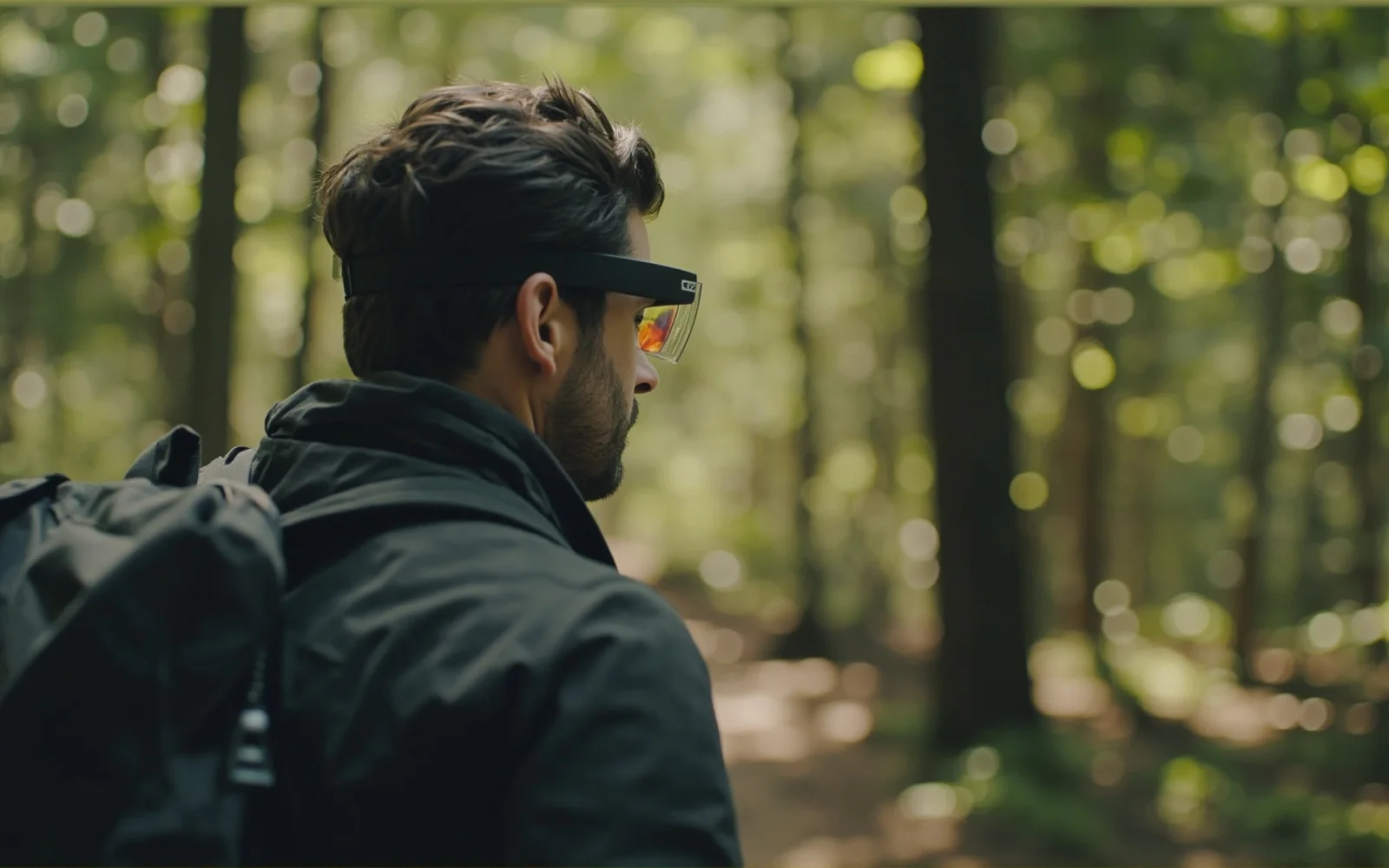
Why eyewear on the trail
Hikers already carry glasses; make them earn the weight
Backcountry travel rewards people who travel light and stay attentive. Every extra device is weight, a charging cable and something to fumble with cold fingers on an exposed ridge. Yet hikers also want the things connected devices offer: a prompt at an uncertain junction, a photo from the summit, a check-in with the group — without staring at a phone that kills the very reason they went outside.
Glasses occupy a unique position in that trade-off because hikers already wear them. Sport sunglasses come out of the pack for glare, wind and debris from the first hour of a long day. Building open-ear audio and optional capture into that eyewear asks the wearer to carry nothing new: no second headset, no chest mount, no handheld camera. The technology disappears into a piece of kit already on the face.
The safety argument is specifically about attention. Sealed earbuds remove the wearer from the acoustic environment — stream noise, wind shift, rockfall, a partner’s call, the change in weather that arrives by sound before it arrives by sight. Open-ear audio presents navigation prompts, group communication and music while leaving that environmental sound fully audible. Eyes also stay up: a spoken or glanceable cue replaces the head-down phone check that puts hikers on uneven ground while distracted.
Candor about limits is essential in this category. Smart glasses are a comfort, awareness and capture aid. They are not a map-and-compass replacement, not a satellite messenger or personal locator beacon, and not a guarantee of rescue where there is no phone coverage. Any navigation, weather or SOS capability comes from the paired application and the wearer’s other devices; CYNRIN builds the eyewear platform, not a safety service.
Open-ear safety
Situational hearing is a feature with real consequences
Experienced outdoor leaders describe sound as an early-warning system. The rumble upstream that precedes a flash flood, thunder over a ridge, the crack of loose rock, a shout from the next switchback — all arrive acoustically and all vanish when the ear is sealed. Open-ear speakers are engineered for the opposite goal: speech and music at a comfortable level, with the ambient world mixed in rather than blocked out.
- Group communication. Hikers talk with partners and hear responses without removing anything, including when spread out along a trail through a paired call.
- Weather and terrain cues. Wind, water and rock stay audible, supporting the situational judgment the route demands.
- Shared spaces. On popular paths, the wearer hears other trail users, wildlife and official guidance instead of being isolated.
- Eyes-up prompting. Spoken route cues reduce the time spent looking at a handheld screen on exposed or technical ground.
The same principle drives two adjacent pillars. Trail runners rely on hearing footfalls, other runners and remote roads, covered in running safety & visibility; cyclists need traffic and wind audible, covered in road & gravel cycling. The underlying acoustic case is developed for everyday users in open-ear vs earbuds.
What open-ear audio cannot do is compensate for unsafe planning. Brands selling into this audience are best served by positioning the product as awareness-supporting eyewear within a proper kit — map, navigation device, appropriate layers and, where remoteness warrants it, a dedicated satellite communicator.
On the mountain day
Where the platform earns its place before the summit
Value on a long day is distributed across small moments rather than one dramatic feature.
Approach and navigation prompts
Spoken cues from the hiker’s own navigation app support route-finding at junctions while the eyes stay on the ground and the landscape. The glasses are a display-and-audio endpoint for that app, not a substitute for offline maps and route judgment, and they do nothing where the paired phone has no signal.
Hands-free summit capture
A first-person still or clip at the top, on a scramble or across a high valley is captured without putting trekking poles down or extracting a phone in wind and cold. For the content use case behind this, see creator POV content and the travel side in travel vlogging.
Group coordination and check-ins
Partners separated on a climb or a split route talk through open-ear calls; families and club groups coordinate trailheads and lunch stops without anyone sealed off from the environment.
Long, social days and huts
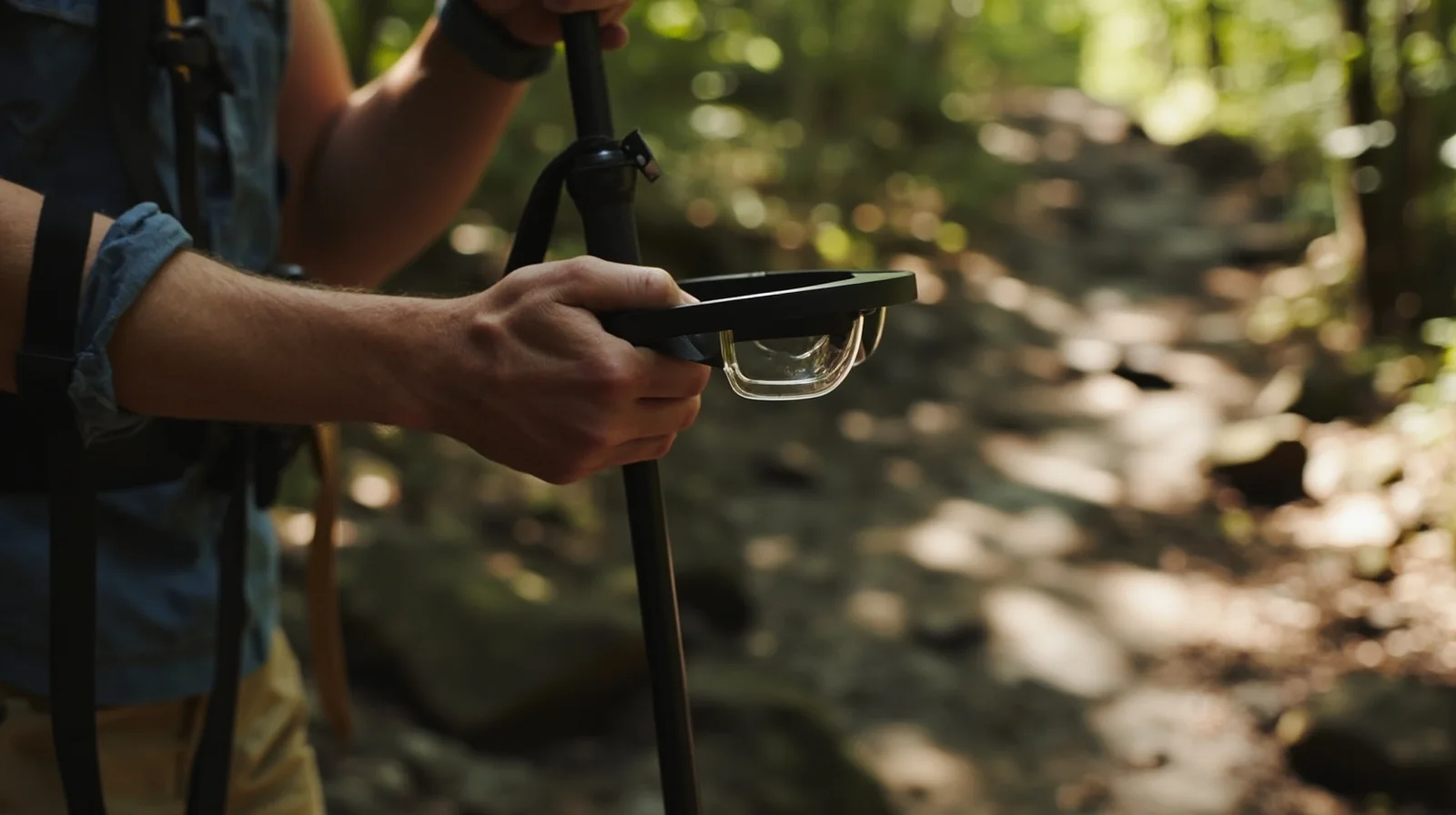
Between the technical sections, open-ear music, podcasts and photos make the hours enjoyable without the isolation of earbuds — a smoother category story for outdoor brands than a purely technical safety pitch.
Camera-free programs matter here too. Many walkers — and groups including children — want the open-ear audio with zero capture. An audio-only frame offers exactly that and removes the camera question in sensitive or shared environments, consistent with the approach on the assistive & accessibility guide.
Built for long days
Battery, optics and weather, stated honestly
Outdoor hardware is judged over a full day in changing conditions, and four decisions separate a product that lives in the pack from one that stays in the drawer.
Power for the real profile. A mountain day mixes standby, occasional prompts, a few calls and a handful of clips — not continuous playback. Power budgets are tuned to that mixed profile and confirmed on the program datasheet; brands should be wary of any generic all-day claim. Sport optics. Lenses do the primary job first: glare control, contrast and distortion-free vision for hours in bright snow and rock, with tint options scoped per program and verified at inspection gates under the quality process.
Sweat and weather handling. Temple materials, sealing and port layouts are designed around sweat, rain and dust, with exact construction confirmed per program rather than summarized as a generic protection rating. Weight and fit. Frames stay light and balanced under a hat or hood, with temple profiles reviewed for cap and strap compatibility — the same geometry discipline described for helmet use under ODM programs.
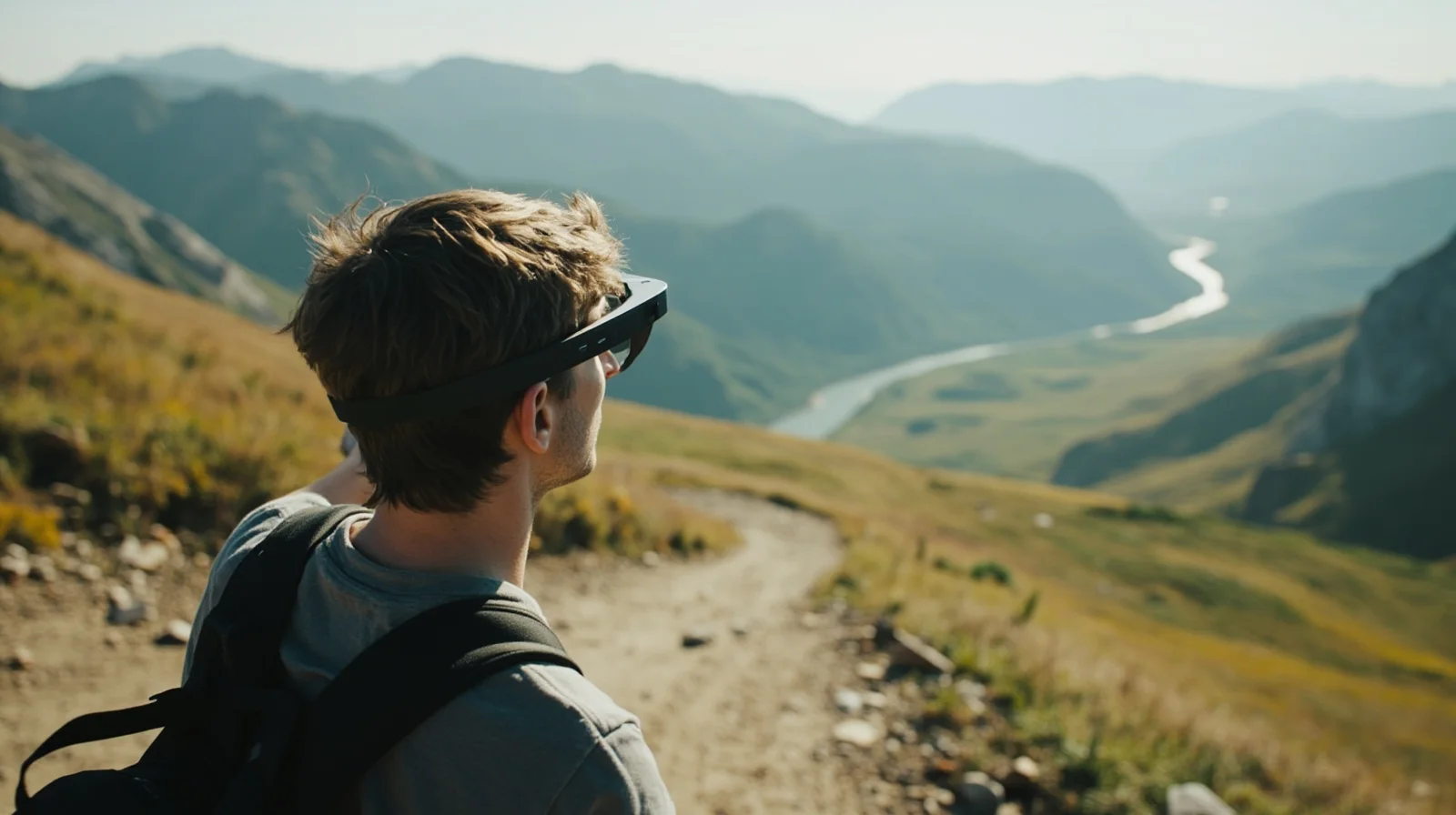
Platform tiering follows the use case. The V03-T5 camera platform suits hikers who want summit POV alongside audio; the E13 Bluetooth audio frames and the value-tier K01 suit camera-free, open-ear days. Outdoor brands typically carry both tiers under one identity. Branding, cases and quick-start material run through customization; destination-market documentation is aligned per program.
Honest claims
What hiking glasses are not
The outdoor consumer is quick to punish overstatement, and rescue-adjacent marketing is both ineffective and irresponsible. Four boundaries should appear in every credible program.
- Not a navigation system. Route guidance comes from the wearer’s own app and device; the glasses prompt and display, but offline maps, route choice and signal limitations remain the hiker’s responsibility.
- Not a PLB or satellite messenger. No eyewear in this program is a personal locator beacon or an SOS guarantee. Remote areas require dedicated communication equipment.
- Not impact or eye protection by assertion. Optical and protective claims are specified and validated on the program datasheet rather than implied for alpinism.
- Not a substitute for judgment. Open-ear audio supports situational awareness; it does not replace skills, planning, companions or the right kit.
This is the same division of responsibility CYNRIN maintains across verticals: capable, honestly specified hardware from the manufacturer; services, software outcomes and safety claims owned by the brand and its partners. The companion app handles routing, media and social features; analytics for endurance sit with running and cycling specialist apps.
Privacy follows the same discipline. A visible capture indicator makes recording obvious on busy summits and in huts, deliberate clip capture replaces continuous filming, and camera-free audio frames are offered to walkers who want no capture at all — the responsible-capture position shared with filming & privacy.
Building the program
For outdoor brands, clubs and tour operators
Customers for hiking eyewear programs are outdoor and mountain-sport brands extending an existing sunglasses or electronics range, walking and alpine clubs kitting members, and tour operators looking for a branded amenity. The path to production is deliberately conventional.
- Define the day. Typical trip length, capture frequency, climate and whether the line leads with camera POV or camera-free audio.
- Scope optics and power. Sport tints, cap and hood compatibility, and a mixed-use power profile confirmed on the datasheet.
- Set the claims boundary. Agree honest positioning on navigation, weather and rescue before packaging copy is written.
- Brand and tier the range. Camera hero plus audio tier with shared identity, cases and quick-start material via OEM and customization, custom geometry via ODM.
- Evaluate, then commit. Reference samples go through real mountain days before volume; MOQ, lead times and market documentation are confirmed per program.
Outdoor brands can review the category-level offer under the sports and cycling brands solution, begin scoping through request a quote, or order evaluation samples; volumes and terms follow the MOQ guidance. The result is eyewear hikers are glad they brought — light, open-ear, honest about its limits, and built to be worn all the way down.
Buying considerations
What to specify in a hiking eyewear brief
Lead use case
Summit POV, open-ear prompts and calls, or camera-free audio — determines the platform tier.
The real mountain day
Typical duration, standby-to-capture ratio, climate and expected temperature range.
Sport optics
Tints and lens performance for bright, high-contrast terrain, verified at inspection gates.
Weather and fit
Sweat and rain construction, plus cap, hood and strap compatibility.
Claims boundary
Explicit, non-rescue positioning: no PLB, no standalone navigation, no signal promises.
Privacy option
Visible capture indicators and a camera-free audio SKU for privacy-conscious walkers.
Browse the application
More sports & outdoor guides
Keep exploring
Related reading
FAQ
Frequently asked questions
Can I use these glasses to navigate or call for help off-trail?
Can I still hear wind, water and my hiking partners while wearing them?
Is there a version without a camera?
How do the glasses handle rain, sweat and long days?
Can an outdoor brand private-label a camera and an audio line together?
Build this use case into a private-label program
Tell us the workflow, environment and volume. Engineering scopes the platform, optics, power and documentation per program.