
The A06 is best for a buyer who has already answered one question that our own documentation leaves open: what actually separates it from the A05. Our catalogue records the A05 and the A06 as having identical specifications in every published row, and it does not state what divides them. Everything else about this model is settled enough to describe, and the parts that are not settled are the parts a buyer should close before committing.
So the honest answer to a06 smart glasses best for has two halves: a set of buying situations it genuinely fits, and one condition attached to all of them.
The published row is a 40 mAh cell, magnetic charging in a time of two hours or less, a rated runtime of approximately twenty hours, and a family feature set consisting of a lens-type electronic fogging element, posture and viewing-distance sensing with a reminder function, and a low-power Bluetooth connection. What that buys a buyer depends entirely on where in the category they are starting from, and this article separates three situations, one condition, and the boundary we hold on the claims.
A06 best for: the buying situations and the condition attached to each
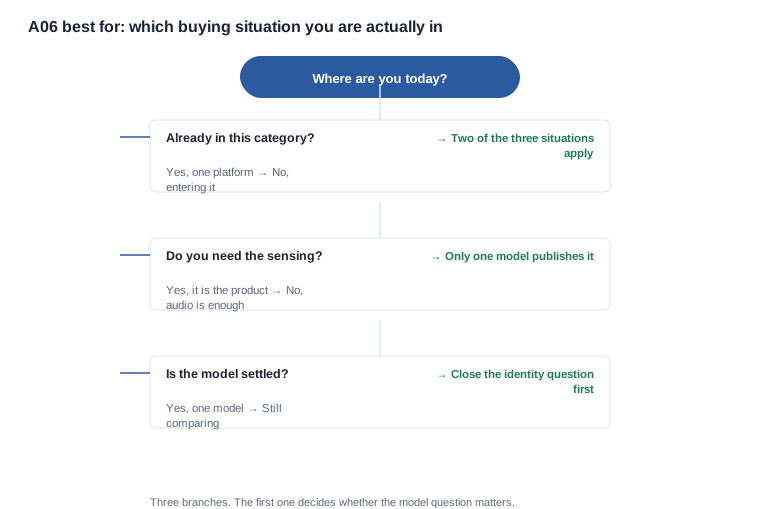
The decision map is short. Where are you today — already selling in the children's category, entering it for the first time, or holding a fixed functional requirement — determines most of the answer, and the model question only matters in some of those places.
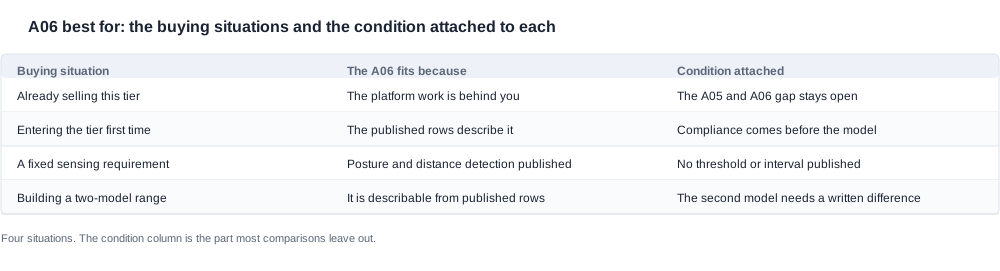
Read the table as a set of fit reasons paired with the condition that travels with the fit. The condition column is the part most comparisons leave out, and in this category it is not a footnote. The situation where the A06 fits best — a brand already working in the children's category — is also the situation where the A05 and A06 identity question is most likely to still be open, because two designations in the same platform is exactly what a range builder ends up with.
The branch is not a score. It is a sequence, and the sequence matters because two of the three branches are about your position rather than about the product. Where you are in the category decides whether the model question is even live. What the product has to do decides which models are candidates at all. And only once those two are settled is it worth spending a supplier call on the specification, because the specification is the cheapest of the three things to obtain.
One thing to establish at the start, because it changes the rest of the discussion. Our catalogue publishes no per-model certification row for any model in the children's tier, and its text contains no reference to CE, FCC or RoHS marking anywhere. The company-level export certification page it does carry is made of images rather than text. Every certification question in this article is therefore a question to a supplier, and none of them can be closed from the catalogue.

For a brand already inside the children's category
This is where the A06 is genuinely straightforward, and the reason is that the expensive part of the work is behind you. A brand already selling in the children's category has already scoped the certification programme for a market, already built the artwork and the packaging, already worked through the data question for the tier, and already trained a channel on the product family. Adding the A06 to that platform is a configuration decision rather than a programme launch.
The published row supports that decision without qualification. A 40 mAh cell, magnetic charging in a time of two hours or less, and a rated runtime of approximately twenty hours. Colour and packaging customisation is published as available for this tier. The family feature set is published: the lens-type electronic fogging element, posture and viewing-distance sensing with a reminder function, and a low-power Bluetooth connection. That is enough to write a product page from, provided the twenty hours is presented as a rated figure under a stated duty rather than as a promise of continuous use.
The twenty-hour figure is a duty-cycle figure rather than a capacity figure, and that distinction matters for a listing. The A07 publishes a 70 mAh cell and the same twenty hours, which means the runtime is describing a light duty cycle with long idle periods rather than a property of the battery. Do not let a listing imply twenty hours of continuous use. The battery specification guidance covers what to ask about the test condition, and the questions worth asking for this family are how often the reminder fires, over how many units, and whether the figure is a mean or a best case.
The condition attached to this situation is the identity question. If the A05 is already in your range, then the A06 is a second designation with identical published rows, and your catalogue cannot describe the difference. That is a live commercial question — two SKUs fragmenting a channel, two price points with no stated reason, two names to keep consistent across the invoice, the carton, the listing and the document pack — and it should be answered before the order rather than discovered at the first shipment. The A05 and A06 specification comparison sets out the detail.
What you gain by staying on one platform is real: one conformity programme, one artwork system, one data-handling position and one support script. What you are accepting is a range question that has to be closed in writing.
What staying on one platform actually saves
The saving is in the programme rather than in the product, and it is worth itemising because it is the argument for staying on a platform that a buyer can put to a finance reviewer.
The conformity programme is the largest single saving, and it is a saving in elapsed time rather than in unit cost. A certification scope is scoped against a specific model designation, a specific configuration and a specific destination market. A brand that already has a settled scope for one model in the tier has already answered most of the scoping questions, and the incremental cost of adding a second model is the difference between a file and a new file — but the difference can still be a testing cycle, and a testing cycle is a delay before the first unit can be listed.
The artwork and packaging system is the second saving. The carton, the insert, the warranty card, the label artwork and the manual all carry the model designation, and reworking them for a new designation is a round of approvals with a supplier, a printer and a compliance reviewer. A platform that is already in production has those assets live, and the marginal cost of a variant is a text change rather than a redesign.
The data-handling position is the third and it is the one most often underestimated. Our catalogue records the app and firmware customisation capability for this tier as awaiting verification, which means that the notification behaviour has to be established on units regardless of how many models you carry. What a platform does not save you is that work. It only saves you the cost of doing it twice for two different product identities — and that saving only exists if the two identities turn out to share an application, which is a question for the supplier, not something to assume.
The fourth saving is in the supply chain and the fifth is in the support script, and both are real but smaller. The order minimum is often lower for a repeat order on a known configuration, and a support line that already knows the product's behaviour does not need a new script.
None of this makes the A06 a special choice. It makes it a lower-risk choice for a brand that has already paid the entry costs, and it makes the identity question the thing to spend the next call on.

For a brand entering the children's category for the first time
Here the A06 is not a good first choice, and the reason is compliance rather than the product. The hardware is describable, which is more than can be said for a model with unpublished weights or unpublished radio versions. The problem is what is missing around it.
Our documentation records no certification information for this family at all — no certificate numbers, no issuing bodies, no validity periods, no covered model schedules. Children's products carry additional requirements in most destination markets, and those requirements determine the test programme, which determines the cost and the schedule. A first-time brand in this category should resolve the compliance position before it resolves anything else, and the model is a secondary decision by comparison. The A06 certification status sets out the document set to request and the reading method for the answers.
The second reason is the model identity itself. The A05, the A06 and the A07 all publish a twenty-hour rating and magnetic charging, and the A07 publishes a larger cell on the same runtime. Two of the three are recorded as having identical specifications, with the difference unstated. Choosing one of those two before the difference is documented means carrying a SKU that your own catalogue cannot describe, which is the situation this article exists to prevent.
The A07 is the easier first choice on documentation grounds, because it publishes a larger cell and a radio version on its own row. That does not make it a better product; it makes it a more describable one, and describability is what a first-time buyer in this category is short of. The A07 best-for analysis covers that comparison from the other side.
There is a third reason that is easy to overlook. The app and firmware customisation capability for this tier is recorded as awaiting verification, so the notification behaviour — which is the part of the product that a parent is actually buying — cannot be listed from a datasheet. It has to be established on units, during a pilot, before the packaging is designed.
Scoping the compliance programme before the model
The order here is deliberate and it is the opposite of how most first-time buyers in this category work. They choose the model they like, then discover the compliance scope, and then find that the scope changes the model choice. Scoping first inverts that and it costs nothing, because the scoping questions do not depend on which of the three models you are buying.
There are four scoping threads and each of them has a deliverable. The radio thread: a wireless product with a cell falls under the radio equipment framework, the Radio Equipment Directive (EU) 2014/53/EU, and the deliverable is a technical file that names the model, the radio configuration and the standards applied. The battery thread: the cell in this model is small enough that its watt-hour rating determines how it has to be packed and documented, and the deliverable is the cell test summary that UN38.3 transport documentation refers to. The children's product thread: the applicable standards in each destination market, and the deliverable is a scope from a test house for the specific product type rather than an assumption assembled from general knowledge. The economic operator thread: the details that appear on the packaging and that a marketplace or a customs authority will look for.
The reason the order matters is the schedule arithmetic. Testing is queued. A model chosen after the scope is settled has a chance of being inside an existing scope; a model chosen before the scope is settled has to wait for the scope to be written and then for the testing to be booked. For a brand entering this category for the first time, the model decision is genuinely the smaller of the two questions, and the compliance scoping guide is where the four threads are set out in full.

For a buyer with a fixed functional requirement
If the requirement is the posture and viewing-distance reminder, the published feature set serves it, and the A06 serves it as well as anything else in this tier. If the requirement is the lens-type electronic fogging element, that too is a family-level published feature. On the narrow question of which model publishes the capability, the A06 is as good as any candidate.
What is not published, for any model in this family, is how any of it performs. No sensing accuracy, no sensing range, no reminder interval, no anti-fogging cycle time, and no description of what triggers the reminder. A buyer whose brief depends on the sensing behaviour has to test it with a sample and a child, and a sample test is a different kind of activity from a document review: it needs a written protocol, a pass condition for each check, and units from the production batch rather than from a showroom. The A06 buyer review checklist sets out the kind of questions that work for this family.
There is a practical ordering point for a buyer with a fixed requirement. The functional requirement narrows the model list faster than the specification does, but the specification is what tells you whether the model can be described to a channel. With the A06 you can describe the capability; you cannot describe its behaviour, its weight, its size, its age band or its certification status. Those are the conditions on the fit, and they are the reason a brief-led buyer still needs a document request.
What a fixed requirement implies for the listing
A buyer who holds a fixed functional requirement is usually also holding a marketing claim in mind, and the two are not the same thing. The requirement is that the product detects posture and viewing distance and reminds. The claim is what a parent is told that reminder will achieve. The published rows support the first. They do not support the second, because no accuracy, no range, no interval and no trigger logic is published for the detection behaviour.
That gap has to be closed with two different tools, used for two different purposes. The sample establishes what the product does, and it is the only instrument that can answer it: what the child actually sees when a reminder fires, whether it can be dismissed, how long the interval is, whether the detection survives a normal school day. The supplier establishes what you are allowed to claim, by giving you the thresholds, the interval and the trigger logic in writing, and by confirming whether the published copy you have drafted is consistent with them.
Once both are in hand, the listing wording is the last thing to be signed off rather than the first, and the order of the two is the difference between a claim you can defend and a claim a regulator can challenge. In a category where the product is aimed at children, a claim that outruns the evidence is a compliance exposure rather than a marketing preference, and it lands on whoever wrote the copy — which, in a brand, is usually the procurement team's problem several months later.
The practical sequence is therefore: sample first, supplier document second, copy third. Most buyers do it the other way round, because the copy is what the launch calendar waits on.
The one condition that applies to all three situations
Across every situation above, there is one item that travels with the decision and that cannot be closed by any of them: the difference between the A05 and the A06 has to be documented before both are ordered. Not because it is likely to be a large difference, but because a difference that is not documented is a difference you cannot put on a listing, cannot put in a price list, cannot put in a channel briefing and cannot put in a quality claim.
The A06 boundary we will hold
We make no claim about myopia, vision development, vision protection or eye health for this model, and we hold no clinical data, no test protocol and no regulatory assessment for this category. A product that senses posture and viewing distance is a behaviour-reminder product. It is not a vision product, and a listing that implies otherwise is a regulatory problem rather than a marketing one. The boundary is set out in our medical boundary guidance.
We will not estimate a certification position, a sensing accuracy, a durability rating or an ingress rating, and none of the models in this family publishes one. And we will not invent a difference between the A05 and the A06 in order to make a range look better organised — that question is open in our own documentation and it is open on this page.
Also not published: frame weight, temple length and lens dimensions. For a product on a growing head, that omission decides the return rate, and it is a sample question rather than a document question. The A06 limitations analysis sets out what the published rows leave out.
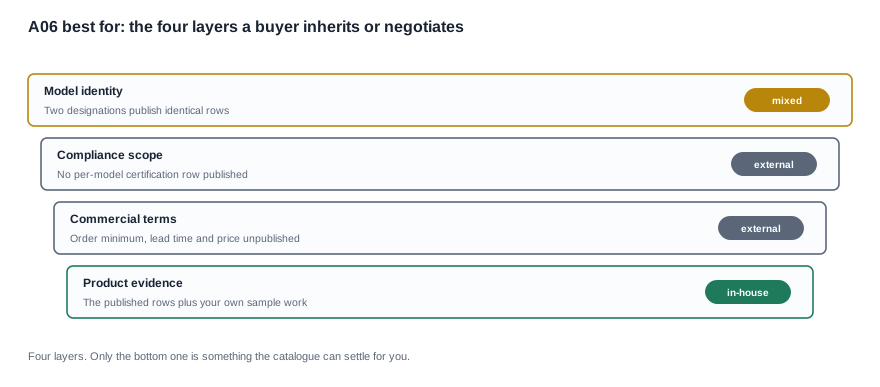
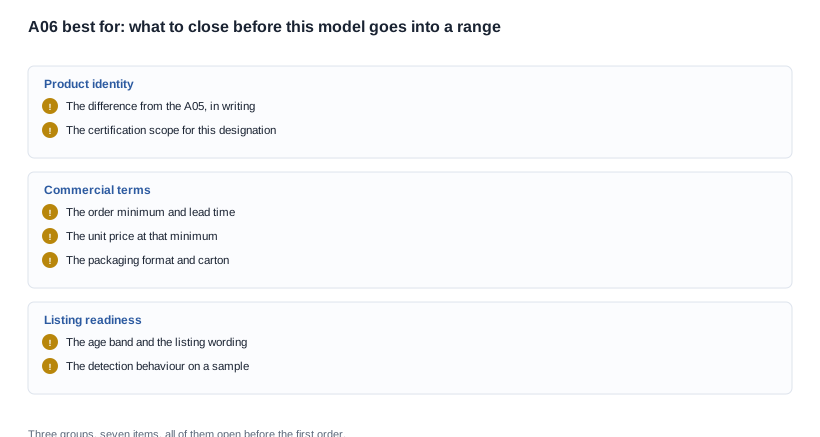
The four layers in that chart are worth reading as a division of labour. The published rows are ours and they are the base you build on. The model identity is mixed, because it is a question about our documentation that only you and we can close. The compliance scope and the commercial terms are the supplier's to produce, and they are the two layers that set your schedule and your landed cost.
What we will do is confirm the published rows, tell you which of the three models in this family publishes the most, and say which of the questions we can close for you directly. If you write down the target markets, the volume, the age range and the channel, we will come back with the published range and the gaps in it. The family is on our kids smart glasses range page, and the ordering side is covered in the bulk ordering guide.
Related reading
- The model decision in full — which model to pick in this tier
- The document set for the A06 — A06 certification status
- The sample work this model needs — A06 buyer review checklist
Set out the volume, the channel, the target markets and the age range, and we will answer with what we can supply and what we cannot.


