
The A07 is the third model in the children's family and the easiest one to specify, for a reason that is easy to miss: it is the only model in the entire children's range that publishes a Bluetooth version. The A05 and the A06 publish their cell, their charge time, their rated runtime and their charging method, and they publish no radio version at all. The A07 publishes Bluetooth V5.4.
A radio version appears to be a trivial row on a spec sheet. In a connected device it is the row that tells you what the device actually connects to, and therefore whether a specification, a compatibility statement and an instruction leaflet can be written at all.
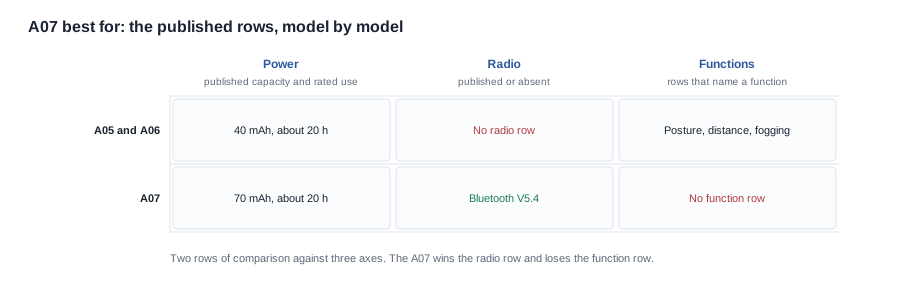
This article is written for a buyer who is deciding whether the A07 is the right starting point for a category, or whether starting here is a way of avoiding a decision. The four profiles below are the ones this model genuinely fits; the section after them is the one where it does not.
A07 best for: the four buyer profiles this model actually fits
The children's range in our catalogue has three models. Two of them — the A05 and the A06 — publish identical rows, and the catalogue does not state what separates them. The third is the A07. That structure narrows the choice considerably, and it is why the profiles below map onto the models rather than onto features.
Profile one: a brand building its first SKU in the category. The A07 publishes the radio version, which means the first line of a compatibility statement can be written from a catalogue row rather than from a factory answer. It publishes no camera, no sensing function and no lens arrangement, which means the data and health conversations that dominate a connected device do not arise at all. For a buyer whose organisation has never qualified a connected device before, this is the cheapest possible first qualification. The A07 buyer review checklist is the shortest review sequence in this category, and it is short because there is less to verify, not because there is less to get wrong.
Profile two: a school, a district or a tender channel. Here the argument is the absence of the camera and the absence of the sensing rows. A procurement officer reviewing a children's device will ask what data the device collects, what it transmits and who can see it. For this model the answer is that the published specification contains no camera and no capture function, which is a much shorter conversation than a data-protection assessment. That does not remove the compliance work — the catalogue prints no per-model certification row — but it removes the hardest part of it.
Profile three: an audio-led retail or distributor line. The A07 carries a 70 mAh cell, magnetic charging, a charge time of two hours or less and a rated use of about twenty hours. That is a coherent small consumer electronics proposition for a channel whose existing range is audio, and it is the only model in the children's range that would sit next to an adult audio line without a gap in the documentation.
Profile four: a range where three models is one model too many. Because the A05 and the A06 publish identical rows, a buyer who cannot establish the difference between them should narrow the range rather than carry a SKU that cannot be described. The A07 is the model to narrow to when the choice is between one audio model and two sensing models.
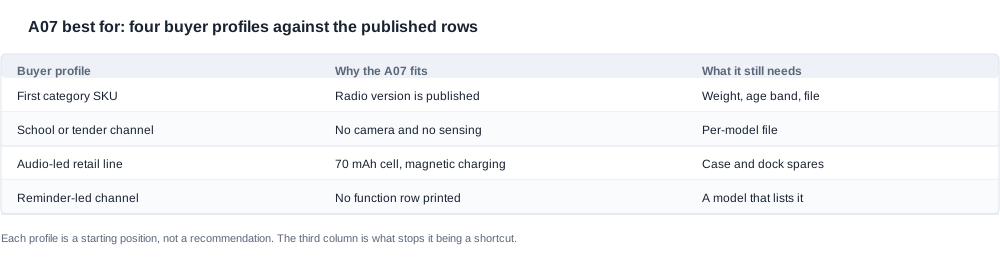
How to choose between the four profiles. The criterion is not a preference; it is the number of rows you would otherwise have to invent. If your channel needs a sensing function, the A05 and the A06 are the only models in the range whose published rows name one, and the cost of choosing them is a per-model conformity file plus a claim review you cannot skip. If your channel does not need a sensing function, the A07 is the cheaper qualification, because the published row set is small enough to write from and because the absence of a camera and of a sensing row removes the two questions that generate the longest legal reviews in this category. A useful shortcut for a first-time buyer: count how many of your listing claims you can write from a catalogue row. On this model the answer is a runtime rating, a charge ceiling, a cell size, a charging method and a radio version. Anything beyond those five is a request, and requests have a lead time.

The A07 radio row and why it decides a first specification
It is worth being precise about what a published radio version does and does not do, because the value of this row is easy to overstate and easy to understate.
What it does. It tells you that the device contains a radio, which generation of the protocol it speaks, and therefore which class of host it can interoperate with. It tells you that a connection flow exists. And it gives you a line you can check on a delivered unit against a written specification, which is the difference between a technical claim and a commercial promise.
What it does not. It does not tell you what the radio connects to. The catalogue publishes no application, no companion device, no host requirement and no connection name for this model. The app and firmware position for this tier is recorded as awaiting verification, which is the wording our documentation uses for a row that exists and has not been confirmed — which is not the same as a row that does not exist, and a buyer who treats the two alike will draw the wrong conclusion in either direction. If your channel's proposition depends on a phone application, a notification, a remote-control flow or a parent dashboard, then the radio version row is the easy part of the question and the application is the part you have to obtain in writing.
Why it is decisive for a first specification. A first specification has to be writable before a sample exists, because the packaging artwork, the instruction leaflet, the compatibility statement and the listing copy all descend from it. A specification built on published rows can be written by your own team. A specification built on verbal answers has to be written by the supplier, and it will change the next time somebody asks the question differently. The radio row is the clearest example of this: one published line carries a whole branch of the specification that would otherwise be an open negotiation.
The connection name is a product decision, not a technical detail. If the device appears in a host's device list as the factory's name rather than yours, that string is what a parent will read when a unit will not connect, and it is the string that ends up in a support ticket. Ask whether the pairing name can be your brand, and put it in the sample order.
The application question has three parts, and asking them separately is faster. What the application is called and who operates it. What it can show — a device status, a battery state, a reminder history, a parent dashboard. And what it sends away from the device, because a device with a radio that talks to a server carries a data question even when it has no camera. The catalogue names none of these for this model, and the app and firmware position for this tier is recorded as awaiting verification. That wording tells you the branch exists in the documentation and has not been confirmed, which is not the same as a branch that does not exist. Whether the result is a branded application under your control, a factory application you license, or a configuration where the device operates without an application at all is a commercial question with a cost attached to each answer, and the trade-offs between those answers belong in the range plan rather than in a later negotiation.
A07 best-for decisions: where this model is the wrong choice
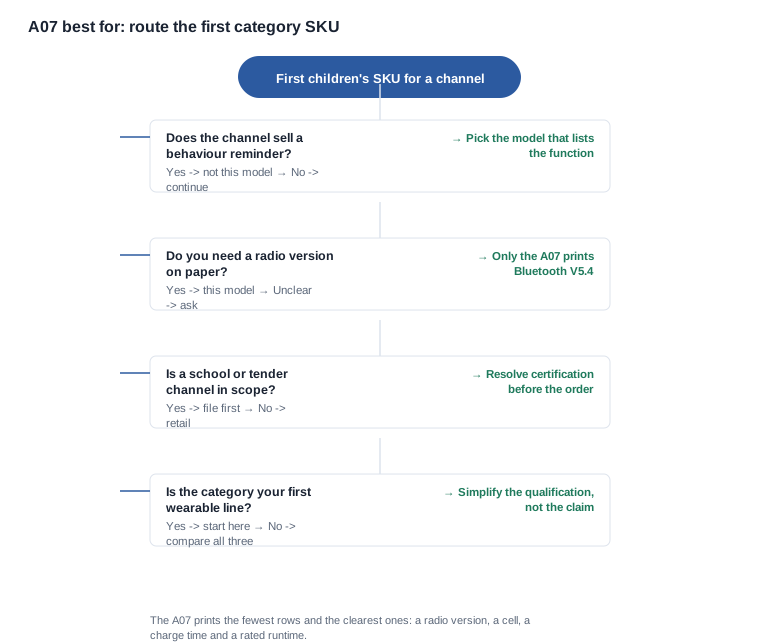
The profiles above are starting positions, and the value of a starting position is that it also tells you where to stop. There are four situations in which this model is the wrong answer, and it is worth naming them before a range plan is signed rather than after.
If your proposition is a behaviour reminder, this is the wrong model. The A05 and the A06 publish posture and viewing-distance indication. This model publishes no function row at all. A channel selling a reminder, a parent dashboard or a habit-building product needs a model whose published rows name the function, because that is the row a compliance reviewer and a marketplace reviewer will read. A model that is silent cannot support the claim, however capable it may turn out to be.
If your proposition is an eyesight concern, this is the wrong category. A device that indicates a posture or a viewing distance and reminds a child sits close enough to the line where marketing language becomes a health claim that the line has to be drawn before the packaging is designed. We make no vision, myopia, eyesight or eye-health claim for this model or any other, we hold no clinical data, no test protocol and no regulatory assessment for the category, and we will not support a listing that does. If the channel's proposition is an eyesight concern rather than a behaviour reminder, neither this model nor its siblings will serve it.
If your channel cannot answer a data question, the missing rows will surface anyway. The published rows for this model are thin: no camera, no sensing, no charge-indicator row, no charging-case row, no accepted charging input, no frame weight, no dimensions, no recommended age band and no ingress marking. A channel that expects a complete datasheet on day one will find the specification thin in places where the absence matters commercially — the weight and the size range especially, because a fixed frame with no published dimensions has a narrower audience than a buyer might assume.
If you need a per-model certification position to open a tender, the catalogue cannot give it to you. The export certification page in our catalogue is a company-level page whose content is images rather than text: ten patent certificates, eight appearance-design patents and two utility-model patents. The catalogue text contains no reference to CE, FCC or RoHS anywhere, and there is no per-model certification row for the A07 or for the other two models. A patent certificate is not a conformity declaration. Whatever your destination market requires is a matter for a testing body in that market, and that is a programme with a lead time you do not control.

Settling the A07 before it goes on a range plan
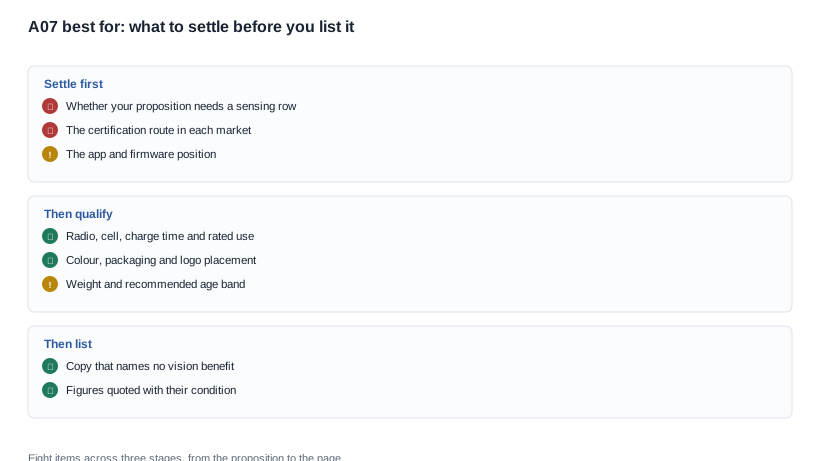
Eight items have to be settled before this model can be listed honestly, and they fall into three stages. The order matters, because the first stage decides what documents you need to chase.
Stage one — settle the proposition and the market. Whether your channel needs a sensing row at all, and which destination markets the line will ship into. Children's products attract requirements that adult electronics do not — EN 71 in the European Union, ASTM F963 and the Consumer Product Safety Improvement Act in the United States — and the radio side sits under the Radio Equipment Directive (EU) 2014/53/EU, which is a separate workstream from the restricted-substance side. Establish which frameworks apply with a testing body in your own market rather than with the factory, because the route is a question about your market. The child product compliance framework covers why this is the first question rather than the last.
Stage two — qualify the product and the programme. The radio version, the cell, the charge time and the rated runtime, all of which are published and can be written today. The colour, the packaging and the logo placement, which are documented as available for this category. And the four rows that are not: the frame weight and dimensions, the recommended age band, the charge indicator behaviour, and the app and firmware position recorded as awaiting verification. Those four are the work.
Stage three — write the listing. Copy that names no vision, hearing or eye-health benefit. Figures quoted as ratings with their condition attached, where the condition is known. The charge time described as two hours or less, which is a ceiling rather than a measurement. And no implication of continuous use anywhere in the copy, because the runtime is a rated figure and the documentation does not support a promise.
Three commercial terms are worth settling at the same time, while the range plan is still open. The number of models and colour combinations you commit to, because each combination carries its own minimum order quantity and its own file. The artwork round count, because each additional round is a week and the charge indicator, the charging instruction and the claim wording all belong on the same artwork. And the unit price tiers against the volume you are realistically able to place, because a quotation built on a volume you will not reach in the first year is not a price and the margin assumption behind it will not survive contact with the first purchase order.
Order the sample as a sample order and name the branch. A sample order carries a cost, a lead time and a defined configuration, and it is the only purchase in the programme where the configuration is under your control rather than under the factory's. Name the colour, the logo, the packaging state and the firmware branch you intend to ship, and get the sample order to carry those names. A sample that arrives with the wrong logo tells you nothing about the production unit, and a factory that will not name the branch on a sample order is telling you how the branch will be handled at volume. The sample evaluation note covers the difference between a sample that demonstrates a feature and a sample that demonstrates a configuration.
Model the total cost before the range plan is signed. Unit price is the smallest figure in the file. The total cost adds freight and incoterms, per-market labelling and documentation, amortised tooling, the certification cost per model per market, and the support cost of a device that ends up in a child's hands and generates a longer conversation than a stock query does. For a range that narrows from three models to two, the documentation component is the largest saving, because a file is priced per model per market and the elapsed time is set by the testing body rather than by your order. Two red flags to watch for in the quotation: a unit price quoted against a volume you will not reach in the first year, and a tooling figure bundled into the same line as the certification cost, because the two behave completely differently and only one of them amortises across the first order.
The boundary on this model, stated plainly
On the A07, our position is that it is the easiest model in this category to qualify and the hardest to differentiate, and that a brand selecting it should be doing so on the strength of an uncomplicated compliance and documentation story rather than on a feature claim. We will publish the twenty hours as a rating and not as an active-use figure, we will publish the charge time as two hours or less and not as under two hours, and we will not quote a weight, an age band, a case capacity, a charge indicator or a certificate number that the documentation does not contain.
We will not describe this model as carrying the sensing or the lens arrangement of its siblings, because those rows are not published for it. We will not invent a difference between the A05 and the A06 to make a range look better organised. And we will not tell you the A07 is certified, because our documentation contains no per-model certification row and no reference to CE, FCC or RoHS anywhere in the catalogue text.
What we can answer today is narrower than what a buyer usually wants, and the narrow version is the useful one. We can tell you the cell size, the charge ceiling, the rated runtime, the charging method and the radio version for this model, and we can tell you that the catalogue prints no function row and no per-model certification row for it. We can tell you the app and firmware position is recorded as awaiting verification. We can tell you that the frame weight, the dimensions, the recommended age band, the charge indicator behaviour, the accepted charging input, the ingress position and the charging-case situation are not published, and that the only two models in our whole catalogue carrying an ingress marking are the V06 and the S7. We can also tell you what a range plan should not contain, which is often the more useful of the two answers. What we cannot do is supply a figure the documentation does not hold, and we will not fill a gap with a typical value to make a table look complete.
We also do not publish prices, minimum order quantities or lead times, and we would rather say so than quote a number that changes between conversations. What we will do is tell you which of the eight items above our documentation answers today, which have to come back to you as unknown, and which are yours to close with a testing body in your own market. Send us the destination markets, the channel, the age range and the volume, and we will come back with the rows we can answer and the ones we cannot. The family is on our kids smart glasses range page, and the A07 specifications and features breakdown sets out the row set in full.
Related reading
- The buyer-side check for this family — A07 buyer review checklist
- The published row set in detail — A07 smart glasses specifications and features
- The regulatory framework for this category — child product compliance
Tell us the channel, the volume, the destination markets and the age range, and we will reply with what is available.


