

The certification status of this model is not "unpublished" in the way it is for most rows in a catalogue. For our children's category, no certification information has been provided to us at all — no certificate numbers, no issuing bodies, no validity dates, no model schedules and no declaration of conformity. That is a different position from an unpublished row, and it deserves different handling.
This article is about the difference between three things that buyers routinely collapse into one: a product that is certified, a product whose certification has not been evidenced, and a product nobody has assessed. It is written for the compliance function and the procurement manager jointly, because the two of them are usually handed the same question and they need different answers.
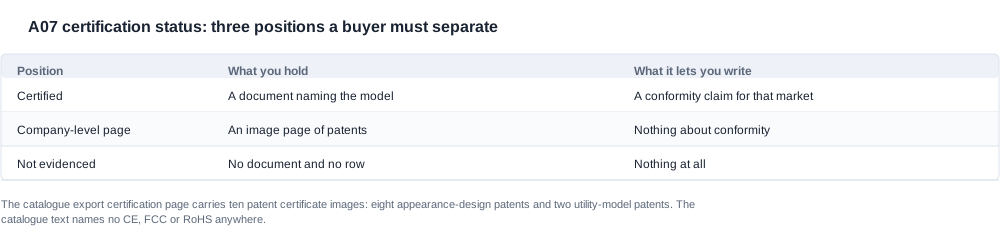
A07 certification status: three positions a buyer has to keep apart
Position one: certified, and you hold the document. A certificate number, an issuing body qualified in your market, a validity date, and a model schedule naming the exact designation you intend to ship. Nothing about that is difficult to check, because it is a document. It can be verified with the issuing body, it can be dated, and it can be attached to a purchase order as a condition.
Position two: a company-level page, which is what our catalogue carries. The export certification page in our catalogue is a company-level page. What it shows is a set of pictures: ten patent certificates, of which eight cover appearance designs and two cover utility models. Nothing in the catalogue text names CE, FCC or RoHS — in any casing, on any page. There is no per-model certification row for the A07, for the A05, for the A06 or for any other model in the range, and there is no pending-confirmation line against any of them either.
Position three: not evidenced, which is where this model sits. Nobody has established a position that we can pass on. That is not the same as saying the product fails. It says that we cannot tell you it passes, and you cannot write that on a page.
The reason these three are worth separating is that they lead to three different commercial answers, not to three shades of the same answer.
| Position | What a buyer can write today | What the buyer has to do next | What it costs |
|---|---|---|---|
| Certified | A conformity claim scoped to one model and one market | Maintain the file and track the expiry | File maintenance and re-testing on an edition change |
| Company-level page | Nothing about conformity | Obtain a per-model file from a testing body | One file per model per market, plus the elapsed time behind it |
| Not evidenced | Nothing at all | Establish the route before committing to a launch date | The route, the testing, and the artwork waiting on both |
The row most buyers get wrong is the middle one. A company-level page of patent certificates is a real document about intellectual property, and it is frequently mistaken for a conformity position because it appears in a place where a conformity page would be expected. A patent certificate says that a design or an invention is protected. It says nothing about whether a product meets the requirements of a market, and it cannot be attached to a purchase order as a condition because it does not name a market.
How to evaluate a supplier's answer about certification. Three answers look like evidence and are not, and they are the three red flags worth naming. A statement that the factory has already shipped this model into several markets is a sales history rather than a document, and it tells you nothing about the market you are shipping into. A statement that the product is compliant across categories conflates a radio approval with a children's product conformity and names no model. And a certification mark printed on the packaging artwork with no document reference behind it is a claim on a box rather than a position in a file. The criteria for a usable answer are narrower and simpler than the market language around them: a standard name with an edition number, a certificate number, an issuing body, a validity date, and a covered-model list that contains the designation you are buying. If any one of those five is missing, the answer is the opening of a request rather than the end of one, and the item stays on the register until the document itself arrives.
What the A07 catalogue actually records about certification
This section exists because the question is asked differently every time and the answers should be identical.
What is recorded. The catalogue has a company-level export certification page at page four. The extractable text on that page is the page title and the page number. Everything else on it is image content — ten certificate images, of which eight are appearance-design patents and two are utility-model patents.
What is not recorded. The catalogue text contains no occurrence of CE, no occurrence of FCC, no occurrence of RoHS, no occurrence of REACH, no occurrence of RED, no occurrence of EN 18031, no occurrence of UKCA and no occurrence of a general product safety regulation reference. The word for certification appears once in the whole document and the word for export appears once, and both of them are on that page's heading. There is no per-model certification row. There is no row saying a model is pending confirmation. There is no listing of test reports, no laboratory names, no standard numbers, no certificate identifiers and no validity dates for any model in the range.
What follows from that. Three conclusions, and the third one is the one that changes a buyer's plan.
First, no conformity claim about the A07 can be made on the basis of our catalogue. Not a qualified claim, not a conditional claim, not a claim about the company as a whole. The information is not there.
Second, the absence of a per-model row is not evidence of a problem with the product. Our documentation simply does not carry a conformity position for this category. A supplier may well hold current documents in a form we have not been given.
Third, and this is the planning consequence, the conformity work for this model is not something a buyer inherits from the catalogue. It is a programme the buyer owns or commissions. That changes the launch schedule, the artwork dependency and the per-model cost, and it changes them before a single sample is ordered.
One further question belongs to due diligence rather than to the catalogue. Whether the factory holds current conformity documents for this model for any market, and if it does, whether it will supply them for your market and your branding. There is a reasonable answer in either direction — it may hold nothing at all, which is the honest position and one you can plan around — and both answers are workable, provided you know which one you have before the artwork is signed. The answer that is not workable is discovering it in the month before your first delivery, because at that point the alternatives are a launch without a file or a launch without the range, and neither is a decision anybody wants to be making.
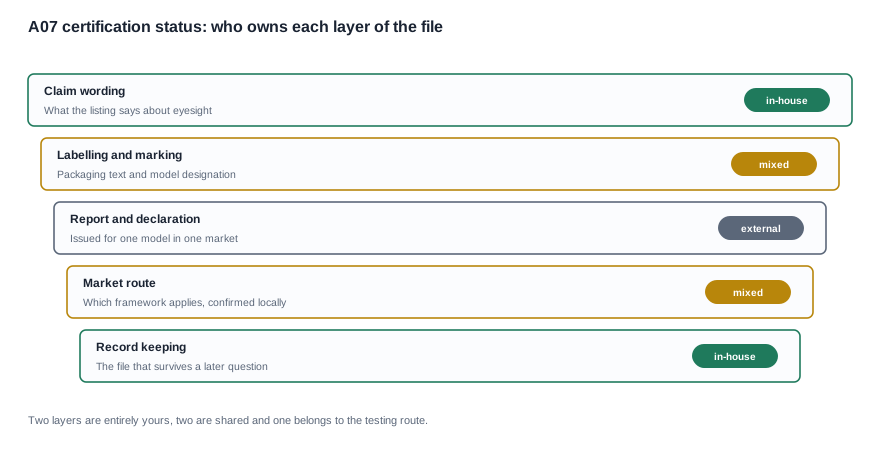

Why a children's product sharpens the A07 certification question
Children's products attract requirements that adult electronics do not, and the difference is one of scope rather than of difficulty. We have not verified which requirements apply to this product or in which market, and we will not guess — the standards and their applicability differ by territory and by product type, and a wrong answer here is more expensive than an open one.
In the European Union, the frameworks applicable to children's products include EN 71, which is separate from CE marking and separate from the General Product Safety Regulation. A product can carry a valid CE declaration and still be non-compliant for children's use. On the radio side, the framework is the Radio Equipment Directive (EU) 2014/53/EU, which covers the radio element of a connected device and is a different workstream from the restricted-substance side of the same product. The electromagnetic side is demonstrated against harmonised standards in the EN 301 489 series, which is a different kind of reference from a directive number and is the kind of mix-up that turns a document request into a longer conversation.
In the United States, ASTM F963 and the Consumer Product Safety Commission rules apply to children's products, and neither is covered by an FCC equipment authorisation. A device with an FCC filing is not thereby compliant for children's use.
In the United Kingdom, the corresponding national framework applies in place of the European one.
Two further questions make this sharper for this category specifically, and both of them are questions for the supplier rather than for a laboratory.
Does the product carry a reminder function? Our category documentation describes posture and viewing-distance indication for two models in this family. The A07's own published row does not list it. If it does not, the requirement profile is simpler and the market route may be shorter. If it does, a product aimed at children with sensing functions related to viewing habits sits closer to a line you do not want to be uncertain about. The catalogue publishes no function row for this model, so the answer is not available from the documentation — and a product whose function set is unclear cannot be classified for conformity either, because classification depends on what the product is.
What does the packaging say? The wording on the box is part of what a regulator examines, and the wording on the box is decided by the channel, not by the factory. We hold no clinical data, no test protocol and no regulatory assessment for this category, and we will not help write a claim about myopia, vision development or eye health. A product that detects a position or a distance and reminds is a behaviour-reminder product, and describing it as though it changes a child's eyesight is a clinical claim that the product is not in a position to make.


The A07 certification route, market by market
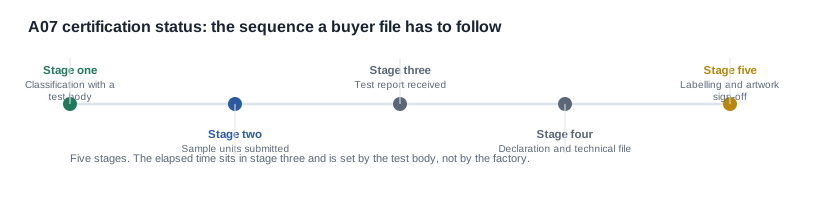
The route below is the sequence a buyer's own file has to follow. It is written for a buyer who has a compliance function, but it works without one if the steps are assigned to named people.
Step one: classify the product and the destination market. Classification is not a formality; it determines the size of the file, the label set, the elapsed time and the cost. It is also the step most often skipped, and skipping it is how a programme arrives at the artwork stage with an unknown file scope.
Step two: establish the route with a testing body in your own market. Ask what is required to sell this product with the exact wording you intend to use, in the market you intend to ship into. This is a question about your market, and a factory's answer about what it has done for other customers in other markets does not answer it. It is also the step with no cost attached, which is why it should be the first thing done rather than the last.
Step three: allocate the model designation you will ship. The A07 and one other model in this category publish identical rows, which means the documentation alone cannot tell them apart, and a certificate needs something to name. Settle the designation before the file is commissioned, because a file issued against a designation you then change is a file you pay for twice.
Step four: confirm which functions this specific model carries, in writing, before the packaging describes them. Classification depends on function, so the written function list has to exist before the file is scoped, and it has to be the same list the packaging uses.
Step five: obtain the report and the declaration for that exact model. Ask for the standard names with their edition numbers, the certificate numbers, the issuing body, the validity dates and the covered model designations. A document that covers a family rather than a model is not a document for your product, and the covered-model list is the field that proves it.
Step six: assemble the technical file so that it survives a later question. Product description, component list, supporting reports, the user-facing instructions and markings, and batch traceability. The file is built for the day somebody asks, not for the day it is filed, and the difference shows up in the years after launch.
What to ask for, and in what form. A single written request that lists the fields is more efficient than a conversation that has to be reconstructed later. Ask for the standard names with their edition numbers, the certificate numbers, the issuing bodies, the validity dates and the covered model designations, per market, with the model designation written out in full. Ask whether the file is issued in your name or in the factory's, because a document in the factory's name is a document you will have to re-request through them for every subsequent shipment and every subsequent question. Ask what triggers a re-test — a firmware change, a component substitution, a packaging change — and get the trigger written into the agreement rather than left to a courtesy conversation. And ask which change costs least to make, because the answer tells you which parts of the design you should treat as frozen for the life of the programme.
Step seven: fix the claim wording and keep it aligned with the file. If the artwork says more than the file supports, the artwork is the problem. If the file supports more than the artwork claims, you are leaving a selling point unused. Both are worth a review, and the second is worth doing deliberately.
A shortlist of questions for the testing body, kept as a checklist against each market. Which frameworks apply to a children's connected product with this wording, in this market. Whether the radio element and the children's requirements are handled as one engagement or two. What the sample quantity is, and whether the samples can be drawn from a production batch rather than an engineering build. How long the report takes to issue, and what happens to the elapsed time if the testing body requests a re-run. Whether the certificate can be issued in your company's name rather than the factory's. And what the file has to contain so that it survives a later question from a distributor, a marketplace reviewer or an institutional buyer. Keep the answers market by market, because the answers differ by market, and because a question answered once and then not written down will be asked again in six months by somebody who has no way of knowing it was settled.
The compliance programme is a cost line, and it should be modelled as one. The total cost of taking this model to market is the testing cost per model per market, the elapsed time behind it, the artwork rework if the label scope changes, the file maintenance and the re-test triggered by an edition change, and the cost of the delay to the launch date while the file is pending. Two of those five are fixed and outside your negotiating range: the testing cost is the testing body's price, and the elapsed time is the testing body's queue. The other three are yours, and the artwork rework is the one most often left out of the model. Deciding the label scope before the artwork is drawn costs nothing; changing it after the artwork is signed costs a round, a week and a new set of samples. The trade-off is therefore not between spending and not spending on compliance. It is between buying the scope earlier and buying it later, and the second is always the more expensive version of the same work.
A07 certification: what we can evidence and what we cannot
We can tell you what the A07 is published as. We can tell you precisely that our documentation holds no certification information for this category. We can tell you that the catalogue's export certification page is company-level and shows pictures rather than typed content, that it shows ten patent certificates, eight of them appearance designs and two utility models, and that no conformity framework is named in its text at any point. We can tell you that not one of the models in the range carries a per-model certification row.
What we will not do is describe an unassessed product as compliant, estimate which requirements apply, or describe the company-level patent page as though it were a conformity position for a model. We will not support a listing that implies a health or vision benefit, for this model or any other. And we will not fill the absence with a typical figure, because a plausible certificate number is the kind of thing that ends up quoted in a tender response.
We will also point out where a buyer's own function makes this easier rather than harder. If your organisation has a compliance function, that function can establish the position with a testing body in your own market and the decision proceeds from there on a known basis. If your organisation does not have one, then that absence is itself the finding, and it arrives before the tooling rather than after it.
Send us your destination market, the wording you intend to use and the age range you intend to serve, and we will tell you which of the seven steps above is the first one you have to take, and which of them are already behind you by the time you ask.
Related reading
- The category this model belongs to — kids smart glasses
- The verification procedure in full — certification checks
- Market-by-market compliance routes — market compliance
- The sample-stage work for this model — A07 buyer review checklist
Send the destination market, the wording and the age range, and we will tell you which step comes first.


