

AI camera glasses export considerations come down to three subjects that have to be settled before freight is booked, and all three catch first-time shippers in the same place: the paperwork is assembled after the commercial decision instead of before it. This is a radio product with a lithium cell, a camera module that raises its own questions, and a model designation that has to read identically on the order, the label, the unit and the file. Get those three right and the rest of an export programme is logistics; get them wrong and the shipment stops at the border rather than at the factory gate.
Nothing in this article is a customs or regulatory opinion, and it is not legal advice. It is the set of things to get settled before the first shipment rather than during it, written for a procurement team that has done consumer electronics and has not yet done a radio-and-battery product with a camera in it.
The catalogue publishes eleven camera models — KY06 and S7, L2 Utral and MT5, CY03 and MT6, V06 and CY05, V03 Pro and V03, and L1 Pro — and it publishes the rows that matter for shipping: the frame the rated runtime, cell capacity, the charge time, the resolution tier, the charging method for seven of the eleven, the charging case position in all four of its states, and one unit weight in the whole range, at 158 g for the MT6 glasses unit excluding its foldable case. Everything else in this article is about the rows the catalogue does not publish.

AI camera glasses export considerations: the pre-shipment sequence
The sequence below is ordered so that each step is finished before the one that depends on it. Running it out of order is what turns a three-week question into a three-month delay.
Step one is model identity, and it comes first because everything else is a comparison against it. Write the exact model designation, including the variant, onto the purchase order, onto the label artwork and into the document request. The eleven camera models in our range include near neighbours by design: the CY03 and the CY05 differ in name only on the published sheet, and the V03 and the V03 Pro differ by one word and by a photochromic lens configuration. A designation that drifts between the order and the file is not a paperwork inconvenience — it is the thing that stops a clearance.
Step two is the document set, requested before the samples are produced. Ask each supplier for report numbers, issuing bodies, validity dates and the model list printed on each document, for the specific designation from step one. For the European market the radio question sits under the Radio Equipment Directive (EU) 2014/53/EU and the electromagnetic compatibility question sits under the EMC Directive (EU) 2014/32/EU. These are two different instruments, and a report under one does not cover the other. Standards such as EN 301 489 and EN 300 328 are harmonised standards that sit underneath a directive, not directive numbers themselves, and a document that cites them has still cited them under an instrument. Buyers who mix these up lose weeks.
Step three is the battery transport evidence, for every cell in the parcel. Our camera range publishes frame cells of 220 mAh, 260 mAh, 265 mAh and 290 mAh, and it publishes a case capacity for five models — 1400 mAh on the CY05 and the CY03, and the L1 Pro, 900 or 1400 mAh on the L2 Utral, and 1200 mAh in a foldable case on the MT6. The KY06 and the MT5 ship a case whose capacity is not published, and the V03 and the V06, and the S7 carry no case row at all. Each of those states changes the number of declared lithium items, and the declared count and capacity are what set the freight mode. The catalogue publishes no UN 38.3 summary for any camera model, so this is an item to request rather than one to quote.
Step four is the labelling and the market position. Each destination market has its own labelling requirement, and the consumer product layer sits alongside the electrical file — the general product safety regulation for the European Union is (EU) 2023/988, and it adds a documentation and traceability layer on top of the electrical conformity work. The practical question is not whether the regulation applies, but which of your markets it covers and who is named on the label.
Step five is the freight mode and the declaration. Confirm the declared cell count and the capacity of each item with the forwarder before the cartons are sealed, and confirm that the mode chosen is one the declared contents allow. Booking freight against an assumption about the second cell is the most common avoidable cause of a re-rating in this category.
Step six is the retention of the file, with an owner and a review date. A document set that nobody holds is not a document set. Record who holds it, for how long, and what triggers a review. A change of model, a change of configuration and a change of destination market are three separate triggers, because each of them can invalidate a document that was otherwise in order.

The three subjects a first shipment has to settle
The sequence has six steps and only three subjects underneath them, and separating the subjects is what makes the work manageable.
The radio subject. A wireless product needs a radio assessment in every destination market, and the instruments differ by market as well as by product. For the European Union the instrument is the Radio Equipment Directive (EU) 2014/53/EU. For the United States the market works through the equipment authorisation regime rather than through a self-declaration, and a buyer who assumes the European model applies will discover the difference at the first customs query. The methodology is the same everywhere even though the paperwork is not: get the numbers, resolve them in the issuing body's register, read the model list, and keep the record.
The battery subject. A lithium cell is a transport question before it is a product question, and the transport rules key off the declared capacity and the number of items, which are both properties of the shipped configuration rather than of the product family. The practical consequence for an exporter is that the case configuration is a freight decision, not a merchandising one: five of our eleven camera models publish a case capacity, two ship a case with an unpublished capacity, three have no case row and one is published without a case, and each of those four states produces a different declaration.
The camera subject. A camera module raises a question an audio product does not, which is whether the module has been assessed for the emissions it introduces into a device carried close to the head, and what the imaging specification actually is. The catalogue publishes no sensor model, no field of view, no video resolution and no frame rate for any camera model, and it publishes no per-model certification row of any kind. So this subject is closed by a document that names the model, or it is not closed at all.
There is a fourth subject that is easy to forget because it is not electrical, and it is the market labelling layer. Consumer products sold into a market need a label in that market's language, an identified economic operator, and instructions that match what the unit actually does. For a camera product the third of those is where a mismatch causes a problem: a listing or an instruction that describes a feature the shipped firmware does not have is a labelling issue as well as a returns issue.
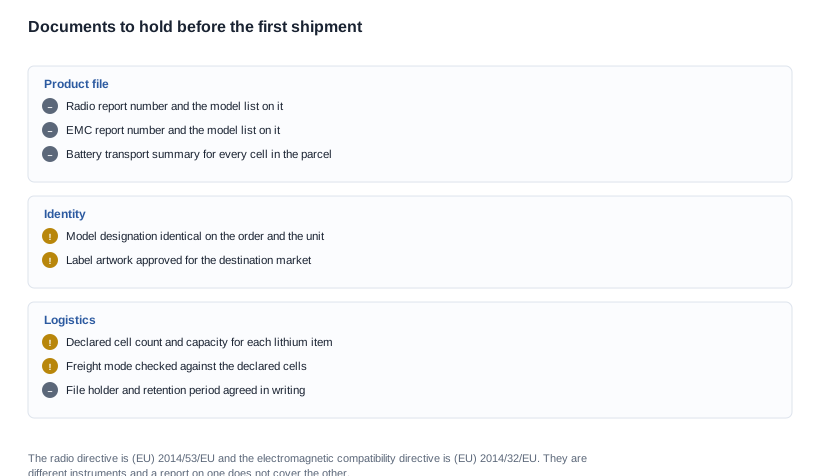
The right way to think about the three subjects is that they have different owners and different clocks. The radio and battery documents are the supplier's to produce and yours to verify; the market labelling is jointly yours, because it depends on what you list and where you sell. A programme that starts all three at once and expects them to finish together will wait on the slowest. A programme that starts the supplier's two first, verifies them while the labelling is being drafted, and closes the labelling against the documents rather than in parallel, finishes materially sooner.
A first shipment is also an information-gathering exercise, and it is worth treating it that way rather than as a one-off delivery. The three questions a first shipment can answer cheaply — how the units actually arrive packed, how long the clearance takes in practice, and how the freight forwarder treats a two-cell parcel — are the three that will decide whether the second shipment is cheaper than the first. An importer who has seen one container of this product has a basis for negotiating freight rates, for assessing the supplier's packing quality and for confirming that the declared cell count matches reality. An importer who has not is relying on a quotation for all of it. The cost of the first shipment is higher because of the learning, and the cost of every shipment after it is lower because of it, which is the argument for making the first one small enough to be safe and large enough to be informative.
The commercial terms belong in the same conversation as the logistics ones, because an incoterm decides who carries the risk between the factory gate and the destination. A first-time exporter who treats the incoterm as a detail in the quotation has left the most consequential variable in the shipment undiscussed. Payment terms, deposit structure, insurance responsibility and the point at which risk transfers are all negotiable, and all of them are cheaper to settle while the parties are still working through the document list than after the first container has been loaded.
The documents to have in hand before freight is booked
Here is the working list, in the order it should be assembled. The point of listing it is that a buyer who has never exported this product type tends to start with the label and the manual, and those are the two items that cannot be finalised until the file behind them exists.
- The radio report number, with the issuing body, the standard applied, the validity dates and the model list printed on the document.
- The EMC report number, with the same four details. Do not accept the radio document as covering it.
- The battery transport summary, one for the frame cell and one for any case cell, with the declared capacity of each.
- The model designation list — the exact set of designations the file covers, written out, and checked against the designations on the purchase order.
- The market labelling file: the label artwork per market, the instruction text, and the identified economic operator for each destination.
- The general product safety documentation for the consumer layer in each market you are shipping into, including the traceability records the regulation requires and the incident-recording process it obliges you to keep.
- The packing instruction and the carton configuration, with the declared cell count written into it rather than implied by it.
- The retention record: who holds each document, from what date, and what triggers a review.
Two things about this list are worth stating explicitly. First, several items are the supplier's to produce and are not negotiable in the sense that they are not a commercial term — they are a fixed cost per configuration and a fixed schedule set by a laboratory queue rather than by order size. What is negotiable is the schedule around them: the review obligation, the notice period when a document lapses, and whether a re-issue is included or billed separately. Second, the freight mode is not on this list because it is not a document, but it is decided by item three. Booking before item three exists is booking against an assumption, and the re-rating lands on the buyer.
For the paperwork side, the certification checks set out the document set as a checklist, and the market compliance section covers the framework the destinations sit inside. The battery transport compliance buyer checklist handles the second cell in detail, and the export documentation checklist covers the retention side.
Where the model designation has to match
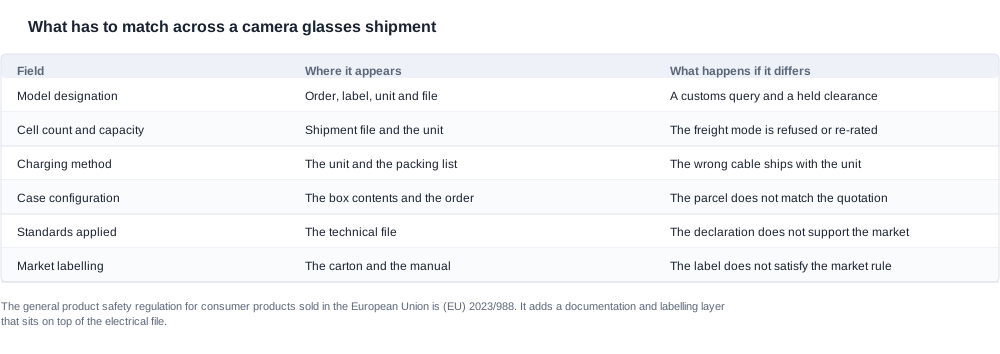
A designation is a short string with several near neighbours in it, and matching it is a mechanical task that people do badly under time pressure. The rule is simple: write the designation once, in one place, and copy it — never retype it, never abbreviate it, and never let a trade name stand in for it.
There are six places it has to read identically, and each of them is written by a different party.
On the purchase order. This is the master copy, and it should be the copy that everything else is checked against. On the product label. Usually produced by the factory from artwork, and the artwork is usually approved by the buyer weeks before the order is placed. This is why the designation has to be settled at step one rather than at artwork approval. On the unit. Either moulded, printed or written on a label, and this is where a substitution or a late engineering change becomes visible. On the packing list and the carton. The carton carries the designation, the carton count and the cell declaration, and they travel together. On each document. The model list printed on the report is a set of designations, and the check is whether the set contains yours. On the import declaration. Written from the commercial documents, and it has to agree with the unit rather than with the order.
The failure pattern in this category is specific and it is not rare. A programme orders the V03 Pro; the artwork is approved with the V03 Pro designation; the factory ships the V03 because that is the line that was in stock; and the paperwork is correct because it was drawn from the order. Every document matches every other document and none of them matches the unit. The check that catches this is the one that compares the unit against the order, and it has to be done on arrival, before the units are opened, distributed or listed.
A second pattern is the one that costs more. A unit arrives that matches the order but does not match the document, because a component was changed after the test — a different cell, a different module, a different charging interface. The product is compliant with what was documented and not with what was shipped. The only defence is to establish the tested configuration before the order and compare it against the received unit, which is why the configuration question belongs in the document request rather than in the inspection plan.
What the catalogue does not settle for an export buyer
We would rather give you an accurate list of what exists than a longer list of claims we cannot substantiate, and for the export buyer that means being explicit about five things our catalogue does not contain.
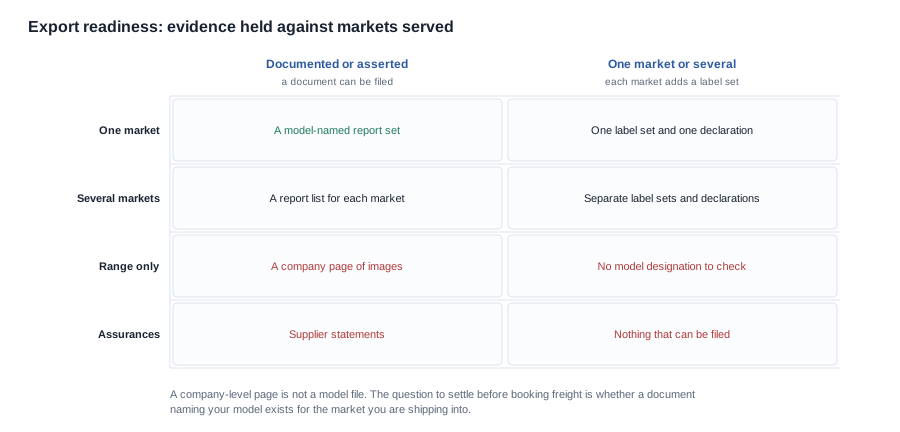
No per-model certification row. What we publish is a single export certification sheet, at company level rather than model level, and the ten certificates on it are photographs rather than text: eight appearance-design patents together with two utility-model patents. That is a statement about intellectual property at the organisation level. No CE mark, no FCC reference and no RoHS statement appears in the catalogue text, and no per-model row exists for any of the eleven camera models. If a buyer needs to know which document covers which model, that has to come from the supplier.
No UN 38.3 summary. We publish the cell capacities because they are in the catalogue, and we do not publish the transport evidence because it is not. The consequence for an exporter is direct: the freight conversation cannot start from our catalogue.
No certification numbers at all. No certificate number, no report number, no issuing body and no validity date. A number can be checked later by a broker, a customs authority or your own compliance function; an assurance cannot be checked by anyone.
No sensor model, no field of view, no video specification and no frame rate. The camera subject therefore cannot be closed from our material, and any listing that depends on the imaging specification depends on a document we do not publish.
No weight except one. The range publishes 158 g for the MT6 glasses unit, which includes the battery and the camera and excludes the foldable case, and nothing else. Every other unit has to be weighed, because the frame weight, the case weight and the packed weight are all unpublished, and the packed weight is what the freight forwarder needs.
We publish no minimum order quantity, no lead time, no production capacity, no warranty period and no unit price for any camera model, and we will not estimate them. Those belong in a quotation, where they are specific and negotiable. What we can do is tell you which published rows bear on your shipment and which questions have to be put to the factory before the booking is made.
If you are preparing a first shipment, send us the destination countries, the models, the quantities and the case configuration you intend to ship. We will tell you which of our published rows constrain the shipment, which of the documents above will have to come from the supplier, and which of the six matching points above needs a written control in your purchase order. The range is at AI camera glasses, and the parcel arithmetic is in the shipping weight analysis.
Related reading
- The documents to request — certification checklist
- The second cell in the parcel — battery transport compliance buyer checklist
- Retention of the file — OEM ready platforms export documentation
Send us the destination countries, the models and the case configuration, and we will tell you which documents have to come from the supplier before freight is booked.


