

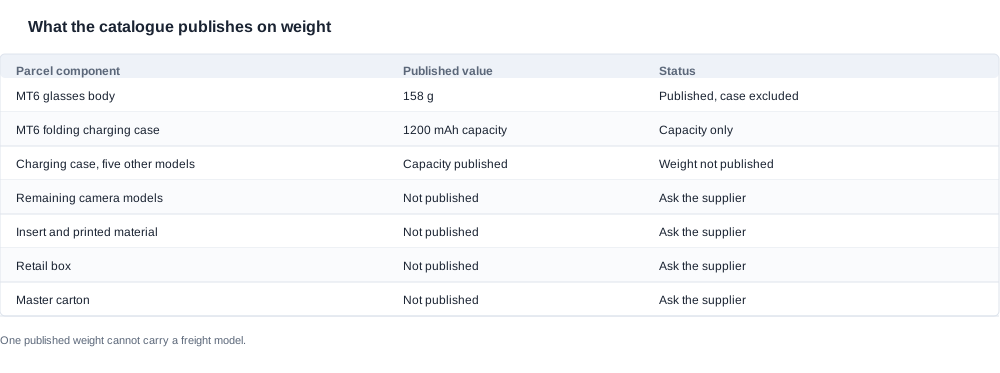
AI camera glasses shipping weight cannot be read from the catalogue, and the reason is a single fact rather than an omission. The catalogue publishes the weight of exactly one camera model: the MT6 glasses body at 158 g, excluding its folding charging case. For the other ten camera models, and for every charging case, insert, retail box and master carton in the range, no mass is published at all. That means a freight model, a landed cost calculation and a warehouse plan cannot be built from our documentation, and any buyer who receives such a calculation from anyone else — including from us — should treat it as an estimate. What this article does is set out exactly what is published, what has to be measured instead, the order in which the measurements should be taken, and the questions to ask a supplier so that the answers arrive in a form that can be used in a quotation.
AI camera glasses shipping weight: what is published and what is not
The published position is precise enough to state in a sentence, and it is worth stating exactly rather than approximately because a buyer who assumes more than this will build a plan on a number that does not exist.
One model has a published mass. The MT6 glasses body is published at 158 g. That figure covers the body with its 265 mAh cell and its camera fitted, and it excludes the folding charging case, whose 1200 mAh capacity is published separately and whose mass is not published at all. The exclusion is not a rounding detail — a 1200 mAh folding case and the body it holds do not fit inside a 158 g figure, and a quotation that treats them as one number is wrong in a way that will only surface at the freight invoice.
One mass is published for the whole range. No other camera model publishes a mass. The KY06 and the L1 Pro, the V03 Pro and the CY05, the V03 and the MT5, and the S7 and the CY03, and the V06 and the L2 Utral have no published mass, and no bare frame weight is published for any model in the catalogue. A buyer looking for a comparable figure for a different model will not find one.
Three things are published that are often mistaken for weight. The cell capacities are published for every camera model — 220 mAh, 260 mAh, 265 mAh or 290 mAh depending on the model. The charging-case capacities are published for five models, at 900 mAh, 1200 mAh or 1400 mAh. The charge time is published for every model. These are electrical figures, and while they are obviously related to what a cell weighs, they are not a mass and cannot be converted into one without a cell chemistry and a packaging density that nobody has published. Any weight estimate derived from a capacity is an estimate, and it should carry that label.
Nothing about the parcel is published. No retail box, no insert, no printed material, no master carton and no unit count per carton appears in our documentation. The freight rate is calculated on the greater of actual and volumetric mass, so the dimensions matter as much as the mass, and the dimensions are the part that packaging changes most easily and most often.
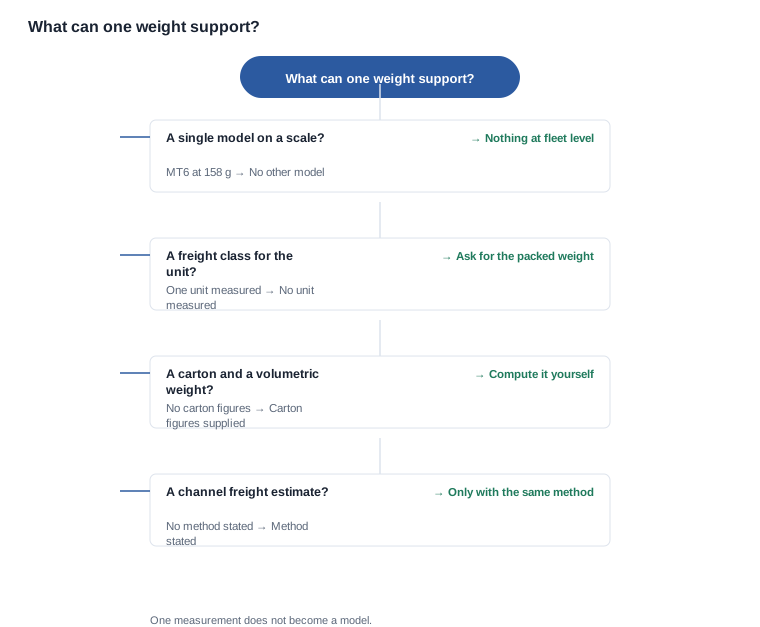
This is why the article is framed as a set of questions rather than a set of figures. The published rows tell a buyer the shape of the problem — which models carry a second cell, which configurations differ in accessories, which one carries a published mass — and they tell the buyer precisely which figures have to come from a measurement and from whom. That is enough to write a request for data and to judge the answer. It is not enough, and will never be enough, to produce a freight cost per unit on this page.
Why one published weight cannot carry a freight model
It is tempting to treat the 158 g figure as the start of a scale: assume the other models are similar, adjust for the cell, and produce a range. The method fails for three reasons, and each of them produces a different kind of error.
The models are not variants of one product. The eleven camera models differ in cell capacity, in charge interface, in whether they carry a charging case and in whether they have a removable inner frame. A model with a 1400 mAh case and a model with no case row are not two weights of one object; they are two different parcel configurations with different accessory chains, different packaging and different warehouse handling. The AI camera glasses packaging options piece covers why the contents of the box drive the freight class, and the AI camera glasses charging case options piece covers the accessory economics model by model.
Mass does not follow capacity. Cell capacity is a proxy for how much charge a cell holds, and it is a weak proxy for mass because the same capacity can be delivered by different cell formats with different packaging, and the case, the protection board and the connector all scale with it. Converting 290 mAh into grams requires assumptions that are not published and that vary by supplier. The arithmetic looks rigorous and is not.
A single measurement cannot describe a production distribution. Even a weight measured on one unit is one unit. A production lot varies, and a buyer who receives a single figure has no way of knowing whether it is a typical value, a minimum, a maximum or a convenient round number. This is a general point about measurement rather than a property of this category, and it is the reason a weight request has to ask for the method and not only for the number.
The practical consequence is that freight modelling in this category starts with a measurement request, not with a calculation. A buyer who needs a freight budget before the first sample exists has a sequencing problem, and the honest way to handle it is to build the budget on a placeholder that is explicitly labelled as one, and to fix it at the first packed sample rather than at the first invoice.

There is a second reason the published mass cannot carry the freight model, and it is commercial rather than technical. A freight figure that a buyer cannot reproduce is not a number a buyer can defend to a channel partner, present to a bank or use in a landed cost model. Every one of those uses requires a figure with a stated method, and that is what makes the method question in the next section worth as much as the scale question.
The parcel components a buyer has to get measured
A parcel for a camera-glasses unit is made of a small number of components, and each one has to be measured by somebody. Listing them explicitly is the practical output of this article, because it converts a general request for "the weight" into a list a supplier can actually answer.
The product alone. The mass of the glasses body with its cell fitted and without any packaging, without a case and without accessories. This is the figure to compare against the one published mass, and it is the only figure that can be compared across suppliers, because it is the only one with a single defined state. It is also the figure nobody has published for ten of the eleven camera models.
The product with its case. Where a case ships in the same box, the combined mass. This is a different number from the product alone, and it is the one that matters for the parcel. For the MT6 specifically, the two published figures sit on opposite sides of this: the body is published at 158 g and the case capacity at 1200 mAh, with the case mass unpublished.
The accessories. The charging cable, the dock or the magnet cradle, whichever ships. Where the charge interface is magnetic — published for the MT5 and the V03, the S7 and the V06, and the KY06 — the accessory may be a dock rather than a cable, and a dock is a different object in the parcel. Where the interface is published as Type-C — the V03 Pro and the L2 Utral — the accessory is a cable. Four camera models publish no interface at all, and for those the accessory set has to be established in writing.
The insert and the printed material. Small individually and awkward to estimate collectively, because the insert size scales with the language count and the printed material changes with the artwork. A programme serving several markets will have a different insert in each language version.
The retail box. Its mass and its dimensions. This is the component most often forgotten and the one with the largest effect on a volumetric calculation, because a box designed around a charging case is materially larger than one designed around a bare product.
The master carton. Its gross and net mass, its external dimensions and the number of units inside it. This is the figure the forwarder needs, and it is the figure that determines whether a consignment is rated on actual or volumetric mass.
There is one further component that sits alongside the parcel in the file rather than inside it, and a buyer should not forget it: the battery transport documentation. A camera-glasses unit contains a cell, and five of the eleven camera models also ship a charging case that contains a second, larger cell — 900 mAh, 1200 mAh or 1400 mAh depending on the model. Our catalogue publishes the charge time for every model and does not publish a UN 38.3 transport test summary for any cell in the range, so the documentation that a carrier or a forwarder will ask for at the consignment stage is a supplier question rather than a catalogue lookup. It belongs in the same request as the weights and the carton dimensions, because it is asked at the same moment and because a consignment held for missing transport documentation costs time and storage that a buyer has budgeted for none of.
Each of these six has to come from a measurement. The OEM ready platforms logistics planning piece covers where that data set sits in a wider plan, and the OEM ready platforms packaging design piece covers the design decisions that determine the last three of them.
Questions to ask a supplier about weight, carton and method
The request is short, and the method is what makes it usable. A buyer who asks only for "the shipping weight" will receive a number that cannot be used; a buyer who asks the six questions below will receive a data set that can be used in a freight quotation and re-checked at the next order.
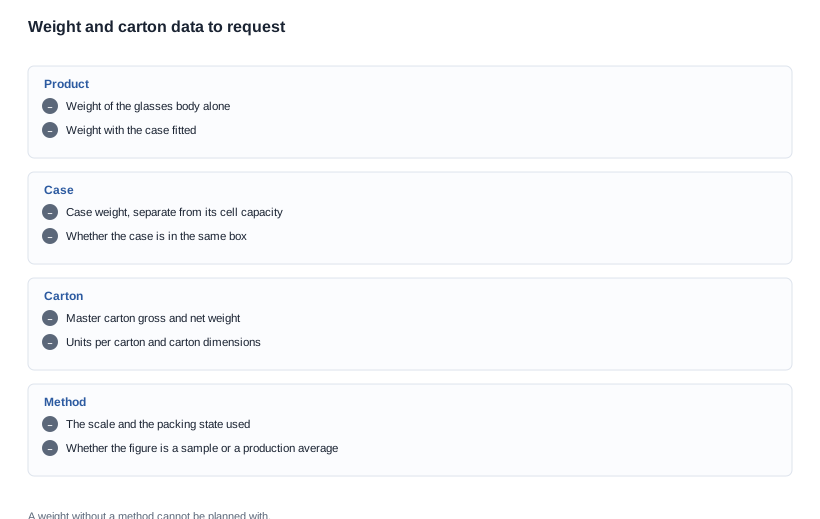
What is the mass of the product alone? Ask for the unit without packaging and without accessories, with the cell fitted. Ask whether the figure is for a sample or for a production average, and if it is an average, over how many units.
What is the mass of the packed retail unit? Ask for it per configuration, because a configuration with a case and one without are different units. Ask for gross and net, because the gross figure is what the carton is weighed with and the net figure is what the goods inside weigh.
What are the dimensions of the packed unit and of the master carton? Ask for the external dimensions as packed, including any protrusion, and for the units per carton. The carton quantity and the carton dimensions together determine the volumetric mass, and they are the pair most often supplied as an estimate.
What is the master carton's gross and net mass? Ask for it per filled carton, and ask whether the figure is measured on a packed carton or computed from the unit figures. A computed carton figure inherits every error in the unit figures and adds the carton itself on top.
What method was used? Ask for the scale, the packing state and the point in the process. Ask whether the same method will be used for subsequent orders, because a change of method produces a change of figure that looks like a change of product.
Will the figures be re-taken if the packing changes? Ask this as a change-control question. A new insert language, a new artwork version or a new accessory changes the parcel, and the freight plan has to be re-based rather than carried forward.
The questions to ask a supplier, then, are the questions above and one more: which model and which configuration does each figure describe. A weight without a model behind it is a range average, and an average across a range that includes a charging case and a model without one will be wrong for every configuration in the range. Before you order, insist on the pairing.
Those six answers are enough to build a freight model for a programme. They are also the six answers a buyer should ask when comparing two suppliers, because a supplier who cannot measure a packed sample has not done the work that the freight line depends on. And they are the answers to write into the purchase order as acceptance criteria where the freight terms are shared.
A freight data walkthrough for a first container
The following is a hypothetical walkthrough, written to show the decision sequence rather than to report a result from a client project.
Assume a distributor placing a first container order for camera glasses across three models and two markets. The distributor has a freight budget, a warehouse plan and a forwarder who quotes on the carton figures. The constraint is that the forwarder's quote is due before the samples have been produced.
The distributor's first step is to separate what is known from what is unknown. The known part is the shape: which of the three models publish a charging-case capacity and which publish none, which publish a magnetic interface and which publish a Type-C port, and how many distinct configurations that produces. The unknown part is every mass and every dimension. The distributor writes this into a freight planning note rather than into a budget, so that nobody downstream mistakes an assumption for a measurement.
The second step is to request the data. The distributor asks for the product-only mass, the packed unit mass per configuration, the packed unit dimensions, the master carton gross mass, the carton dimensions and the unit count, each with a stated method and each labelled as a sample measurement. It also asks for the charge interface on the models where the catalogue publishes none, because without that it cannot even determine which accessory is in the parcel.
The third step is to build a placeholder budget from the returned figures, and to label it as provisional with the date and the method on it. It applies the forwarder's own volumetric divisor, because that is the forwarder's term and not the buyer's to assume, and it runs the calculation on the carton rather than on the unit. It then writes down which single error would move the number most — usually the carton dimensions, since the volumetric calculation is sensitive to the box and the box is the part most often changed without notice.
The fourth step is to set a re-measurement trigger. Whenever the insert language, the artwork version or the accessory set changes, the carton dimensions are re-taken and the freight plan is re-based before the next shipment. The distributor writes this into its own change-control process rather than relying on a supplier to prompt it.
The fifth step is to set the acceptance criteria on the purchase order for the data itself, so that the figures supplied at the second order are produced the same way as the figures supplied at the first.
The result of the walkthrough is a freight plan with a named source, a named method and a named trigger for revision. None of the numbers in it came from a catalogue, because the catalogue publishes one mass and this order involved three models, several configurations and a carton.
What we publish about shipping weight, and the limits of it
On AI camera glasses shipping weight, our position is that the honest answer is a short one: we publish one mass, for one model, on one part of the product, and we would rather say that plainly than quote a typical figure a buyer cannot verify. The MT6 glasses body is published at 158 g with its 265 mAh cell and camera fitted and its folding charging case excluded. The case capacity is published at 1200 mAh and the case mass is not. For the remaining ten camera models, and for every box, insert and carton in the range, we publish nothing, because our documentation does not contain it.
The second half of our position concerns what a buyer should require from any supplier, ourselves included. The product-only mass, the packed unit mass per configuration, the packed unit dimensions, the master carton gross and net mass, the carton dimensions and the unit count, each with a stated method and a re-measurement trigger on packaging change. Those are the data that make a freight model possible, and they are the data a forwarder will need. The AI camera glasses bulk ordering piece covers where that measurement belongs in a production sequence, the AI camera glasses buying guide piece covers how the range decision comes before the logistics decision, and the AI camera glasses quality checks piece covers the inspection that catches a carton whose contents do not match the order.
Send us the models and configurations you are shipping, and we will tell you which published rows apply to each one, which figures you will need measured, and which questions to put to the supplier so that the measurements arrive in a form your forwarder can use.
Related reading
- The parcel arithmetic — AI camera glasses shipping weight
- The box that carries it — AI camera glasses packaging options
- The accessory that changes it — AI camera glasses charging case options
- Where the measurement belongs — AI camera glasses bulk ordering
- The range decision first — AI camera glasses buying guide
- The logistics plan — OEM ready platforms logistics planning
- The packaging design — OEM ready platforms packaging design


