

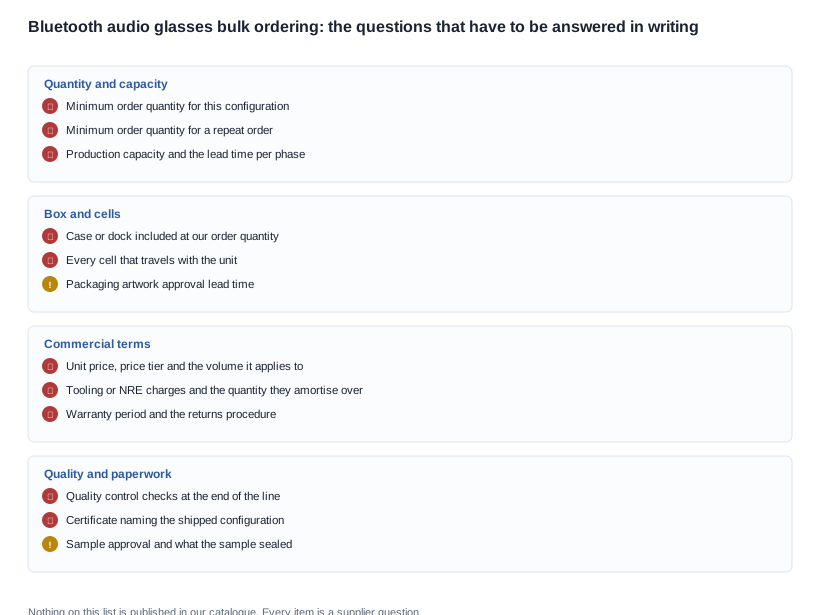
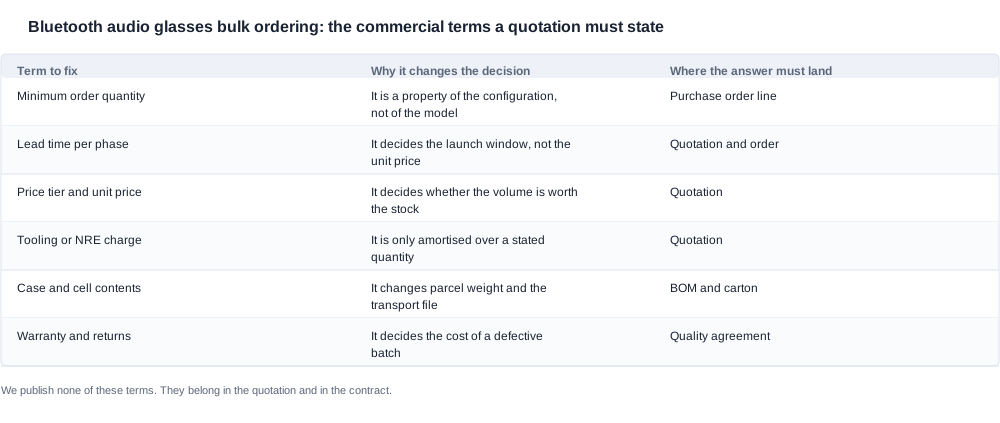
At volume the risk in this category stops being the unit price and becomes everything that was left unresolved at sample stage: the minimum order quantity for the configuration you actually asked for, what happens on a second run, whether the certificate names your build, and what is in the carton. None of those four is published for any model in this range. We do not publish a minimum order quantity, a lead time, a capacity figure, a warranty period, a sample cost, a tooling charge or a certification handling fee, because we do not have versions of those numbers that we would stand behind in front of a customer. That is not a gap we are going to paper over with a plausible-looking figure. What we can do is set out the questions that have to be answered in writing before the order, in the order they have to be answered, so that nothing important is still open when the goods are booked.
Bluetooth audio glasses bulk ordering starts with the configuration, not the quantity
The most expensive mistake in a bulk order is negotiating the quantity before the configuration is fixed. A minimum order quantity is a property of a build, not of a model: the same model produces different numbers depending on whether the order carries a logo change, a colour change, a packaging change or a moulding change. Any figure quoted against a model name alone is a figure against an undefined configuration.
So the first conversation is about the build, and it should produce a written configuration that names, at minimum: the model from the catalogue, the colourway, the packaging format, the logo treatment, the artwork version, the firmware version and the region it will be sold into. Several of these have published rows and several do not, and the buyer needs to know which is which before anyone discusses numbers.
What the catalogue does settle for the audio range. Eight audio models publish their cell configuration, their charging method, a charge time of two hours or less and a Bluetooth version. That is a solid basis for a technical specification and a poor basis for a commercial one. Specifically, the range divides on three published axes: the K01 and the K02 publish 90 mAh x 2 with magnetic charging and Bluetooth 5.3; the D11 and the D12 publish a single 100 mAh cell with Type-C charging and Bluetooth 5.4; the LC-105-2 and the YK12, and the LC-105-1 and the G07 publish 55 mAh x 2 with magnetic charging and Bluetooth 5.4. Those rows travel into the purchase order unchanged, because they are the specification.
What the catalogue does not settle, and therefore belongs in the contract. The minimum order quantity for a given configuration. The lead time, and whether it is measured to production start or to goods ready. The production capacity and what it is reserved against. The warranty period and the returns procedure. Whether a charging pad, a case or a cable is in the carton at your quantity. Whether tooling is dedicated to you and what happens to it if you reorder. The certification file and whether it names your configuration. The quality control regime and the defect rate on the previous run.
None of that is published, and the honest position is that a supplier who quotes a number for each of them without being asked for the underlying basis is giving you a number you cannot audit. The questions below are how you get the basis.
Bluetooth audio glasses bulk ordering questions about what is in the carton
The carton is where the range's published rows turn into a shipping decision, and it is the part of a bulk order that is most often left to the supplier's default.
The magnetic-charging models need something in the box to charge on. The K01 and the LC-105-1, the K02 and the G07, and the YK12 and the LC-105-2 all publish magnetic charging. A magnetically charging frame requires a charging pad, a case or a dock in order to charge at all. Whether one of those is included at your order quantity is not published for any model in the range, and it is a real commercial line because it changes the parcel weight, the unit cost and the number of lithium cells that travel with the goods.
The Type-C models need a cable. The D11 and the D12 publish a Type-C port. A cable is cheap and light, but the question still has to be answered in the quotation: is a cable in the box, is it the only accessory, and does the packaging artwork show it. A packing list that omits the cable produces a returns problem at retail scale rather than a shipping problem.
The case decision has a second-order consequence. A product that ships with a case contains a second cell, and the second cell changes the transport classification, the declared weight, the carton configuration and the set of documents that has to travel with the consignment. This is the point where a packing decision becomes a compliance decision, and it is why the battery transport compliance buyer checklist sits earlier in the programme than most buyers put it.
The question set for this stage:
-
What exactly is in the carton at our order quantity? We need a packing list per model that names every accessory, including any cable, pad, case, dock or printed insert.
-
For the magnetic-charging models, is a charging pad or a case included, and if a case, what is its cell capacity? Our catalogue publishes case capacities for camera models, but not for the audio range, so this has to come as a written answer.
-
What is the shipped weight per unit, including packaging? It is not published for any audio model, and it decides the freight class.
-
What is the carton specification, and what is the maximum units per carton? A case or a dock changes the carton dimensions and the unit count per carton, which changes the container plan and the landed cost.
-
What are the packaging artwork requirements, the approval lead time and who signs off? Artwork approval is a milestone with a duration, and it sits upstream of production.
-
Is the packaging material per market, and who is responsible for the printed material in each market? A single artwork version rarely covers several markets, and each additional version is a cost and a deadline.

Bluetooth audio glasses bulk ordering questions about the second run
Most first-time bulk buyers plan the first run and then discover, at the second, that the first run was the easy one. The second run exposes every assumption that was never written down.
Minimum order quantity on a repeat. The first run's minimum was a number against a configuration. The second run's minimum may be a different number against a different configuration, because the configuration has moved — a new colourway, a revised artwork, a packaging change for a new retailer. The question is whether the repeat minimum is the same, lower or higher, and if it is higher, why.
Tooling and its dedication. If the order involved any moulding change, the tooling that carries it needs to be addressed in the contract: whether it is dedicated to you, who owns it, where it is stored, how long it is kept, and what happens to it if you place no further orders. We publish nothing about tooling for any model in this range, and no supplier should be left to assume anything on this point.
The repeat order is against a sample that no longer exists. The sample that was approved was built at a point in time. Components change, suppliers change and firmware changes. A buyer who wants the second run to match the first needs a written statement of what is controlled, whether the cell part number, the charging method, the packaging artwork and the firmware version are all under change control, and who authorises a substitution.
Capacity and scheduling. A second run lands in a different quarter with a different order book. The question is whether production capacity is reserved by advance payment, by written allocation, or by nothing at all — and what the realistic delivery window is when the same factory is running other programmes.
Quality history as an input. A buyer placing a second order can ask for the defect rate on the first run and can ask what changed as a result. This is a normal, commercially sensible question and the answer belongs in the relationship rather than in a one-off quotation.
The question set for this stage:
-
Is the minimum order quantity for a repeat order the same as for a first order, and if not, what drives the difference?
-
Is any tooling dedicated to us, and what are the storage, ownership and retention terms?
-
Which components are under change control between runs, and who approves a substitution?
-
Is the cell part number the same as on the first run, and can we be notified before a change rather than after?
-
Is production capacity reserved for our window, and what is the notice we have to give?
-
What was the defect rate on the previous run, and what corrective action came out of it?

Bluetooth audio glasses bulk ordering questions about the documents
Documents are the part of a bulk order that is cheapest to fix before the order and most expensive to fix after the goods have moved. The catalogue shows a company-level export certification page the content on it being images rather than text, and it publishes no per-model certification row for any model. There is also no CE, FCC, RoHS or REACH reference anywhere in the catalogue text. That means every certification question in a bulk order is a document request, not a catalogue lookup, and it is worth being precise about that from the start.
The document set that should be requested. The EU Radio Equipment Directive declaration under (EU) 2014/53/EU, which covers the radio. The EMC declaration under (EU) 2014/32/EU, which is a separate instrument and a separate test programme. The harmonised standards used, by number, so that the reader can tell a directive number from a standard number. A Bluetooth SIG qualification record. A RoHS declaration and a REACH declaration for the exact configuration. The UN 38.3 test summary for every cell type that travels, which is not published by us and has to be requested. A record under the General Product Safety Regulation (EU) 2023/988, where that applies to the destination market.
The matching test. Each document has to name the same model designation as the unit and the carton. A file written for a sibling model with a similar name is the most common documentary defect in this category, and it is invisible until an inspector reads the carton against the file.
The scope test. Every file has a market scope and a configuration scope. A buyer has to know which markets the file covers, because a file that covers one market does not cover another, and a declaration that covers a different configuration from the one being shipped is not evidence for that configuration.
The change-control test. If a component changes after the file is issued, the file should be reissued. The question is who triggers that and whether the buyer is notified.
The question set for this stage:
-
Which certification documents exist for this exact configuration and this market set?
-
Does each document name the model designation that appears on the unit and the carton?
-
Are the radio declaration and the EMC declaration separate instruments, with a separate test report behind each?
-
What is the test report number behind each declaration?
-
Does the transport file cover every cell type that travels with the product, including any case cell?
-
Which component changes are allowed without reissuing the file, and who is notified?
-
Who in our organisation is allowed to accept a document set, and what is the acceptance criterion?

Bluetooth audio glasses bulk ordering risks that a unit price does not cover
A unit price is the part of a bulk order that is easiest to compare and least able to explain a loss. The five risks below are the ones that show up in the landed cost and in the returns data rather than in the quotation.
The red flags in a quotation that has been assembled rather than answered. There are four, and they are worth naming so that a buyer can recognise them immediately. First, a minimum order quantity quoted against a model name rather than against a frozen configuration. Second, a lead time quoted as a single number with no milestone definition behind it. Third, a certification answer that says a declaration exists without naming a directive number or a report number. Fourth, a warranty answer expressed as a percentage of the order value rather than as a period and a procedure. None of these is unusual in this category, and none of them is disqualifying on its own. What matters is that a buyer asks which of them apply before the deposit rather than after the first shipment. A supplier who treats these four as reasonable opening positions has answered the due diligence question for you.
The minimum order quantity is quoted against the wrong thing. This is the first risk because it is the most expensive. A number quoted against a model name, with a logo or a packaging change applied afterwards, is a number that will move. The mitigation is to freeze the configuration in writing before the quantity is discussed, and to require the quantity to be restated against that frozen configuration in the purchase order.
The carton changes after the transport file is written. A case that is added at the artwork stage, after the documentation has been assembled, turns a single-cell transport product into a two-cell one. It happens because the case looks like an accessory rather than a powered component. The mitigation is to freeze the carton contents at the same moment the cell configuration is frozen, and to name every cell that travels on the bill of materials.
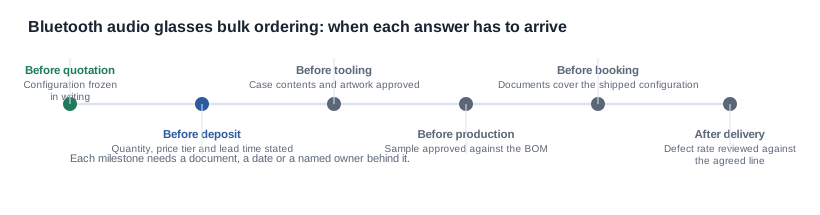
The lead time is quoted for production start rather than for goods ready. These are different dates and the difference between them is the part of the schedule the buyer does not control. The mitigation is to ask for the milestone definitions in the contract — goods ready, quality control complete, container loaded — and to write the date that matters to the launch into the order.
The sample is approved and then not built. A sample approved from a different production window, or from a different cell supplier, is a sample that proves nothing about the shipment. The mitigation is to require the shipped unit to be checked against the approved sample, and to hold the cell part number and the charging method as controlled items on the purchase order so that a substitution has to be raised deliberately.
The defect rate is discovered after the container lands. Nothing in the catalogue protects a buyer here, and it is the risk with the longest tail: a defective batch costs the retrieval, the second shipment, the channel discount and the review data. The mitigation is to agree the quality control regime, the acceptance criteria and the returns procedure before the deposit, and to have the sample approval reference written into the quality agreement.
What we can and cannot commit to in a bluetooth audio glasses bulk order
A bulk order is a set of answers in writing, and a supplier who cannot give them should not be given a deposit.
We can tell you, without qualification, the specification rows for the eight audio models: cell configuration and count, charging method, a charge time of two hours or less, the rated endurance and the Bluetooth version. We can tell you which of those rows are absent — frame weight, case contents, leakage figures, microphone specifications, prices, minimum order quantities, lead times, capacity, warranty periods, sample costs, tooling charges and certification handling fees — and we can tell you that our catalogue publishes no per-model certification row and no CE, FCC, RoHS or REACH reference at all.
We cannot commit to a minimum order quantity, a lead time, a production capacity figure, a warranty period, a price or price tier, a case inclusion, a certification outcome or a defect rate, and we will not put a number against any of them in a document. A buyer who has a supplier willing to commit to those in writing has something we cannot offer, and that is worth more than a catalogue.
What we will do is make the request easy. Tell us the model, the configuration, the destination market and the volume band, and we will tell you which published rows apply, which rows do not exist, and exactly which items in the six question sets above we can answer from our own records and which have to come from the factory floor, the test laboratory or the compliance file. That separation is the useful part, because it is the difference between a question that takes a week and a question that takes a month.
Before you commit to any of it, the criteria that actually separate one supplier from another in this range are narrow and checkable: does the supplier answer the configuration question before the price question, does it put the milestone definitions in writing rather than in a slide, does it name a test report number rather than a certificate type, and does it treat a change to the cell part number as something that reopens the documentation. A supplier that answers those four the same way every time is a supplier whose total cost can be forecast; a supplier that does not is a supplier whose total cost will be discovered in the channel.
The practical sequence we would recommend is short. Take the model shortlist from the published rows. Put the six question sets into a single document and send it to every supplier on that list unchanged, so that the answers are comparable. Score the answers on completeness rather than on price. And take the winning quotation apart line by line against the configuration document, because the shortest line items are usually the ones that will change the carton.
The bluetooth audio glasses customization options article covers the configuration items in detail, and the oem ready platforms sample before bulk article covers the sample stage that sits between the quotation and the order. The bluetooth audio glasses buying guide sets out the specification rows that any purchase order has to carry.


