

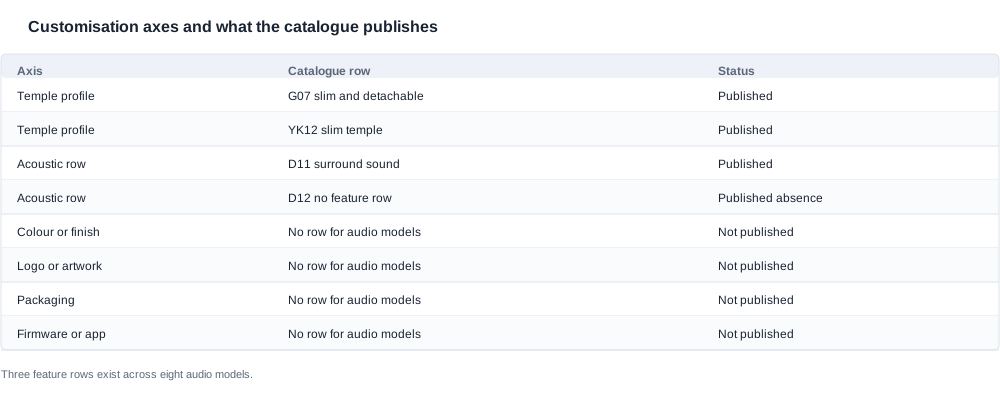
Across the eight Bluetooth audio glasses models, the catalogue publishes three feature rows in total: a slim and detachable temple on the G07, a slim temple on the YK12, and a surround-sound row on the D11. Everything else a buyer might call a customisation option — colour, logo, packaging, firmware, an app — has no published row for any audio model in this range. That is the honest starting point, and this article is built on it: the customisation conversation in this category is a conversation about questions to put in an enquiry, not about options we can promise.

Bluetooth audio glasses customization options: what is actually documented
The table below separates the axes by what the catalogue says about them, because conflating the two is the single most common error a first-time buyer makes in this category — arriving with a list of options from another product category and assuming the same list applies here.
Only three rows exist across the eight models. The G07 publishes a row describing a slim temple and a detachable temple. The YK12 publishes a row describing a slim temple. The D11 publishes a surround-sound row alongside a long-endurance row. The D12 publishes no feature row at all, which means it is the one model in the range about which the catalogue makes no structural statement whatsoever.
Everything else is absent. No audio model publishes a colour list, a finish option, a logo or artwork area, a packaging configuration, a firmware branch, an app or a pairing name. Their absence is meaningful in a specific way: it means a request on any of those axes cannot be confirmed from the catalogue, and therefore has to be put to the supplier as a question.
Why an absent row is not a refused request
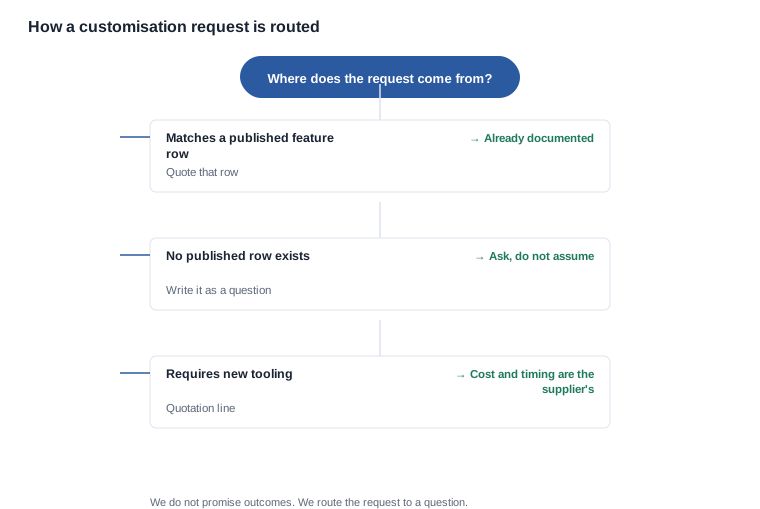
The distinction that governs the whole of this article is between a row that is absent and a capability that is unavailable. The catalogue publishes no colour row for the audio range. That is a statement about the catalogue, not about the factory, and the two are not the same thing. A factory may well offer colour variants drawn from a broader range; the buyer simply cannot confirm it from this source.
The consequence for a procurement process is concrete. An absent row cannot be frozen into a specification, cannot be quoted against, and cannot be defended later when a customer or an inspector asks where the claim came from. A confirmed capability, by contrast, can be written into the quotation with a cost line and a lead time attached to it, and can be checked at goods-in.
So the practical rule for this range is: treat every absent row as an open question, and move it into the enquiry rather than into the specification. A buyer who does that has a short list of open items. A buyer who assumes availability has a specification containing unverifiable claims.
What each customisation axis means when it is not documented
The axes a buyer typically brings to this category are worth working through one at a time, because each fails differently and each produces a different kind of quotation line.
Colour and finish. No audio model publishes a colour list. A colour request is therefore either an existing moulding or paint option, or a new one — and the distinction matters commercially, because a new colour involves tooling or a paint change, minimum quantities of that specific variant, and a lead time that belongs to the colour rather than to the model. The catalogue publishes no variant minimum for any audio model, so this is a quotation line in its entirety. The packaging options article covers where variant-level costs land in the commercial structure.
Logo and artwork. No audio model publishes a printable area, a position or a finish. A logo on a temple is constrained by the moulding: the printable region and its tolerance are properties of the tooling, not of the design. This is why artwork should be approved after the mould constraints are confirmed in writing — a mark that has to be repositioned because of a tooling constraint is a tooling charge, and the cost of finding that out after the artwork is final is disproportionate to the artwork itself.
Packaging. No audio model publishes a packaging configuration. This axis has the widest consequences of the seven discussed here, because the carton contents decision drives the packed weight and therefore the freight class. Nothing in the catalogue settles what accompanies a frame in the box, and as the charging options article sets out, no audio model publishes a charging-case row either. Packaging and carton contents are one decision, and it is the decision most likely to need revising after artwork approval.
System, firmware and the pairing name. No audio model publishes a firmware branch, an app or a device-list name. The device-list name deserves separate attention because it is the only brand element most end users read consciously, and it also appears in the pairing instructions, on the packaging, in diagnostic logs and in every support ticket that follows. Deciding it before firmware work begins is a sequencing point rather than a technical one, and it costs nothing to observe.
Acoustic configuration. This is the one axis where the catalogue does publish something. The D11 publishes a surround-sound row. What the catalogue does not publish is what that row describes physically — driver count, driver size, or a processing mode — so the axis is documented in name and undocumented in substance.
Temple geometry. The G07 publishes a slim temple and a detachable temple; the YK12 publishes a slim temple. These are the only published structural differentiators in the range, and a detachable temple in particular is a serviceability and adjustability property rather than a cosmetic one.

Bluetooth audio glasses customisation questions: the enquiry to send
The list below is written to be sent. Each line is a question rather than a request for confirmation, because none of these axes has a published row that would let a buyer ask for confirmation instead.
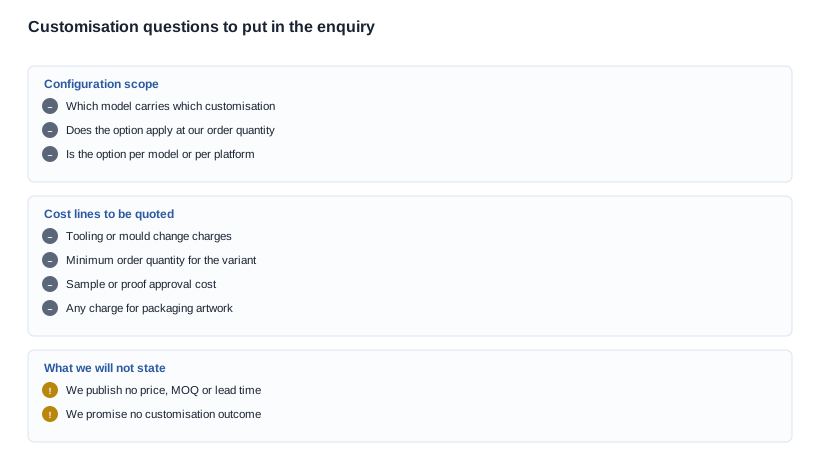
- Which of the eight audio models carries which customisation options, and is that per model or across the platform?
- For the colour or finish requested, is it an existing option or a new one, and what is the minimum order quantity for that specific variant?
- For any logo or artwork requirement, what are the printable area, the position and the finish tolerance imposed by the tooling?
- What is the cost of a tooling or mould change, and does that cost recur on the repeat order or only on the first?
- What is the minimum order quantity for a customised variant, and how does it differ from the minimum for the standard model?
- Is a sample or an artwork proof chargeable, and is that charge credited against a production order?
- What packaging configurations are available, and what does each do to the packed unit weight?
- What is in the carton at the ordered quantity, and does that change between a pilot run and a production run?
- Does any customisation affect the certification file, and does the file have to be reissued for the variant?
- For firmware or system changes, what is the effect on the per-unit cost, the minimum quantity and the schedule?
- What is the lead time for the customised variant, stated as a set of milestones rather than as a single number?
What a customisation enquiry should not contain
There is a category of sentence that appears frequently in this category's enquiries and that we have to decline in writing: the sentence that asks for a commitment rather than for a fact. "Can you put our logo on it at our quantity?" asks for a commitment. "Which models carry a printable area, and what does the tooling impose?" asks for a fact. The second question can be answered and written into a specification; the first can only be answered with a yes, and a yes that later proves expensive or impossible is the kind of statement a buyer cannot use.
The same applies across the range. We do not publish prices, minimum order quantities, lead times, tooling charges, sample charges, certification fees or warranty periods for any model, and we will not commit to a customisation outcome in advance of a quotation. The reason is straightforward: a customisation outcome depends on the model, the quantity, the variant and the existing tooling state, and a commitment made without those four is not a promise but a guess.
What we can do is considerably more useful than a guess. We can state which feature rows exist and which models they belong to, we can tell a buyer which of their requests fall inside a published row and which fall outside it, and we can make sure every open question reaches the quotation in a form where it has to be answered. The entry level grouping article covers how the published rows group for shortlist purposes, which is the other half of deciding what to customise.

How to freeze a customisation so a repeat order matches it
The most expensive point at which to discover that a customisation was never frozen is the second order. The first order is built against a sample and a conversation; the second order is built against a written description, and a written description that records a colour name without recording the variant minimum, or a logo without recording the tooling reference, cannot be matched.

Four things make the difference. Record the request against a specific model rather than against a family, so that the record identifies something buildable. Record it against a quantity, since most of these axes have variant-level minima that differ from the model-level minimum. Record the cost as a quoted line rather than as an expectation, so that a repeat order can be costed without reopening the conversation. And record which published rows the request sits on top of, so that a later change to the underlying model is visible rather than silent.
A configuration record built that way turns a customisation from a conversation into a controlled item, and it is the only way a repeat order can be placed against something other than a memory of the first one. The bulk ordering article covers how the same freezing discipline applies to the commercial terms.
Where a customisation decision interacts with the charging configuration
One interaction is worth isolating, because it is easy to miss and expensive to discover late. A customisation that adds an item to the carton changes the charging configuration of the order, even when the frame itself is unchanged.
If the customisation adds a case, a dock or a spare cell, then the number of powered items in the consignment changes, and with it the transport classification, the declared weight, the bill of materials and the set of documents that has to travel. If the customisation changes the frame's charging method from magnetic to a Type C port, then the accessory question resolves in the opposite direction and the carton contents change accordingly. Neither of these is a packaging preference; both are configuration changes with a compliance tail.
The sequence that avoids the problem is short: settle the charging method from the published row first, settle the carton contents second, and only then approve the artwork that shows them. Reversing that order produces artwork that has to be reissued after the accessory decision, and the artwork is almost always the artefact with the longest lead time in the programme. The charging options article works through the accessory decision in full, and the battery transport checklist covers the documentation a second cell triggers.
The seven axes, and why each one fails differently
The seven axes above are worth handling one at a time in a working enquiry, because they do not fail in the same way and they do not produce the same kind of quotation line. Sorting them into three groups — those that require tooling, those that are documentation decisions, and those that are configuration choices — tells a buyer which of their requests are expensive, which are slow, and which are merely unreplied.
The tooling group. Colour or finish and logo or artwork both act on the physical moulding. A new colour changes the paint or the plastic; a new mark changes the tooling or the printing process. Both can carry a charge that recurs, both can carry a variant minimum that differs from the model minimum, and both can carry a lead time that belongs to the variant rather than to the model. Nothing in the catalogue settles any of the three, which is why these two requests go to a quotation rather than to a specification.
The documentation group. Packaging, the carton contents and the pairing name are decisions rather than mould changes. They cost design and artwork effort rather than tooling, and they are governed by lead times that belong to print rather than to the factory floor. Packaging has one additional complication: because the carton contents decision determines the packed weight, it also determines the freight class, so a packaging decision taken without weighing the assembled carton produces a landed cost that is wrong from the first shipment. The pairing name has no cost at all and a long lead time, because it has to be fixed before firmware work starts.
The configuration group. Temple geometry and the acoustic row are the axes where the catalogue actually publishes something, and the two published entries sit on different models from each other. A request that aligns with a published row is confirmable now; a request that does not is a question. That is a useful division, because it tells a buyer which part of their customisation brief can be settled before an enquiry is sent and which part cannot.
Why a platform-level capability is not a per-model guarantee
One recurring source of confusion deserves naming, because it produces the same disappointment across every category. A factory may offer a capability across a platform rather than on one model, and a buyer who has seen the capability described at platform level will reasonably assume it applies to the model they have selected. It frequently does not, for reasons that have nothing to do with willingness: the platform capability may sit on a different housing, a different board or a different production line.
The catalogue cannot resolve this, because it publishes no platform-to-model mapping for customisation. The resolution is procedural: ask which model carries the capability, and require the answer to name the model rather than the platform. An answer that names the platform is not a refusal, but it is not a confirmation either, and it cannot be written into a specification.
Sequencing the artwork against the mould constraint
There is one ordering constraint in this whole area that costs nothing to observe and a great deal to ignore. Artwork approval should follow the confirmation of the mould constraints, not precede it.
The printable area, its position and its finish tolerance are properties of the tooling. A design approved against an assumed area has to be redrawn when the real constraint arrives, and the redraw is the expensive part — not the reprint of the artwork, but the cycle of re-approval that a changed mark triggers across every artefact it touches. In a programme with several markets, that cycle multiplies.
The same logic applies to colour. A colour named in an artwork file is a specification; a colour named as a variant of an existing moulding is a request. Only the first can be frozen, and only the first belongs in a configuration record that a repeat order can be built against.
The four claims this article will not make
It is worth stating the boundary in the positive form, because these are the four sentences we are most often asked for and most reliably decline.
We will not state which customisations are available at a given quantity, because the catalogue publishes no availability row for any axis. We will not state a price, a minimum order quantity or a lead time for a customised variant, because we publish no commercial figures for any model in this range. We will not state that a customisation does not exist merely because the catalogue has no row for it, because silence is not a refusal. And we will not recommend a model for a customisation scenario, because the choice depends on the quantity, the variant and the market in a way that no published row resolves.
The enquiry sequence, end to end
The sequence below puts the four pieces together in the order they have to happen.
- State the requirement in your own words, without assuming it is available on any model.
- Ask which model in the eight the requirement applies to, and at what order quantity.
- Get the cost lines — tooling, variant minimum, sample or proof, artwork — written into the quotation rather than estimated.
- Confirm whether the certification file is affected and whether it has to be reissued for the variant.
- Freeze the configuration in a written record that names the model, the variant, the quantity and the cost lines.
- Reference that frozen record on the purchase order so the second order runs against a document.
Related reading
- How the published rows group for shortlist work — Bluetooth audio glasses entry level options
- The carton contents decision — Bluetooth audio glasses charging options
- Freezing the commercial terms — Bluetooth audio glasses bulk ordering
- Packaging and variant costs — Bluetooth audio glasses packaging options
Send us the models you are considering, the customisation you need and the quantity, and we will tell you which parts of it sit on a published row and which parts have to be quoted.


