

The audio range publishes eight models and, on the specification sheet, four electrical groups. A buyer who chooses on cell capacity gets one set of candidates; a buyer who chooses on rated endurance gets a different set; and a buyer who chooses on charging method gets a third. None of the three is wrong, and none of the three is sufficient. The reason is that the published rows describe how the product is built rather than how well it will perform in your channel, and the row that actually narrows a shortlist is usually the one that describes what travels in the box.
This guide is written in the order that actually narrows the range: first the box, then the power architecture, then the published rating, then the rows the catalogue does not publish, and finally what to do with the gaps once you have found them.
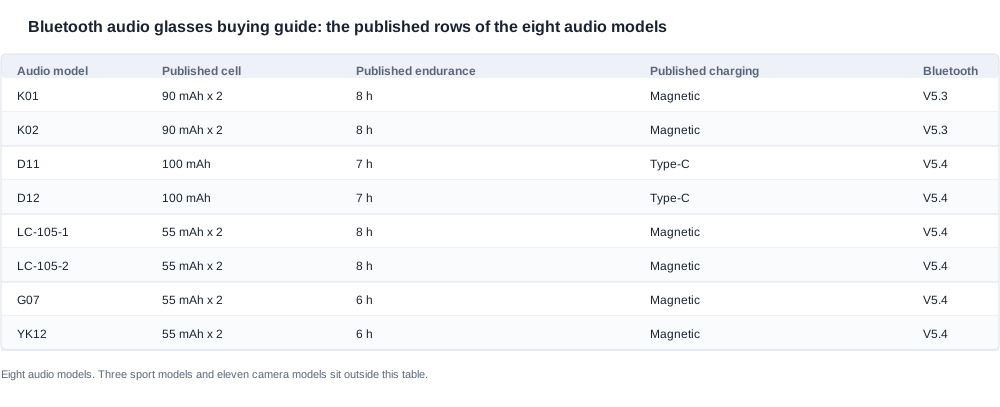
Bluetooth audio glasses buying guide: read the range by its published rows
The eight audio models are the YK12 and the LC-105-2, the D12 and the K02, the G07 and the D11, and the K01 and the LC-105-1. Between them they publish five rows: Bluetooth version, cell capacity and count, charge time, rated endurance and charging method. Everything else in this article is either about how to use those five rows or about the things they do not cover.
Two boundary notes come first, because getting either of them wrong will corrupt everything downstream. The first is that this range has eight models, not more: the YKC02, the D17 and the ZH12 are sport models with their own catalogue names, and a shortlist that folds them into an audio enumeration has changed the group it is measuring. The second is that the audio models are not the whole catalogue either — the camera models, the child-protection models, the AR model, the photochromic model and the bone-conduction model all publish their own rows, and each of them carries at least one dimension the audio range does not have, most obviously a camera.
The five published rows, and what each one is good for.
- Bluetooth version. Published for all eight. The K01 and the K02 publish 5.3; the other six publish 5.4. This is a specification claim a buyer can verify on a sample in seconds, and it is the one row in the range that can be checked rather than believed. It is also the row with the least commercial consequence, which is why a guide should not spend a paragraph on it.
- Cell capacity and count. Published for all eight. This is a build fact and the most structurally useful row in the range, because it tells you how many power paths a frame has, how many cells have to be handled in a transport document, and how much of the frame's volume the battery occupies.
- Charge time. Published for all eight as a ceiling of two hours or less. Note that no audio model publishes a charge time of about an hour; the two models in the catalogue that do are sport models. A guide that treats "two hours or less" as a measured figure will overstate the commitment.
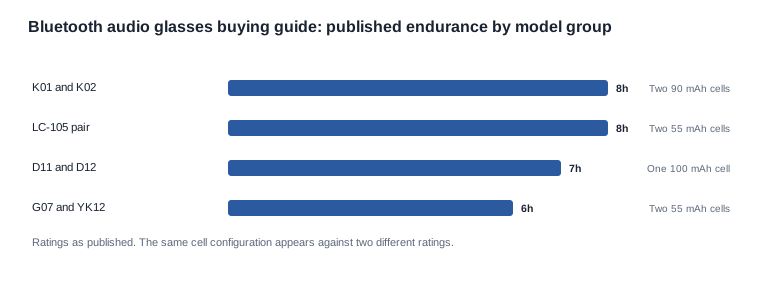
- Rated endurance. Published for all eight, at three different values: about eight hours for the K01, the K02 and the LC-105 pair; about seven hours for the D11 and the D12; about six hours for the G07 and the YK12. No model publishes the conditions behind its rating.
- Charging method. Published for all eight. Six publish magnetic charging, two publish a Type-C port. This row is where the box decision starts, which is why it is the last one to read rather than the first.
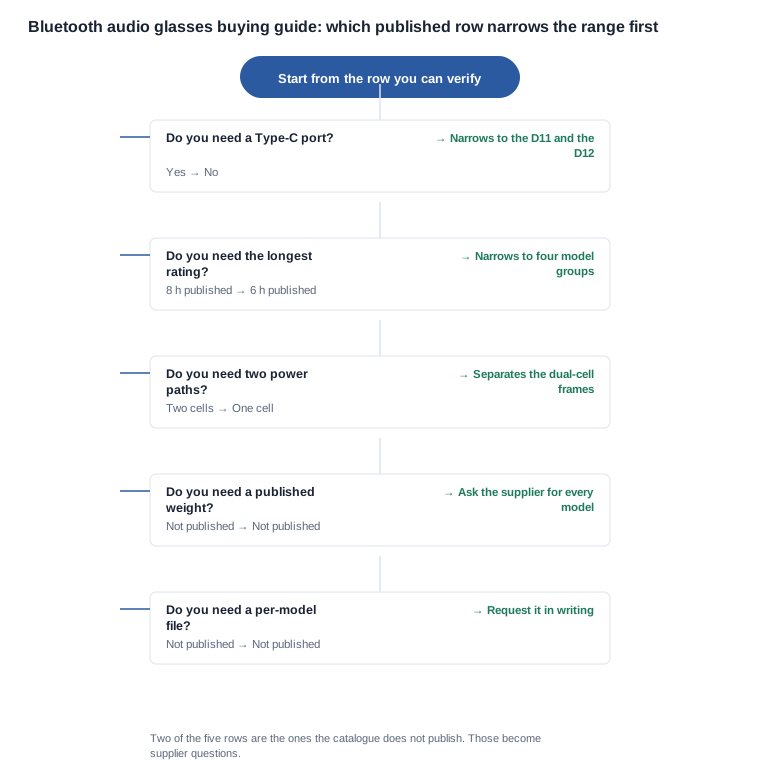
Bluetooth audio glasses buying guide on the cell and charging architecture
Read together, the cell and charging rows split the range into three groups that behave differently in a supply chain, and the differences are not cosmetic.
Group one: dual cell, magnetic, the higher published rating. The K01 and the K02 publish 90 mAh x 2, magnetic charging and about eight hours of rated endurance. Two cells per frame means two charging contacts, two power paths and a charging pad or a case in the carton. Both publish Bluetooth 5.3 rather than 5.4, which is the only row on which these two differ from most of their neighbours. The K02 versus K01 specification comparison covers that pair in detail.
Group two: dual cell, magnetic, the lower published rating. The LC-105-1 and the G07, and the YK12 and the LC-105-2 publish 55 mAh x 2, magnetic charging, and two different ratings: about eight hours for the LC-105 pair and about six hours for the G07 and the YK12. Same cell configuration, same charging method, same charge-time ceiling, two-hour difference in the rating. The published differences between them are form-factor notes — the G07 publishes an ultra-slim, detachable temple and the YK12 publishes a surround-sound, slim-temple note — which is either a design trade-off or an indication that the ratings were taken under different protocols. Either way, a buyer cannot read the rating as a specification. The YK12 comparison article and the G07 limitations article take those two notes further.
Group three: single cell, Type-C. The D11 and the D12 publish a single 100 mAh cell, a Type-C port and about seven hours of rated endurance. One cell, one cable, the lightest parcel of the three groups and the simplest charging story in the range. The D11 publishes an additional surround-sound, long-endurance note that the D12 does not, and the D12 comparison article sets out what that difference is worth checking.
What the cell architecture decides commercially. It decides the number of cells in the carton and therefore the transport documentation. It decides what has to be in the box to charge the product at all. It decides how much of the frame's interior the battery occupies, which bears directly on the ergonomics question covered in the frame ergonomics analysis. And it decides how the product behaves when one of two cells behaves differently from the other, which is a sample-test question rather than a catalogue question.
Bluetooth audio glasses buying guide on the interface and what it puts in the box
The charging method row is the one that turns a specification into a shipping decision, and it is the row most often left until after the artwork is approved.
Magnetic charging means the product cannot charge without something. A magnetically charging frame needs a pad, a case or a dock. Six of the eight audio models publish magnetic charging: the K01 and the G07, the YK12 and the K02, and the LC-105-2 and the LC-105-1. Whether one of those accessories is included at your order quantity is not published for any model in the range, which means the accessory is a commercial line that has to appear in the quotation and on the packing list, and it has to appear in the artwork, because a retail listing that shows a case the carton does not contain generates returns that have nothing to do with the product.
Type-C charging means a cable. The D11 and the D12 publish a Type-C port. The cable is a trivial cost and a trivial weight, but it still has to be specified: whether it is in the box, what length it is, and whether the packaging artwork shows it.
The range boundary that catches buyers. The camera models in the catalogue publish charging-case capacities — 1400 mAh for three of them, 900 or 1400 mAh for one, 1200 mAh for the foldable case on another — while the audio range publishes no case capacity at all. That gap is the reason a case question in an audio order cannot be answered from the catalogue by analogy with a camera order, and it is also the reason the answer has to be requested per model.
Why the box decision comes first in practice. The carton contents are frozen early because artwork approval, the packing list, the freight calculation and the transport file all depend on them, and each of those has its own lead time. A decision taken after the artwork is approved is a decision taken too late to change anything cheaply. The bluetooth audio glasses packaging options article covers the artwork and print side, and the bluetooth audio glasses charging options article takes the charging row further into the parcel and the interruption.
Bluetooth audio glasses buying guide: the rows that are not published
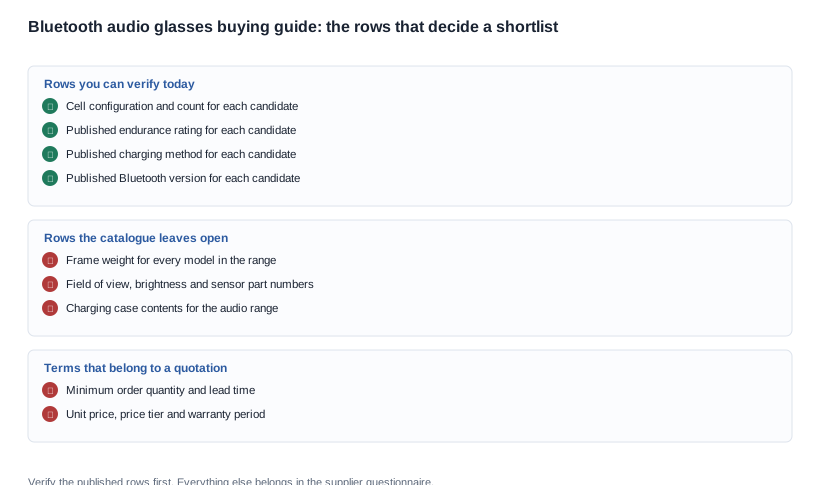
A buying guide that only lists what exists is half a guide. The rows below do not exist for any model in the audio range, and each of them is a question you will otherwise have to answer badly.
Frame weight. No audio model publishes a frame weight. The catalogue publishes one weight figure across the whole range, and it belongs to a camera model, so it cannot be borrowed. Weight is also the criterion that decides whether a frame can be held for a full shift, which makes its absence the most consequential gap in the table. The bluetooth audio glasses weight comparison article explains why substituting an unrelated figure is the wrong move.
Case contents and case capacity. Not published for any audio model, as set out above.
Field of view, brightness, sensor part numbers, lens specifications. Not published for any audio model. These belong to the camera and AR models, and even there the catalogue publishes only the pixel count for the camera models.
Touch behaviour. The catalogue publishes no touch row for any model in the range. Any statement about a capacitive touch surface, a swipe gesture or a multi-tap behaviour has to come from the supplier as a written description of the specific model, with the configuration it applies to. The same is true of microphone specifications and of any leakage figure: none of them is published, and none of them can be inferred from the cell capacity or from the charging method.
Test conditions behind the ratings. No start state, no end criterion, no volume level and no protocol. See the bluetooth audio glasses battery comparison article for why this gap decides whether two suppliers can be compared at all.
Commercial terms. No prices, no price tiers, no minimum order quantity, no lead time, no production capacity, no warranty period, no sample cost and no certification handling fee are published for any model. These belong in a quotation, not in a specification table.
Rows that sit outside this range. A buyer working across the whole catalogue will meet rows that do not exist in the audio group and should not be carried into it by analogy. The camera models publish a pixel count and, for most of them, a charging-case capacity; the sport models include the only two products in the catalogue with a charge time stated as about an hour; the AR model, the photochromic model and the bone-conduction model publish their own battery configurations and their own charging methods; and the three child-protection models publish a usage figure on a different scale again. Each of those groups has at least one axis the audio range does not have, and each of them makes its own comparison meaningful only inside its own boundaries. The practical rule is simple: a comparison table needs one range, one set of published rows and one set of assumptions, and a table that mixes two ranges has to declare which basis each column uses.
Bluetooth audio glasses buying guide: how to verify a candidate
Once the range is narrowed to two or three candidates, verification begins. The order below is deliberate, and each step has a completion test that produces a document, a number or a named owner rather than an assurance.
-
Check the model designation on the sample against the catalogue row. Every published row should be readable or measurable on the unit in your hand. A sample whose published cell configuration cannot be confirmed against the catalogue is not a sample of the model you quoted.
-
Confirm the charging method on the unit, and time a full charging cycle from a stated start state. The catalogue's figure is a ceiling of two hours or less; your measurement produces the interval that your operation has to plan around. Record the start state you used.
-
Confirm the Bluetooth version on the sample. This is the fastest check in the set and the one with the clearest pass or fail.
-
Count the cells and confirm the charging path. For a dual-cell frame, confirm how the second cell is charged and how the unit behaves if the two cells are at different states of charge.
-
Measure the frame weight yourself and record it. Nothing published tells you this number, so the sample is the only source. Record the method so that the figure is repeatable at the next shipment.
-
Test the audio under the conditions your channel will use, not under the conditions the sample bench offers. Volume, ambient noise and whether the microphones are active all change the current draw and the usable runtime.
-
Confirm the shipped contents against the packing list, including any pad, case, dock or cable, and photograph the carton.
-
Request the certification file for this exact configuration and this market set, and match the model designation on every document against the unit and the carton. The procurement certification checklist covers the document structure, and the bluetooth audio glasses quality checks article covers the incoming inspection side.
-
Get the commercial terms in writing against the frozen configuration: minimum order quantity, lead time with its milestone definitions, unit price at your volume, warranty period, returns procedure and the defect-rate history on the previous run.
Why this sequence is ordered this way. Each step produces something the next step can be checked against, and the order moves from facts that are published or measurable on the unit towards terms that only a supplier can supply. The first three checks cost minutes and settle the identity of the product. The next four cost hours and settle its behaviour. The last step is the only one that takes weeks, which is the argument for starting it in parallel rather than after the others are finished. A buyer who works the list sequentially and waits for the commercial terms before starting the verification will discover, at the end of it, that the configuration they verified is not the configuration they are going to buy — because the quantity discussion moved the colourway.
Bluetooth audio glasses buying guide: how the shortlist gets signed off
A shortlist is signed when every candidate has a documented answer for every criterion, not when the most attractive specification has been found. That distinction is what separates a buying guide from a recommendation, and it is what protects the person signing the order six months later.
The sign-off has four parts. First, a configuration document that names the model, the colourway, the packaging, the artwork version and the firmware version, with the published catalogue rows attached and marked as published rather than as measured. Second, a gap register: a list of every row the catalogue does not publish for the shortlist, with the question that closes it and the person who owns the answer. Third, a supplier questionnaire, sent identically to every candidate so that the answers are comparable. Fourth, a decision record that explains why the shortlist was shortened, written in terms of constraints rather than in terms of preference.
The trade-off to watch is the one the catalogue cannot arbitrate. The published rows separate the range into three distinct groups, and each group carries a different commercial shape. The dual-cell magnetic group produces a heavier parcel and a richer unboxing. The single-cell Type-C group produces a lighter parcel and a simpler accessory story. The second dual-cell group produces the same parcel logic as the first but carries two published ratings for the same cell configuration, which means the rating cannot be used to choose between its members. All three trade-offs are real, all three are visible in the published rows, and none of them can be settled without the missing figures.
What we publish and what we do not. We publish the five rows above for the eight audio models, and we publish them in the form the factory builds them. We do not publish frame weights, case contents, test protocols, prices, price tiers, minimum order quantities, lead times, production capacity or warranty periods, because we do not have verified versions of those figures. That is a deliberate boundary rather than an omission, and it is the reason this guide is written as a method rather than as a ranking: the rows we can stand behind are enough to build a structure, and the rows we cannot stand behind have to be closed with a document from the supplier before an order is signed.
One practical note on the order of the two questions. Buyers frequently start with the endurance rating because it is the number they can quote to a customer. That order is backwards. The rating is the row most likely to be re-interpreted later, because it is the row most easily repeated in a listing and least easily defended. The box and the charging method are the rows that change the freight, the artwork and the transport file, and all three are decided earlier in the programme. Start with those, and treat the rating as the number you will have to make defensible rather than the number you will lead with.
What a buyer should take from this guide. The published rows are reliable, minimal and enough to build a defensible structure: three architectural groups, one published rating question you have to ask, one accessory question you have to ask, and a long list of measurements nobody has published. Buy on the structure, ask on the gaps, and write the answers into the purchase order.
The bluetooth audio glasses entry level options article sets out the same range as structural groups rather than as tiers, and the bluetooth audio glasses bulk ordering article takes the shortlist into the questions that have to be answered before a volume order is placed.


