
Sampling in this category matters more than it usually does, and the reason is a plain fact about the documentation rather than a claim about quality. The product record for this catalogue carries twenty-eight models, and for every one of them the record states that no product photographs, no video and no detection reports have been supplied. The catalogue pages themselves publish specification rows and nothing else: a pixel count, a cell capacity, a charge limit, an endurance figure, a charge method, and in some cases a charging case capacity. Everything else a buyer needs to decide is either a physical property of a unit, a document that has to be requested, or a commercial term that has to be written down. For a large share of the rows that decide a programme, a sample is not the best available source. It is the only one.
So the question is not whether to sample. It is what the sample is designed to answer, what it will not answer even if it sits on a desk for a month, and which of the remaining questions has to leave the sample stage and go to a document or to a second unit.
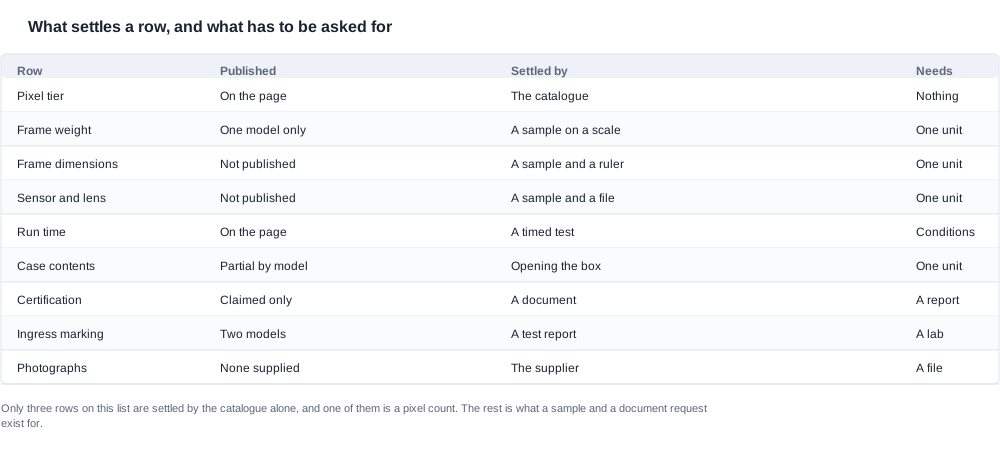
What settles a row, and what has to be asked for
The table below sorts the commercially decisive rows by where the evidence comes from. Only three of them are settled by the catalogue on its own, and one of those three is a pixel count.
| Row | Published | Settled by | Needs |
|---|---|---|---|
| Pixel tier | On the page | The catalogue | Nothing |
| Frame weight | One model only | A sample on a scale | One unit |
| Frame dimensions | Not published | A sample and a ruler | One unit |
| Sensor and lens | Not published | A sample and a file | One unit |
| Run time | On the page | A timed test | Conditions |
| Case contents | Partial by model | Opening the box | One unit |
| Certification | Claimed only | A document | A report |
| Ingress marking | Two models | A test report | A lab |
| Photographs | None supplied | The supplier | A file |
Three observations come out of that table, and each of them changes what a sample request should contain.
The first is that the published rows and the decisive rows are barely the same set. The catalogue publishes a pixel count, a cell capacity, a charge limit and an endurance figure for most models, and it publishes them well: the camera range divides eight and three on the pixel tier, and the endurance figures come in three shapes, as points and as ranges. What it does not publish, for any of the twenty-eight models, is the frame weight except in one place, the frame dimensions anywhere, the sensor model anywhere, the lens specification anywhere, the capture format anywhere, the field of view anywhere and the frame rate anywhere. A sample is the shortest route to those rows, and for several of them a sample is the only route that does not involve a second sample.
The second is that the endurance row, which reads like a published row, is really two rows. The catalogue states a figure and states no test condition behind it, on any of the twenty-eight models. So the published figure is a starting point and not an answer. What a sample settles is the difference between the published figure and a figure measured under the conditions your customer will actually be in, and that difference is itself the useful output, because it tells you whether the published number and your channel's expectation agree.
The third is that certification and the ingress marking are not sample questions at all. The certification position is stated in one of three ways. For the camera and audio categories we publish no CE, FCC or RoHS text and no per-model certification row, and no certificate number exists for us to quote, so the framework has to be requested in writing against a named model. For the sport category the position is the same absence, and the IP marking adds a catalogue annotation with no third-party test report number behind it. For the children's category no certification information is published at all, and children's products usually carry additional requirements in most markets. None of those states can be settled by holding a unit in your hand, and one of them, the sport ingress marking, cannot be settled by anything except a laboratory.
What a sample can settle
The rows a sample closes fall into four groups, and it is worth being precise about each because a test brief written this way produces data rather than impressions.
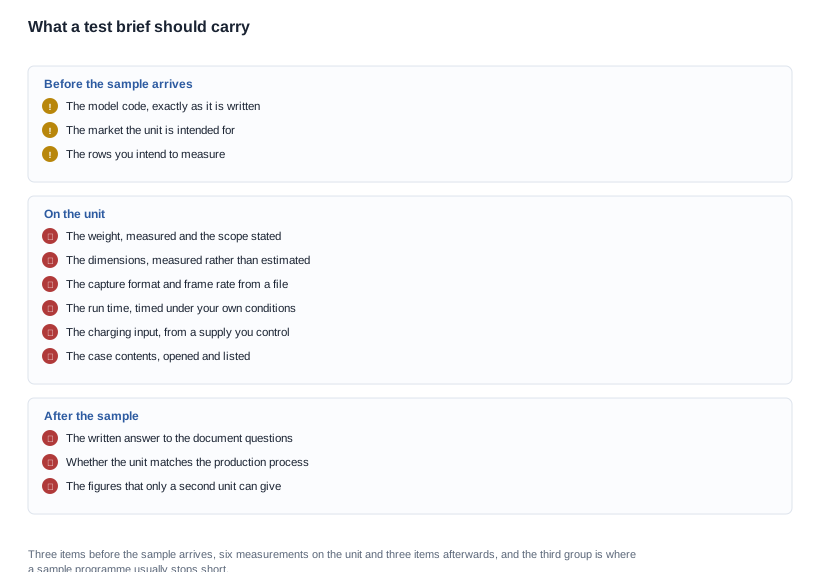
The first group is the physical rows nobody publishes. Frame weight on a scale, with the scope of the measurement stated, because the one weight figure in the whole catalogue sits on the same image caption as a foldable charging case and the catalogue does not say which item it measures. Temple length and lens dimension with a ruler. The capture format and the frame rate, read from a recorded file rather than taken from a menu, because the distinction matters and a specification sheet will not show it. The charging input, measured from a supply you control, which is the only way to know what your customer needs in the box. Each of these is a short test, and each of them is one that correspondence does not produce, because the supplier is quoting from a specification sheet rather than from a measurement.
The second group describes how the product sits and how it behaves. Two frames with identical published rows can sit completely differently on a face, and a sample carried for a full working day by the person who represents your customer tells you more about returns than any specification does. This is the test that is routinely skipped because it takes a day rather than an hour, and it is the one that most directly predicts a return rate.
The third group describes the box. Whether a case is included, and what is in it, which the catalogue answers differently from model to model: five camera models publish a case capacity, two name a charging case without publishing its capacity, four carry no case row at all. Whether the accessories are present. How the packaging is assembled. Whether the unboxing works on camera, which in a retail channel is the product.
The fourth group is the one that samples handle worst. One sample is one unit. It shows you what a good unit looks like and nothing about what the tenth unit looks like. That gap is the subject of a later stage, and a programme that treats an approved sample as evidence of consistency has a gap in it that surfaces only in production.

What a sample cannot settle
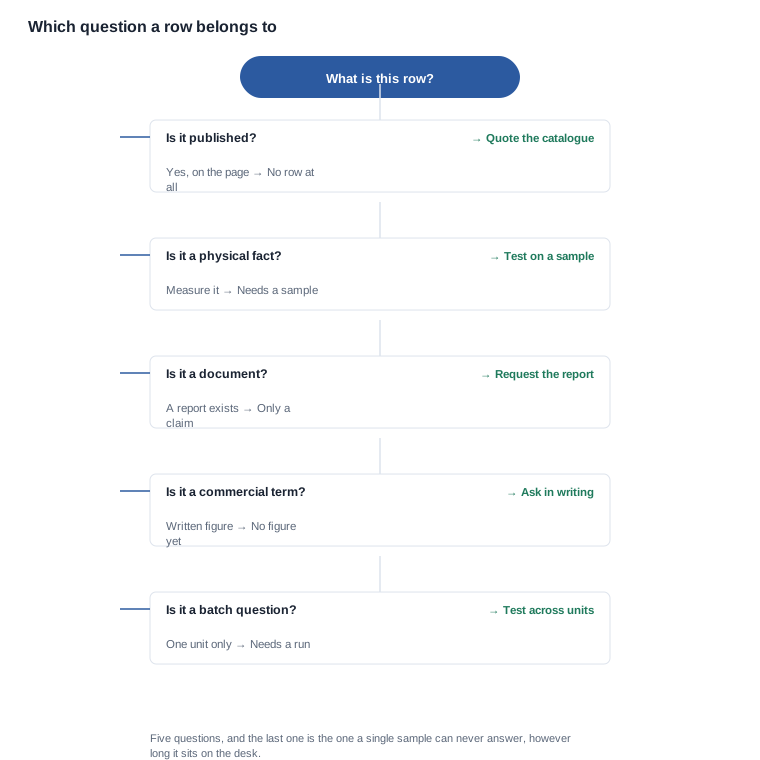
Four categories of question are outside what a sample can answer, and the reason each one is outside is different.
Certification is a document question. A sample does not tell you which document covers it, whether that document is current, or whether the issuing body is qualified in the market you are shipping into. This is the one to settle before spending time on the sample, because a no at this stage makes the sample evaluation pointless, and the certification checks page sets out the request in a form a supplier can answer.
Batch consistency is a process question. If the sample was built on a different production run from the order you intend to place, it tells you about that run rather than about your shipment. The question to ask is whether the sample unit and the production units come from the same process, and it is worth asking in writing because the answer determines what the sample can be used for.
The commercial terms are not sample questions at all. Unit cost, minimum order quantity, lead time, sample cost, setup charges and payment terms are all written figures rather than measured ones, and no sample changes any of them. They belong in a quotation. The minimum order quantity page and the lead time page cover what those two conversations look like, and the point worth making here is the order in which they happen: a commercial conversation before the sample is approved is a conversation about a product nobody has measured yet.
And whether the change you need is possible is not a standard-sample question. A unit drawn from the standard build cannot validate a changed firmware, a changed interface or a changed temple, because those need their own approval sample, which is a longer and more expensive exercise. The sample evaluation page covers the evaluation format, and the practical point is that the depth of the sample request has to match the depth of the change being requested.
The criteria for deciding what a sample is for are worth stating separately, because the question a buyer should ask is not which rows to measure but which rows a sample is the right instrument for. The test is simple: if the answer has to be written down in a document and signed, the sample cannot produce it. If the answer has to be measured on a unit, the sample is the only instrument that works. If the answer is a number that varies from unit to unit, one sample produces an impression and a second unit starts producing a range. If the answer is a commercial term, no amount of testing will move it, and the right action is a request for a written figure for the specific configuration in question. Those four cases cover almost every row in this category, and sorting a row into the right case before the sample is ordered is the whole difference between a sample programme and a product evaluation. The trade-off worth naming is the one between waiting and not waiting: a programme that runs the certification question in parallel with the sample risks a sample it cannot use, and a programme that runs it first risks a delay it cannot compress. What the record supports is that the certification question is cheap to ask in writing and expensive to discover late, which is the argument for asking it first.
The OEM ready platforms sequence that wastes the least time
Seven steps, ordered so that the ones that can end the programme cheaply come first.
- Settle the certification question in writing. Get the document, check the model schedule and the issuing body's qualification for your market. If the answer is no, stop here.
- Request the sample with a written test brief attached. A sample supplied without a brief produces impressions rather than data, and impressions are what get quoted back at you as findings.
- Measure the unpublished rows. Weight with the scope stated, dimensions, the capture format and frame rate from a recorded file, the charging input from a supply you control, the case contents opened and listed.
- Have someone carry it. Have the person who represents your customer carry it for a full working day, in the conditions your customer will use it in.
- Time the runtime under your customer's conditions, not under the manufacturer's. The gap between the published figure and your own is the information, and the gap itself is the finding.
- Ask whether the sample is production-equivalent, and whether the bulk run comes from the same process.
- Only then take the commercial rows to writing, once the product is known to meet the brief.
Step two is where most programmes lose the value of their sample, and the fix is not a better supplier but a better brief. A brief that lists what you intend to measure, in what conditions, and against which published row, converts a unit into evidence, and it also protects the sample from becoming a demonstration. A brief that only says please send a sample, and then discovers at measurement time that the capture settings were wrong, or that the run time was measured with the case on, or that the weight was taken with the packaging included, has burned a unit and gained a number nobody can use.
There is a second layer to the brief, and it is the one that distinguishes a camera programme from an audio programme from a sport programme. The rows worth measuring are not the same in each category, because the catalogue publishes different things in each one, and a brief written for the wrong category measures the wrong things beautifully.
A camera programme has the widest set of physical rows to close, and the largest number of them are optical. The catalogue publishes the pixel tier and the capture behaviour is entirely unpublished, so a camera brief has to specify the scene, the lighting, the capture settings and the file format, and it has to record the same scene on every model it intends to compare. It also has a case question that is model-specific, because the case row differs across the camera range, and it has a charge-method question that is model-specific too, because four camera models publish no charging interface row at all and one of those is the model with the only published weight. An audio programme has a different set, and the hard row there is acoustic rather than optical. The record notes explicitly that acoustic performance has no third-party measurement behind it, so an audio brief has to specify the source material, the volume level and the environment, and it has to say which pair of units is being compared, because the audio range contains models whose published rows are identical. A sport programme has a third set again, and its distinguishing row is the ingress marking, which the catalogue annotates on two models and which no sample can settle at all, so the brief is really about the enclosure, the removable inner frame and the remote, and it needs a laboratory document running alongside it rather than instead of it. And a programme in the children's category has to establish its compliance position before anything else, because the record states that certification information is entirely not provided for those models and that children's products usually carry additional requirements in most markets. That is not a sample question and it is not a brief question. It is a gate.
The practical consequence is that a brief should name the category before it names the measurements, and it should say which rows are deliberately out of scope and why. A brief that lists the weight, the dimensions, the capture format, the run time, the charging input and the case contents, and then adds a line saying that certification and the ingress marking are being pursued separately as documents, is a brief that a supplier can act on and a buyer can audit. A brief that lists twenty rows without a category is a wish list, and the supplier will answer the two rows it finds easy.
One more piece of discipline belongs with the brief, and it costs nothing: decide in advance where the measurement record goes and what form it takes. A measurement without a recorded condition is a number without meaning, and the conditions are the part that gets forgotten. The record for each measurement should carry the unit identifier, the date, the instrument used, the settings, the ambient conditions and the operator, and it should be written at the moment of the measurement rather than reconstructed afterwards. That last point is the one that is routinely lost, because reconstructing the conditions after the fact produces a record that is plausible and unusable. A programme that keeps this record for the first unit has a template for the second unit and for the tenth, and a programme that does not have to re-derive the method every time it measures. It also gives the supplier something specific to react to, because a disputed measurement becomes a conversation about a stated condition rather than a disagreement about two numbers. The brief is therefore not only a request, it is the start of the file that the eventual production order will be judged against.
How to read a sample programme against the record
Samples answer fewer questions than buyers hope, so here is the honest subset. We will supply samples, and we will say honestly which of your questions a sample can answer and which ones it cannot. We will not present a sample as evidence of certification, because certification is a document question and a unit in a box settles nothing about it. We will not describe a sample unit as production-equivalent unless it is, and we will not quote you a minimum order quantity, a unit cost or a lead time to move a conversation along, because those are written figures that have to be quoted for a specific configuration rather than asserted in general. And we will not fill a blank with a figure the record does not contain, which is why this piece names the gaps rather than estimating them.
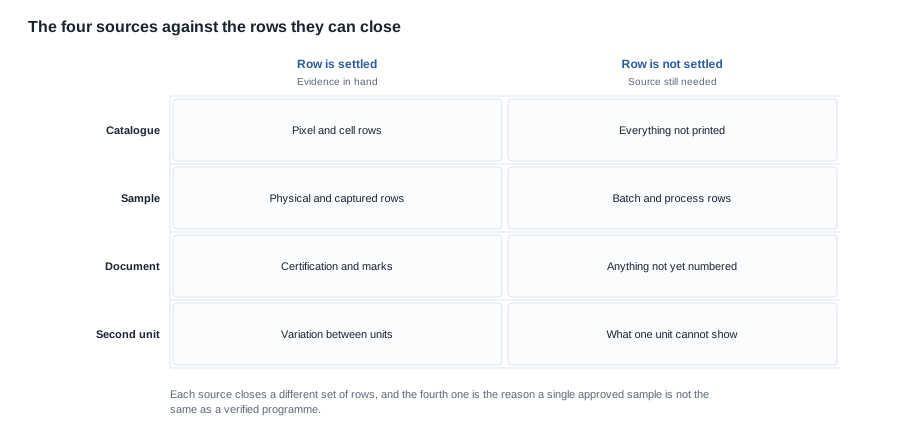
What the record does support is a division of labour that makes a programme efficient. The catalogue settles the specification rows, and it settles them well enough to shortlist against. The sample settles the physical and captured rows, which are the majority of the commercially decisive ones. The document request settles certification and the ingress marking, and it has to be started before the sample because it can end the programme. And the second unit settles what one unit cannot, which is the question of whether the programme is repeatable, and which is the difference between a sample that was approved and a programme that is verified.
A brand that runs those four sources in that order ends up with a shortlist it can defend, a compliance file it can hand to a test house, and a set of claims it can actually make. The model-selection question that precedes all of it is set out in OEM ready platforms which models are ready, and the sampling discipline that follows it connects to OEM ready platforms sample before bulk and to OEM ready platforms quality consistency.
Send the model, the market, the quantity and your test brief, and we will tell you which of the seven steps we can support and what we would measure on our side.


